City of Dead in Cairo: The Enigmatic Allure
City of Dead in Cairo is one of the most important and...



Some wonder, who would choose to visit a tomb? But what if this place is not just a burial site, but a historical landmark filled with stories and architectural beauty? What if Hosh Al-Basha stands as a silent witness to an era no less important than Egypt’s grand palaces and monuments?
Hosh El Basha tombs are actually considered one of the most important tourist attractions, attracting tourists from all over the world. A strange kind of magic draws you toward these places, just like the magic that draws you to the museums, the pyramids, and the Valley of the Kings. Exploring such places is a different kind of adventure.

The -Establisher -Of -Hosh -El -Basha.
These tombs belonged to the Alawite royal family, next to the Imam Shafi’i Mosque. Muhammad Ali bought this land in 1805 to build a burial place for himself and his family.
When his son Tusun died, he built a unique tomb for him, encircled it with a bronze enclosure, and connected it to the water system of the Imam Shafi’i cemetery”.after repairing and renovating the wall of the watercourse. The developments continued until reaching the final form.
Hosh El Basha tombs are located in Imam Layth Street, behind the dome of Imam Shafi’i in the cemetery, which bears its name.

The- Description -Of- Hosh -El-Basha.
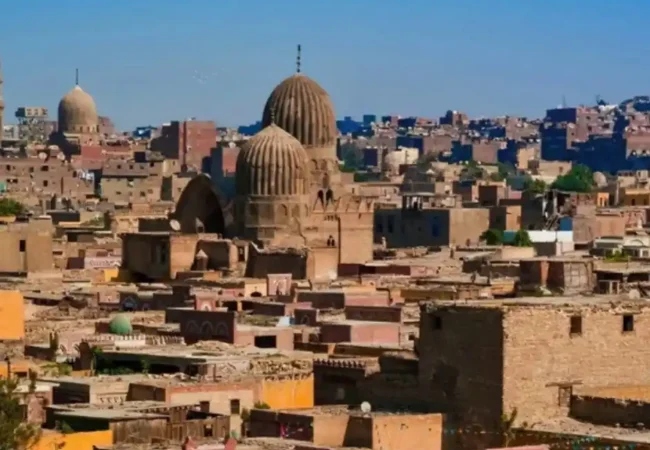
Hosh El-Basha tomb complex is considered the second largest cemetery in the world after Taj Mahal in India and is distinguished by its innovative construction, architectural beauty, and colorful windows, reminiscent of the splendor of palaces. They combine Egyptian Islamic heritage with Turkish style.
The tombs are located under three large domes, accompanied by three medium-sized ones, all on square stone columns, decorated with intricate artistic carvings and ornaments. A small dome crowns the entrance, from which a copper chandelier hangs, leading to a large hall with two doors that open onto the garden of the enclosure.
Built on a rectangular area, the main facade faces west, overlooking Imam Layth Street in the Imam Shafi’i area, the tombs architecturally designed in the Turkish style, with decorative elements of Turkish-Roman style, influenced by Islamic architecture. Oil colors, gilding, curtain folds, flying ribbons, and plant elements were used.
The enclosure also contains a collection of distinctive marble compositions, and the scripts used in the inscriptions vary between Naskh, Thuluth, and Persian, with Thuluth being the dominant style. It houses 16 tombs.

The -Development -Of -Hosh- El -Basha.
The development of Hosh El-Basha tomb complex was important after the death of King Muhammad Ali’s son, where a luxurious tomb was built and ringed by a bronze enclosure, and water was connected to the Imam Shafi’i cemetery after repairs to the wall of the watercourse.
Later, two more domes were built, then two new ones, bringing the total number of tombs to 15. Khedive Tewfik also contributed to the construction, building a burial chamber for his mother, Shafak Noor Hanim, and other structures were made during his reign, such as the main entrance to the tomb, the dome and the main corridor leading to the tomb.

The -Importance -Of- Hosh -El -Basha.
Its importance lies in the fact that Muhammad Ali bought this plot in 1805 to build a burial place for himself and his family. When his son Tusun died, he built a unique and luxurious tomb and surrounded it with a bronze fence and connected it to the water system of the Imam Shafi’i cemetery, after repairing and renovating the wall of the watercourse.
Hosh El-Basha tomb complex is the second largest in the world after the Taj Mahal in India, and their importance lies in their location, which is an urban extension of the small cemetery next to the Imam Shafi’i dome.
Hosh Al-Basha Tomb Complex architectural and artistic importance is shown in their construction, which combines Egyptian Islamic, Turkish, and Roman styles, incorporating oil paints, gilding, curtain folds, and plant motifs.
Hosh El-Basha tomb complex contains a large collection of marble compositions and their importance is further highlighted by the use of various scripts, including Naskh, Thuluth, and Persian, with Thuluth being the dominant style.

The -Tombs -In -Hosh- Al-Basha.
Hosh El-Basha tomb complex contains numerous tombs and includes:
Ibrahim pasha was the ruler of Egypt and son of Muhammad Ali. The tomb is a three-floor structure made of Italian marble, with its base decorated completely with floral and Arabic designs in the Islamic style up to the top of the headstone. The tomb is adorned with geometric units and has two headstones, one with poetry, elegy, and praise, and the other with a Turkish inscription identifying the owner, and it is topped with a red fez.
which is a three-Floor structure with beautiful floral and Arabic designs, and a headstone with a Turkish inscription identifying the owner and a prayer for him, topped with a Turkish fez, and the tomb is surrounded by a huge copper fence decorated with intricate geometric designs.
She was the mother of Khedive Tewfik, which is one of the most luxurious and important female tombs, standing 3 meters tall and made of rare alabaster. There’s also the tomb of Hami Pasha, son of Abbas Helmi I, which is a two-story marble structure decorated with Quranic inscriptions.
Other tombs belong to Fathiya Hanim, Princess Shams, wife of Abbas Helmi I, Princess Anji, wife of Muhammad Said Pasha, Princess Malik, wife of Muhammad Said Pasha, Prince Tusun Pasha, son of Muhammad Said Pasha, Prince Muhammad, son of Tusun, Prince Mahmoud Tusun, Prince Mahmoud, son of Muhammad Said Pasha, Prince Muhammad Ali, son of Ismail Pasha, and Princess Zainab, among others from the children and grandchildren of Muhammad Ali.
Outside Hosh El-Basha tomb complex, there are other burial sites for some family members, and it’s said that the victims of the Citadel Massacre, 40 Mamluks, are buried beneath these tombs.
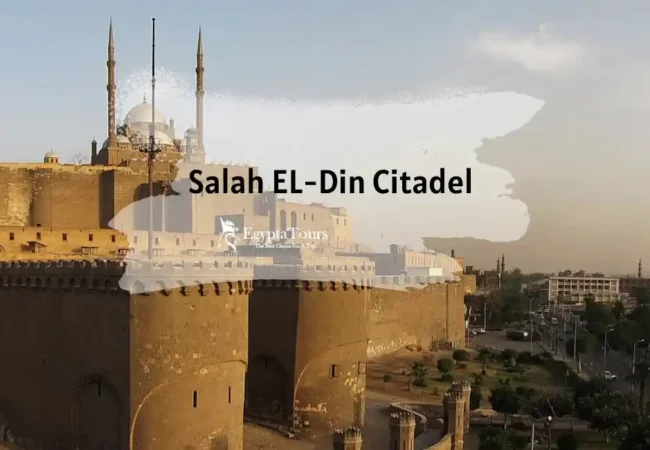
Although Muhammed Ali founded Hosh Al-Basha as a burial place for himself and his descendants, he was not buried there. Instead, he was buried in his mosque, located within the Citadel of Salahuddin, with his tomb situated on the right side of the entrance, in the southwest corner of the mosque. The tomb is made of white marble.

Muhammed -Ali -Mosque.
The mosque is rectangular in shape, divided into two sections: the eastern section for prayer and the western section is the courtyard. Each section has two opposing doors, one facing the Qibla and the other facing the sea.
Muhammed Ali bought this land in 1805 to build a burial place for himself and his family.
When his son Tusun died, he built a unique tomb for him, encircled it with a bronze enclosure, and connected water to the Imam Shafi’i cemetery after repairing and renovating the wall of the watercourse. The developments continued until reaching the final form.
Hosh El-Basha tomb complex is located in Imam Layth Street, behind the dome of Imam Shafi’i in the cemetery, which bears its name.
Hosh El-Basha tomb complex is considered the second largest cemetery in the world after Taj Mahal in India and is distinguished by their innovative construction, architectural beauty, and colorful windows, reminiscent of the splendor of palaces. They combine Egyptian Islamic heritage with Turkish style.
Hosh El-Basha tomb complex is located under three large domes, accompanied by three medium-sized ones, all on square stone columns, decorated with intricate artistic carvings and ornaments. A small dome crowns the entrance, from which a copper chandelier hangs, leading to a large hall with two doors that open onto the garden of the enclosure.
The historical and archaeological significance of Hosh
Al-Basha tombs:
The significance lies in the fact that Muhammad Ali bought this plot in 1805 to build a burial place for himself and his family. When his son Tusun died, he built a unique and luxurious tomb, surrounded it with a bronze enclosure, and connected water to the Imam Shafi’i cemetery after repairing and renovating the wall of the watercourse.
The tombs are the second largest in the world after the Taj Mahal in India, and their importance lies in their location, which is an urban extension of the small cemetery next to the Imam Shafi’i dome.
The Architectural And Artistic Significance:
The architectural and artistic significance is reflected in their construction, which combines Egyptian Islamic, Turkish, and Roman styles, using oil colors, gilding, curtain folds, and plant elements.
He was buried in his Mosque “ Muhammed Ali Mosque”.
Although Muhammad Ali founded Hosh Al-Basha as a burial place for himself and his descendants, he was not buried there.


Explore our top-rated Egypt travel packages and embark on an unforgettable journey. From the Pyramids of Cairo to the magical temples of Luxor, Aswan, and Abu Simbel, discover expertly curated tours designed for your perfect Egyptian adventure