


Kalabsha Temple in Aswan: A Nubian Masterpiece
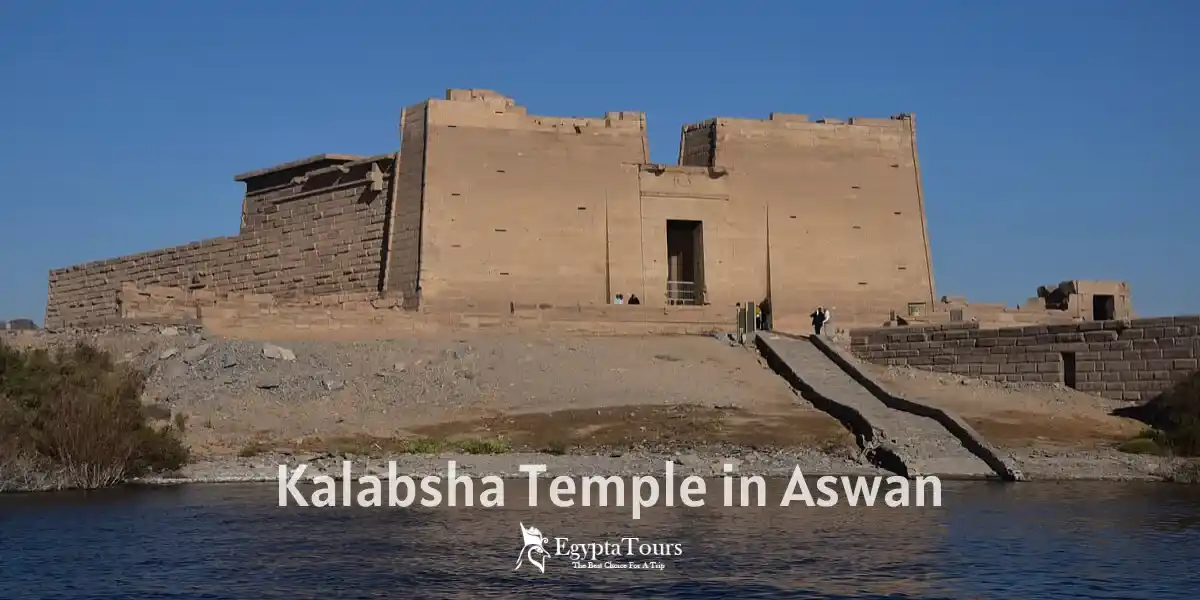
Kalabsha Temple is one of the most impressive Nubian temples in southern Egypt. Located near Aswan and Lake Nasser, this remarkable monument was originally built during the Roman period and dedicated to the Nubian god Mandulis. Although less famous than Abu Simbel or Philae Temple, Kalabsha Temple is a true architectural treasure.
The temple was relocated in the 1960s during the UNESCO rescue campaign to save monuments threatened by the construction of the Aswan High Dam. Carefully dismantled and rebuilt on higher ground, Kalabsha remains one of the largest free-standing Nubian temples in Egypt.
Its well-preserved reliefs, detailed carvings, and peaceful lakeside setting make it a fascinating stop for travelers exploring Aswan and Upper Egypt
About-Kalabsha-Temple
The Temple of Kalabsha in Nubia, documented in the Brooklyn Museum Archives within the Goodyear Archival Collection, was originally located on the west bank of the Nile River. It was built around 30 BC during the early Roman period. Although the construction of the temple began during the reign of Augustus, it was never fully completed. The temple was dedicated to Mandulis (Merul), the sun god of Lower Nubia and it was constructed on top of an earlier sanctuary belonging to Amenhotep II.
The temple measures 76 meters in length and 22 meters in width. Even though it dates to the Roman period, it contains many exquisite reliefs, including a notable carving of Horus emerging from the reeds on the inner curtain wall. From the sanctuary chambers of Kalabsha, a staircase leads up to the roof, offering a magnificent view of the temple itself and the sacred lake nearby.
Several historical inscriptions are found on the walls of the temple. One of them, carved by the Roman Governor Aurelius Besarion in AD 250, forbids the presence of pigs within the temple. Another records the victory of the Nubian king Silko over the Blemmyes during the 5th century, showing him dressed as a Roman soldier on horseback. Silko was the Christian ruler of the Nubian kingdom of Nobatia.
With the spread of Christianity in Egypt, the temple was later repurposed as a church. In 1819, the traveler Joseph de Senkowsky described a variety of paintings inside the temple, depicting Christian saints, including John the Baptist.
Kalabsha Temple is attributed to the village of Kalabsha, which is located about 57 km south of the Aswan Reservoir. It dates back to the early Roman era, when it was built by Emperor Augustus.
It was dedicated to the worship of the god Mandolis (a Nubian deity) in addition to the two deities, Osiris and Isis.
Emperor Caligula and Emperor Trajan added to the temple, and this temple is considered one of the most complete temples in Nubia in terms of architectural elements, and it still retains the anchorage (this element is often not found due to the floods to which the region is exposed).
It is worth noting that it contains many ancient Egyptian and Coptic inscriptions (after the entry of the Christian religion into Egypt, its walls were used to write sacred texts
Despite the destruction that befell its walls and inscriptions, it is considered one of the best Roman temples that have been preserved for us.
The temple, before it was moved to its current location, was located on the west bank of the Nile River, south of Aswan, and due to the construction of the Aswan reservoir, the temple was covered with water for about 9 months.
- It was built during the reign of Emperor Augustus, to worship the god Mandulis, the Nubian god of the sun.
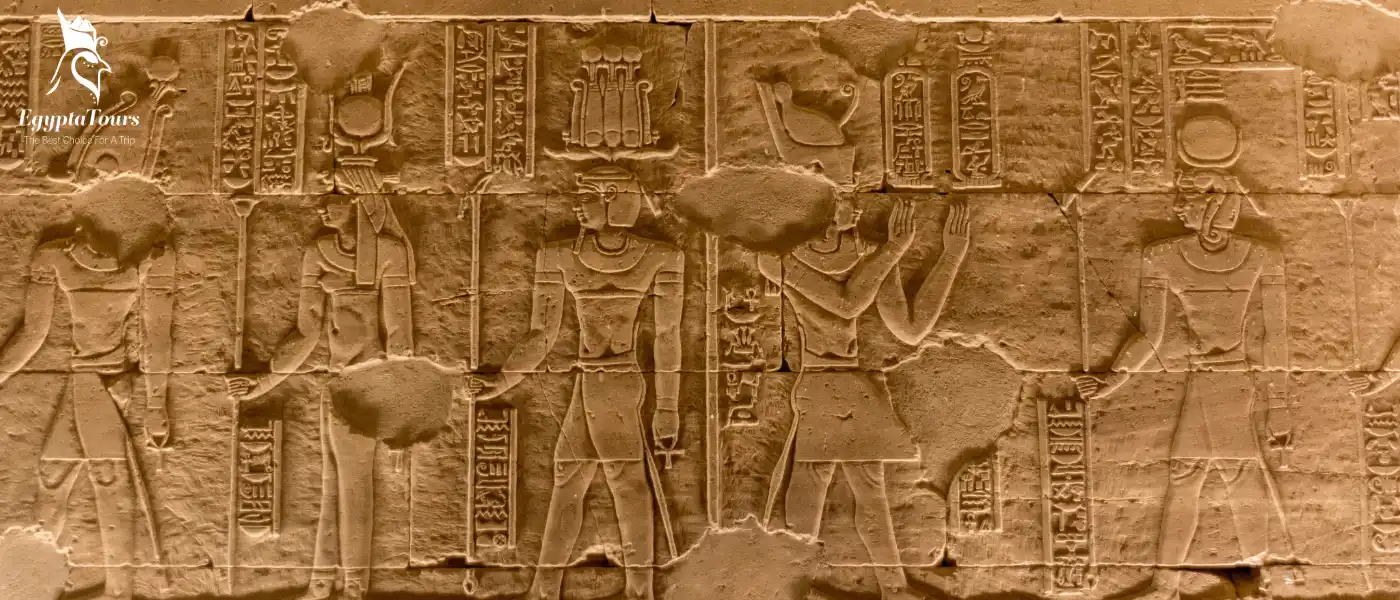
- The walls of the temple contain inscriptions of the goddess Mandulis and other inscriptions related to Isis, Aziris, Ptah, and Horus, and Christian inscriptions after it was transformed into a church.
- The temple, which is considered the most important temple in Nubia, contains an important inscription prohibiting the raising of pigs in the temple precincts.
- It also contains a historical inscription explaining the victories of the Nubian King Silku.
- It is considered the second largest of the Nubian temples after the Temple of Abu Simbel, and one of the most important temples with a unique Nubian architectural style.
Movement of Kalabsha Temple
The Kalabsha Gate, dating back to around 30 BCE, is now part of the Egyptian Museum of Berlin as a gesture of thanks within the International Campaign to Save the Monuments of Nubia. When the Aswan High Dam was constructed, the temple of Kalabsha was relocated with assistance from Germany to protect it from the rising waters of Lake Nasser.
The relocation took more than two years to complete. Kalabsha was the largest free-standing temple in Egyptian Nubia, after Abu Simbel (which is rock-cut rather than free-standing), to be moved and re-erected at a new site, located just south of the Aswan High Dam. Despite never being finished, it is considered one of the finest examples of Egyptian architecture in Nubia.
In 1971, as a gesture of gratitude for Germany’s participation in the rescue of the Nubian temples, Egypt gave one of the temple’s gates to the Federal Republic of Germany. Since 1977, the gate has been displayed in the annex of Berlin’s Egyptian Museum in Berlin-Charlottenburg. According to plans as of 2023, the gate will be relocated to serve as the monumental entrance to the fourth wing of the Pergamon Museum in Berlin, which is currently under construction.
The Origins of Kalabsha Temple
The-Origins-of-Kalabsha-Temple-EgyptaTours
Kalabsha Temple rises from Egypt’s early Roman period as a striking blend of architectural traditions and cultural influences, establishing itself as one of Nubia’s most important religious monuments. Its significance endured for centuries, through continuous worship and gradual expansion.
Built during the Roman era under Emperor Augustus
The ambitions of Rome in Egypt took shape around 30 BC, when Emperor Augustus, newly in control of Egypt, initiated the construction of this grand temple. As the first Roman ruler of Egypt, Augustus envisioned Kalabsha as a symbol of imperial power, merged seamlessly with local religious traditions. Archaeological research reveals an interesting fact: despite the temple’s grand design, it remained unfinished throughout Augustus’s reign.
Construction continued under later Roman rulers. Emperor Vespasian (69–79 AD) contributed major additions, expanding both the temple’s size and its religious functions. Stone inscriptions found inside the temple chambers provide evidence of its enduring spiritual importance, these carvings, dated from Vespasian’s reign through approximately 248–249 AD, show that Kalabsha remained a vital place of worship for nearly three centuries. These records highlight how the temple preserved its sacred status long after its original Roman founders had passed.
Devoted to the Nubian sun god Mandulis
Mandulis, also known as Merul, was the main god worshiped at Kalabsha. He was seen as the Nubian form of the sun god and had an important role in religious life in Lower Nubia. In temple art, he appears as a human figure wearing decorated headdresses topped with a solar disk, a clear sign of his power over the sky and the sun.
The temple was not dedicated to Mandulis alone. Inside the complex, there were also sacred areas for Isis and Osiris, which made Kalabsha a place where more than one god was worshiped. In Nubian belief, Mandulis had two closely linked roles. He was seen as a sun god but he was also connected to fertility, a role that reflected farming seasons and everyday life in Nubia.
Constructed over an earlier sanctuary of Amenhotep II
Excavations beneath the Roman temple showed that the site had an even older sacred past. The Romans did not choose this location by chance. They built their temple above an earlier sanctuary from Egypt’s 18th Dynasty, dating back to the reign of Pharaoh Amenhotep II around 1400 BC. This shows that the site remained sacred for nearly fifteen centuries and kept its religious importance over time.
The different layers of the building clearly tell this story. Sacred places often stay important even when rulers and cultures change. The Roman builders respected the older traditions linked to the site. They kept the Egyptian architectural style and added Roman elements of their own. In this way, the temple became a unique mix, where ancient Egyptian beliefs met Roman ideas in one place.
Saving Kalabsha from the Nile
The survival of Kalabsha Temple feels like a rescue story. Saving it required rare international cooperation to protect it from the rising waters of Lake Nasser.
Threat from the Aswan High Dam and Lake Nasser
When Egypt decided in 1954 to build the Aswan High Dam, it marked a major step in development but it also threatened many ancient monuments. Built between 1960 and 1971, the dam created Lake Nasser, a huge artificial lake that covered large areas of Upper Nubia. Kalabsha Temple, like many other sites, was at risk of being submerged under nearly 50 meters of water.
The UNESCO’s International Campaign to Save Nubian Monuments
In response to this danger, Egyptian and Sudanese authorities turned to UNESCO in 1959. In 1960, UNESCO launched the International Campaign to Save the Monuments of Nubia, bringing together efforts from around the world. Hundreds of sites were excavated, thousands of artifacts were saved and entire temples were moved to safer locations. When the campaign ended on March 10, 1980, UNESCO described it as a complete and spectacular success.
The Germany’s role and the gift of the Kalabsha Gate
West Germany played a crucial role in Kalabsha’s rescue, taking responsibility for dismantling and reconstructing the temple. Germany’s involvement reflected its long-standing Egyptological scholarship, dating back to Franz Christian Gau who documented Kalabsha in 1819. In 1971, Egypt gifted one of Kalabsha’s gates to Germany which has been displayed in Berlin’s Egyptian Museum since 1977. Plans now call for its installation as the grand entrance to the Pergamon Museum’s fourth wing.
Reconstruction at New Kalabsha near Aswan
The relocation took more than two years with each stone block carefully catalogued and transported. Today, visitors can see the temple reconstructed on New Kalabsha Island, 15 kilometers south of Aswan, near the High Dam. This site also has other rescued Nubian monuments, including the Temple of Beit el-Wali, the Temple of Gerf Hussein and the Kiosk of Qertassi. In total, 20,000 tons of ancient stone were moved, preserving these treasures for future generations instead of letting them rest beneath Lake Nasser.
Design and planning of Kalabsha Temple
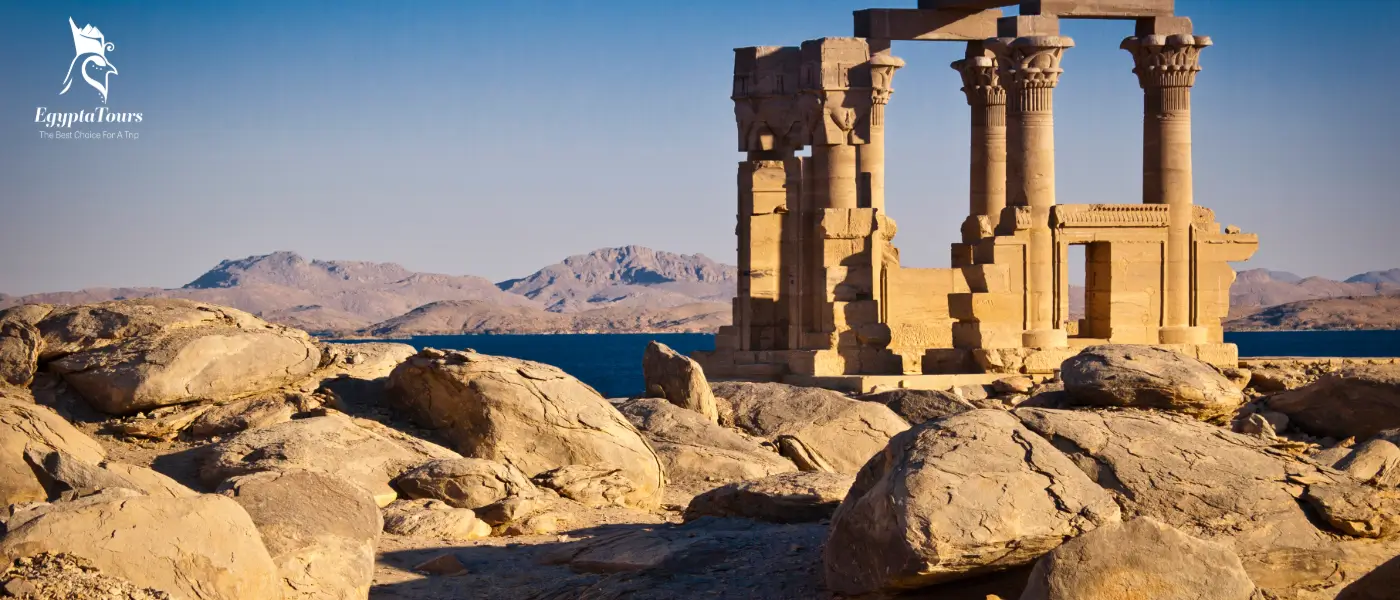
Design-and-planning-of-Kalabsha-Temple
Kalabsha Temple is considered one of the best, if not the best, Roman temples in Egypt. The one who built it was keen to merge modern Egyptian architecture with authentic Nubian inscriptions.
In its layout, the temple is similar to the usual layout of temples in the era of the modern state.
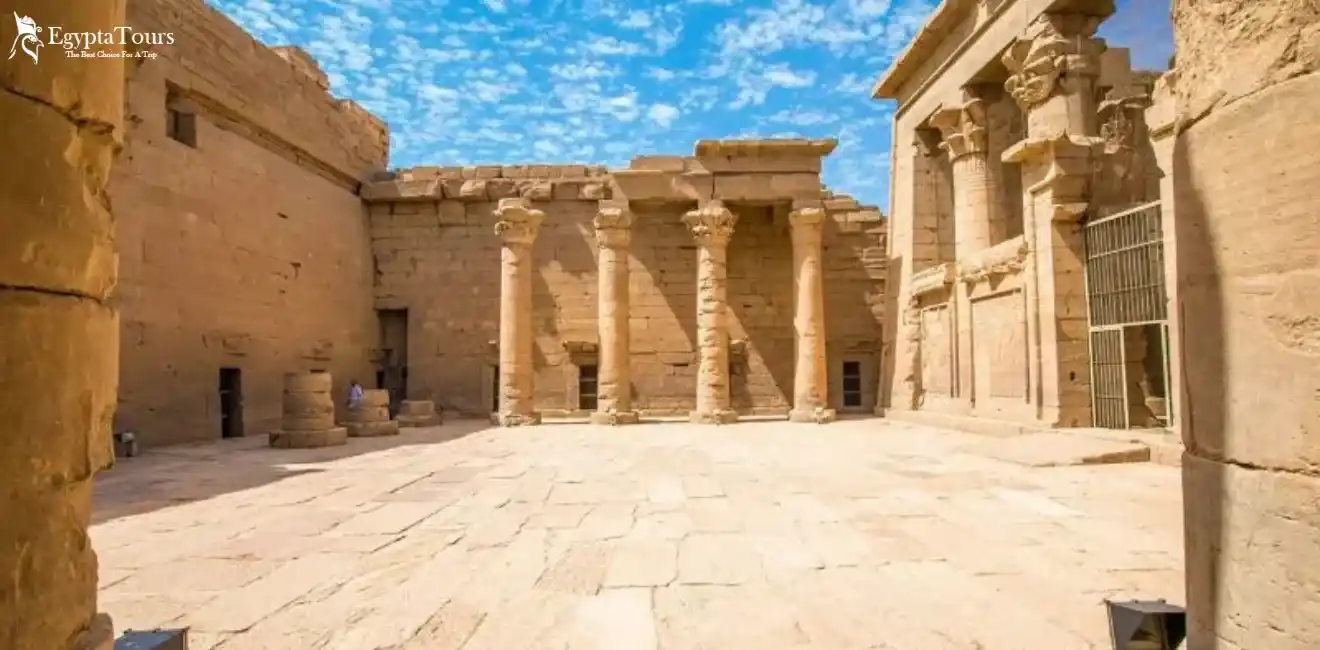
It consists of a edifice with an entrance in the middle that leads to a front courtyard, and the courtyard leads to the hall of legends, then two vestibules (corridors) that lead to the Holy of Holies (the holiest place in the entire temple, and when the temple is built, construction begins with it).
The sacred statue of the deity, the owner of the temple, is also placed there, where daily rituals are performed.
The Mamizi (an essential element of Kalabsha temples in this era.
It was dedicated to the worship of the goddess Isis and is located in the southwest of the temple
The temple contains scenes of Nubian deities such as (Mandulis, the main deity of the temple, Isis, Osiris, Shu, Horus, Amun, Khnum, and Ptah).
In addition to many inscriptions, including: Demotic, Coptic, and Greek inscriptions, in addition to a group of scribbles dating back to the Christian era.
Kalabsha Temple is considered the best witness to the ingenuity of the ancient Egyptians in architecture and construction, as it is one of the unique monuments in which Aswan flourished. It is considered one of the most important temples that combine the Egyptian style and the Nubian style, and therefore the state has made many efforts to preserve it as a historical legend until now.
FAQs
What is Kalabsha Temple?
A Nubian/Roman-era temple dedicated to the god Mandulis, relocated to Kalabsha island on Lake Nasser after the 1960s dam projects.
Where is Kalabsha Temple located?
On Kalabsha Island near Aswan, Egypt, in the Nubian region by Lake Nasser.
When was Kalabsha Temple originally built?
it dates to the 2nd century BC, with later Roman-era modifications and additions.
Why was Kalabsha Temple moved?
It was relocated to save it from flooding caused by the construction of the Aswan High Dam and Lake Nasser.
What deity is primarily worshipped at Kalabsha Temple?
Mandulis (Mandoula), a Nubian sun god associated with Nubian religious traditions.
What are the must-see features inside the temple?
Carved columns, bas-reliefs, depictions of Mandulis, and the largeii- style entrance; the surrounding pylon and courtyard are also notable.
Is Kalabsha Temple part of a larger UNESCO/Nubian Monuments site?
Yes; it’s part of the group of Nubian monuments relocated for the Lake Nasser era, often featured with Beit el-Wali and other nearby sites.
How do I reach Kalabsha Temple?
By road from Aswan to Kasr Ibrim area, then a short boat ride to Kalabsha Island; some tours combine Beit el-Wali and other sites.
What is the best time to visit?
Cooler months (roughly October–April). Sunrise or late afternoon visits offer dramatic lighting.
Are there guided tours available?
Yes. Local guides at the site or tour operators in Aswan offer guided visits with historical context.
What are the visiting hours and entrance fees?
Hours vary by season; check with your tour operator or the Egyptian Antiquities Authority updates. Entrance fees apply to most sites; fees are modest for foreign visitors.
Can I take photos at Kalabsha Temple?
Photography is generally allowed, but check for any restrictions inside sacred chambers or with staff.
Is there any on-site facilities or amenities?
Basic amenities are limited on-site; plan for water, sun protection, and comfortable footwear.
What other sites are nearby worth combining with Kalabsha?
Beit el-Wali (Temple of the Roman Governor’s Palace), and other Nubian monuments along Lake Nasser are commonly included in combined tours.
Why is Kalabsha Temple considered a “magical” Egypt monument?
Its ancient Nubian-Roman fusion, grand island setting by a shimmering lake, dramatic relocations, and the aura of Mandulis’ temple myths create a uniquely enchanting experience.
About EgyptaTours

EgyptaTours is a name synonymous with trust, excellence, and unforgettable travel experiences, proudly standing as one of the leading travel agencies in Egypt. Renowned for its deep expertise, personalized service, and carefully crafted itineraries, EgyptaTours serves as the ultimate gateway to discovering Egypt in its most authentic and inspiring form.