





King Tut Mask
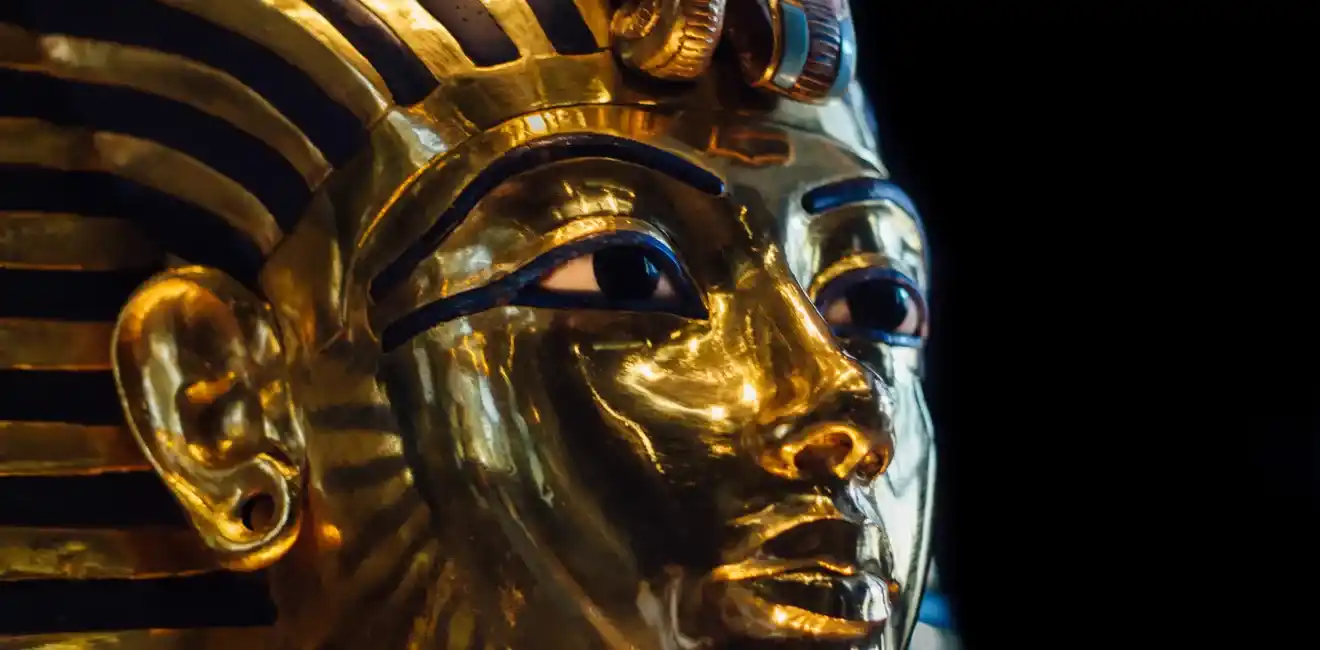
King Tut Mask was discovered in 1925 by the British archaeologist Howard Carter. It is called the golden funerary mask and is one of the most prominent symbols of ancient Egyptian art because it is made of pure gold, in addition to lapis lazuli and other precious stones. It shows ancient Egyptian royal symbols such as the cobra and the vulture. It has an artificial golden beard and hieroglyphic inscriptions from the Book of the Dead on its back. It has been placed in the Grand Egyptian Museum near the Giza pyramids.
Tutankhamun’s Golden Mask

King Tut Mask was made for King Psusennes I, who ruled Egypt during the 21st Dynasty around 1047-1001 BC. It is 48 cm high and 38 cm wide. The mask embodies the king’s facial features with perfect artistic precision. He wears the royal headdress known as the “nemes,” which is topped by the symbol of royal protection, the sacred cobra, a sign of the king’s divine power and eternal protection. It is also adorned with a braided false beard, representing a symbol of sovereignty and high status.
The eyes, eyebrows, and the straps holding the beard were inlaid with blue and white glass paste, which made the face more vibrant, while the eyes were made of black and white stone to appear as if they are looking with steadfastness and dignity.
The secrets of the design of King Tut Mask
The difference in the color of the mask from one direction to another confirms the use of nanotechnology, which is concerned with extremely small particles, and with the innovation of new methods whose dimensions are measured in nanometers, which is one-thousandth of a micrometer. It was made of pure hammered gold. If you look at it closely, you will find two types of colors in its golden locations. We see light blue or golden white on his face and neck, and yellow gold in the rest of the mask’s parts.
What you don’t know about the King Tut Mask?
It was discovered that the death mask was not specifically designed for King Tut, but was made for Queen Nefertiti, the young king’s stepmother, who was married to Akhenaten, Tutankhamun’s father. This was discovered through the holes in King Tut Mask on the ears, which indicate that the mask was originally intended for a woman. However, it was found in the tomb of King Tutankhamun by the British archaeologist Howard Carter.
How was the King Tut Mask made?
King Tut Mask was made of more than 11 interlocking gold pieces, which highlights the skill of the ancient Egyptians in metalworking. The king’s eyes were made with extreme precision from quartzite and obsidian. As for the necklace that adorns his neck in the mask, it consists of twelve harmonious rows, studded with pieces of colored glass that mimic in their colors lapis lazuli, jasper, and carnelian, in addition to obsidian.
On the back of the mask, fine longitudinal inscriptions extend from top to bottom. They are hieroglyphic writings engraved on gold, considered as magical spells and sacred texts aimed at protecting the king on his journey to the other world. These details combine deep artistic creativity and the firm religious beliefs that embodied the greatness of ancient Egyptian art.
The symbolism of the mask in ancient Egyptian religion
The mask in the ancient Egyptian religion is a means of connecting the soul to the body after death, so that it can recognize it upon its return during the journey of resurrection. It is designed with ideal features that embody divine perfection, which reflects the Egyptians’ belief that the deceased transforms in the other world into a sacred being who shares in eternity with the gods.
In the early Old Kingdom, around 2686-2181 BC, linen masks covered with plaster were used to cover the face of the deceased. Then they evolved by the Middle Kingdom era, around 2040-1782 BC, and cartonnage masks, made of multi-layered linen or papyrus reinforced with plaster, became widespread. These masks were painted very meticulously and were painted with the symbols of features of divine perfection.
During the New Kingdom period, 1550-1070 BC, the masks were more elaborate with the added protection spells and heavenly symbols. Innovations of The Twenty-first Dynasty: The mask of Psusennes I, circa 1077-943 BC of silver and gold represents the highest art of the creation of funerary masks.
The use of these masks was not limited to offer only physical protection, but it played a certain role in the spiritual transformation which guaranteed the continuation of the identity of the deceased and its recognition by the deities. The masks were frequently inscribed, with spells of the Book of the Dead, and symbolic protection, e.g. the Eye of Horus.
These aspects brought out the ideology that the physical and spiritual identity should be maintained to attain eternal life. The mask was discovered in the tomb of Tutanchamun.
Howard Carter was found inside tomb KV62 in the Valley of the Kings in Luxor when he entered the tomb of Tutankhamun, the King Tut Mask. He also discovered over 5,000 additional artifacts in the tomb such as clothes, gold jewelry, furniture, statues among others.
Where is King Tut Mask?

King-Tut-Mask
The complete tomb of Tutankhamun is being exhibited in the Grand Egyptian Museum in a single location. It holds the rare and special universal use and uniqueness of the museum since it exhibits 5,300 artifacts that were stolen and found in the Egyptian Museum in Tahrir, the Luxor Museum, and the Military Museum, the most important, greatest, and most valuable item in the world, King Tut Mask.
Conclusion
The King Tut Mask is one of the most notable artifacts as it is both an art masterpiece and historically valid, an eternal representation of the glory of the ancient Egypt culture. It symbolizes their development in art, engineering and religion that captures the world to this day by its immortality, splendor and enduring magic. The mask never changed its form with the times, and it has managed to enshrine its owner in the minds of the mankind up to this day, therefore, the face of Tutankhamun is a reminder of eternity even thousands of years later.
FAQs
What is unique with the mask of King Tut?
The question arises why King Tut Mask is special. It possessed numerous decorations, the greatest of them being: that it was of pure hammered gold and adorned with precious and semi-precious stones lapis lazuli, turquoise, carnelian. It is also 10.23 kilograms in weight, height is 54 cm and width is 39.3 cm.
What will the value of the mask of King Tut be?
You cannot put a price on it. It is among the most costly artifacts to have ever existed as it consists of gold and such precious stones as carnelian, quartz, lapis lazuli, and colored glass. The stones that decorated the mask are all present and familiar.
How much gold is in Tut’s mask?
The weight of gold present in King Tut Mask is over 11 kg of pure gold.
Has King Tut mask ever been spoilt?
The golden beard of King Tut Mask was then detached during the restoration process and a gluing exercise was done. When the tomb was found in 1922, it was also mentioned that the beard was not attached to the mask previously.
Who owns King Tut’s mask?
Nobody is the owner of the mask, which is kept in the Grand Egyptian Museum, after the procedure of transfer of the contents of the mask known as the old Egyptian Museum in Tahrir square in the center of Cairo.
Which is the most well known death mask on the planet?
The most well known death mask on earth is King Tut Mask. This is because it is known on an international scale as the symbol of the ancient Egyptian civilization, besides the fact that it boasts of great artistic beauty and is one of the most relevant treasures discovered.
About EgyptaTours

EgyptaTours is a name synonymous with trust, excellence, and unforgettable travel experiences, proudly standing as one of the leading travel agencies in Egypt. Renowned for its deep expertise, personalized service, and carefully crafted itineraries, EgyptaTours serves as the ultimate gateway to discovering Egypt in its most authentic and inspiring form.