




Pyramid of Menkaure: The Smallest Pyramid of Giza Explained
One of the oldest and most enduring monuments of Ancient Egypt is the Menkaure Pyramid of Giza. Dating back to around 2500 BC, this pyramid stands as a testament to the impressive engineering feats of the ancient Egyptians.
In this article, we’ll be taking an in-depth look at this incredible structure, exploring its history and what makes it so fascinating.
Introduction to Ancient Egypt
Ancient Egypt is one of the most fascinating and well-known ancient civilizations. The Egyptian pyramids are some of the most iconic structures in the world, and the Menkaure Pyramid of Giza is one of the best-preserved examples of these impressive buildings. In this article, we’ll take an in-depth look at the Menkaure Pyramid and what it can tell us about Ancient Egyptian society.
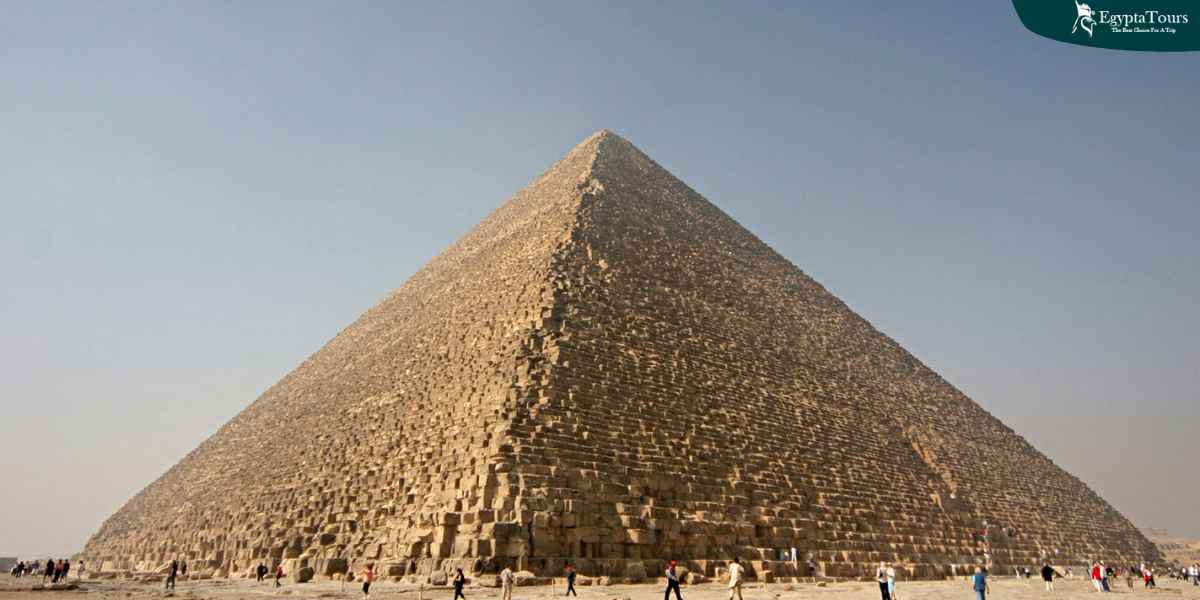
The Menkaure Pyramid was built during the reign of Pharaoh Menkaure, who ruled from 2490 to 2472 BCE. It is located on the Giza Plateau, just south of the Great Pyramid of Khufu (also known as the first pyramid).
The Menkaure Pyramid is smaller than its famous neighbor, but it is still an imposing structure measuring around 61 meters (200 feet) tall.
The pyramid was constructed using limestone blocks weighing up to two tons each. It is thought that around 10,000 workers were involved in its construction. The exterior of the pyramid was originally covered in a white limestone casing, which would have made it gleam in the sun. However, most of this casing has now been stolen or destroyed.
Inside the pyramid, there are three chambers: a small antechamber leading to a larger burial chamber, and a second smaller chamber known as a serdab. The Serdab was probably used to house statues of Pharaoh Menkaure and his family. These statues would have been placed there so that
History of Menkaure Pyramid
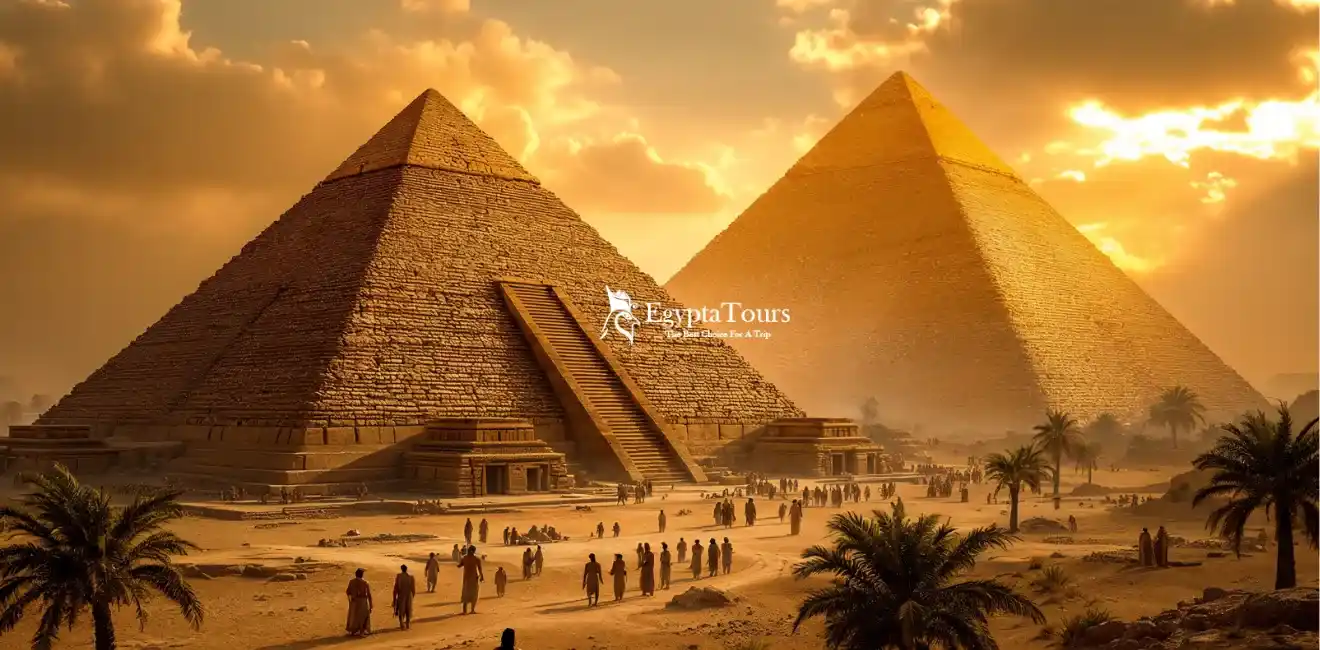
History-Of-The-Pyramid-Of-Menkaure-Giza-EgyptaTours
The real Pyramid of Menkaure was called “Menkaure is Divine,” a name that was given around 2510 BC during the 4th dynasty. It was built to represent the legacy of one of the last kings of the 4th dynasty in the 26th century BC. This pyramid is known as the smallest among all the Giza pyramid complexes because economic difficulties limited the resources available for its construction.
The pyramid stayed in its original location and remained in good condition until 1196 AD, when Al-Aziz Uthman, the Sultan of Egypt and son of Saladin, tried to destroy it. He hired workers for eight months but even with the use of wedges, levers and ropes to move and pull down the stones, they could remove only about one stone a day. When stones fell, they often sank into the sand, making them very hard to recover. In the end, the workers were able to cause only one large vertical gap on the northern side of the pyramid.
The history of Menkaure continued through the centuries and reached the 19th century AD, when it was mentioned in the poem “Mycerinus” by the English poet Matthew Arnold. Over time, the pyramid suffered more damage with its casing stones being taken and reused for other buildings. One notable example is in the 19th century, when Muhammad Ali Pasha used some of these stones to build an arsenal in Alexandria.
How Was It Built?
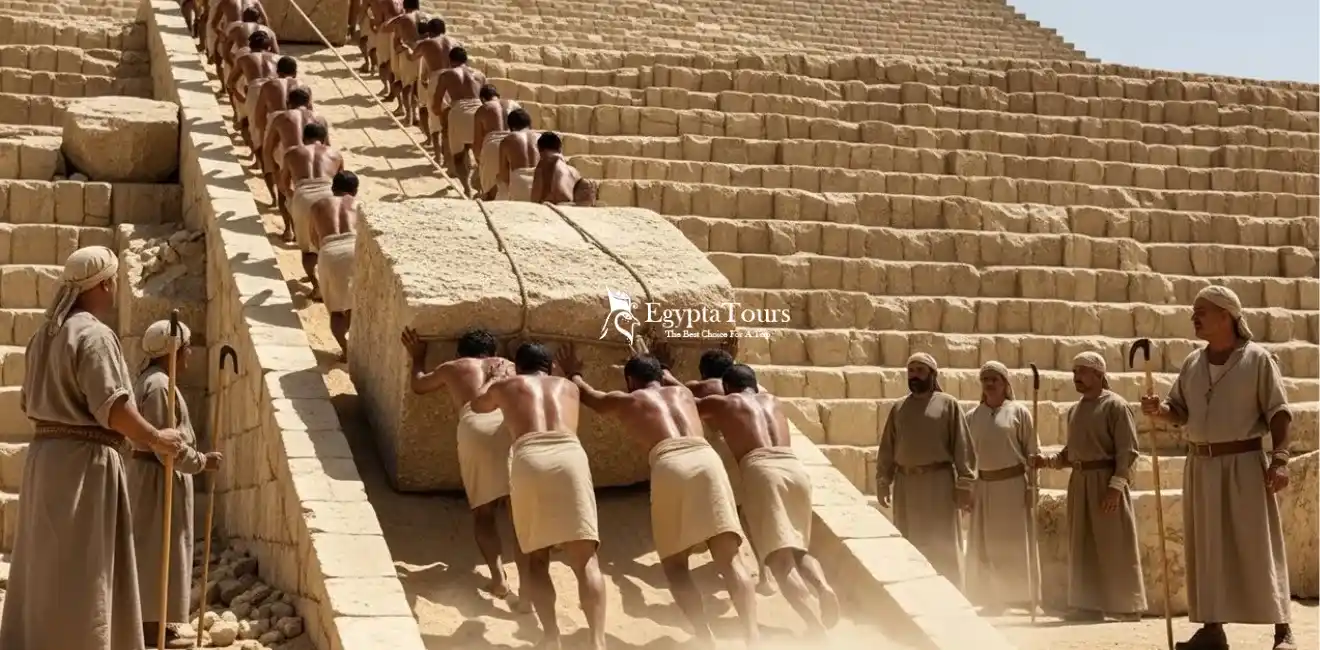
How-The-Pyramid-Of-Menkaure-Was-Built-EgyptaTours
Construction of the Menkaure pyramid began around 2560 BCE and was completed around 2532 BCE. Unlike the other two major pyramids at Giza, it was not built by slaves but by Egyptian peasants who were conscripted for public works projects.
It is thought that around 10,000 workers were employed in its construction.
The first stage of construction involved quarrying and transporting huge limestone blocks from nearby quarries to the site. These were then used to build the pyramid’s core, which was then faced with fine white Tura limestone brought from even further afield. Once the pyramid was completed, a capstone known as a ‘pyramidion’ was placed on top.
Unearthing the Mysteries of Menkaure Pyramid
The Menkaure pyramid is one of the three pyramids built in the Giza Necropolis for the Pharaoh Menkaure. It is the smallest of the three pyramids, but nonetheless an impressive feat of engineering. The pyramid was built using limestone blocks weighing up to 15 tons each.
The pyramid stands at a height of 65.5 meters (215 feet) and has a base length of 104.6 meters (345 feet). The pyramid was originally covered in white limestone casing stones, which were later looted by thieves.
One of the most interesting features of the Menkaure pyramid is its enigmatic chambers. There are three known chambers within the pyramid, but their purpose is still unknown. One theory is that they were used as storage rooms for the Pharaoh’s burial equipment. Another theory suggests that they were intended as ritual rooms for use in the afterlife.
Whatever their original purpose, the chambers are now an important mystery that archaeologists are still trying to solve. Hopefully, further excavations will shed more light on these intriguing chambers and help us to unlock the secrets of this ancient Egyptian monument.
The Artifacts Found Inside the Pyramid
Coffin and Sarcophagus
In 1837, the archaeologist Howard Vyse discovered a wooden coffin with the name of Menkaure on it, along with human bones. Later, these bones were identified as substitutes from the Saite period. Radiocarbon dating showed that the bones were less than 2,000 years old, which suggests that the remains were mishandled or that people had accessed the pyramid during ancient Roman times. The lid of the coffin was taken to the British Museum.
Deeper inside the pyramid, Vyse also found an impressive basalt sarcophagus that contained the remains of a young woman. Unfortunately, in 1838, this sarcophagus sank while it was being transported to Britain. It remains one of the few Old Kingdom sarcophagi lost at sea.
The Age and Location of the Pyramid of Menkaure
The exact date when the pyramid was built is not known because Menkaure’s reign has not been precisely determined but it was probably finished in the 26th century BC. It is located a few hundred meters southwest of its bigger neighbors, the Pyramid of Khafre and the Great Pyramid of Khufu, in the Giza necropolis.
The pyramid was likely looted as early as the First Intermediate Period. According to authors Bob Brier and Hoyt Hobbs, “all the pyramids were robbed” by the time of the New Kingdom when the construction of royal tombs began in the Valley of the Kings.
Tours To Menkaure Pyramid by Category
| Category Name |
|---|
| Alexandria Tour Packages |
| Cairo Short Breaks |
| Day Tours |
| Egypt Honeymoon Packages |
| Egypt Travel Packages |
| Luxor Short Breaks (Valley of Nobles Tours) |
| Nile Cruises |
| Egypt Sahara Tour Packages |
The Architecture and Design of the Pyramid
The Menkaure Pyramid, located in Giza, Egypt, was built during the Fourth Dynasty of ancient Egypt (c. 2575-2465 BCE). It is the smallest of the three Great Pyramids of Giza but is notable for its intricate design and beautiful architecture.
The pyramid was built for the Pharaoh Menkaure (r. c. 2558-2532 BCE) who succeeded his father Khafre (builder of the second largest pyramid at Giza) and preceded his son Shepseskaf (owner of the smallest pyramid at Giza).
The Menkaure Pyramid was not only smaller than its predecessors but also less complex in design, perhaps due to the fact that construction began later in Menkaure’s reign than it had for his father and grandfather. It has been suggested by some scholars that the simpler design may have been due to a change in religious beliefs during this time but this is speculative.
The exterior of the pyramid was originally clad in white limestone blocks which would have given it a shining appearance; many of these have since fallen away or been pillaged for other building projects over the millennia.
The interior chambers are constructed of granite and are much more ornate than those of previous pyramids, with reliefs on the walls and ceilings depicting scenes from Egyptian mythology and daily life.
The Pyramid of Menkaure originally stood 65.5 meters (215 feet) tall and was the smallest of the three main pyramids in the Giza pyramid complex. Today, its height is 61 meters (200 feet) and its base measures 108.5 meters (356 feet). The angle of its slope is about 51 degrees 20–25 minutes. The pyramid was built from limestone from Tura and granite from Aswan.
The first sixteen courses on the outside were made of red granite, while the upper part was covered in the usual way with Tura limestone. Some of the granite was left in its rough, unfinished state. Unfinished projects like this pyramid help archaeologists understand the techniques used to build pyramids and temples.
To the south of Menkaure’s pyramid, there are three smaller satellite pyramids, each accompanied by a temple and supporting structures. The easternmost is the largest true pyramid. Its casing was partially made of granite, similar to the main pyramid, and it is believed to have been completed because of the nearby limestone pyramid found close to it. The other two were not advanced beyond their inner cores.
Shortly before reaching the granite burial chamber, a doorway in the north wall of the entrance hall leads, via a staircase of six steps, to a series of six small chambers carved in the rock with comb-like teeth designs. These rooms are generally interpreted as places where canopic jars and crowns of Upper and Lower Egypt were kept.
Diagram of the Pyramid
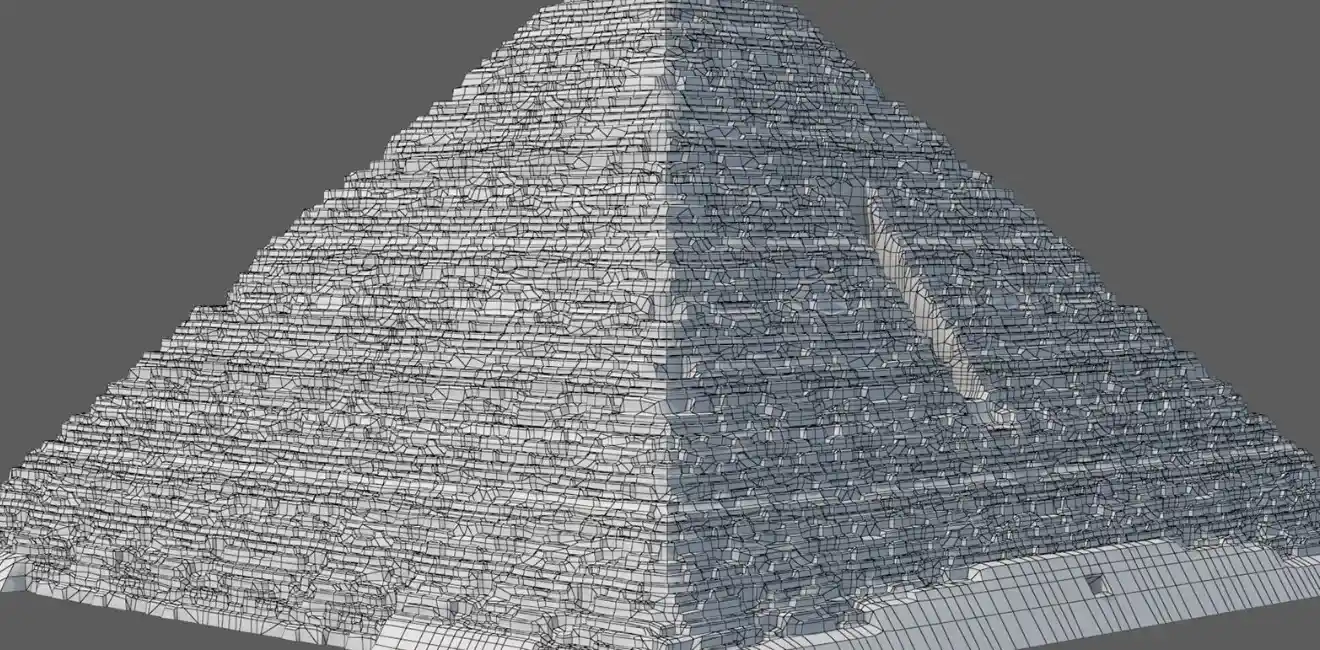
Diagram-Of-The-Pyramid-Of-Menkaure-Structure-EgyptaTours
It appears that three construction projects followed one another in the king’s tomb. The first, modest in size, corresponds to the unfinished passage. The second expanded the first project with a waiting room, a subsidiary room, and a large chamber preceding the burial chamber, which was eventually abandoned.
Finally, a third project was added to the second by extending an underground passage directly to the granite burial chamber, which included storage rooms to house the king’s funerary items. While the first project seems to have been abandoned, it is possible that the second and third projects were planned and executed at the same time. This may explain the dimensions of the large rectangular chamber, which likely served as a maneuvering room for arranging the granite beams covering the king’s burial chamber.
This is the first time that royal burial apartments were developed in a pyramid. Later royal tombs would adopt and develop the components of Menkaure’s burial chambers. Examples include the tombs of Khentkaus and Shepseskaf. The royal pyramids of the Fifth Dynasty retained guiding elements, such as the waiting room preceding the comb-chamber, the dome divided into a waiting room, a sarcophagus room, and storage rooms whose purpose is still unclear today.
On the other hand, the decoration of the first waiting room and Menkaure’s sarcophagus are unique. Such elaborate decorations were not seen in royal pyramids before the Sixth Dynasty, more than a century and a half later. In this sense, the Pyramid of Menkaure is an exception and represents a prototype for the classical pyramids of later periods.
The Artifacts Found Inside the Pyramid
Many ancient Egyptian pyramids contain a rich assortment of artifacts that offer insight into the lives of the people who built and used them. The Menkaure Pyramid, located in Giza, is no exception. Within its walls have been found a number of objects, including statues, jewelry, and pottery.
One of the most intriguing artifacts found inside the Menkaure Pyramid is a statue of the king himself. Carved from limestone, the statue stands just over three feet tall and depicts the king in a traditional pose with his arms crossed over his chest. Also found within the pyramid were several smaller statues of gods and goddesses, as well as a number of inscribed stone tablets.
Jewelry and other personal items belonging to those buried in the Menkaure Pyramid have also been found. These include necklaces, bracelets, and rings made from both gold and silver. Some of the more unusual items include amulets in the shape of animals, such as crocodiles and bulls.
These amulets were likely worn for protection or as symbols of power and status.
In addition to these more personal items, a number of everyday objects were also found inside the Menkaure Pyramid. These include pottery vessels used for cooking and storage, as well as lamps and other tools used by the ancient Egyptians in their daily lives. Taken together, these artifacts provide us with a fascinating glimpse into the lives of those who built and inhabited this ancient monument.
Cultural Impact Of The Menkaure Pyramid Today
The Menkaure Pyramid is one of the most iconic structures in ancient Egypt. Today, it stands as a reminder of the rich cultural heritage of this once-great civilization. The pyramid is also a popular tourist destination, attracting visitors from all over the world.
The Menkaure Pyramid was built during the reign of Pharaoh Menkaure, who ruled Egypt from 2490 to 2472 BCE. It is located in the Giza necropolis, which also houses the Great Pyramid of Khufu and the Pyramid of Khafre. The Menkaure Pyramid is smaller than its two neighbors, but it is nonetheless an impressive structure.
The pyramid consists of three main chambers: the antechamber, the king’s chamber, and the queen’s chamber. The antechamber and king’s chamber are connected by a narrow passageway known as the Grand Gallery.
The walls of the chambers are decorated with reliefs and hieroglyphs.
The pyramid was originally clad in white limestone, but only a few fragments of this original casing remain today. The rest of the pyramid was covered in rubble after it was abandoned and forgotten about for centuries. It was not until 1816 that European explorers rediscovered the pyramid.
Since then, the Menkaure Pyramid has undergone extensive restoration work. Today, it is once again a beautiful and imposing structure. Visitors can enter the pyramid and explore its chambers, or they can enjoy views of the pyramid from afar.
Who is King Menkaure
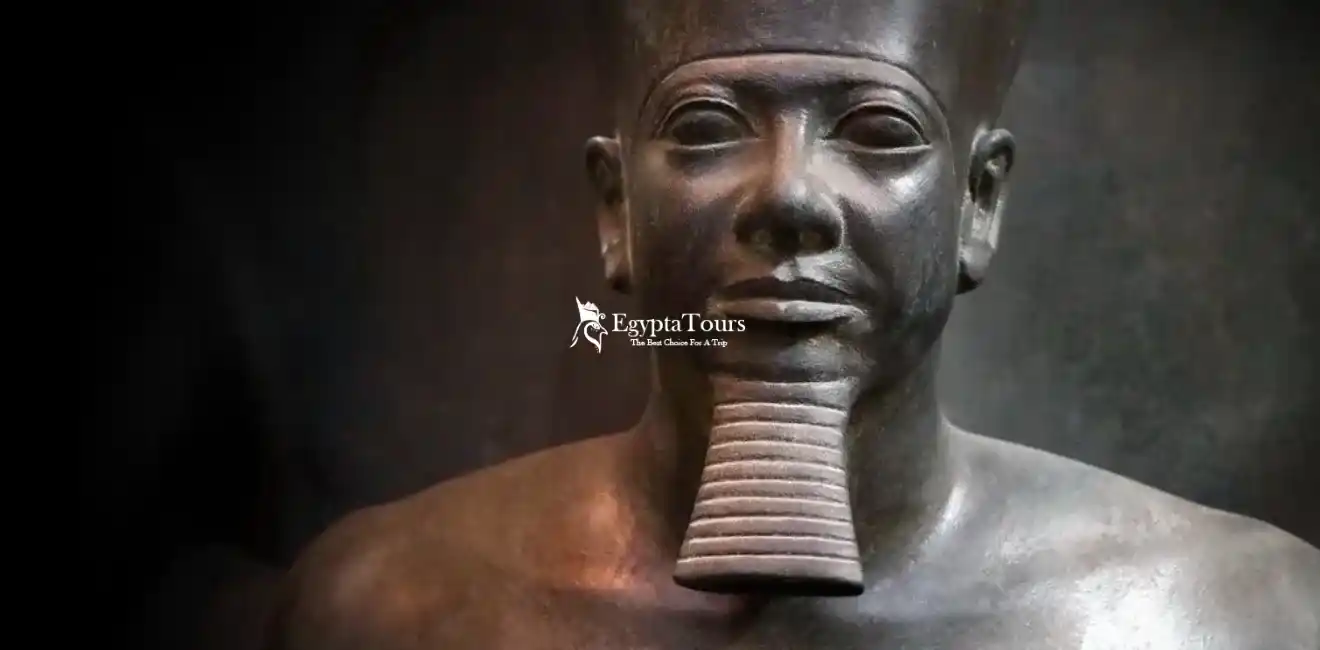
King-Menkaure-Fourth-Dynasty-Pharaoh-EgyptaTours
Pharaoh Menkaure, also called Mycerinus or Menkheres, was one of the rulers of ancient Egypt during the Fourth Dynasty of the Old Kingdom which lasted from 2700 to 2200 BC. He became king after his father, Khafre, who built the Second Pyramid at Giza. Menkaure is best known for his own Pyramid of Menkaure at Giza and for statues showing him with his wives and various gods.
He ruled around 2530 BC for approximately 18 to 22 years. After Menkaure, his successor was Shepseskaf. Menkaure was the son of Khafre and the grandson of Khufu. He probably had at least two wives, Khamerernebty I and Rekhetre and had several children, including Khuenre, Shepseskaf, Sekhemre and possibly a daughter named Khentkaus I.
Records such as the Turin King List and inscriptions left by workers indicate that his reign lasted about 20 years. His royal court included several of his half-brothers who served as viziers during his rule. In 2013, a fragment of Menkaure’s sphinx was discovered at Tel Hazor, an interesting find that showed evidence of his historical presence outside Egypt.
The Valley Temple of Menkaure
The Valley Temple of Menkaure was excavated between 1908 and 1910 by George Andrew Reisner. During the excavation, a large number of statues were found, most of them representing Menkaure alone or as part of a group. All of these were carved in the naturalistic style of the Old Kingdom with a high level of detail.
In the funerary structure, the foundations and core were made of limestone. The floors began with granite, and some walls were finished with granite facings. The foundations of the Valley Temple were built from stone, but both temples were completed using mudbrick.
Reisner estimated that some of the local stone blocks in the walls of the funerary temple weighed up to 220 tons, while the heaviest granite blocks imported from Aswan weighed over 30 tons. It is believed that Menkaure’s successor, Shepseskaf, completed the construction of the temple. An inscription in the funerary temple states that he “made it a monument to his father, the King of Upper and Lower Egypt.”
Later architectural additions, along with two Sixth Dynasty obelisks, indicate that the king’s cult was maintained or periodically renewed for about two centuries after Menkaure’s death.
The Upper Temple
The gigantic marble statue of Menkaure was discovered in the funerary temple. The temple itself is located east of the king’s pyramid, not directly adjacent to its side. The wide limestone building includes a large open courtyard that leads to interior rooms and small chapels where food offerings and ritual items for daily ceremonies were kept.
On the north side, a passage provided access to the rear of the temple, leading to a sanctuary that contained a funerary stele of the king, an element of worship conducted in these spaces. This sanctuary consisted of a small open courtyard connected to the eastern face of the pyramid. Its facade was reduced and the funerary stele it held has now disappeared.
In front of this courtyard was a covered waiting room that gave access to an attached chapel located to the south. All areas could originally be accessed from the pyramid’s perimeter through a doorway in the north wall of the waiting room. Later, the complex was expanded with a new waiting room in front of the first, which allowed access to a series of five small rooms or chapels. This essentially doubled the original design and may have accommodated royal worship requirements for the following dynasties.
Fragmented marble statues were discovered in this temple during comprehensive excavations in Egypt conducted between 1906 and 1924. These pieces have since been kept at the Museum of Fine Arts in Boston. Some of them were reassembled to create a giant statue of the king, depicted as a young man wearing a pharaonic nemes and a finely pleated linen kilt.
Studies of the monument show that construction occurred in two main phases. The first was during Menkaure’s reign and the second during his successor Shepseskaf’s time who completed the complex. The temple walls were made of massive limestone blocks, some weighing over 200 tons. The interior was faced with granite and the columns supporting the ceilings in the inner halls were also made of red granite from Aswan.
During the first construction phase, the temple courtyard was intended to have colonnades of granite columns and walls faced with the same material as the pyramid. If Menkaure’s architects had planned to cover both the funerary temple and the pyramid entirely in granite, the king’s death left the work unfinished.
His successor, Shepseskaf who was responsible for completing his father’s pyramid complex, revised the original plan and used cheaper, more practical materials to finish it quickly. The colonnades were removed and replaced with mudbrick walls with niches installed at regular intervals to imitate the decorative facade of a palace. These niches remain the only decoration of the monument as no reliefs have been found in the temple.
Following the same chronological sequence, the intimate part of the temple was originally designed as a simple plan, consisting of a hall with columns distributed to the north and south by simple passageways used as storage rooms. After the king’s death, Shepseskaf’s architects expanded the plan, doubling the corridors and rooms.
After a disaster caused major damage to the pyramid complex, the entire western part of the temple and the worship chapel were restored during the Sixth Dynasty. This restoration may have occurred under Pepi II as a stele bearing his name was found in the funerary temple, showing that more than 150 years after Menkaure’s death, the temple was still in use and maintained by reigning Egyptian kings.
The Funerary Temple of Menkaure’s Pyramid
The funerary temple, also called the Upper Temple, featured massive uniform blocks, a large courtyard and inner chambers and storage rooms for offerings. The temple complex was aligned with the western face of the pyramid.
The Causeway
The causeway of Menkaure’s complex was about 605 meters long. Only its path remains today which connected the Valley Temple to the funerary temple attached to the pyramid’s enclosure. Access to the causeway was through two gates one in the front courtyard of the Valley Temple and the other to the south of the interior rooms west of the courtyard. The causeway allowed processions to travel directly to the pyramid and its temple or, after performing purification rituals in the large courtyard of the Valley Temple, pass through the western rooms and follow the passage. Vertically aligned with the temple axis, the causeway joined before splitting towards the rear of the temple.
It is likely that this causeway was never completed due to Menkaure’s early death. The unfinished painting of the pyramid, the two phases of funerary temple construction, and the state of the causeway all indicate that Menkaure did not have time to complete his mortuary complex. His successor, Shepseskaf, finished the complex using mudbrick walls above the causeway, forming a long corridor that may have been covered in the same material with an arched roof.
This corridor led directly to the large open courtyard of the Upper Temple, aligned with the central axis of the monument. The thickness of the foundations and passages suggests that this part was designed to support heavy walls capable of holding large ceiling slabs.
The Lower Temple
For the Valley Temple of Menkaure, the king’s architects planned a large building made of limestone and granite to dominate the reception area of the funerary complex. According to Vito Maragioglio and Celeste Rinaldi, who studied the temple, the initial design opened with two side doors leading to a vestibule with four columns, followed by a hall with a column-supported roof. Its south side opened to a passage leading to the pyramid causeway, resembling the overall plan of Khafre’s Valley Temple.
However, like other pyramid complexes, the Valley Temple of Menkaure was barely completed. The foundations were unfinished at the king’s death and were later completed by Shepseskaf. A stele bearing Shepseskaf’s name and a decree from the king shows that he started completing the work. As with the Upper Temple, he modified the plan and used mudbrick to speed up construction.
The entrance leading to the causeway was moved south, creating a large courtyard instead of the columned rooms. In the front, there was a structure with a main entrance leading to a first room with a four-column-supported roof, possibly made of wood. This room was connected north and south by a series of small rooms intended for storing offerings. The south passage led to the causeway, passing the temple’s south and west sides.
The new part of the temple allowed access to the large courtyard, with walls decorated with niches in the stone facade, similar to the Upper Temple. This courtyard led to the westernmost part of the temple, consisting of rooms, chapels, and storage spaces for statues and equipment needed for daily offerings and rituals. This intimate part of the sanctuary had another passage connecting to the causeway through a second doorway in the temple’s south wall.
The Valley Temple represents a final case of significant modifications, reflecting the prolonged use of spaces that likely became a central place of worship in the city, built below the plateau to accommodate various workshops. These spaces were accumulated for royal construction projects at Giza over nearly a century.
The front courtyard of the temple became the first courtyard with its northern entrance leading through a vestibule with four columns opening toward the city of priests, which had developed near Queen Khentkaus’ tomb. It is possible that the queen, Shepseskaf’s wife, also carried out work on Menkaure’s temple while constructing her own tomb-temple.
After damage caused by a natural disaster in the mid-Sixth Dynasty, the temple was rebuilt on a simpler plan and isolated from the other royal tombs. Over time, it was occupied by houses during the First Intermediate Period, due to the tax exemption granted to sacred areas since the Old Kingdom. A complete settlement developed inside the temple enclosure with tightly packed houses, ovens, granaries and narrow winding streets leading to the western colonnade which remained in use for some time.
Eventually, the complex was abandoned shortly before the Middle Kingdom and handed over to quarry workers who removed preferred materials such as limestone or granite, while wooden elements gradually decayed over the centuries.
Satellite Pyramids
To the south of the king’s pyramid, three satellite pyramids are aligned from east to west, identified as G3a, G3b and G3c in tomb plans. Each had a small cult temple on its eastern face.
The first pyramid (G3a) was a smooth-sided pyramid with a 52°15’ slope and a 44-meter base. Its original height was slightly over 28 meters, and all four sides were faced with fine Tura limestone. Its north face had an entrance leading to a descending passage that ended in an underground chamber, where a granite sarcophagus was found. The cult temple, accessible from the northwest corner of the small pyramid complex, faced east to west. It had a large open courtyard and a covered section with a series of rooms for worship, similar to the king’s funerary temple, and appears to be a smaller version.
This group has been interpreted differently. The pyramid of Ka is often considered part of Menkaure’s complex, but the discovery of a stone sarcophagus in the underground chamber and the presence of a cult temple on the eastern face are strong indications that it was the burial place of a queen. According to George Andrew Reisner, it is the tomb of Queen Khamerernebty II. However, debate continues because another burial discovered at Giza is also attributed to the queen.
The other two pyramids are stepped, and their temples are narrower due to the limited space between monuments, facing north toward the king’s pyramid. Each has a descending passage from its north face leading to small chambers carved in the rock. Excavations in G3b revealed a sarcophagus containing the remains of a young woman.
No inscriptions were found to identify her, though one lid had a cartouche of Menkaure, indicating that construction of the small pyramid began during the king’s reign and was part of the overall complex plan. Its incomplete stepped appearance is explained by the king’s death halting work.
The third pyramid, by size, is also an unfinished queen’s pyramid. Its exploration revealed no sarcophagus. However, it deteriorated due to demolition attempts during the French campaign in Egypt. At that time, scholars tried to study pyramid construction by dismantling monuments, hoping to discover secret chambers, but this work stopped after Napoleon’s campaign failed due to Turkish and British intervention. These last two pyramids remain largely unknown.
Mysterious Holes in Menkaure’s Pyramid Puzzle Scientists… Could They Be Secret Passages?
Archaeologists have discovered mysterious holes and “voids” in Menkaure’s Pyramid, the third largest pyramid at Giza in Egypt. This finding has raised many questions about the nature of these voids with surveys suggesting that they could be secret entrances.
A report published by the British newspaper Daily Mail and reviewed by Al Arabiya, stated that scientists believe they may have found traces of a hidden entrance in this historic pyramid near Cairo, more than 4,500 years after it was built.
Menkaure’s Pyramid, built around 2510 BC, stands about 200 feet tall and is the smallest of the three main pyramids at the famous Giza complex. It was constructed as the tomb of King Menkaure of the Fourth Dynasty whose sarcophagus was lost under mysterious circumstances.
From the Surveys
Researchers from Egypt and Germany used advanced scanning methods to look behind the historic granite blocks of the pyramid. They reported finding two hidden air-filled anomalies, which may indicate a hidden entrance that has not been discovered in modern times.
Christian Groß, a professor of non-destructive testing at the Technical University of Munich, described this as “an important discovery at Giza.” He explained: “The testing methods we developed allow very precise conclusions about the interior of the pyramid.”
He added, “The hypothesis of another entrance is very reasonable and our results bring us one step closer to confirming it.”
The main entrance of Menkaure’s Pyramid is on the north side, but experts believe a second entrance may exist on the east side, facing the Nile. They specifically pointed to a rectangular area on the eastern side, about four meters high and six meters wide, close to the ground.
Interestingly, the granite blocks in this area of the eastern facade are “unusually smooth” as if they were polished with precision thousands of years ago. It is also notable that similarly smooth stones exist at the main northern entrance, suggesting that a second entrance may have existed for a long time but was forgotten over the centuries.
Independent researcher Steger van den Hoeven first suggested the possibility of this additional entrance in 2019 but it remained a hypothesis until now.
Experts from Cairo University and the Technical University of Munich used non-invasive techniques like radar, ultrasonic waves and electrical resistance tomography to examine the interior without dismantling the old bricks, according to Daily Mail.
They discovered two air-filled voids behind the smooth facade, each different in size and height. The scientists noted that the arrangement of these voids is puzzling, but together they “may support the hypothesis of a second entrance.”
The team explained that each technique has its limitations, but using the three methods together makes their conclusions reliable.
They also noted that tourists can currently enter Menkaure’s Pyramid, exploring burial chambers, passageways and small openings. However, a potential second entrance on the eastern side suggests the possibility of undiscovered chambers or passages that might contain treasures unseen by modern eyes.
Still, the scientists caution that “the interpretation of these anomalies must be discussed among Egyptologists” before any definitive conclusions can be reached.
Modern Adventures To The Menkaure Pyramid
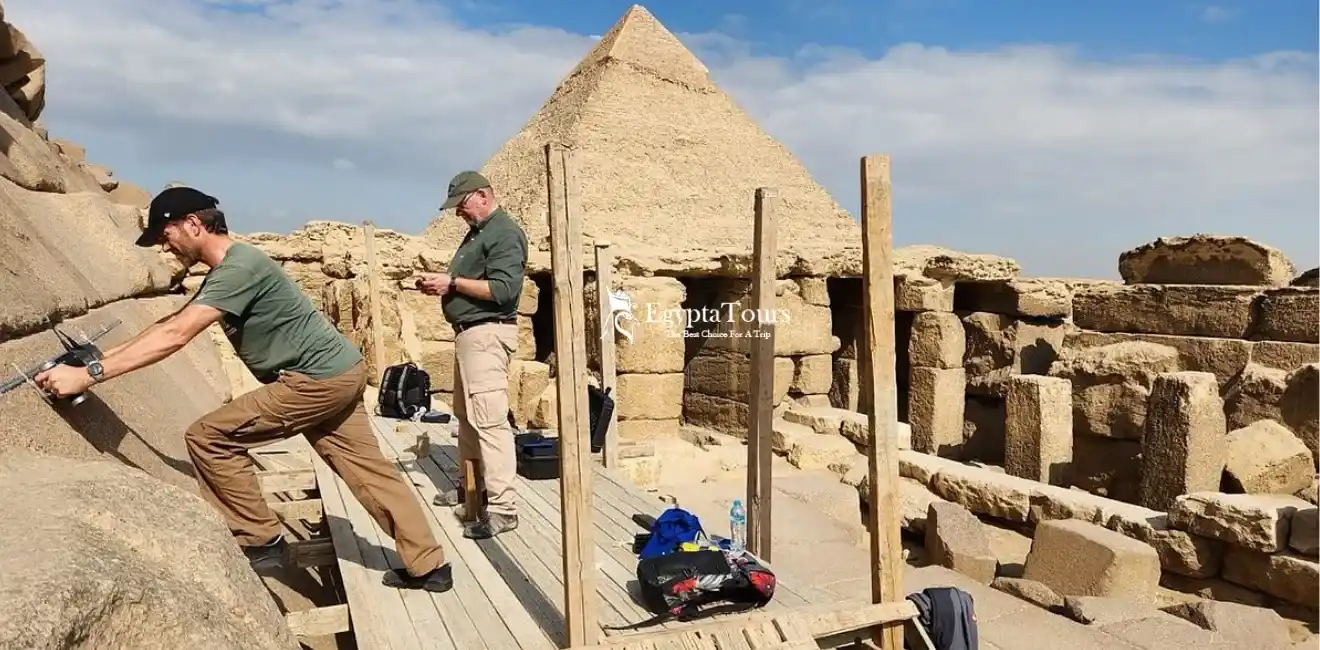
Modern-Adventures-To-The-Menkaure-Pyramid-Giza-EgyptaTours
In ancient times, the Menkaure pyramid was one of the Seven Wonders of the World. Today, it’s still an awe-inspiring sight, and a popular tourist destination.
The Menkaure pyramid was built during the reign of Pharaoh Menkaure, in the Fourth Dynasty of ancient Egypt. It’s located on the Giza Plateau, just to the south of the Great Pyramid of Khufu.
The Menkaure pyramid is smaller than its neighbor, Khufu’s pyramid. But it’s still an impressive structure, measuring around 61 meters (200 feet) tall.
Visitors can explore the interior chambers of the Menkaure pyramid, which include a burial chamber and three smaller rooms known as queen’s pyramids. There are also several boat pits nearby, where archaeologists believe the king’s funeral boat was stored.
A visit to the Menkaure pyramid is a truly unique experience. It’s a chance to step back in time and imagine what life was like in ancient Egypt.
The Best Cheap Tour Packages In Egypt
| Tour Name | Duration |
|---|---|
| Egypt 12 Days : The Ultimate Itinerary | 12 Day – 11 Nights |
| 6 Days Cairo and Hurghada Tour Package | 6 Days – 5 Nights |
| 5 Days Cairo and Luxor Trip | 5 Days – 4 Nights |
| Tour package to visit Cairo, Alexandria, Luxor and Aswan | 6 Days – 5 Nights |
Conclusion
Exploring the Menkaure Pyramid of Giza has truly been an incredible journey. Not only did we learn about the ancient civilization that built this magnificent structure, but we also gained insight into what life may have been like back then and how they were able to develop such a complex pyramid system. We hope you have enjoyed learning as much as we did!
The Pyramid of Menkaure, the smallest of the three main pyramids at Giza, is a remarkable structure built for Pharaoh Menkaure during Egypt’s Old Kingdom. Though smaller in size compared to the pyramids of Khufu and Khafre, it stands out due to its unique features.
The lower part of the pyramid was originally covered in impressive granite casing blocks, giving it a striking appearance.
The pyramid complex includes both a mortuary temple and a valley temple, which were integral parts of the funerary process. Inside the pyramid, a stunning stone sarcophagus was discovered, though it was later lost at sea during transport.
Interestingly, Al-Aziz, a medieval sultan, attempted to dismantle the pyramid, but his efforts were largely unsuccessful, leaving the structure mostly intact for future generations to admire.
Insights into the Menkaure Pyramid
What is the Menkaure Pyramid?
The Menkaure Pyramid is the smallest of the three famous pyramids at the Giza Plateau in Egypt. It was built for Pharaoh Menkaure, who ruled during the Fourth Dynasty of the Old Kingdom.
When was the Menkaure Pyramid constructed?
The pyramid was likely constructed during the reign of Pharaoh Menkaure, around 2510 BCE. However, the exact timeline of its construction is not precisely documented.
How tall is the Menkaure Pyramid?
Originally, the Menkaure Pyramid stood about 215 feet tall. Due to erosion and the loss of the outer casing, it now measures approximately 204 feet.
What makes the Menkaure Pyramid unique?
Unlike the larger pyramids built by Khufu and Khafre, Menkaure’s pyramid is distinguished by its smaller size and its extensive use of granite in the lower layers and mortuary temple.
Are there any chambers inside the Menkaure Pyramid?
Yes, the pyramid has a series of chambers, including a descending passage leading to a burial chamber. Unfortunately, the burial chamber was found empty, likely due to tomb robbing.
What were the materials used in building the Menkaure Pyramid?
The base of the Menkaure Pyramid features granite blocks, while the upper sections are primarily limestone. The original casing stones were polished Tura limestone.
Has the Menkaure Pyramid been restored?
Yes, the pyramid has undergone various restoration efforts over the years, both by ancient Egyptians and modern archaeologists, to preserve its structure and historical significance.
Can visitors enter the Menkaure Pyramid?
Visitors can enter the pyramid, but access may vary based on preservation efforts and ticket availability. It’s advisable to check ahead if planning a visit.
What is the significance of the surrounding pyramid complex?
The Menkaure complex includes three smaller pyramids for queens and a mortuary temple. These structures reflect the intricate planning and religious significance of the site.
How does the Menkaure Pyramid compare to the other pyramids at Giza?
While smaller in size, the Menkaure Pyramid is renowned for its architectural finesse and the quality of materials used. It provides valuable insights into ancient Egyptian engineering and culture.
About EgyptaTours

EgyptaTours is a name synonymous with trust, excellence, and unforgettable travel experiences, proudly standing as one of the leading travel agencies in Egypt. Renowned for its deep expertise, personalized service, and carefully crafted itineraries, EgyptaTours serves as the ultimate gateway to discovering Egypt in its most authentic and inspiring form.