Graeco Roman Museum
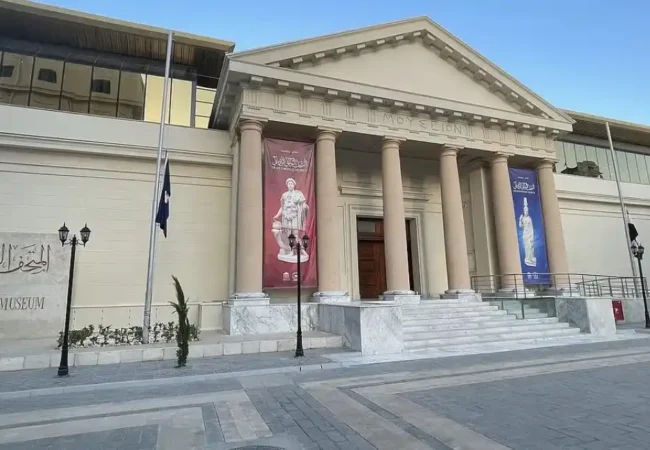
The Graeco Roman Museum is an archaeological museum in Alexandria , Egypt....



Pompey’s Pillar is one of Alexandria’s most iconic and enduring historical landmarks, standing as a towering Roman triumphal column within the archaeological remains of the ancient Serapeum. Though historically misnamed after the Roman general Pompey the Great, the monument was actually erected between 298 and 302 AD to honor Roman Emperor Diocletian following his suppression of an Alexandrian revolt. Crafted from a single monolithic block of Aswan pink granite, the pillar reaches a height of nearly 27 meters and represents a masterclass in ancient engineering, offering visitors a profound glimpse into Alexandria’s rich Greco-Roman heritage.
Key Takeaways
True Identity and Purpose: Despite its traditional name, the monument has no connection to the Roman general Pompey the Great; it was built between 298 and 302 AD to commemorate Roman Emperor Diocletian following his suppression of a local Alexandrian rebellion.
Origin of the Misnomer: The name “Pompey’s Pillar” arose from a historical translation confusion between the Greek spelling of the monument’s dedicator, Publius (Pouplios), and the Roman general Pompey (Pompeios).
Monolithic Engineering: Standing as one of the largest ancient monoliths ever erected, the 20.46-meter shaft and base are carved from a single piece of pink Aswan granite (lapis syenites), weighing approximately 285 tonnes, topped with a grey granite pseudo-Corinthian capital.
Original Top Statue: The column originally supported a colossal, armor-clad porphyry statue of Emperor Diocletian standing roughly 7 meters tall, fragments of which were documented during the 18th century.
The Serapeum Connection: Situated in the Karmouz district, the pillar stands within the sacred precinct of the ancient Serapeum complex—once a grand sanctuary dedicated to the Greco-Egyptian deity Serapis and the site traditionally linked to the “Daughter Library” of the Great Library of Alexandria.
Historical Ascents: The monument has a history of daring climbs by early travelers and naval officers, most notably an 1803 ascent by British naval officer John Shortland, who successfully hoisted the Union Jack at its summit.
Alexandria is a city with a rich history, and Pompey’s Pillar in Alexandria is one of its most famous landmarks. This towering red granite column was erected in honor of Roman general and politician Pompey the Great, who died in Alexandria in 48 BC.
If you’re visiting Alexandria, make sure to stop by Pompey’s Pillar for a glimpse into the city’s fascinating past. This attraction is one of Alexandria’s most popular tourist destinations, and for good reason – it’s a must-see for anyone interested in Egyptian history.
The Roman Triumphal Column was known as Pompey’s Pillar and is situated within the Serapeum of Alexandria, in the area of Al Karah WA, Toubageyah WA Kafr Al Ghates, Karmouz district, Alexandria. Alexandria can be easily reached from any location in Egypt by air, train or road and from there visitors can access Pompey’s Pillar along with the city’s other historical landmarks. It is recommended to arrange the visit through a travel agency that offers the services of an experienced tour guide, a private means of transportation and round-the-clock customer support, ensuring assistance throughout every stage of the journey.
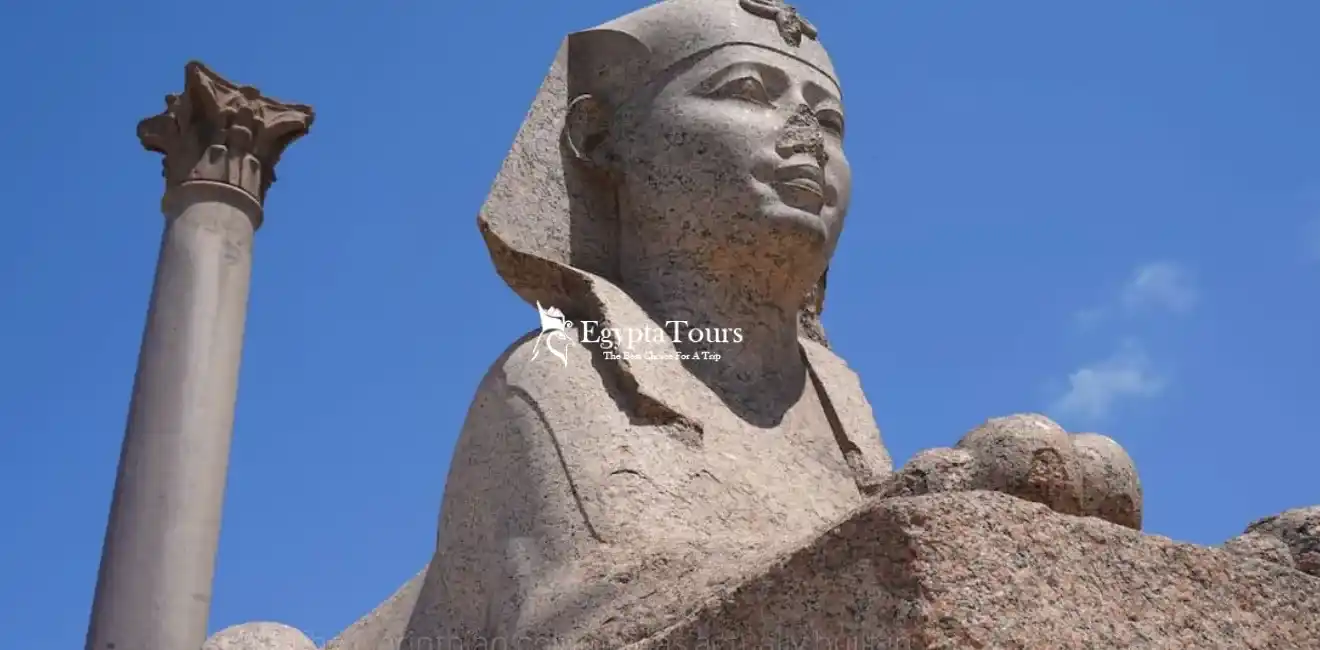
Pompey’s -Pillar-Construction-EgyptaTours
In 297 AD, Emperor Diocletian, who had held the title of Augustus since 284, led a military campaign in Egypt to put down a rebellion led by the usurper Domitius Domitianus. Following a prolonged siege, Alexandria fell to Diocletian’s forces and in 298 Domitianus’s successor, Aurelius Achilleus, was captured and executed.
Diocletian later returned to Alexandria in 302 where he established an official state grain distribution system. The inscription dedicating the monumental column and its statue refers to Diocletian as polioúchos (Ancient Greek: πολιοῦχον Ἀλεξανδρείας), meaning the “guardian deity of the city of Alexandria.”
Pompey’s Pillar is an ancient Egyptian monument located in Alexandria. It was built to commemorate the victory of Gnaeus Pompeius Magnus over the Arab king of Egypt, Mithridates III, in 31 BC.
You can still see the inscription on the pillar that reads: “To the son of Venus, eternal Magnus”. The pillar itself is made from red granite and is 82 feet high. It’s a popular tourist attraction and a must-see for anyone visiting Alexandria.
The Monument, or Pompey’s Pillar as it is more commonly known, is an ancient Egyptian structure that was built in honor of the Roman general and politician Pompey. The monument has an impressive architecture, and it still stands tall even today.
You’ll be able to find the Monument in the district of Alexandria known as Kom al-Dikka. It’s an easy landmark to spot, as it’s one of the tallest structures in the city. Plus, the pillar itself is carved with beautiful hieroglyphs and designs.
During the fourth century AD, this same title was also associated with the god Serapis, regarded as the male counterpart of Isis within the religious system introduced by the Ptolemaic rulers of Egypt. The column originally stood within the sanctuary complex of Serapis, known as the Serapeum, which was first constructed under King Ptolemy III Euergetes in the third century BC.
This complex was later rebuilt during the Roman period, probably between the late second and early third centuries AD with completion occurring under Emperor Caracalla. By the later fourth century AD, the historian Ammianus Marcellinus described the Serapeum as a wonder surpassed only by the Temple of Jupiter Optimus Maximus on Rome’s Capitoline Hill, the Capitolium.
The monument itself reaches a height of approximately 26.85 meters including both its base and capital and it originally supported a colossal statue estimated to have stood around 7 meters tall. It is the only known monolithic column from Roman Egypt, meaning it was carved from a single piece rather than assembled from drums. The column ranks among the largest surviving ancient monoliths and is considered one of the biggest monolithic columns ever erected. The shaft alone measures 20.46 meters in height with a basal diameter of 2.71 meters while the socle exceeds 6 meters in height.
Both the shaft and base are made from lapis syenites, a distinctive pink granite quarried at ancient Syene, present-day Aswan. In contrast, the pseudo-Corinthian capital was carved from grey granite. The weight of the column shaft has been estimated at around 285 tonnes.
Four surviving and legible lines of a Greek inscription remain on the column’s sole. These lines state that the monument was dedicated in honor of Diocletian by a Praefectus Aegypti (Ancient Greek: ἔπαρχος Αἰγύπτου), named Publius. A prefect of Egypt bearing this name is known from two papyri discovered at Oxyrhynchus. His term in office must have fallen between that of Aristius Optatus, attested as governor on 16 March 297 and Clodius Culcianus who held the post from 302 or 303 onward.
Since Publius is identified as the dedicator, the column and the statue of Diocletian erected upon it must have been completed sometime between 297 and 303, during Publius’s prefecture. Much of the governor’s name was later erased due to damage to the inscription. The Greek form of Publius’s name, ΠΟΥΠΛΙΟΣ (Πού̣π̣[λιος], Pouplios), was eventually confused with the Greek spelling of the Roman general Pompey, ΠΟΜΠΗΙΟΣ (Pompeios) which led to the later misidentification of the monument.
Fragments of the original porphyry statue of Diocletian, depicting him in military armor, were recorded at the base of the column during the eighteenth century AD. From a surviving fragment measuring approximately 1.6 meters and representing the statue’s thighs, scholars have calculated that the full height of the statue would have been close to 7 meters. Although some fragments were known to have entered European collections during the nineteenth century, by the 1930s their locations were no longer known and they are now considered lost.
It has been suggested that the massive column carrying Diocletian’s statue may once have been accompanied by an additional column or by three smaller columns supporting statues of his co-emperors: the Augustus Maximian and the two Caesares, Constantius and Galerius. If this arrangement existed, it would have formed a commemorative group honoring the Tetrarchy, the system of shared imperial rule established during Diocletian’s reign.
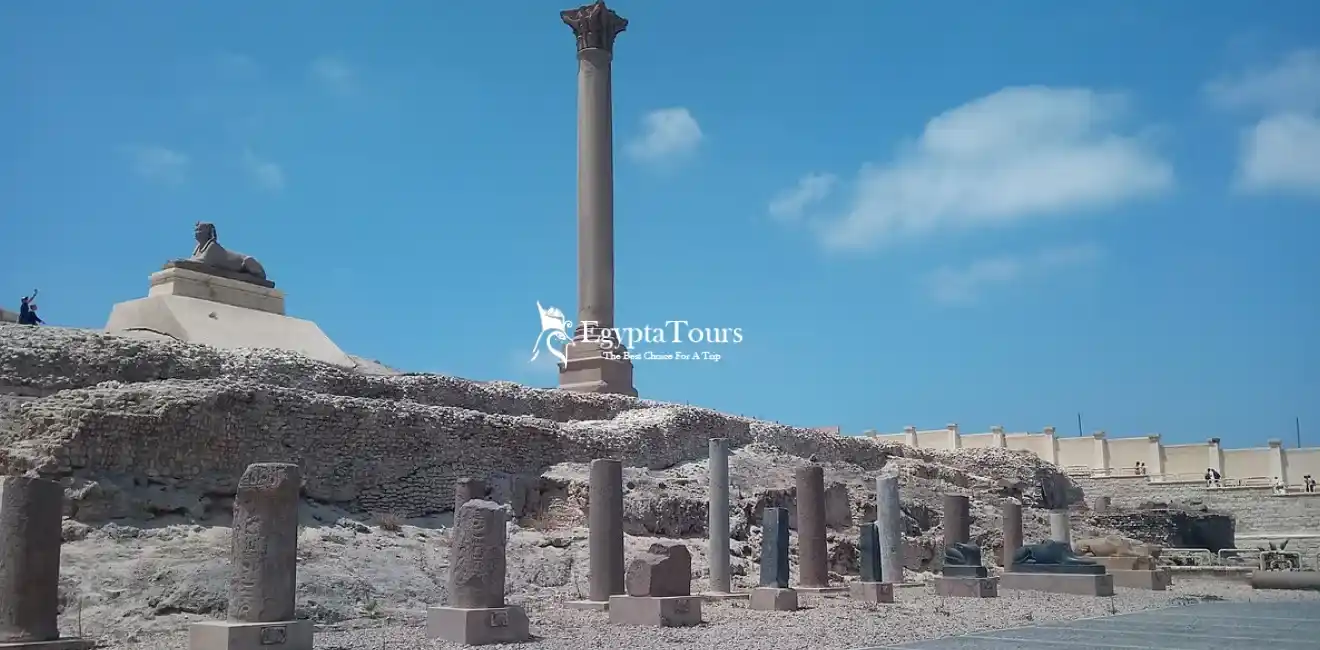
Facts-about-Pompey’s-Pillar-EgyptaTours
Pompey’s Pillar has no historical connection to the Roman general Pompey who was assassinated in Alexandria in 48 BC. Instead, the monument was constructed between 298 and 302 AD to honor the Roman emperor Diocletian, marking his suppression of a revolt in Alexandria. The inscriptions carved on the base of the pillar celebrate Diocletian and record his victories.
The pillar is considered one of the few ancient structures in Alexandria that remains standing in its original location. It consists of a single monolithic column carved from red granite extracted from the quarries of Aswan which places it among the largest ancient monoliths ever created. The shaft of the column measures 20.46 meters in height and has a diameter of 2.71 meters at its base. When the base and capital are included, the total height of the structure reaches 26.85 meters.
Originally, Pompey’s Pillar supported a massive statue of Emperor Diocletian, estimated to have been approximately 7 meters tall. Beneath the pillar, a set of steps leads down to the archaeological remains of the Serapeum including the location traditionally identified as the “Daughter Library” of the Great Library of Alexandria. The monument stands on the site of the ancient Serapeum, a sacred complex that once housed a temple dedicated to the Greco-Egyptian deity Serapis.
Pompey’s Pillar remains a striking archaeological landmark that offers visitors a direct connection to Alexandria’s Roman heritage. Despite longstanding confusion surrounding its name, the monument continues to provide a powerful visual and historical experience for modern visitors.
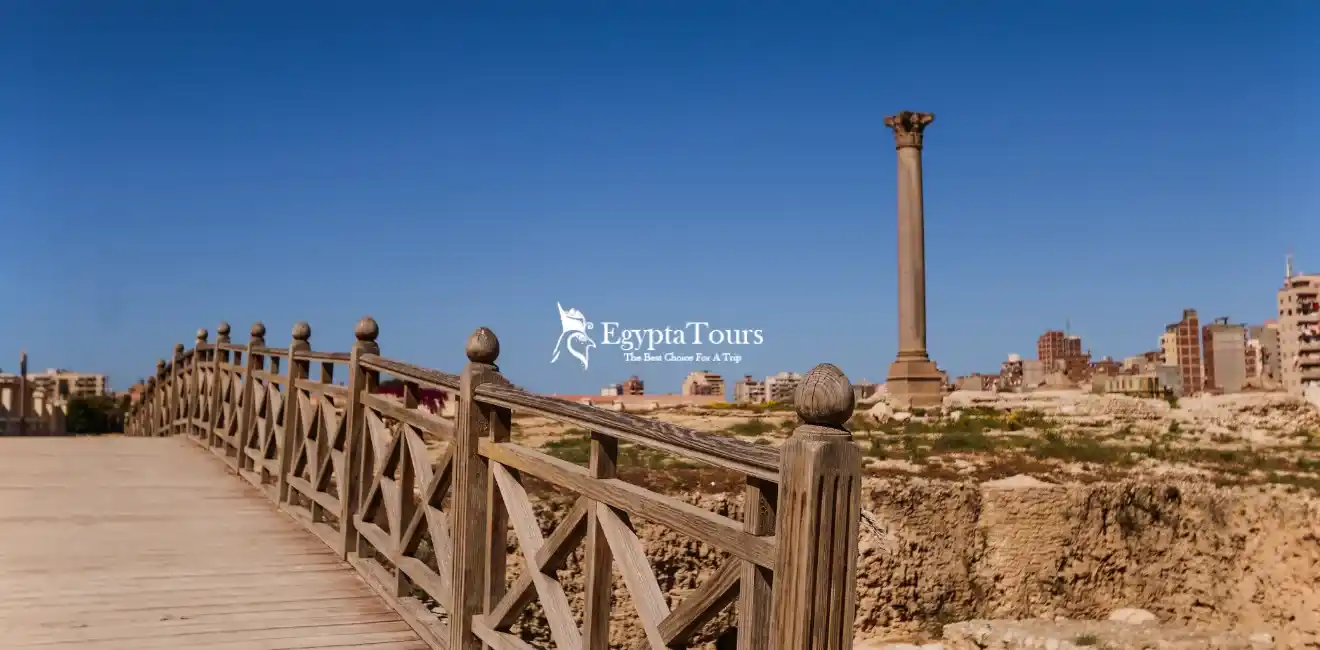
Ascending-the-Pompey’s-Pillar-EgyptaTours
The Muslim traveler Ibn Battuta visited Alexandria in 1326 AD and recorded a description of the pillar. In his account, he narrates the story of an archer who managed to climb the column by first shooting an arrow attached to a string over its top. Using this string, the archer was able to pull a rope across the pillar and fasten it on the opposite side, which then allowed him to ascend to the summit of the column.
In the early months of 1803, the British naval officer Commander John Shortland of HMS Pandour succeeded in sending a kite over the Column of the Sariyed, also known as Pompey’s Pillar. This method allowed ropes to be drawn across the monument, after which a rope ladder was secured.
On February 2, Shortland, accompanied by John White, the Master of the Pandour, climbed to the top of the pillar. Upon reaching the summit, they raised the Union Jack, proposed a toast in honor of King George III and gave three cheers. Four days later, they repeated the ascent, during which they set up a staff, installed a weather vane, ate a beef steak and once again drank a toast to the king.
One explanation for the origin of the nickname “Pompey,” used for the Royal Navy’s home port of Portsmouth and its football team, suggests that these sailors came to be known as “Pompey’s boys” after their successful climb of Pompey’s Pillar and that the name later became widespread. However, other unrelated explanations for the nickname have also been proposed.

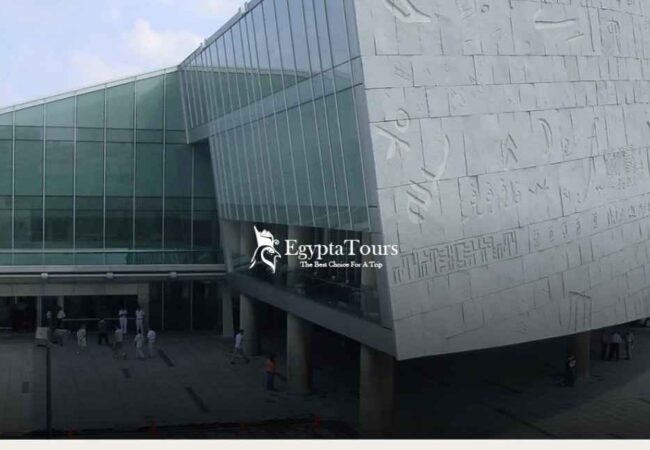
Bibliotheca-of-Alexandria-EgyptaTours
Serapeum of Alexandria
Catacombs of Kom El Shoqafa
Bibliotheca Alexandrina
Anfushi Tombs
Roman Theatre of Kom El Dikka
| Tour Name | Duration | View Tour |
|---|---|---|
| 1 Day Alexandria City Tour | 1 Day | View Tour |
| 2 Days Cairo & Alexandria Tour | 2 Days | View Tour |
| 3 Days Alexandria Short Break | 3 Days | View Tour |
| 4 Days Cairo and Alexandria Tour Package | 4 Days | View Tour |
| 5 Days Alexandria, Cairo & Giza Tour | 5 Days | View Tour |
| 6 Days Cairo, Alexandria & Nile Experience | 6 Days | View Tour |
| 7 Days Cairo, Alexandria & Upper Egypt Tour | 7 Days | View Tour |
When booking a tour, make sure you do your research and choose one that fits your needs. Some tours include a guided walk around the column and its grounds, while others might involve visiting other nearby attractions like the Catacombs or the Royal Quarters.
It’s also worth noting that many tour companies offer different packages for different groups of people – from short day trips to multi-day excursions – so make sure to shop around until you find something that suits your interests.
No matter what kind of tour you decide to book, you can be sure that exploring Pompey’s Pillar will be an unforgettable experience!
Traveling to Alexandria for the first time? Pompey’s Pillar is a must-see! Here are a few tips to get the most out of your visit:
Following these tips will ensure that you make the most of your visit to this amazing historical site!
Pompey’s Pillar is a Roman triumphal column located in Alexandria, Egypt. Standing at about 88 feet tall, it was erected in 297 AD in honor of the Emperor Diocletian.
Despite the name, the pillar has no direct connection to Pompey the Great. The name possibly arose from the confusion due to a misinterpretation of inscriptions found on the column.
It stands in the Serapeum of Alexandria, an ancient temple complex dedicated to the Greco-Egyptian god Serapis.
No, climbing the pillar is not allowed. Visitors can explore the surrounding archaeological site and view the pillar up close, though.
The column is made from red Aswan granite. It was transported and erected through impressive ancient engineering techniques, though the exact methods remain a topic of historical investigation.
Visitors can explore the ruins of the Serapeum, including underground galleries and other artefacts from the Roman period.
Yes, there is a small entrance fee to access the site. Fees may vary for locals and international tourists.
The pillar is accessible by taxi or local transport from central Alexandria. It’s advisable to check local travel guides for the most convenient routes.
The cooler months from November to March offer a more comfortable climate for visiting this outdoor site.
Yes, guided tours are available. They can provide in-depth historical insights and answer specific questions about the site. It’s recommended to book tours in advance.
The site has uneven terrain, which might be challenging for wheelchair users. Visitors with accessibility needs should inquire in advance and plan accordingly.
Comfortable footwear, sun protection, and water are advisable due to the outdoor setting and potential heat. A camera is also recommended for capturing the historical sights.



Explore our top-rated Egypt travel packages and embark on an unforgettable journey. From the Pyramids of Cairo to the magical temples of Luxor, Aswan, and Abu Simbel, discover expertly curated tours designed for your perfect Egyptian adventure