





The Creation of Egyptian Mythology
The ancient Egyptians explained a lot about the origin of the world and life through ancient Egyptian myths, which were linked to the gods representing natural forces. These myths helped in understanding natural phenomena and explaining what happened in the lives of the ancient Egyptians, such as the occurrence of floods and seasonal changes. In this article, we will talk about The Creation of Egyptian Mythology.
Cosmic phenomena and the natural environment played a major role in shaping ancient Egyptian myths, as the ancient Egyptians faced many challenges in the past, and these challenges were addressed through myths. We will learn about that in the following:
- Religious interpretation of the appearance of nature: The ancient Egyptians believed that the occurrence of anything was due to one of the divine causes, and these myths were linked to the gods.
- The need to explain existence and creation: This raised the curiosity of the Egyptians, as they wanted to know the reason behind the existence of creation, and myths were found that told stories about that, such as the myth of Heliopolis.
- Major characters and events: The gods were depicted in the form of human or animal characters, due to the religious practices of the Egyptians, for example, the god Ra and Osiris.
- Evolution over time: The myths were mixed with other cultures, including ancient African cultures, which led to the evolution of myths over time.
- The role of myths in daily life: Myths became part of the daily life of the Egyptians, with festivals, rituals, and temples associated with them.
The First Creation Gods in the Egyptian religion

The-First-Creation-Gods-in-the-Egyptian-religion-The-Creation-of-Egyptian-Mythology-EgyptaTours
The Creation of Egyptian Mythology was linked to the gods that the ancient Egyptians believed were the creators of the universe.
Among the most prominent of these gods are the following:
- Ra: He is the sun god, and the Egyptians believed that he created himself from the primordial waters, and then he created the rest of the universe.
- Amun: He was one of the ancient gods, and they believed in some myths that he was the one who created the universe, especially in Thebes.
- Ptah: He was one of the gods in Memphis, and it was believed that he was the one who created the world through his words and thought.
- Khnum: It was believed that he was the one who created humans and also destiny, and that he was the creator in the Aswan region.
- Isis: The Egyptians believed that she had great creative power and that she could bring the dead back to life.
The role of Atum in the beginning of the universe
The Creation of Egyptian Mythology includes the god Atum, who is the first god who created the universe according to their beliefs in ancient times. Chaotic waters existed before the appearance of order, and at that time, Atum believed that he created himself from these waters.
After that, he created the rest of the universe. He began by creating Shu, who is the god of air, and Tefnut, the goddess of moisture, as they believed. The creation of the universe continued from Shu and also Tefnut until the universe was complete. Through the myths, both Ra and Atum were merged to become the god of creation and the sun. All of this was according to their beliefs.
The creation of Shu and Tefnut according to the Egyptian myth
According to The Creation of Egyptian Mythology, we can say that after Atum created himself, it was believed that he created Shu and Tefnut through word and thought. It was also believed that the universe was completed through them, as the earth and the sky were separated from each other, and thus the universe became ready for growth, according to what they believed.
The myth of Geb and Nut and the beginning of life on earth

The-Creation-of-Egyptian-Mythology-The-myth-of-Geb-and-Nut-EgyptaTours
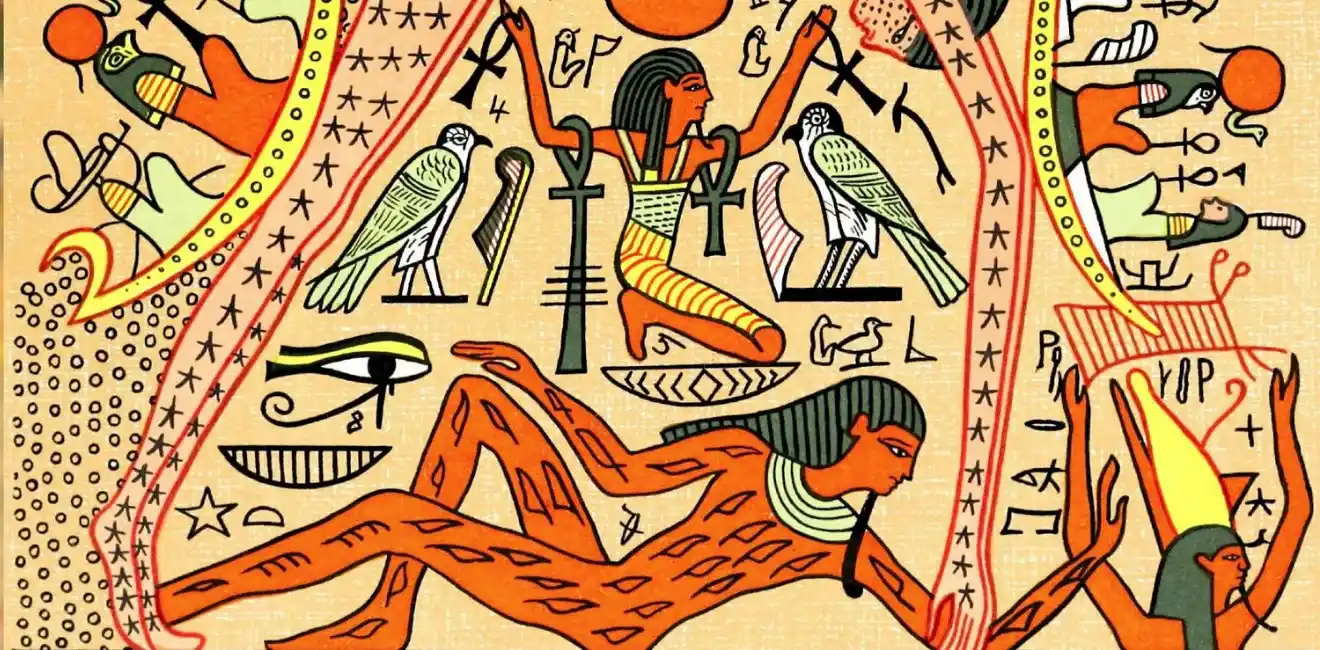
Geb and Nut form a large part of the beginning of life on earth, as it was believed that the former represents the earth with all its contents of plants and animals. In some other myths, it was believed that he was a person with a power that helps him create life, so he was called the god of life.
As for the latter, Nut, she was called the goddess of the sky, and she was often depicted in the form of an extended woman with her whole body covered by the blue sky. For this reason, they considered her the mother of the universe because she covered the earth and protected everyone, and she was also a symbol of the sky.
It was said that Geb and Nut separated from each other after they were united. After that, Nut was raised to be the sky, while Geb remained on the earth. Thus, the necessary distance was found for the completion of the universe and the creation of life, and life appeared on earth. All of this was according to their beliefs in ancient times.
The relationship between the gods and the order of the universe
It became clear through The Creation of Egyptian Mythology that the gods possessed a power that made them able to control the different aspects of the universe. An example of this is Ma’at, who they believed was the representative of order and justice. The god Ra was the sun god, and he was the god who controlled the movement of the sun through the sky, as they believed.
As for Osiris, he was the god of life and death, who controlled the achievement of justice in the other life. Also, Isis and Hathor were the ones capable of protecting life and prosperity. As for Set, he was the god of chaos who could threaten this balance. It is clear from this that each god had the ability to control one of the natural aspects.
The concept of chaos and order in the thought of the ancient Egyptians
In ancient times, order and chaos were the basic forces for understanding the universe. An example of this is Ma’at, who represented order and justice, and that the god Ra was the one who protected her from the chaotic forces. In contrast, chaos was represented in Nun.
As for Set, he was the god who threatened the achievement of balance. Preserving Ma’at was one of the religious and social duties to achieve and ensure the continuity of life in this universe.
The emergence of religious beliefs in the first temples

The-emergence-of-religious-beliefs-in-the-first-temples-EgyptaTours
Religious and social thought developed, which led to the emergence of religious beliefs. The temples were the centers of worship for the gods, and each region had a special temple for the local god.
These temples are represented in the temple of Amun in Thebes and also the temple of Ra in Heliopolis. In this context, the ancient Egyptian myths arose, which were considered an essential part of religious thought, such as the myth of Ra, who created himself from the chaotic waters, and also Osiris, who brought back life after death, as they believed.
With time, these beliefs were developed, which turned into the belief in one god, for example, the merging of the sun god and the air god, Amun-Ra. The temples also became sacred places, and they believed that the gods lived in them.
The role of priests in transmitting and preserving the myths
The priests had a role in The Creation of Egyptian Mythology, as they transmitted and preserved them. These myths were initially an integral part of the oral rituals that the priests later transmitted. This is represented in the creation myth that told how the universe was created by Atum, as well as the myth of Osiris that told of life after death, as they believed.
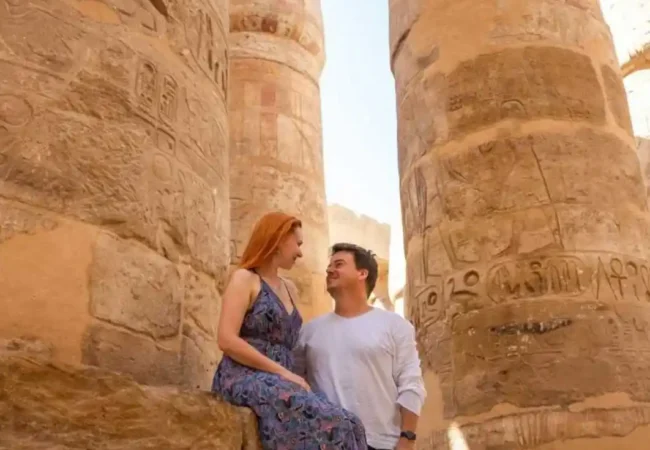
All these myths were explained in the temples, in addition to being recorded on the walls through hieroglyphic symbols, thus ensuring their continuity and preservation through the generations. The priests also performed daily worship and rituals through which these myths were recited, and thus they became part of the cultural and religious heritage.
How myths influenced the building of the religious identity of ancient Egypt

How-myths-influenced-the-building-of-the-religious-Temples-EgyptaTours
The myths were the framework through which the relationship between man and the gods could be interpreted. The ancient Egyptian myths arose due to the interaction of the Egyptians with legal and natural phenomena. These myths carried in their content spiritual and moral messages that helped to organize daily life and to know the relationship between the god and humans. Among these myths are the myth of Ra and Osiris.
Thus, it is clear that the role of myths was not limited to explaining natural phenomena only, but it also helped the religious identity in building a collective perception of it. The pharaohs also adopted these myths as part of their authority. The collective faith was also strengthened, as the temples formed the main religious and cultural centers for studying and preserving the myths.
The evolution of myths between the Pharaonic eras
After The Creation of Egyptian Mythology, they evolved through the various Pharaonic eras and retained the role for which they were created, which is to explain the universe and natural phenomena. They were also affected by political and cultural changes. In their beginning, their whole focus was on the god Atum, who created himself from the chaotic waters in ancient times. Then, these myths evolved to deal with Osiris and the idea of life after death associated with him.
As for later eras, the god Amun-Ra appeared as a result of the merging of Ra with Amun. The myths began to take on a royal character, as the ancient Egyptians believed that the pharaoh was the living god on earth. Thus, it can be said that the evolution of myths was a reflection of the evolution of what the Egyptians believed and imagined about the cosmic nature and the gods over time. It is truly a mirror of ancient Egyptian society.
Conclusion
The Creation of Egyptian Mythology helped the Egyptians to understand the cosmic and natural phenomena and the relationship between the god and humans. They were preserved and developed by the priests and the rituals that were practiced in the temples. With the evolution of the Pharaonic eras, they were developed in a way that reflects the beliefs and perceptions of the ancient Egyptians.
FAQs
How was Egyptian mythology created?
Ancient Egyptian myths evolved to understand the nature of the universe, and they also linked various phenomena and gods.
Who is the creator of Egyptian mythology?
The myths were developed by the priests, and their creation cannot be attributed to only one person, but was passed down through the Egyptian generations through the inscriptions that were told on the temples and also the temples that told the stories of the myths.
What is the origin of the Egyptian gods?
The gods were an embodiment of natural forces, where the god Ra was the sun, Hathor was love, and some of them had turned into a god after death, according to their belief.
When did Egypt mythology start?
These myths began in the pre-dynastic era, and one of the ancient texts is the texts that appeared in 2400 BC, which are the Pyramid Texts.
About EgyptaTours

EgyptaTours is a name synonymous with trust, excellence, and unforgettable travel experiences, proudly standing as one of the leading travel agencies in Egypt. Renowned for its deep expertise, personalized service, and carefully crafted itineraries, EgyptaTours serves as the ultimate gateway to discovering Egypt in its most authentic and inspiring form.