Discover The False Doors In Ancient Egypt
Discover The False Doors In Ancient Egypt False doors held significant religious...



The goddess Sekhmet is a famous deity in ancient Egyptian religious beliefs.
She appears in many inscriptions and statues as a woman with the head of a lioness a form associated with strength and control.
Sekhmet was also associated with the ancient city of Memphis and was part of the city’s sacred trinity alongside the god Ptah and the young god Nefertem.
Sekhmet bore many titles reflecting her status and power such as “Eye of Ra,” sent to exact revenge on her enemies, “Lady of War,” and “The Mighty One.”
She was also called “Lady of the Two Lands,” a reference to her symbolic sovereignty over Upper and Lower Egypt.
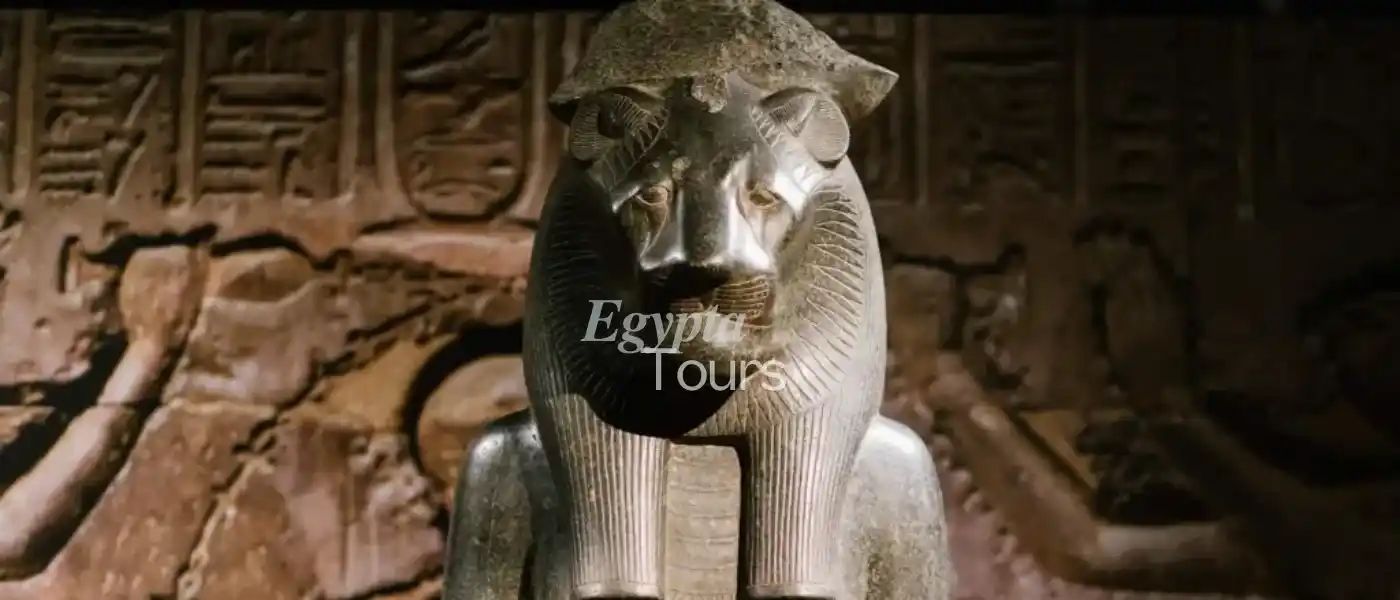
The-Story-of-the-Goddess-Sekhmet-EgyptaTours
The worship of the goddess Sekhmet was centered in the city of Memphis where the priests considered her the consort of the god Ptah and the mother of the god Nefertem the god of flowers fragrance, and healing.
Together they formed a deity known as the Memphis Triad.
Sekhmet was viewed as the angry force within this triad summoned only in moments of chaos and vengeance.
Sekhmet is associated with a famous myth about Ra the sun god becoming angry with humans when they dared to insult him. He decided to punish them irrevocably.
He summoned Sekhmet who was none other than the brutal and vengeful side of the goddess Hathor, and unleashed her upon the earth to purify it of treason.
Sekhmet emerged like a storm killing without mercy until the earth turned into a river of blood.
The problem however was that she continued killing until she nearly wiped out humanity finding pleasure in shedding blood.
Here Ra resorted to a trick he ordered huge quantities of beer to be poured dyed red to resemble blood, and left on its way.
When Sekhmet saw it she thought it was fresh blood.
She drank until she became drunk, and her anger gradually subsided. She stopped killing and returned to her former self leaving behind a story that would be told for thousands of years.
Within the Great Karnak Temple in Luxor lurks a terrifying and sacred legend, its heroine being the goddess Sekhmet whom the ancient Egyptians always associated with violent power and mysterious healing.
Sekhmet was not merely a symbol of war and destruction, but the angry eye of the god Ra.
She was embodied in the body of a woman with the head of a ferocious lioness a terrifying female lioness who carried both disease and cure in her breath. Other rumors about her spread including the following:
Over time the story of Sekhmet transformed into a source of popular terror.
The people of Luxor called her “Mother Ghoul,” a name that became associated in popular memory with fear and night terrors especially after a mysterious incident at the beginning of the twentieth century.
In 1907, while children were playing near one of the temple walls during excavation work the wall collapsed on their heads.
This coincided with the discovery of a group of Sekhmet statues fueling the myth that the “ghoul” had emerged to devour the young.
The lioness head which distinguishes Sekhmet’s statues with its stern features and piercing gaze, heightened the awe of the scene causing workers to stop work convinced that this furious force did not wish its sanctuary to be touched.
Because illness was part of her specialty King Amenhotep III when he was exhausted by illness resorted to making statues of her to draw near and beg for a cure.
He created more than 700 statues creating two daily—one at sunrise and another at sunset—as if seeking her favor between day and night.
Thus the legend of “Our Mother Ghoul” was born from a blend of sacred belief and tragic events.
Sekhmet became in the collective consciousness, a supernatural being half healer, half predator, appearing at night in the imaginations of children and remaining immortal in the Karnak Temple.
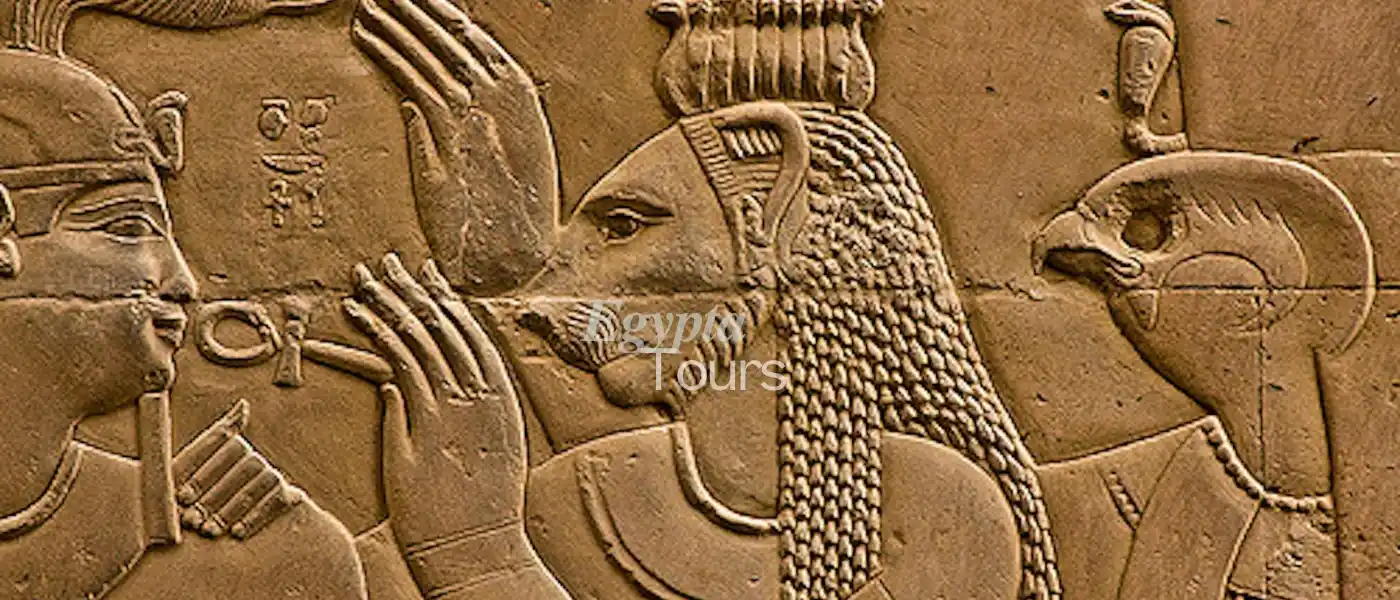
The-Myth-of-the-End-of-the-Statue-of-the-Goddess-Sekhmet-EgyptaTours
The French researcher Georges Legrand set out to debunk one of the oldest myths of Karnak.
He convinced the workers that the curse of the goddess Sekhmet had ended forever.
He stood in the temple and announced to the crowds that he had recited a secret hieroglyphic incantation capable of quelling the wrath of the lioness goddess who had terrorized the living and made the temple a place where souls trembled before feet.
No one dared question this for the unknown words possessed their own majesty.
From that day on the story spread among the people: “Our mother, the ghoul was defeated, and Karnak is now safe.” Thus, the myth faded, or at least receded, and talk of it ceased.
But Sekhmet as seen by the people of Luxor was not only the mistress of wars and plagues she was also a refuge for women deprived of motherhood. Women flocked to her statue praying and circling it in search of offspring.
One man from the city afflicted with infertility despite having four wives took out his anger and resentment on the statue and destroyed it after all his hopes for it had been dashed.
Despite all these tales the statue of Sekhmet continued to arouse curiosity and awe until it returned to the forefront of the scene once again during a grand celebration organized by the Ismailia Antiquities Museum attended by hundreds of visitors and tourists.
Although King Amenhotep III was not one of those kings who entered the battlefield or expanded their empires with the sword he was captive to an eternal belief in the absolute power of the goddess Sekhmet.
He believed that her presence even if symbolic, carried a supernatural and unquenchable energy.
For this reason he erected more than 700 statues of her inside his mortuary temple in Western Thebes making her a silent guardian of the world of the living and the dead.
Her statues made of black granite stood like sacred battalions guarding the temple.
Across continents Sekhmet’s relics continue to tell her story.
A rare granite statue now in the National Museum in Copenhagen dates back to between 1402 and 1365 BC.
In Berlin, the Atlas Museum houses a rare image of the ritual necklace of Menat depicting a solemn ceremony before Sekhmet seated on her throne surrounded by the goddesses Wadjet and Nekhbet as if guarding her heavenly gate.
In the Temple of Kom Ombo, her image bears the sun disk and a cobra crown, a mixture of light and poison.
In the Egyptian Museum in Tahrir she appears again next to the golden coffin of Tutankhamun as if she accompanied him into eternity.
This is perhaps the most astonishing discovery ever made by the French researcher Georges Legrain.
The goddess Sekhmet appears in female form With the head of a lioness surmounted by the radiant sun disk and surrounded by a cobra she is adorned with a luxurious wig.
Her clothing is typically draped in a red sheer robe naturally reflecting her courageous warlike character.
This earned her the nickname “Lady of the Red Lines.”
This distinctive color may symbolize her close association with Lower Egypt or perhaps highlight her combative side as a merciless warrior goddess.
Although Memphis was her most important center of worship as she was part of the sacred trinity that included the gods Ptah and Nefertem Sekhmet’s worship was not limited to this location.
Temples were built for her in many locations, including a special shrine in Abusir.
Her inscriptions are found even in temples dating back to the Greek and Roman eras.
She also had a special temple representing her composite image Sekhmet-Hathor, in Kom el-Hisn in the western Delta, and through numerous spells and ancient texts.
The lion-headed goddess Sekhmet stands as one of the most powerful divine goddesses in the Egyptian pantheon.
Often depicted in Egyptian art as a statue of the head of a lioness, she embodies fierce strength as the goddess of war and protector of physicians and healers.
Closely linked to the sun god Ra, Sekhmet was believed to unleash plagues and cure them, a dual nature that made her both feared and revered.
Amulets depict her fearsome image to invoke protection, while myths tell how she played music to calm her rage—a story that reveals the complex balance she held among divine goddesses in ancient belief.
Sekhmet is an ancient Egyptian goddess depicted as a woman with the head of a lioness demonstrating her ferocious nature and immense power.
She was considered the wife of the god Ptah the god of craftsmen and artisans, and the mother of the god Nefertem the god of lotuses and perfumes. Together, they formed the sacred triad of Memphis, and her main cult center was the city of Memphis.
The name “Sekhmet” is derived from the ancient Egyptian word “sḫm,” meaning “power” or “might.”
Her name thus translates as “powerful” or “mighty,” reflecting her nature as a goddess possessing immense power and the ability to both destroy and heal.
Sekhmet is often depicted as a woman with the head of a lioness, symbolizing her ferocity and strength.
She sits on a throne decorated with the symbol of the unification of the north and south of Egypt holding the anchor, the key of life, symbolizing eternal life.
Above her head is the sun disk surrounded by a cobra (the oraius) symbolizing protection and royalty.
In conclusion, we would like to inform you that the goddess Sekhmet is a powerful symbol of power and destruction.
She was closely associated with several goddesses such as Hathor Mut, and Bastet, sharing the lioness form with them.
She protected kings on the battlefield and bore military titles that demonstrated her brutal strength.
The Egyptians believed that her breathing of fire in the face of her enemies was what gave her this terrifying power.
Indeed the scorching desert winds were considered the “breath of Sekhmet.”
The goddess was also associated with death and plague with the plague being known as the “messenger of Sekhmet.”


Explore our top-rated Egypt travel packages and embark on an unforgettable journey. From the Pyramids of Cairo to the magical temples of Luxor, Aswan, and Abu Simbel, discover expertly curated tours designed for your perfect Egyptian adventure