Makeup Ancient Egypt: Beauty Secrets of the Pharaohs
Women were famous in the era of the ancient Egyptians for ancient...



A scientific team initially believed the mummy contained a fetus inside the womb, making it one of the most controversial mummy discoveries in recent years.
The mummy of the Mysterious Lady is one of the most exciting discoveries in Egyptology and has sparked scientific controversy in recent years due to conflicting information about her health and identity.
This mummy was discovered in the 19th century and was kept in the National Museum in Warsaw Poland.
Initially, it was believed to be that of an ancient Egyptian priest, but later CT scans revealed that it was actually that of a woman.
Let’s learn more about it together.

The-Truth-About-the-Mummy-of-the-Mysterious-Lady-EgyptaTours
In the ancient city of Luxor a mummy was found that astonished scientists for decades. Everyone thought it belonged to an Egyptian priest, but the surprises didn’t begin until 1826.
The mummy was shipped to Poland and displayed in the Warsaw National Museum where it remained for more than two centuries mistakenly classified as belonging to a clergyman. However time revealed the truth.
In 2021, a Polish scientific team led an advanced CT scan analysis project and found themselves faced with a scientific shock the mummy belonged to a young woman, not a man as had been believed for many years.
The surprise didn’t stop there. A mysterious mass was detected in the pelvic area prompting the team to announce that she may have been carrying a fetus in her womb at the time of her death a discovery unprecedented in the world of mummies.
The team indicated that the fetus may have been in the late sixth or seventh month, and that the acidity of the uterus led to the decomposition of its skeleton over the centuries. Some analyses even linked her condition to the possibility of a rare cancer of the nasopharynx.
However science doesn’t stop at first impressions. In a new study conducted with the participation of 14 international researchers, more than 1,300 accurate x-rays of the mummy of the mysterious lady were re-examined.
The results corrected previous assumptions. It turned out that the mass previously described as a fetus was merely material used during the mummification process and appeared in an inaccurate location within the abdominal cavity.
No clear biological indicators of cancerous tumors in the skull or neck were found thus dismissing the malignant disease hypothesis.
The new study rewrites the narrative surrounding this woman, confirming that our understanding of history can be completely transformed when we examine it closely.
Questions have been raised within academic circles about the plausibility of the complete disappearance of fetal bones inside a mummified womb thousands of years later especially given the meticulous mummification processes that took place on the mummy of the mysterious lady.
A recent study has settled this controversy definitively denying the validity of this theory and confirming that the strange mass in the abdominal area is merely the remains of conventional mummification materials.
Dr. Sahar Saleem a radiologist and mummy expert stated in 2022 that the Warsaw team had not found any actual anatomical evidence confirming the presence of a fetus which further casts doubt on the previous conclusion.
The new research team chose a precise scientific analysis asserting that while acidity has a dissolving effect in some circumstances the chemicals used during mummification were sufficient to completely negate this effect.
Based on a detailed re-examination it was found that what some thought were fetal remains were nothing more than four separate bundles of mummification materials deliberately placed inside the abdomen in accordance with ancient Egyptian organ preservation practices.
The sole purpose of these materials was to maintain the internal balance of the mummified body as part of the religious rituals embedded in royal burial concepts.
News spread in 2021 indicating that the mysterious mummy was suffering from a rare form of nasopharyngeal cancer based on some strange abnormalities in the shape of the skull.
Despite the scientific appeal of this claim the new research treated it with extreme caution revealing that the observed deformities were not due to a tumor, but rather a direct result of the brain removal process during mummification.
The ancients also carefully pierced the skull to remove soft tissue from within the head which explains the cavities or bony erosions that some have mistaken for disease.
None of the 14 international experts involved in the recent analysis found any cellular signs or tumor remnants to support the hypothesis of cancer. Consequently the research team agreed that both the claims of pregnancy and cancer were merely misinterpretations of the imaging data.
The body of the mysterious lady’s mummy was mummified in an unusual way transforming her internal body environment into a pool of intense chemical acidity.
Researchers suggest that the mummification here was not just ordinary drying, but rather a biological pickling process similar to that used to preserve bodies deep in ancient peat bogs.
As archaeologist Marzena Owarek-Zelke who participated in the Warsaw Mummy Project described, the body was covered with natural soda to draw out moisture, but the uterus remained relatively isolated allowing a different internal reaction to occur.
The fetus remained inside the uterus without external interference exposed to increasing acidity due to internal decomposition, and its tissues began to gradually disintegrate resembling a “soft chemical pickling,” as the scientists describe it.
Researcher Wojciech Eismon explained that the closest analogy to this phenomenon is placing an egg inside an acidic shell the outer shell being completely dissolved while the albumen and yolk, i.e., the soft tissues remain.
In such an acidic environment something similar to the dissolution of minerals from the bones occurs while the soft tissues remain saturated with acids and trapped within a completely sealed environment.
The scientists’ analyses revealed that the pH inside the womb dropped sharply after death accompanied by an increase in the concentration of ammonia and formic acid.
These reactions strongly affected the structure of the bones and led to their complete decomposition.
Covering the body with natron an alkaline compound used by the Egyptians to dry out the dead significantly limited the entry of oxygen creating a tightly sealed ventilation-free environment that helped preserve the remains The tissues were removed in an unconventional manner.
What happened was not merely ritual mummification, but rather a complex biological process resulting from unbalanced conditions between the interior and exterior resulting in a “chemically sealed chamber” within the deceased’s womb.
This internal environment demonstrated a phenomenon previously observed in European bog mummies, where excessive acidity preserved the skin and muscles while completely eroding the bones.
Scientists have likened what happened inside the womb of the “mysterious lady” to a precise scientific experiment demonstrating the precision of biochemical reactions emphasizing that this phenomenon is rare and has never before been recorded in this form in Egyptian mummies.
The strange contrast between the condition of the mysterious lady’s mummy and her fetus lies in the different mummification conditions they underwent, which were as follows:
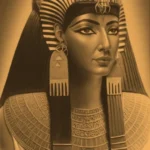
The face of the Mysterious Lady’s mummy was reconstructed using advanced imaging techniques such as CT scans and X-rays. Scientists reconstructed her external appearance with amazing accuracy.
The results yielded two visual representations of the face both depicting a young, dark-skinned woman with brown eyes staring straight ahead with a still gaze.
Analysis indicates that the woman died between the ages of 20 and 30, in the seventh month of pregnancy specifically in the 28th week.
She was mummified under strange circumstances, unlike other mummies.
She died between 25 and 30 years old.
The royal mummies were moved from the Egyptian Museum in a grand procession to showcase the greatness of Egyptian civilization and to re-display them in the Museum of Civilization in a manner befitting their historical and symbolic status.
At the end of the story of the mysterious mummy we see the splendor of ancient Egyptian civilization with all its secrets and complexities.
This reveals the importance of modern science in rereading history from more precise perspectives.
This mummy which has puzzled researchers for years bears witness to complex burial traditions spiritual beliefs, and human attempts to understand death and immortality. Scientists have done their utmost to uncover the truth.




Explore our top-rated Egypt travel packages and embark on an unforgettable journey. From the Pyramids of Cairo to the magical temples of Luxor, Aswan, and Abu Simbel, discover expertly curated tours designed for your perfect Egyptian adventure