Discover the Power of Bastet God: Egypt’s Beloved Cat Goddess
Bastet is considered one of the most important deities in ancient Egyptian...



While the great state gods like Ra and Osiris held power over the cosmos, Bes was the god of the everyday. Represented as a fierce, dwarfish figure with a lion’s mane and a mischievous, forward-facing grin, he was the ancient world’s ultimate protector of the home.
Unlike other deities who were distant and regal, Bes lived among the people, guarding nurseries, watching over childbirth, and warding off evil spirits with his humor and strength. From simple amulets worn by children to massive stone carvings in the Temple of Dendera, Bes remained a beloved symbol of joy, music, and family safety for over two millennia.
Key Takeaways
The “Forward-Facing” Guardian: Unlike most Egyptian gods depicted in profile, Bes was almost always shown facing forward. This unique iconography was designed to meet the “evil eye” head-on and scare away malevolent spirits.
A Protector of the Vulnerable: Bes was the primary guardian of women, children, and newborns. He was often paired with the goddess Taweret to form a powerhouse duo of domestic protection.
The God of Joy and Music: Beyond protection, Bes was a deity of celebration. He was intimately linked to music, dance, and laughter, believed to bring happiness to children and comfort to families in times of hardship.
An International Traveler: His appeal was so strong that his influence transcended Egypt, spreading across the Levant, Cyprus, and even into the Persian Empire, where artists adapted his image to fit their own cultural styles.
Everyday Faith: Evidence of Bes’s worship isn’t found in massive, exclusive temples, but in the intimate details of daily life—on cosmetic mirrors, feeding bottles, furniture, and even in personal tattoos worn by musicians.
God Bes was a lesser known god in ancient Egypt, usually shown as a dwarf with a large head, wide eyes, a sticking out tongue, bowed legs and a feathered crown. The name Bes is often used for a group of similar protective deities that shared the same appearance. His unusual and humorous look was meant to bring happiness, comfort people during difficult times and scare away evil spirits.
Unlike most Egyptian gods who were usually shown from the side, Bes was often depicted facing forward. This made him stand out and reflected his special role as a guardian. His image appeared on everyday items such as mirrors, cosmetic containers and household objects. Bes was closely connected with music, childbirth and family life and his image was commonly placed in homes and birth rooms to offer protection and good fortune.
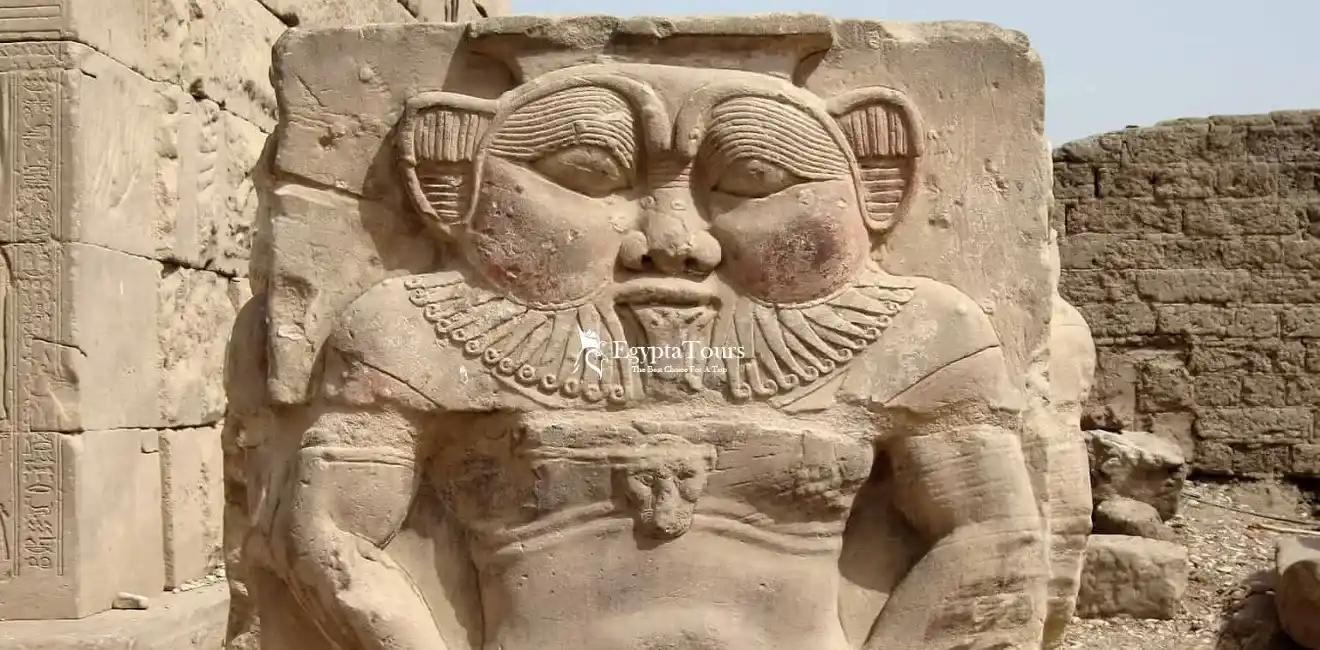
Origin-Of-The-Egyptian-God-Bes-EgyptaTours
Many historians believe that Bes may have originally come from Nubia or regions south of Egypt. Evidence suggests that people in Upper Egypt worshipped Bes before his cult became popular in Lower Egypt.
Some researchers point out that the word Bes may be related to a Nubian word meaning cat which fits the feline features often seen in his images. His appearance, including his feathered crown, also shares similarities with traditions from ancient Kush.
Other theories suggest that his name may have come from ancient Egyptian words connected to fire or initiation rituals. While his exact origins remain uncertain, Bes became an important part of Egyptian religion over time.
The earliest references to Bes appear in the Pyramid Texts but his popularity grew significantly during the Middle Kingdom. He continued to be worshipped for many centuries and evidence shows that his cult survived well into the Coptic period. One of the latest discoveries linked to Bes is a jug found at Tell Edfu, dating to around the 10th century CE, showing that people still remembered and honored him long after the age of the pharaohs had ended.
Bes was one of the most popular protective gods in ancient Egypt. People believed he watched over homes, protected children, helped women during childbirth and kept away snakes, evil spirits and other dangers. He was often connected with the goddess Taweret and together they were thought to guard mothers and newborn babies.
His appearance was very different from that of other Egyptian gods. While most deities were shown from the side, Bes was usually depicted facing forward. He often appeared with a fierce expression and was sometimes dressed like a warrior, showing that he was always ready to defend people from harm.
Ancient Egyptians placed statues and images of Bes in their homes to protect their families. Because he was believed to drive away evil, he also became associated with happiness, music, dancing and enjoyment of life. During the Middle Kingdom, his image appeared on many objects such as amulets, masks, baby bottles and protective charms. In the New Kingdom, some dancers and musicians even wore tattoos of Bes as a symbol of protection.
During the Ptolemaic Period, special rooms decorated with images of Bes and his female counterpart, Beset, were built at Saqqara. Historians believe these spaces may have been used for healing ceremonies or fertility related rituals.
The popularity of Bes spread beyond Egypt and reached other parts of the ancient world. His worship became known in places such as Crete, Phoenicia and Cyprus. Later, images of Bes were also found throughout the Persian Empire, including in the city of Susa and parts of Central Asia.
As his image traveled to different regions, artists adapted his appearance, sometimes showing him wearing Persian style clothing and headdresses.
Over the centuries, Bes remained a symbol of protection, joy and good fortune, making him one of the most beloved gods among ordinary people in ancient Egypt.
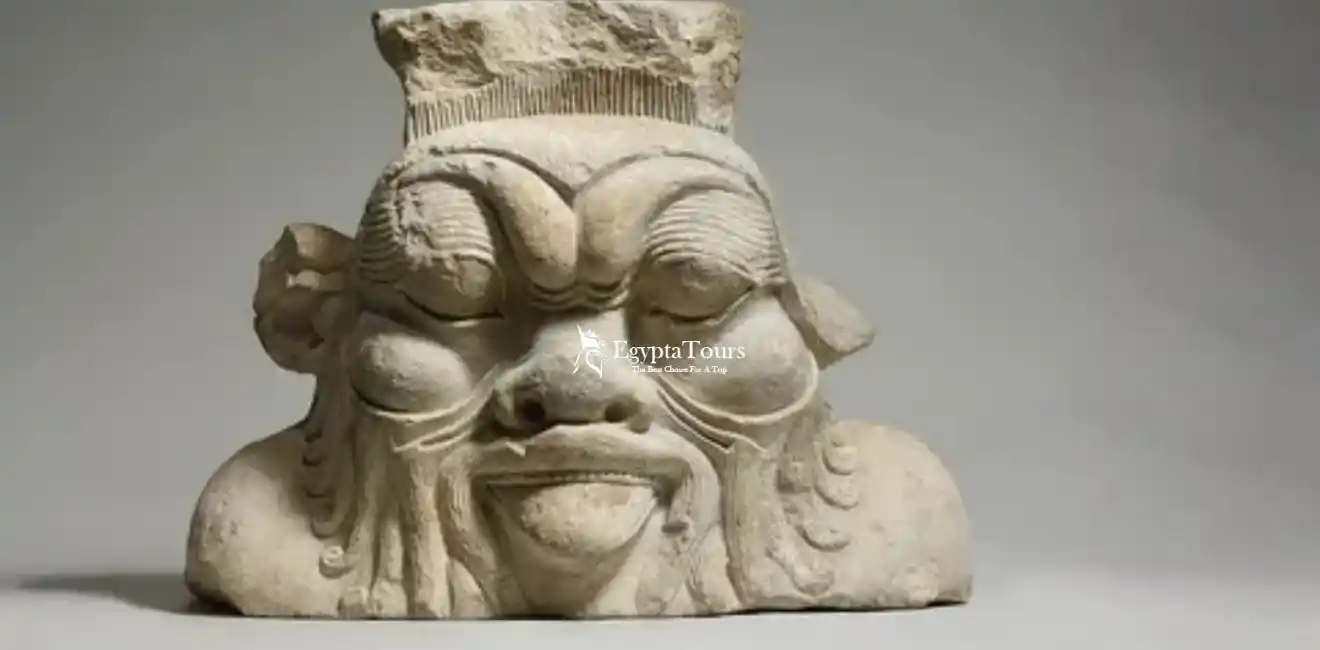
Symbols-And-Meaning-Of-Bes-In-Ancient-Egypt-EgyptaTours
Some modern researchers, including Egyptologist James Romano, believe that the earliest form of Bes may have been inspired by a lion standing on its back legs. This idea suggests that his image slowly changed over time into the figure that later became widely known in ancient Egyptian culture.
From the Middle Kingdom onward and especially after the Third Intermediate Period, Bes became a very common figure in daily life.
His image appeared on many household items such as furniture, personal care objects, children’s feeding bottles and even game pieces. This shows that he was not only a religious figure but also an important part of everyday protection and comfort for ancient Egyptian families.
Bes was sometimes shown in tattoos in ancient Egypt. Evidence from wall paintings in the workmen’s village of Deir el Medina, dating to the 19th Dynasty, shows a female musician with a tattoo of a dancing Bes on her thigh while she plays music.
This suggests that Bes was closely linked not only to protection but also to music, joy and daily life. His image was meaningful enough for people to carry it permanently on their bodies as a sign of protection and good fortune.
Images of the god Bes were often found on everyday pottery in ancient Egypt. Most commonly, he appeared on jugs, vases and storage containers. One interesting style shows human-like faces on jars which is similar to designs found in West Asian pottery. This suggests that the idea may have been influenced by cultures from the Syro Palestinian region.
Archaeologists have also discovered evidence supporting this cultural connection. For example, in tomb 1300 at the Mayana cemetery near Sedment, objects dating to the Second Intermediate Period included vases decorated with Bes alongside small jars believed to come from Palestine. This shows that there may have been trade and contact between Egypt and the Levant and that some Bes style objects may have been made outside Egypt.
Similar pottery has been found in other important sites. Painted jars from the late 18th Dynasty were discovered at Amarna and many more examples were found at Deir el Medina. In addition, small faience baby bottles decorated with Bes have been found at el Lisht, showing his strong connection to the protection of children.
In later periods, even ritual objects linked to Bes were used. Chemical analysis of a 2nd century BCE Bes vessel found traces of certain plants, suggesting it may have been used in religious or healing ceremonies.
Bes was represented through several important symbols that reflected his role as a protector and bringer of joy. His lion-like mane was a sign of strength and courage, showing his power to defend people from danger.
He was also linked to music and celebration so musical instruments were often connected with him, symbolizing happiness, dancing and festive life. In addition, knives or swords sometimes appeared in his images, representing his ability to scare away evil
spirits and protect families from harm.
Another important feature was his feathered headdress which was seen as a sign of divine power and his connection to the gods.
Many ancient Egyptians wore amulets of Bes not only for protection but also as a symbol of good luck. His image was also placed on everyday items like mirrors and jars of ointment. People believed he could protect them from the evil eye which was thought to bring illness, misfortune, or bad energy.
The ancient Egyptians believed that the world was full of dangers, both seen and unseen. They thought that evil forces and demons could appear in many different forms so people needed to live carefully, honestly and stay aware of their surroundings.
For them, gods like Bes were very important because they offered protection from both supernatural threats and real life dangers such as snakes and crocodiles. This belief gave people a strong sense of comfort and safety in their daily lives, knowing that protective forces were always watching over them.
Bes was especially known as a protector of women, children and childbirth. His image was often placed on walls, furniture and in rooms connected with birth or childcare such as nurseries and birthing areas. This shows how important he was in daily life, especially for ordinary Egyptian families.
He was one of the few Egyptian gods who was truly popular among common people. Many believed that Bes not only protected children but also made them happy. If a child suddenly smiled or laughed, people thought Bes was nearby making funny faces or playing with them.
Bes was also connected with music, dancing and joy. Through these playful actions, he was believed to both entertain children and scare away evil spirits at the same time. Because of this, he became known as a god of happiness, fun and protection.
During the Greek and later Ptolemaic period (332–30 BCE), the worship of Bes became even more widespread. Many amulets, charms and temple carvings from this time show how popular he was across Egypt. People even asked him questions through oracles written on papyrus.
Although Bes did not have large temples or a formal priesthood in most periods, he was still an important local god in places like Khemenu during the Middle Kingdom. Over time, statues and images of Bes appeared in many homes across Egypt.
In the end, Bes became one of the most loved gods in Egyptian culture. People turned to him in their daily lives for protection, comfort and good fortune.
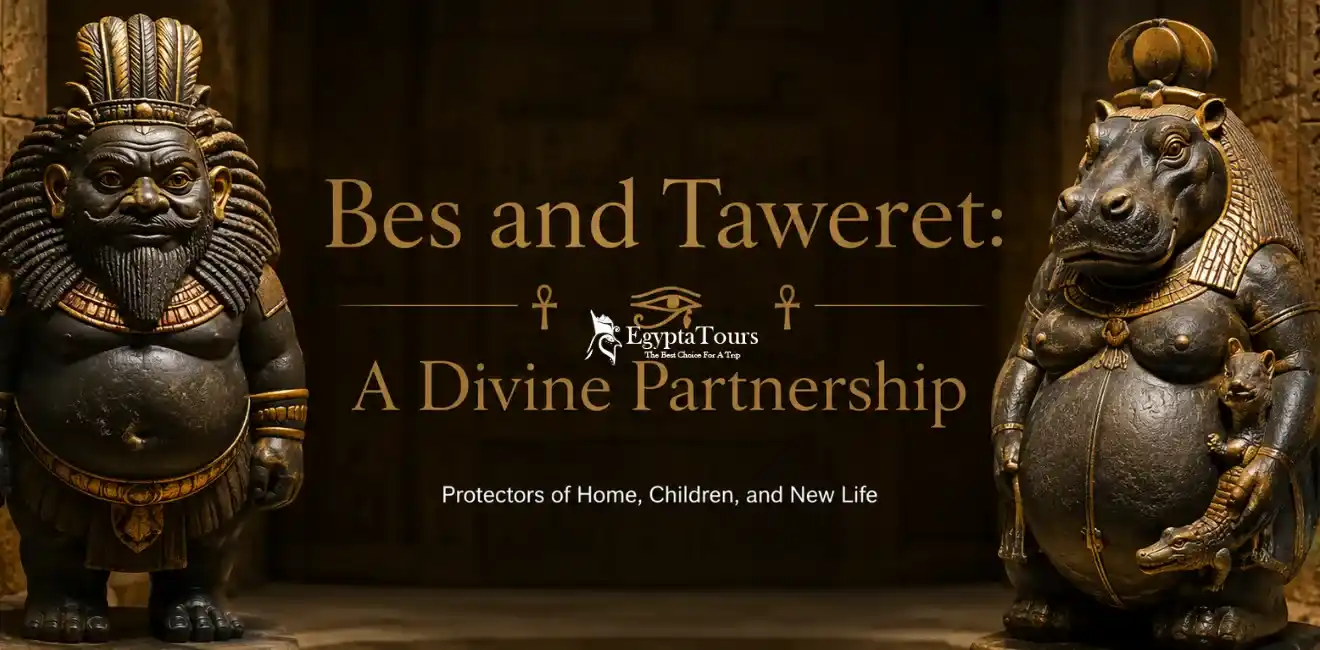
Bes-And-Taweret-A-Divine-Partnership-EgyptaTours
Bes was often shown together with the goddess Taweret, another important protector in ancient Egyptian belief. Taweret was usually depicted with the body of a hippopotamus and features of a lion and she was strongly connected with pregnancy and childbirth.
In Egyptian homes, these two deities were seen as a powerful protective pair. Taweret was believed to protect pregnant women and ensure safe childbirth while Bes helped chase away evil spirits that could harm mothers or babies.
Together, they represented a balance of care and protection. Taweret symbolized strength and motherhood while Bes brought courage, joy and a sense of comfort through laughter and music. Because of this, their images were commonly placed on household items, amulets and walls to protect families in daily life.
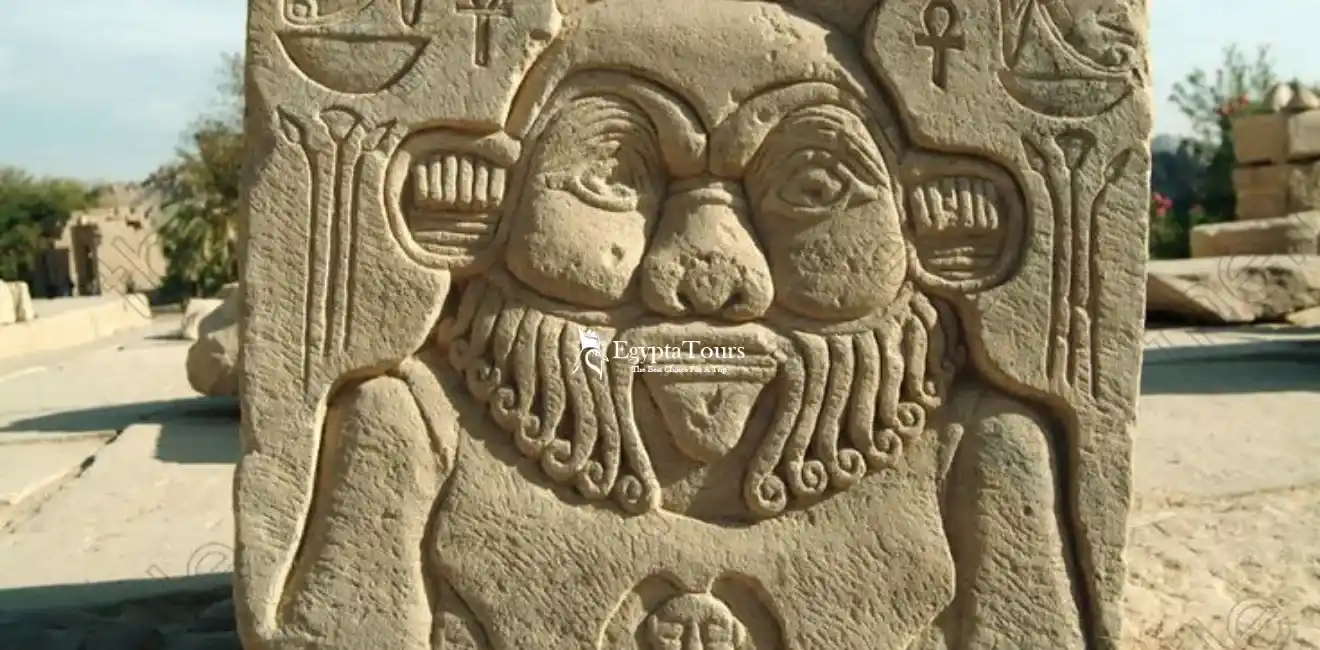
The-Temple-Of-Bes-In-Egypt-EgyptaTours
Bes did not usually have large temples built only for him like many other major gods. Instead, people honored him mainly in small household shrines and in certain temple areas shared with other deities. His statues and images were commonly placed in these spaces, showing how important he was in everyday protection and family life.
One well known place where Bes appears in temple decoration is the Temple of Hathor at Dendera. There, his image is shown alongside other protective gods, reflecting his role as a guardian figure who worked with other deities to protect people in both religious and daily settings.
Today, the god Bes still attracts a lot of interest from Egyptologists and researchers. New discoveries of statues, inscriptions and household objects continue to reveal more about how he was worshipped and what he meant to ancient Egyptian families.
These findings help experts better understand everyday life in ancient Egypt, especially how people protected their homes and children through religion and belief.
Even now, Bes is remembered as a symbol of safety, joy and protection. His unique appearance and special role in Egyptian mythology continue to fascinate people around the world who are interested in ancient history and culture.
If you’re traveling through Egypt and want to find the mischievous, protective face of Bes, you won’t find many massive, stand-alone temples dedicated to him. Bes wasn’t a god of the state elite; he was the god of the living room, the nursery, and the jewelry box. Because he was a domestic deity, you’ll find him hidden in the details of larger complexes or tucked away in museum display cases.
Your best chance to see Bes on a grand scale is the Temple of Hathor at Dendera. It is truly spectacular. As you wander through the massive Hypostyle Hall, take a moment to look closely at the column capitals. You’ll spot several relief carvings of Bes, depicted in his signature, forward-facing, “don’t mess with me” stance. It’s rare to see him represented with such monumental power, and seeing him standing guard in such a massive temple is a real highlight for any history lover. The lighting there is perfect for photography, so have your camera ready.
For something a bit more mysterious, head to the vast necropolis of Saqqara. In the areas surrounding the Serapeum, you can find the ruins of chambers once used for healing and fertility rituals. These rooms were specifically plastered with images of Bes and his female counterpart, Beset. While you’ll need a bit of imagination to picture the space in its prime, there is a special, quiet energy in these chambers that makes you feel connected to the ancient families who once came here seeking luck and protection.
Finally, you can’t skip the Egyptian Museum in Cairo (or the growing collections at the Grand Egyptian Museum). This is where you really see how much the average Egyptian loved him. You’ll find hundreds of tiny, personal items—faience amulets, bits of jewelry, and carved cosmetic jars—all sporting that unmistakable, bearded face. Seeing these intimate, handheld objects is a poignant reminder that Bes wasn’t just a myth; he was a source of comfort for a mother in the middle of the night or a child needing a laugh.
Bes was an ancient Egyptian god known for protecting families. He guarded homes, children, and mothers, especially during childbirth, and was also linked with happiness and music.
Bes was the god of protection, childbirth, children, and households. He was also connected with joy, music, dancing, and good luck.
He was very popular because ordinary people believed he protected them in daily life, especially in their homes and during childbirth.
He was usually shown as a dwarf with a big head, wide eyes, a beard, and a lion-like face. His strange appearance was meant to scare away evil spirits.
No. Over time, his image spread to other regions like Crete, Cyprus, Phoenicia and parts of the Persian Empire.
He was a protector god, so he was considered good. His scary appearance was meant to fight and scare away evil spirits.



Confidently choose your perfect Egyptian adventure from our selection of trusted, expert-curated tours.



Unlock the true wonders of Egypt with confidence. We combine expert local knowledge, seamless logistics, and round-the-clock support to deliver flawless, responsible, and unforgettable travel experiences.