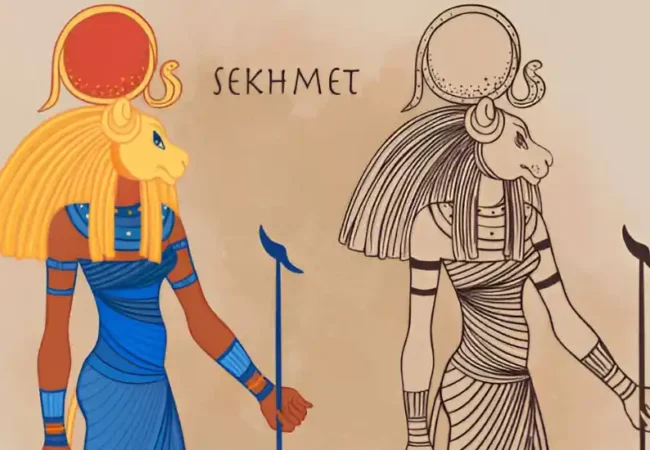
The Goddess Sekhmet
The goddess Sekhmet is a famous deity in ancient Egyptian religious beliefs....



Egypt went through many wars due to the desire to defend its borders or to expand by conquering new lands. It was exposed to many threats, and this matter prompted it to form a strong army and protect itself from all greed. These wars were divided into two types: defensive and offensive wars. Indeed, many wars were fought against the Nubians, the Hyksos, and others the Hittites, and internal battles like the unification of the two lands.
Additionally, there were later wars in different eras, such as the Battle of Kadesh during the reign of Ramses II, wars against the Crusaders like the Battle of Hattin, and modern wars like World War II, the Arab-Israeli wars (1948, 1956, 1967, 1973), the War of Attrition, as well as other wars and military campaigns throughout history.
Egypt fought various historical wars, including conflicts with external forces like the Hyksos and the Hittites, and internal battles like the unification of the two lands. Additionally, Ancient Egypt warfare in different eras, such as the Battle of Kadesh during the reign of Ramses II, wars against the Crusaders like the Battle of Hattin, and modern wars like World War II, the Arab-Israeli wars (1948, 1956, 1967, 1973), the War of Attrition, as well as other wars and military campaigns throughout history.
Wars of Unification of the Two Lands: These were wars fought by King Menes to unite the kingdoms of Upper and Lower Egypt into a single state, according to the Hindawi Foundation.
Hyksos Invasion: Egypt was invaded by the Hyksos at some point in its history.
Battle of Perire: Fought by the New Kingdom against the Libyans and Sea Peoples around 1208 BC, ending in an Egyptian victory.
Battle of Kadesh: Considered one of the earliest major battles recorded in history, it was fought between the Egyptians led by Ramses II and the Hittites, ending with the signing of a peace treaty that is considered the first of its kind in history.
Battle of Megiddo: Fought by Thutmose III against a coalition of Canaanite and Syrian princes.
Battle of Pelusium: Took place in 525 BC between the Persians and Egyptians, ending in a Persian victory and occupation of Egypt.
Wars against Syrian Shepherds: Egypt witnessed wars against Syrian shepherds in the Sinai and Palestine regions.
Roman Wars: The Battle of the Nile and the Battle of Alexandria, which took place between the Romans led by Julius Caesar and Egypt.
Fraser Campaign: A British campaign launched by British forces against Egypt in 1807.
Civil Wars: A civil war between the Quraish and Abs tribes in the pre-Islamic era.
Battle of Kadesh (1274 BC): Between the Egyptian army led by Ramses II and the Hittites.
Egyptian campaigns against Nubia and Canaan: During the Middle Kingdom period.
Medieval and Islamic Wars Battle of Hattin (1187): Fought by the armies of Saladin, which included Egyptian fighters against the Crusaders, leading to the liberation of Jerusalem. Battle of Ain Jalut (1260): The Egyptian Mamluks led their army to liberate the Levant from the Mongols.
Greek War of Independence (1821–1829): Egypt participated as part of the Ottoman Empire led by Muhammad Ali Pasha.
First Egyptian-Ottoman War (1831–1833): Fought by the Eyalet of Egypt against the Ottoman Empire.
World War II (1940–1945): Egypt participated alongside the Allies against the Axis powers.
1948 Palestine War: Egypt participated against Zionist militias in Palestine following the partition plan.
Tripartite Aggression (1956): Britain, France, and Israel launched an attack on Egypt.
1967 War (Naksa of 67): A military defeat for the forces of Egypt, Syria, and Jordan against Israel.
War of Attrition (1967–1970): A series of military skirmishes between Egypt and Israel.
October War 1973: Both Egypt and Syria launched a synchronized attack on Israel to regain the territories occupied in 1967.
Fought by the Eyalet of Egypt against the Ottoman Empire.
Egypt participated alongside the Allies against the Axis powers.
Egypt participated against Zionist militias in Palestine following the partition plan.
Britain, France, and Israel launched an attack on Egypt.
A military defeat for the forces of Egypt, Syria, and Jordan against Israel.
A series of military skirmishes between Egypt and Israel.
Both Egypt and Syria launched a synchronized attack on Israel to regain the territories occupied in 1967.

Ancient Egypt Army Soldiers
The Egyptian army is considered one of the strongest armies in the world in terms of numbers and equipment, as it is considered the oldest systematic army in the world in Egypt, established around 3200 BC, and that was after King Menes unified Egypt. Before that year, each province of the Egyptian provinces had its own army to protect it, but after the Egyptian unification war, Egypt had a unified army.
The Egyptian army consisted of two main sections: the land army, which included infantry, chariots, and the navy, which protected the coasts and included the Nile.
The number of active personnel in the Egyptian army is estimated to be around 440,000 soldiers, in addition to 480,000 reserve soldiers, which raises the total number of personnel to around 920,000 soldiers, with additional paramilitary forces. Egypt is classified as one of the largest armies in the world in terms of numbers.
Active personnel: approximately 440,000 soldiers.
Reserve forces: approximately 480,000 soldiers.
Paramilitary forces: approximately 300,000 soldiers.
Total: approximately 920,000 soldiers (including reserve and paramilitary forces).
Thanks to its strength, the Egyptians were able to establish the first empire in the world, the Egyptian Empire, which stretched from Turkey in the north to Somalia in the south and from Iraq in the east to Libya in the west, and that was the golden age of the Egyptian army.
Egyptians were always the main element in the Egyptian army. The Egyptian army consisted of the land army (infantry, horse-drawn chariots, spearmen, and other branches) and the navy, which protected all of Egypt’s maritime coasts in addition to the Nile River.
The army was able to expand the state in the New Kingdom, and its prominent role appeared in Ancient Egypt Warfare.
These roles are as follows:

Ancient Egypt Weapons
The classification of military weapons generally falls into light and heavy weapons, including personal firearms like pistols and rifles such as the Kalashnikov rifle, support weapons like machine guns, and anti-tank and anti-aircraft weapons, some of which are portable and others that are mounted on vehicles.
There are also weapons of mass destruction like nuclear, biological, and chemical weapons, as well as defensive weapons like mines and bombs.
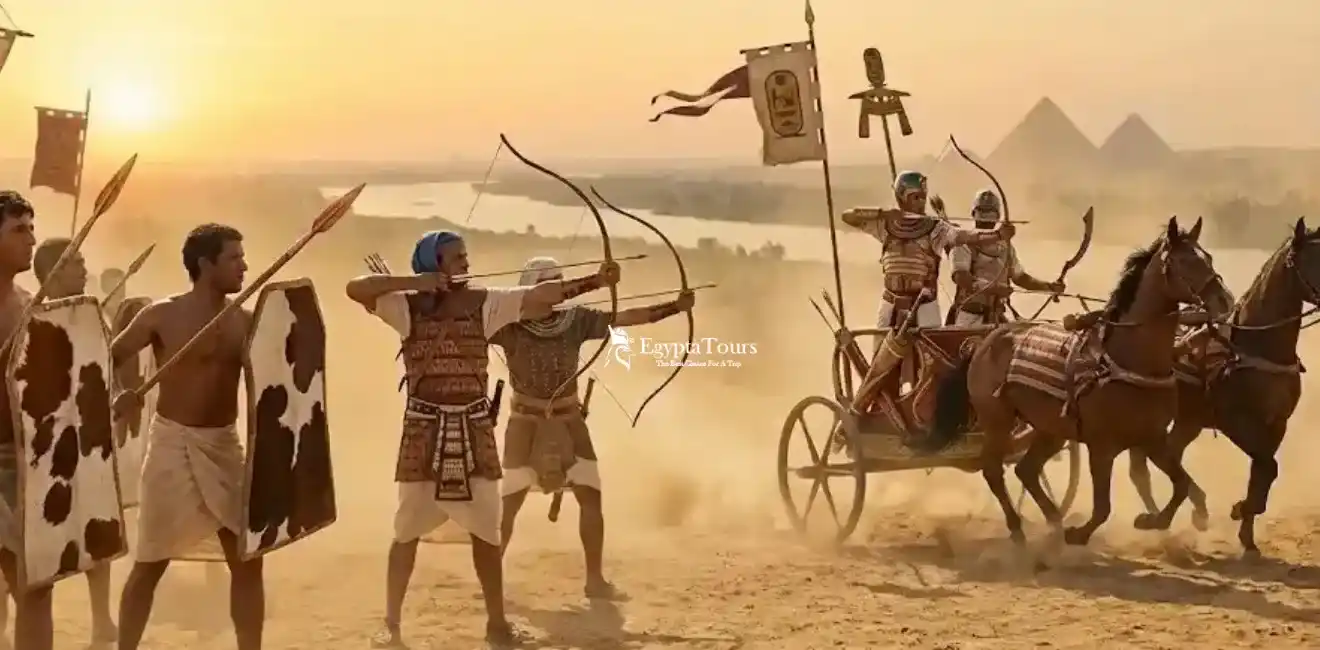
Ancient Egyptian weapons varied and included simple spears and daggers in early periods, evolving to include short swords, axes, and maces. The composite bow emerged as a highly effective weapon in the New Kingdom era, and chariots became a powerful force on the battlefield. Shields were also an important part of the equipment, initially made from animal hides or papyrus before evolving into larger shields for some soldiers.
Spear: It was one of the primary weapons, starting with a stone tip and later evolving to have a copper head in later eras.
Dagger: Used as a secondary weapon in close combat, with blades also initially made of copper.
Bow and Arrows: A common weapon, evolving from simple bows made of a single piece of wood to the more advanced and accurate composite bow.
Axe: A well-known war tool, including various forms of metal axes.
Mace: Used as a combat tool or as a symbol of authority.
Shields: Used to protect soldiers, made from animal hides or papyrus.

New-Kingdom-Advanced-Weapons-And-Chariot-Warfare-Ancient-Egypt-Warfare-EgyptaTours
Khopesh: An Egyptian curved sword developed from the battle axe, which had an effective role in combat.
Chariots: They formed a striking force in battles, where the Egyptians learned strategies for using them from the Hyksos and then deployed squadrons of them during the New Kingdom era.
Composite Bow: Featured immense power and greater accuracy than ordinary bows, becoming a powerful Egyptian weapon after the Syrians introduced it to them.
Swords: Short bronze swords appeared, then evolved to become stronger and more durable, with khopesh swords also emerging.
Individual Engagement Weapons (Light Weapons):
Pistols: Such as revolvers, automatic pistols, and stun guns.
Rifles: Including assault rifles like AK models (e.g., AK-47 and AK-103), sniper rifles, and assault rifles.
Support Weapons (Heavy Weapons):
Machine Guns: Such as light or heavy machine guns.
Artillery: Including mortars, field artillery, anti-aircraft guns, and anti-tank guns.
Missiles: Such as guided anti-tank missiles or missiles launched from portable launchers or other platforms.
Weapons of Mass Destruction:
Nuclear weapons, chemical and biological weapons
Defensive Weapons:
Mines: Land or sea mines, whether anti-personnel or anti-tank.
Bombs: Such as hand grenades, artillery shells, atomic bombs, and missile warheads.
Hunting Firearms: Which differ from combat weapons, as outlined in the law.
Anti-Tank Weapons: A specialized type of heavy weapon or missile.
Anti-Aircraft Weapons: Designed to destroy aircraft, whether portable or mounted on fixed platforms.

Ancient-Egypt-Fortifications-And-Defense-Techniques-Ancient-Egypt-Warfare-EgyptaTours
The fortifications of ancient Egypt included fortresses and strongholds in various regions such as Nubia and the eastern borders, built by ancient Egypt in Nubia, south of Egypt and north of Sudan, following the Egyptian expansion into Nubia during the 12th dynasty of the Middle Kingdom.
These fortresses were mainly built during the reign of the Egyptian king Senusret III and were rebuilt and expanded during the era of the Egyptian Empire. There were seventeen fortresses, but only fourteen have been identified.
These fortresses, apart from those in the Egyptian oases and those on the Way of Horus, are the only examples of this type in ancient Egyptian architecture. The construction of the High Dam and the retention of Lake Nasser’s waters behind it caused most of these fortresses to be submerged under the waters of Lake Nasser.
These fortifications included fortresses such as Buhen, Semna, and Kuban in Nubia, and Qemneh, in addition to the forts of the Way of Horus, which are located in the Tharu area near Ismailia, and are part of the defensive fortifications that extend to Rafah. They included a fortified city with a wall 800 meters long and 7 meters thick, with rectangular towers, and it protected the eastern gate of Egypt.
Fortress of Babylon in the Old Cairo area, which is one of the most prominent fortifications.
Elephantine Fortress.
Aniba Fortress.
Uronarti Fortress.
Evolution-Of-The-Military-System-Ancient-Egypt-Warfare-EgyptaTours
With the Ancient Egypt WarFare, the military system developed and became more effective and complex. It also went through many stages that helped to form a strong empire.
These stages are as follows:
War chariots were of great importance during Ancient Egypt WarFare, as they were used in major battles against the Assyrians and the Hittites. They were made of wood and had horses in the front, and sometimes donkeys. They were used to transport armed fighters quickly and efficiently to the battlefield. The chariot team consisted of the driver and the fighter who fought with spears, swords, and arrows.
The military leader in Ancient Egypt WarFare was the king, as one of his tasks was to lead the army. The pharaoh was the protector of the people and the land, according to what they believed. We notice that King Ramesses II led his armies in the Battle of Kadesh. Many statues and texts have also appeared that confirm that he was the warrior who was able to lead the soldiers to victory, which helped to strengthen and prove his royal status.
This is in addition to the strategic planning that the king was responsible for supervising, along with making military decisions and issuing directives and incentives that help to achieve victory.
There is no doubt that the natural geography greatly affected Ancient Egypt Warfare. The shape of the land and the Nile were among the most important elements that had a role in military planning. The Nile River was a means of rapid transportation north and south, and it helped to protect Egypt from invaders. It allowed the Egyptians to control water and agricultural resources.
As for the eastern and western deserts, it was difficult for enemies to cross them, and they also provided protection from surprise attacks. The terrain was used as a means of fortification and camouflage. Thus, the geographical factors were able to help the pharaohs during the wars that took place, whether for attacking lands or securing the borders.
All aspects were affected by Ancient Egypt Warfare, from the political, economic, and also cultural aspects.
In this context, we can clarify the following:
Yes, Egypt fought many wars to work on expanding its influence and protecting it from external threats and from those who tried to seize its lands.
The biggest of ancient Egypt’s wars was Kadesh, which was fought between Ramesses II and the king of the Hittites. The battle did not end with a victory for either side but ended with a peace treaty.
Military tactics included the use of war chariots, fortifications, infantry, and the plan of surprise attack.
The Egyptians used many fighting styles, which are represented in war chariots and the use of spears, bows, forts, and walls.
Yes, it won many wars, including the expulsion of the Hyksos, which was led by Ahmose I, the Battle of Megiddo, which was led by Thutmose III, and others.
There were seventeen fortresses, but only fourteen have been identified.These fortifications included fortresses such as Buhen, Semna, and Kuban in Nubia, and Qemneh, in addition to the forts of the Way of Horus, which are located in the Tharu area near Ismailia, and are part of the defensive fortifications that extend to Rafah. They included a fortified city with a wall 800 meters long and 7 meters thick, with rectangular towers, and it protected the eastern gate of Egypt.
Fortress of Babylon in the Old Cairo area, which is one of the most prominent fortifications.
Elephantine Fortress
established around 3200 BC, and that was after King Menes unified Egypt. Before that year, each province of the Egyptian provinces had its own army to protect it, but after the Egyptian unification war, Egypt had a unified army. The Egyptian army consisted of two main sections: the land army, which included infantry, chariots, and the navy, which protected the coasts and included the Nile.
Wars of Unification of the Two Lands: These were wars fought by King Menes to unite the kingdoms of Upper and Lower Egypt into a single state, according to the Hindawi Foundation. Hyksos Invasion: Egypt was invaded by the Hyksos at some point in its history.
Battle of Perire: Fought by the New Kingdom against the Libyans and Sea Peoples around 1208 BC, ending in an Egyptian victory. Battle of Kadesh: Considered one of the earliest major battles recorded in history, it was fought between the Egyptians led by Ramses II and the Hittites, ending with the signing of a peace treaty that is considered the first of its kind in history. Battle of Megiddo: Fought by Thutmose III against a coalition of Canaanite and Syrian princes.Egyptian campaigns against Nubia and Canaan:
Spear: It was one of the primary weapons, starting with a stone tip and later evolving to have a copper head in later eras.
Dagger: Used as a secondary weapon in close combat, with blades also initially made of copper.
Bow and Arrows: A common weapon, evolving from simple bows made of a single piece of wood to the more advanced and accurate composite bow.
Axe: A well-known war tool, including various forms of metal axes.
Mace: Used as a combat tool or as a symbol of authority.
Shields: Used to protect soldiers, made from animal hides or papyrus.
established around 3200 BC, and that was after King Menes unified Egypt. Before that year, each province of the Egyptian provinces had its own army to protect it, but after the Egyptian unification war, Egypt had a unified army. The Egyptian army consisted of two main sections: the land army, which included infantry, chariots, and the navy, which protected the coasts and included the Nile.
There were seventeen fortresses, but only fourteen have been identified. These fortifications included fortresses such as Buhen, Semna, and Kuban in Nubia, and Qemneh, in addition to the forts of the Way of Horus, which are located in the Tharu area near Ismailia, and are part of the defensive fortifications that extend to Rafah. They included a fortified city with a wall 800 meters long and 7 meters thick, with rectangular towers, and it protected the eastern gate of Egypt.



Explore our top-rated Egypt travel packages and embark on an unforgettable journey. From the Pyramids of Cairo to the magical temples of Luxor, Aswan, and Abu Simbel, discover expertly curated tours designed for your perfect Egyptian adventure