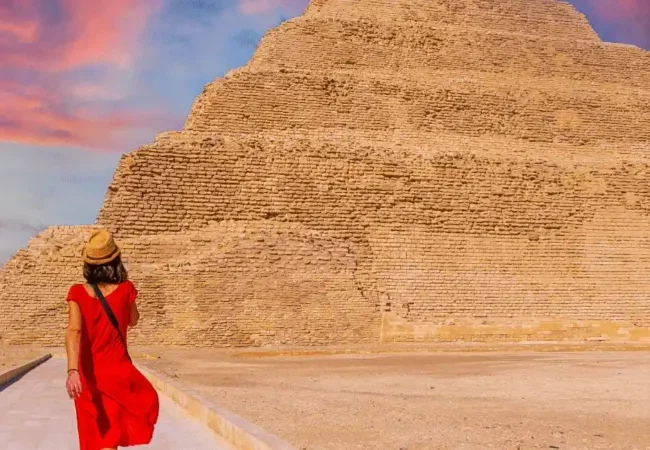
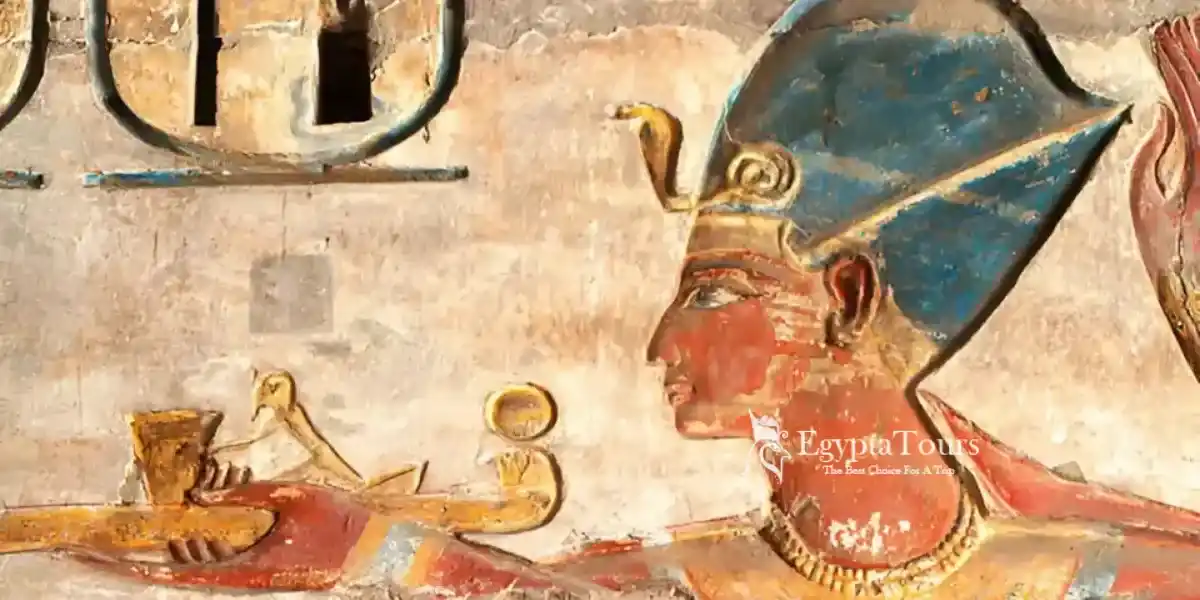
Ancient Golden and Black Crown Egyptian
📋 Summary & Quick Facts
Ancient Egyptian crowns were far more than just royal fashion; they were profound symbols of political authority, geographical control, and divine connection. From the White and Red crowns that divided the north and south, to the iconic Double Crown that represented a unified empire, each headdress served a highly specific purpose. Whether it was the battle-ready Blue Crown worn by Tutankhamun or the Vulture Crown worn by elite queens, these intricate designs—including the legendary ancient golden and black crown egyptian artifacts—provide a fascinating window into the complex religious and political machinery of one of history’s greatest civilizations.
Key Takeaways
-
-
Geography Dictated the Crown: The pharaoh’s headwear instantly communicated their domain. The White Crown (Hedjet) represented Upper Egypt, the Red Crown (Deshret) represented Lower Egypt, and the Double Crown (Sekhemty) symbolized absolute, unified rule.
-
The Mystery of the Missing Crowns: Despite the wealth of artifacts recovered from ancient Egypt, no physical models of the original White, Red, or Double crowns have ever been found. Historians believe they were crafted from perishable, organic materials like woven palm fronds, straw, and leather.
-
Built for Battle: Not all crowns were for ceremonies. The clay or leather Blue Crown (Khepresh) and the towering Hemhem crown were specifically worn to project military dominance, readiness for war, and defiance.
-
Female Power Symbols: Royal women had their own distinct regalia. The Vulture Crown, made of gold and depicting the protective goddess Nekhbet, was an exclusive symbol of power for queens and elite priestesses.
-
A Bridge to the Afterlife: Crowns were heavily integrated into the religion. The Atef Crown, adorned with ostrich feathers symbolizing truth and justice, was so closely tied to the god Osiris that ordinary citizens eventually began using its imagery in their funerary rituals to secure a safe passage to the afterlife.
-
Crowns in ancient Egypt were distinguished by their diverse forms, symbols of majesty and sanctity.
These crowns were not worn randomly, but rather each one was dedicated to representing the authority of the pharaoh or to honoring deities in sacred rituals.
From the sacred Atef crown to the White Crown, a symbol of sovereignty, and the Red Crown which carried connotations of northern rule to Khepresh and the Double Crown of Power, and even the mysterious Hemhem crown all of these were keys to understanding the royal and religious thought of a civilization unlike any other.
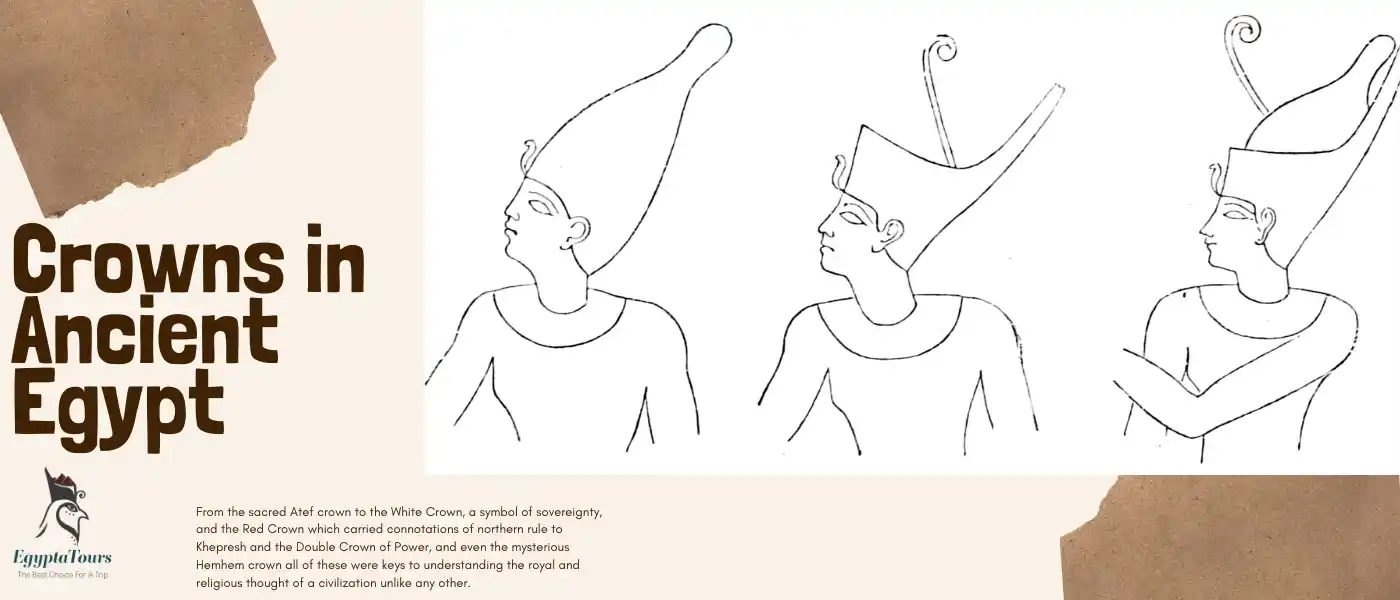
List-of-Crowns-in-Ancient-Egypt-EgyptaTours
There were many crowns in ancient Egypt, and each one was designated for a specific object and a specific king.
Below we list all the names and who used them:
-
Atef
Consisting of a white crown decorated with ostrich feathers it was associated with the god Osiris the god of resurrection and immortality. It can also be seen crowned in the tomb paintings of Nefertari dating back to 1295–1255 BC.
-
The Red Crown
Decorated with the shape of a uraeus (royal cobra) it was a distinctive crown for the rulers of Lower Egypt and associated with the goddess Wadjet the god Horus, and the goddess Neith.
This crown appears in artistic scenes dating back to the Grey Period in the desert including a stunning piece from the 19th-20th Dynasties known as the “Lionslayer.”
-
The White Crown
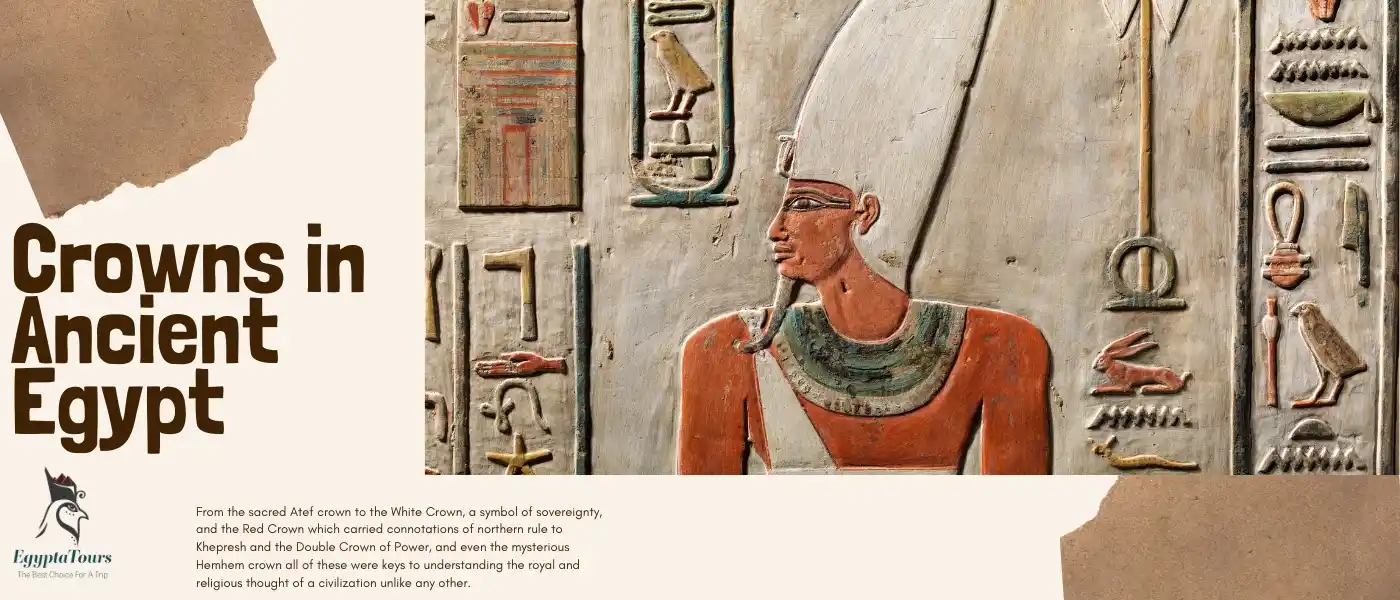
The-White-Crown-One-of-the-Crowns-in-Ancient-Egypt-EgyptaTours
Accompanied by the eagle symbol it was reserved for the kings of Upper Egypt. It represented authority and was also associated with the goddess Nekhbet and the god Horus. Prominent kings such as Ahmose I and Amenhotep I wore it during the Eighteenth Dynasty (1539–1493 BC).
-
The Khepresh (Blue Crown or Battle Crown)
Made of clay with a unique design symbolizing war it was used in battle or on royal occasions by the kings of the New Kingdom.
One of the most famous wearers was Tutankhamun. It was associated with military power and grandeur.
-
The Double Crown
Combining a red and white crown and adorned with a cobra and an eagle it was designed to symbolize the unification of Upper and Lower Egypt under one rule.
It was associated with the god-king Horus as can be seen on an engraved ring dating back to the reign of Ptolemy VI who ruled from the 3rd to 2nd centuries BC.
About the Atef Crown
One of the most famous crowns in ancient Egypt is the Atef Crown, a sacred symbol associated with the god Osiris, lord of the afterlife and god of fertility and resurrection.
This crown consists of a white crown symbolizing Upper Egypt flanked by two ostrich feathers on either side.
A golden disk crowns the crown often perched atop the horns of a ram or bull in a scene that expresses both strength and holiness.
The two ostrich feathers on the crown are not placed in vain; rather they carry profound meanings symbolizing justice, truth, and moral balance—the same values represented by the goddess Maat in ancient Egyptian belief.
It is also said that this crown evokes the city of Busiris which was a center of Osiris worship.
The Atef crown appeared during the Fifth Dynasty and was used to symbolize Osiris as the god of death, resurrection, and the afterlife.
Over time kings began to adorn their tombs with it believing that after death they would transform into an image of Osiris.
During the Middle Kingdom the crown was no longer restricted to kings and priests it even appeared on ordinary citizens in scenes of death and resurrection with Osiris representing the Supreme Judge of Souls.
It was also worn in religious rituals associated with death and celebrations glorifying eternal life.
The Red Crown
The Red Crown also known as the Deshret served as the official insignia of the rulers of Lower Egypt and was one of the most magnificent crowns in ancient Egypt.
It has a unique shape resembling a large bowl slightly protruding from one side with a distinctive proboscis-like element. This element is believed to symbolize the proboscis of a bee a symbol of power and control at the time.
The red color of the crown reflects the arid nature of the land surrounding the Nile Valley known as the “Red Land,” in contrast to the fertile black land that cultivated and nourished Egypt.
The name “Deshret” refers not only to the crown but also to the deserts surrounding the river.
It is likely that this crown was not made of metal or stone, but rather of simple plant fibers such as straw linen or palm fronds.
This makes it difficult to preserve which may explain why no original red crown has been found to date. It is also likely that it was passed from king to king not buried with its owner but continuing to be passed on as a symbol of authority.
Its first depictions likely appeared in the Predynastic Period in the late Naqada Period around 3500 BC.
At that time it was often associated with the god Seth until its symbolism changed at the beginning of the royal period when it became an emblem of rule over Lower Egypt with the emergence of the First Dynasty.
In Egyptian mythology it is said that the god Geb bestowed this crown on the god Horus, allowing him to rule the land of the North. The crown then became a symbol passed from one king to another expressing their continuation of Horus.
The crown was also associated with the goddess Neith who was depicted in feminine form wearing the crown of Lower Egypt.
The oldest known depiction of her in this form was found in the Temple of Userkaf in Abu Ghurab dating back to approximately 2499 BC.
History of the White Crown
The White Crown known as the “Hedjet,” was worn by the kings of Upper Egypt. It is characterized by its elongated cylindrical shape and resembles a bowling pin.
This crown also forms the first half of the double crown that united Upper and Lower Egypt.
No actual model of this crown has been found in archaeological excavations leading some researchers to speculate that it was made of organic materials such as leather or cloth or perhaps woven from plant fibers just as was the case with the Red Crown.
The Hemhem Crown
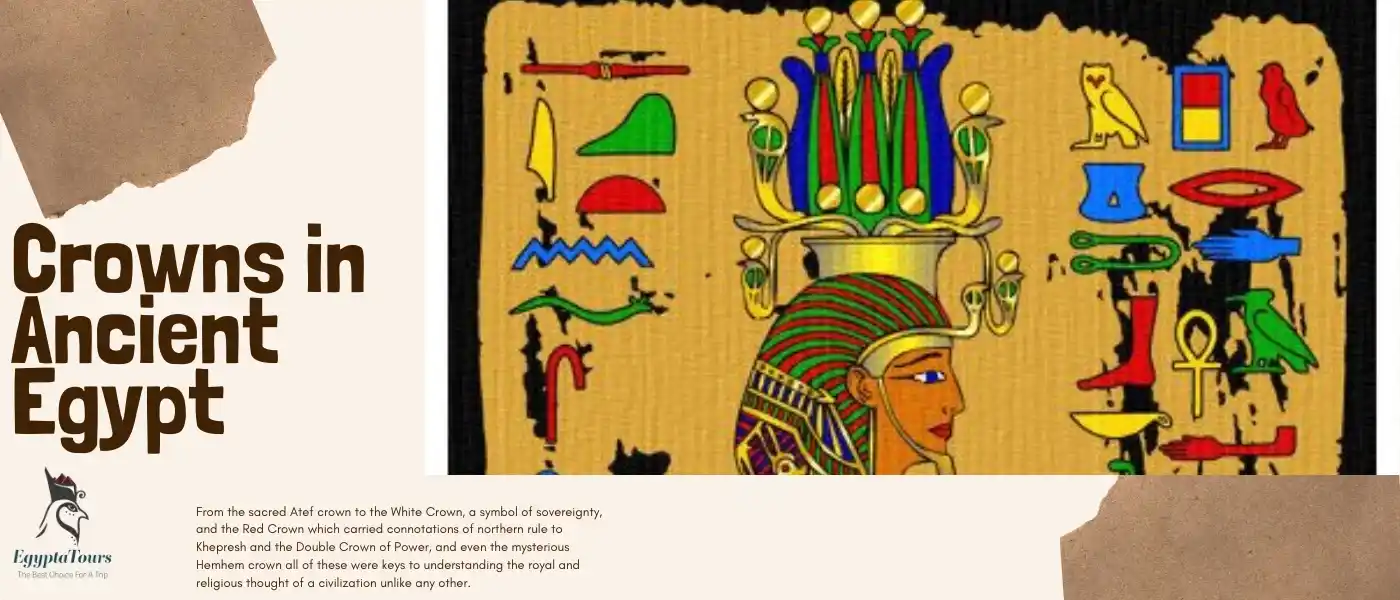
The-Hemhem-Crown-One-of-the-Crowns-in-Ancient-Egypt-EgyptaTours
The Hemhem Crown was a symbol of strength and defiance, and is one of the most well-known crowns in ancient Egypt.
It is a three-tiered crown derived from the Atef crown but more ornate and detailed.
It is topped with a pair of ava Cobras (uraeus) surrounded by bundles of papyrus symbolizing power.
At its base and top is a solar disk surrounded by double horns, giving it a dominant appearance.
This crown was not merely a royal adornment, it was also worn as a clear sign of readiness for war. Its name “Hemhem,” in ancient Egyptian means “cry” or “shout.”
Description and History of the Double Crown
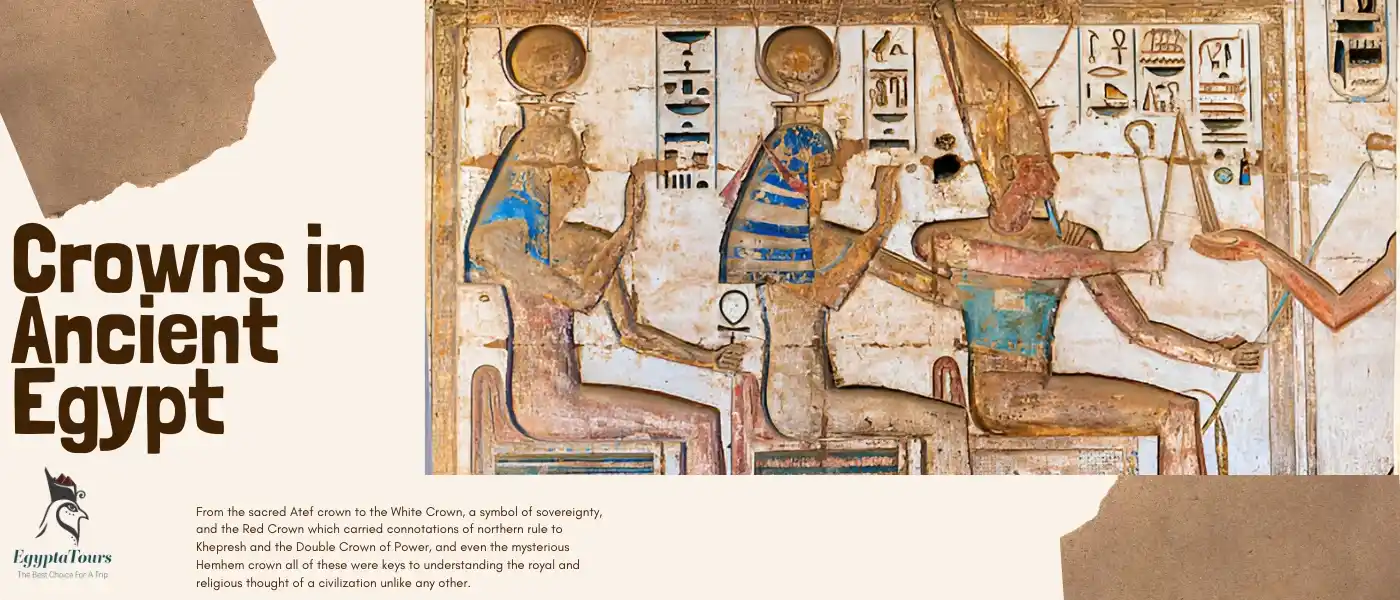
Description-and-History-Crowns-in-Ancient-Egypt-EgyptaTours
The double crown “Peshent,” represented the unity of Upper and Lower Egypt. It combined the white crown “Hedjet,” and the red crown “Deshret,” to become a symbol of the unified power of the country. Its other name “Sekhemty,” reflects this meaning meaning “the two powers.”
The origins of the crown are attributed to King Narmer whose name is associated with the unification process although the first person to actually wear it was King Djer.
Ancient inscriptions refer to this combination with metaphorical symbols such as one in which the red crown “swallowed” the power of the other.
This crown also appears in depictions of the gods Horus and Atum both of whom represent royal sovereignty. Despite its symbolic status the crown itself has not been found. All we know about it comes from murals and ancient texts.
History of the Vulture Crown
The vulture crown was one of the most famous crowns in ancient Egypt. It was a female royal symbol in ancient Egypt worn by queens, pharaohs’ wives, and elite priestesses.
It was designed in the shape of an eagle spreading its wings on either side of the head signifying protection from the goddess Nekhbet.
It was often made of gold and sometimes decorated with uraeus to represent the sovereignty of Upper and Lower Egypt.
Titisheri was the first woman to wear it, and some goddesses also wore it with additions such as the sun disk and ostrich feathers.
What were the headdresses of the gods in ancient Egypt?
The most famous crowns in ancient Egypt found on statues of Egyptian gods, were:
- The solar disk between two horns worn by goddesses, especially Hathor, and distinguished by the presence of cow ears. It was later attributed to Isis.
- The Atef crown: Relating to Osiris it consists of the white crown and two ostrich feathers symbolizing truth and justice. Sometimes ram horns or a solar disk are added.
- The Crown of Justification: Associated with the dead and with Osiris as a symbol of resurrection it remained popular until the Roman era.
- The identification of the gods was not always clear; some crowns were common, and the hieroglyphic name or symbol above the head confirmed the identity.
FAQs
What were the main types of crowns in ancient Egypt?
The most important royal headdresses included the White Crown, the Red Crown, the Double Crown, the Atef, the Hemhem, the Blue Crown (Khepresh), and the Vulture Crown.
What did the White Crown represent?
The White Crown (Hedjet) was the official symbol of Upper Egypt. It was used from the Predynastic period onward to signify southern pharaonic authority.
What materials were Egyptian crowns made from?
Because very few original crowns have survived, archaeologists believe most everyday crowns were crafted from organic, perishable materials like felt, leather, straw, linen, and woven palm fronds, rather than heavy metals.
Similar Posts

About EgyptaTours

EgyptaTours is a name synonymous with trust, excellence, and unforgettable travel experiences, proudly standing as one of the leading travel agencies in Egypt. Renowned for its deep expertise, personalized service, and carefully crafted itineraries, EgyptaTours serves as the ultimate gateway to discovering Egypt in its most authentic and inspiring form.