Fun Facts About Ra: Discover the Ancient Egyptian Sun God
The ancient Egyptians believed that Ra was the creator of all things....



Geb, in ancient Egyptian belief, was the god of the earth and represented the physical foundation of the world. Together with Nut, his sister, Geb made up the second generation in the Ennead (the group of nine gods) from Heliopolis. In Egyptian art, Geb was often shown lying at the feet of Shu, the god of air, with Nut, the goddess of the sky, arched above them.
Geb was usually seen as a man with no special features, but sometimes his head was shown with a goose on top, which was the symbol of his name. He was the third god to rule among the gods, and the kings of Egypt claimed to be his descendants. The royal throne was also known as the throne of Geb.
History of Geb

History -of -Geb
Geb and Nut wanted to have children, but Ra, their grandfather and the king of the gods, heard a prophecy that one of their children would take his place. Worried about this, Ra stopped Nut from giving birth on any of the 360 days of the year. But Nut was determined. She played a game with her uncle Khonsu, the moon god, and won moonlight, which she used to create five extra days. On these days, she gave birth to five children: Osiris, Horus the Elder, Set, Isis, and Nephthys.
As punishment for going against his order, Ra made Shu keep Nut and Geb separated forever, with Nut in the sky and Geb on the earth. This led to Nut becoming the protector of the sky and Geb becoming the lord of the earth.Geb became king of the gods after his father, Shu, stepped down. Later, Geb passed the throne to his oldest son, Osiris. After giving up the throne, Geb became the judge of the gods’ matters and the ruler of the earth.
The Role of Geb

The -Role -of -Geb
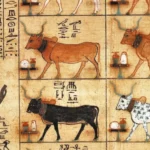
The earliest known image of the god is a bearded figure with a human form, shown with his name. It dates back to the reign of King Djoser in the Third Dynasty and was found in Heliopolis. However, the god never had a temple dedicated to him. Later, he was sometimes shown as a ram, a bull, or a crocodile; the last one appears in a scene from the Book of the Dead of the lady Heryweben, displayed in the Egyptian Museum in Cairo.
Geb was often feared as the father of snakes (since one of the words for snake was son of the earth). In one of the Coffin Texts, Geb is described as the father of the ancient snake god Nehebkau. Geb was also seen as an early king of Egypt, and his son Osiris, along with his grandson Horus, inherited the land after fighting many battles with the troublesome god Set, Osiris’s brother and killer.
Geb could also be seen as the earth itself, both fertile and barren. The barren part of the earth was where the dead were kept, or where they could be freed from their tombs.
This was often described as Geb opening his jaws. He could also trap those who were unworthy of entering the fertile, heavenly Field of Reeds in the northeast. In this role, one of his otherworldly symbols was a scary staff with the head of a jackal, called Mighty One, which would rise from the ground and hold enemies.
In the Heliopolitan Ennead (a group of nine gods created by the god Atum or Ra at the beginning of time), Geb is the husband of Nut, the sky, which includes both day and night. Geb is the son of two earlier gods, Tefnut (moisture) and Shu (emptiness) and the father of four other gods: Osiris, Seth, Isis, and Nephthys.
According to the myth, Geb and Nut were once engaged but were separated by Shu, the god of air. In some myths, Geb is shown as a man lying down, sometimes with his body still facing Nut. Together, Geb and Nut formed the permanent boundary between the original waters and the newly created world.
Over time, Geb became more linked with the land of Egypt and was seen as one of its early rulers. As a chthonic god (a god of the underworld), he was connected to the underworld, fresh water, and plants. It was believed that barley grew on his ribs, and he was often shown with plants and green patches on his body.
Because of his connection to plants, healing, and sometimes the underworld and royalty, Geb was sometimes seen as the husband of Renenutet, a minor goddess of the harvest. Renenutet was also thought to care for the young king in the form of a cobra, and she was considered the mother of Nehebkau, an ancient snake god linked to the underworld. Some classical writers also compared Geb to the Greek Titan Cronus.
Ptah and Ra, the gods of creation, are often listed as the first divine ancestors. There’s debate over whether Shu or Geb was the first king of Egypt. The story of how Shu,
Geb, and Nut were separated to create the world is now seen more in human terms, showing jealousy and conflict. There’s a rivalry between father and son, with Shu rebelling against the divine order.
Geb challenges Shu’s rule by taking Shu’s wife, Tefnut, as his queen, separating Shu from his sister-wife, just like Shu had done to Geb before. In the Book of the Heavenly Cow,
it’s suggested that Geb was the heir to the sun god as he was leaving. After Geb gave the throne to his son Osiris, he took on the role of a judge in the Divine Tribunal of the gods.
War with Nex

War -with -Nex
Until the arrival of the archmage Nex, Geb was a relatively peaceful kingdom. Nex had taken control of the plains to the north of Geb and cut off Geb from the important trade routes of the Golden Road. In 892 AR, the competing ambitions of Nex and Geb over each other’s lands sparked one of the most famous magical rivalries in Golarion’s history, leading to a war that would last for centuries.
During one of the deadliest magical battles, Geb drained the life force from most of the land around Nex’s cities using powerful wishes. In retaliation, Nex cursed Geb’s lands with a series of devastating events that wiped out much of its population. Geb responded by raising the dead into armies of undead, marking the beginning of Geb’s dependence on necromancy.
After another brutal attack in 576 AR, Geb’s forces pushed forward to Nex’s capital, Quantium, and reached the walls of his palace, Bandeshar. As toxic magical smoke ravaged the city’s population, Nex disappeared into the Refuge of Nex, and to this day, no one has found any trace of him.
Geb was convinced that Nex was still alive and was frustrated that he had never had the chance to defeat his long-time enemy. Nex’s loyal servants, known as the Arclords of Nex, showed incredible determination as they fought off relentless attempts to trap their master forever within Bandeshar.
Despite many efforts, the Arclords blocked all attempts to imprison Nex, causing Geb much frustration in his quest for complete victory. After many years of resentment, Geb’s anguish became too much to bear, and he took his own life in 632 AR. However, even his death didn’t end the conflict. Geb’s anger, frustration, and ties to necromancy brought him back as a ghost, doomed to continue his undead existence until he can learn the fate of his old rival.
Land of the Dead
With its ruler now an eternal ghost and much of the population turned into skeletons and zombies, Geb’s society quickly became a land dominated by undead and necromancy. In an act of total devotion, thousands of Geb’s most loyal followers willingly sacrificed their lives, binding their souls to serve their ghostly ruler. By doing so, they pledged eternal loyalty to Geb, ensuring their obedience even in death.
Geb became a terrifying figure to his neighbors, who launched numerous raids by land and sea. One such raid, with lasting consequences, was carried out by the Knights of Ozem.
They hoped to gain more glory after the Shining Crusade ended, but their attack failed. Enraged that distant people would dare to attack his kingdom without provocation, Geb raised six of the fallen knights as graveknights.
He sent these new undead warriors to the Knights’ headquarters in Lastwall to retrieve the body of Arazni, the former herald of the god Aroden and the Knights’ revered patroness.
The knights succeeded, and Geb spent a year and a day pulling Arazni’s soul back from the afterlife. Over several years, Geb twisted her into a lich, stripping her of her former identity. Geb then made Arazni his trophy wife and forced her to rule his kingdom in his place, a task he considered beneath him.
In 4719 AR, Arazni managed to escape from Geb’s control, while Geb himself became increasingly convinced that Nex would soon return. As a result, Geb resumed full leadership over his kingdom.
In 4724 AR, when the Godsrain fell on Geb, it caused hundreds of undead across the nation to return to life, just before they had died and become undead.
This event which was known as The Living Plague had mixed results. Some of those revived died almost immediately while others were left as Reborn living people who had once been dead. These Reborn are now in a different position of power within Geb’s kingdom and many are hiding, planning either to escape the country or to overthrow Geb’s rule.
Society
At one point, most of Geb’s population consisted of humans from Osirian descent. Many perished during the war with Nex and were brought back as undead. After Geb became a ghost, undead beings became more and more prominent in society. Nowadays, the majority of Geb’s people are undead and some living beings even choose to become undead to show their loyalty to Geb.
The only living creatures with real influence in Geb are its powerful necromancers. Their skills in creating and controlling undead give them significant power over the nation’s affairs. Over time, Geb has grown into one of the leading places for studying necromancy and is believed to possess the most complete collection of necromantic knowledge in Golarion.
Gebbite society is divided into three main groups: the quick (living beings and excluding thralls), the dead (intelligent undead) and chattel (living thralls bred for food and mindless undead).
The quick and the dead are treated equally but the chattel have no rights. Relations between the quick and the dead are governed by the Dead Laws which are meant to protect the rights and safety of both groups. However, as in any society not everyone follows the law so visitors should still be careful.
Anyone who died on Geb’s land was turned into a mindless undead creature to serve the state forever, unless stated otherwise. Those with enough influence or wealth can avoid this by willingly becoming an intelligent undead through dark magic or by letting themselves be killed by ghouls, vampires or other creatures capable of creating such undead.
This is seen as a great service to the state, though it leads to a large population of lesser intelligent undead who view themselves as superior to their mindless counterparts even though they have no real power.
Some corporeal undead in Geb cover their bodies with a special substance called unguent of revivification to keep the appearance of life.
Government
The necromancer Geb remains the ruler of his land, even though he has been a ghost for centuries. He rarely shows himself to the people and is cursed to stay within the borders of his country. For many years, Arazni ruled in his place but when she escaped his control, Geb returned to actively lead his kingdom in 4719 AR.
The dark streets of Mechitar are filled with eerie displays as skeletons join parades to honor Geb’s return and the revival of his kingdom. Agents of the ghostly ruler work in otherworldly realms, collecting rare and magical materials hinting at preparations for huge necromantic rituals. No longer a lonely recluse, Geb now eagerly awaits a grand future, getting himself and his eternal realm ready for something of great importance.
The daily operations of the country are overseen by the Blood Lords, a group of 60 powerful necromancers both living and undead trained by Geb himself. Originally all mortal, the Blood Lords are now mostly undead including vampires, mummies,
mohrgs, wraiths, shadows and liches. The leader of the Blood Lords is the vampire Kemnebi who serves as the chancellor.
The lesser nobility is made up of undead beings like mohrgs, wights, shadows and ghouls. While they try to act as if they are part of the aristocracy, they are looked down upon by the true aristocrats, the Blood Lords.
Geb’s laws ban the use of positive energy, which effectively forbids good aligned divine spellcasters from practicing their magic in the land.
Foreign Relations
Geb is not focused on war, even with its old rival, Nex, but it has frequently been attacked by so-called heroes hoping to destroy the undead kingdom. Instead, Geb takes a patient and discreet approach to dealing with other nations. The undead rulers of Geb benefit from immortality,
which allows them to be more strategic and patient in their pursuit of power. With plenty of time on their side, they carefully craft political schemes that span centuries, working their influence in the complex politics of the Inner Sea region.
Their impact runs deeper than most realize, as they quietly operate behind the scenes, manipulating events to further their long term goals. The war with Nex ended long ago, and although the two nations aren’t exactly allies,
they share mutual trade agreements. Geb also maintains good relations with Jalmeray, Katapesh, and Qadira. It has little interaction with the Mwangi Expanse, relying on the Shattered Range to protect it from threats. Before the rise of the Whispering Tyrant, Geb’s only real enemy was Lastwall, which had never forgiven Geb for stealing Arazni’s corpse.
Economics
Geb’s warm climate, combined with moisture rich winds from the Obari Ocean, creates fertile grasslands ideal for farming. These fields are primarily worked by mindless undead, and agricultural products are Geb’s main exports, as the nation has relatively few living citizens. Geb trades with Nex in exchange for rare components and luxury items, and with Alkenstar, it receives the city state’s famous ice wine, a favorite among Geb’s nobility. Geb also exports goods to other nations across the Inner Sea region.
As a gesture of friendship, the country sends an annual gift of corpses and slaves to the ghoul city of Nemret Noktoria, located in the Darklands beneath Osirion.
FAQS
Geb was the ancient Egyptian god of the Earth, representing the ground, soil, and fertility. He was believed to control earthquakes and was considered the source of plant life growing from the land.
Geb was a key member of the Ennead of Heliopolis and served as the father of Osiris, Isis, Set, and Nephthys, making him central to Egyptian creation and kingship myths.
Geb was commonly associated with the goose, which symbolized him, as well as green plants, barley, and snakes, reflecting his connection to the earth and fertility.
Geb was the husband of Nut, the sky goddess, and together they were the parents of Osiris, Isis, Set, and Nephthys, forming one of the most important divine families in Egyptian mythology.
Geb was honored through prayers and rituals related to agriculture, fertility, and burial practices, as the earth itself was seen as his body and the final resting place of the dead.


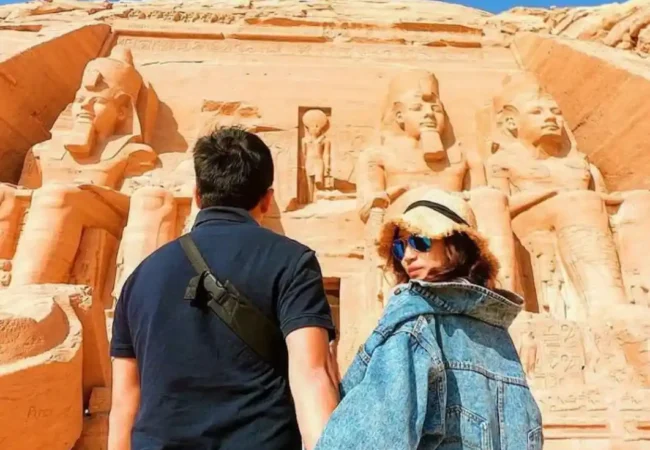
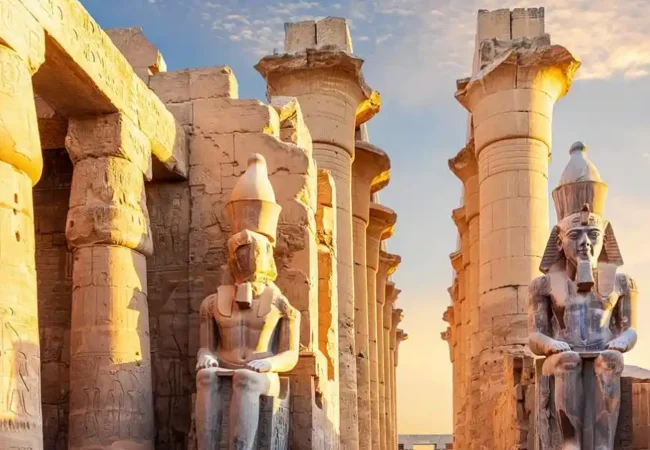
Explore our top-rated Egypt travel packages and embark on an unforgettable journey. From the Pyramids of Cairo to the magical temples of Luxor, Aswan, and Abu Simbel, discover expertly curated tours designed for your perfect Egyptian adventure