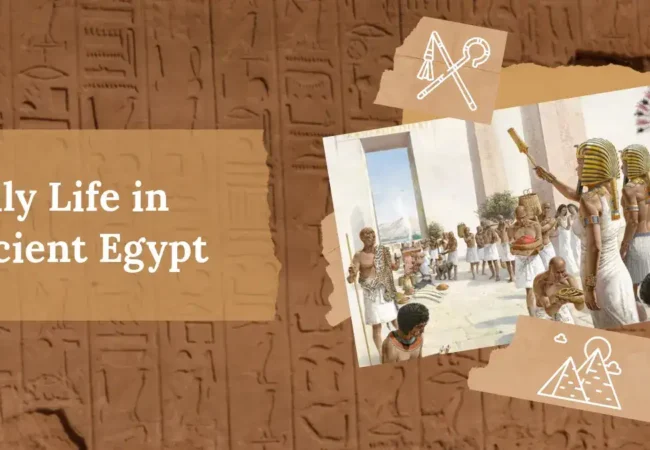
Daily Life in Ancient Egypt: Uncover the Magical Realities
The ancient Egyptians loved life as we were blessed with ideal conditions...



The story of Ramses and the plagues describes the plagues sent upon ancient Egypt after the Pharaoh, identified in tradition as Ramses II, refused to free the Israelite slaves. The 10 plagues included water turning to blood, frogs, lice, flies, livestock pestilence, boils, hail, locusts, darkness, and the death of the firstborn, with archaeological theories suggesting a prolonged drought may have triggered a series of natural disasters.

Ramses- And -The -Plagues
The Nile River and all water in Egypt turned to blood, killing the fish and making the water undrinkable.
Egypt was overrun with frogs, which entered homes, bedrooms, and ovens.
The dust of the land turned into swarms of gnats or lice that covered people and animals.
Hordes of flies descended upon Egypt.
A fatal pestilence killed Egyptian livestock.
Both humans and animals developed painful boils.
A terrible hailstorm struck, destroying crops and trees.
A plague of locusts consumed any remaining crops and vegetation.
A thick darkness covered the land for three days, during which people could not see each other.
The firstborn sons of all Egyptians and the firstborn of their livestock died. The Israelites, however, were spared after marking their doorways with lamb’s blood.

The -First -Plague
The first of the Ten Plagues of the Ramses and the plagues’ story was the turning of the Nile River into blood. Moses and Aaron led this plague: Aaron struck the river with his staff, and the water turned to blood. The fish died, the water became foul and undrinkable, and the plague lasted a full week, causing a catastrophe in Egypt.
Rising temperatures caused severe drying and the rapid growth of red (or bloom) algae, disrupting the Nile’s ecological balance.
These algae released pigments and toxins that turned the water red and killed fish.
Another theory suggests that highland Ethiopian lakes could have overflowed, carrying red‑bloom algae downstream, creating a red tide (or red flood) that made the river look like blood and produced toxins lethal to fish.

The -Second -Plague
The onset of the first plague of the Ramses and the plagues’ story, according to scientists, led to the onset of the other plagues. Tadpoles that were present in the Nile became stressed because of the change in their environment; stressed tadpoles quickly develop into frogs. The water was toxic due to the burgundy blood algae and this caused them to jump out of the water.
The word for frogs also includes toads, and some toads lay thousands of eggs at one time. With no fish to eat the eggs, they would have swarmed the land in overwhelming numbers.

From -The -Third -To -The -Sixth -Plague -Of -The -Ramses -And -The -Plagues’- Story
As the frogs and toads died due to the arid conditions, flies, mosquitoes, and other insects flourished. Since insects, such as mosquitoes, carry diseases, the next plagues, which were boils and diseased livestock, were a natural consequence.
Glanders is a bacterial infection that affects humans and some animals, such as pigs, horses, and sheep; it was used in biological warfare in World War I. Glanders cause boils and are transmitted through body fluids or direct tissue contact.

The- Seventh -Plague -Of -The -Ramses- And -The -Plagues’ -Story
due to the eruption of a Mediterranean volcano located in Santorini, that erupted about 3500 years ago. Since it was one of the largest volcanic eruptions ever recorded, it could have interacted with thunderstorms in the area and produced very dramatic hailstorms.
Excavations of Egyptian ruins have unearthed pumice, which is formed when volcanic lava cools, although there are no volcanoes in Egypt.
Scientists have analyzed the pumice stone and determined that it came from the Santorini volcano when it erupted. This proves that ash from the eruption could have reached Egypt and precipitated the next plague, that of the locusts.

The -Eighth -Plague- Of -The- Ramses -And -The -Plagues’ -Story
The presence of volcanic ash, such as from the Santorini volcano, disrupts the environment and causes weather anomalies such as rain and elevated humidity. These types of conditions are favorable for locusts, and could therefore have precipitated their arrival.
Volcanic ash can remain in the atmosphere for years, but the immediate effect of an enormous volcanic eruption is to darken the entire sky.
the death of all the firstborn male children of any age, could have been attributed to a fungus that poisoned the grain. Since the firstborn males would have eaten more of the grain, they may have consumed more of the fungus and therefore succumbed to the fatal effects of the fungus.
Drought: Some scientists and historians theorize that a prolonged drought, potentially linked to climate shifts in the region around the reign of Ramesses II circa 1279–1213 B.C., could have triggered the sequence of events.
Domino effect: A drought could have led to a series of natural disasters, such as a red-algae bloom in the Nile causing the blood plague followed by a buildup of toxins, which in turn could have caused the frogs to die, allowing other pests like flies and locusts to proliferate. These events could have also caused disease outbreaks in humans and animals.
Pi-Ramses abandonment: The abandonment of the Egyptian capital, Pi-Ramses, around the time of the plagues is also cited as evidence supporting the theory of a major, disruptive event like a series of plagues or natural disasters.
Divine punishment: Judaism and Christianity view the plagues as God’s punishment of Pharaoh for his cruelty and refusal to let the Israelites leave Egypt.
Instrument of chastisement: They are seen as a means to discipline the Egyptians and demonstrate God’s power, confirming Moses and Aaron as His messengers.
Distinction between Egyptians and Israelites: The plagues affected only the Egyptians, not the Israelites, highlighting divine care and protection.
Natural phenomena: Scholars suggest the plagues can be explained as a series of natural events that occurred in the Nile Delta.
Climatic shifts: Some point to extreme climatic changes—e.g., a shift from wet to dry conditions—that could have triggered these disasters.
Ten plagues were sent upon ancient Egypt after the Pharaoh, known as Ramses II, refused to free the Israelite slaves.
The first of the Ten Plagues was the turning of the Nile River into blood. Moses and Aaron led this plague: Aaron struck the river with his staff, and the water turned to blood. The fish died, the water became foul and undrinkable, and the plague lasted a full week, causing a catastrophe in Egypt.
Blood: The Nile River and all water in Egypt turned to blood, killing the fish and making the water undrinkable.
Frogs: Egypt was overrun with frogs, which entered homes, bedrooms, and ovens.
Lice: The dust of the land turned into swarms of gnats or lice that covered people and animals.
Flies: Hordes of flies descended upon Egypt.
Livestock Pestilence: A fatal pestilence killed Egyptian livestock.
Boils: Both humans and animals developed painful boils.
Hail: A terrible hailstorm struck, destroying crops and trees.
Locusts: A plague of locusts consumed any remaining crops and vegetation.
Darkness: A thick darkness covered the land for three days, during which people could not see each other.
Death of the Firstborn: The firstborn sons of all Egyptians and the firstborn of their livestock died. The Israelites, however, were spared after marking their doorways with lamb’s blood.
due to the eruption of a Mediterranean volcano located in Santorini, that erupted about 3500 years ago. Since it was one of the largest volcanic eruptions ever recorded, it could have interacted with thunderstorms in the area and produced very dramatic hailstorms.
the death of all the firstborn male children of any age, could have been attributed to a fungus that poisoned the grain. Since the firstborn males would have eaten more of the grain, they may have consumed more of the fungus and therefore succumbed to the fatal effects of the fungus.
Some scientists and historians theorize that a prolonged drought, potentially linked to climate shifts in the region around the reign of Ramesses II circa 1279–1213 B.C., could have triggered the sequence of events.
Divine punishment: Judaism and Christianity view the plagues as God’s punishment of Pharaoh for his cruelty and refusal to let the Israelites leave Egypt.
Instrument of chastisement: They are seen as a means to discipline the Egyptians and demonstrate God’s power, confirming Moses and Aaron as His messengers.
Scholars suggest that the plagues can be explained as a series of natural events that occurred in the Nile Delta.
Some point to extreme climatic changes, such as a shift from wet to dry conditions, which could have caused these disasters.

Explore our top-rated Egypt travel packages and embark on an unforgettable journey. From the Pyramids of Cairo to the magical temples of Luxor, Aswan, and Abu Simbel, discover expertly curated tours designed for your perfect Egyptian adventure