





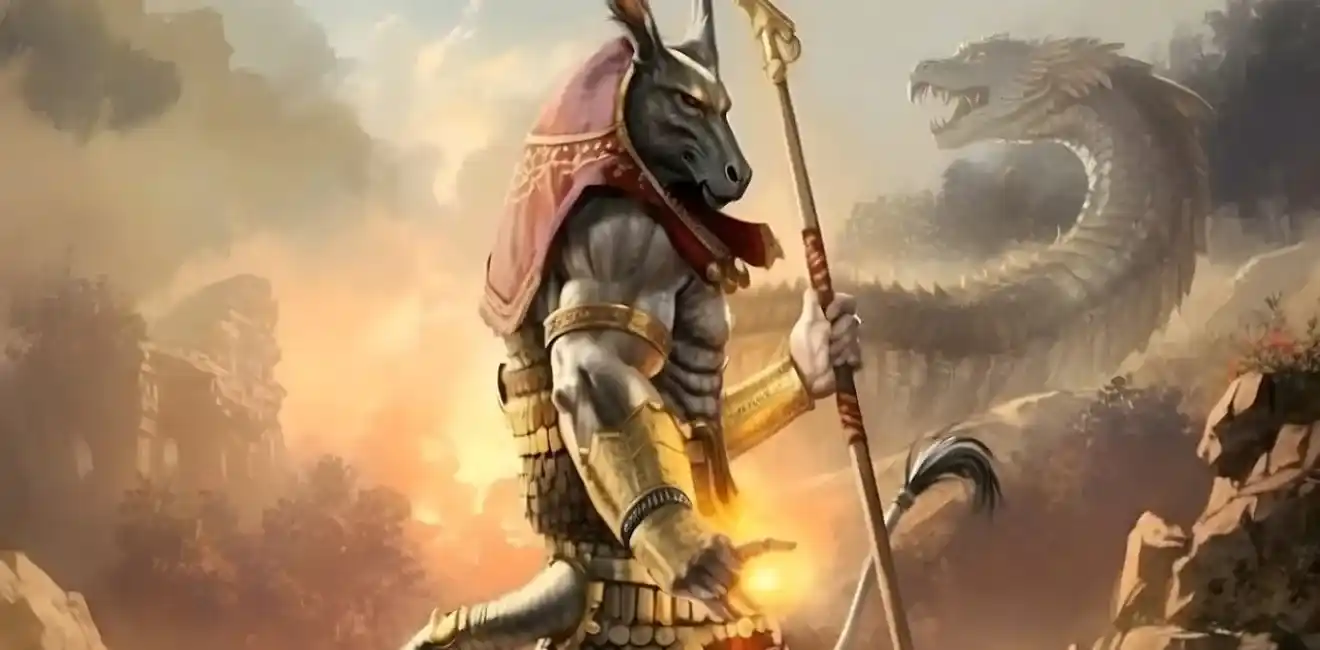
Seth
The religious belief in ancient Egypt was characterized by the multiplicity of gods and the intertwining of their roles where the Egyptians believed that the universe is governed by balanced divine forces that maintain the cosmic order known as “Ma’at”.
The gods were not just symbols of good or evil but rather embodiments of natural forces and abstract concepts such as life and death, fertility and drought, order and chaos.
These gods were depicted in human, animal or hybrid forms and each god had a specific function within a religious system based on the principle of duality and the integration of opposites.
In this complex religious context, the god Seth emerged as one of the most controversial deities. Seth represented the forces of the desert, storms and disorder and was initially a god with a positive and vital role,
considered a protector of the god Ra during his nightly journey against the forces of chaos. With the development of religious thought and the spread of the worship of Osiris and Horus,
Seth’s image changed to become a symbol of chaos and destruction and his name became associated with the myth of the murder of Osiris and the long struggle with Horus for the throne of Egypt.
Despite this, Seth was not seen as absolute evil but rather as a counterforce necessary to maintain cosmic balance reflecting the depth of Egyptian religious philosophy that saw the conflict between opposing forces as a fundamental condition for life and stability.

Seth -The- God -Of -Violence
Seth or Set was the god of the desert, storms, disorder, violence and foreigners in ancient Egyptian religion is Seth (/sɛt/, in Egyptology: Sutekh, swtẖ, stẖ[a] or: Seth /sɛθ/) Ⲥⲏⲧ (in Coptic). The name of the god is written as Seth (Σήθ) in ancient Greek.
Seth played a positive role at first accompanying the god Ra on his boat to fend off the snake Apophis, the serpent of chaos. Seth was a reconciled warrior and lord of the desert forming a balance with the role of Horus lord of the fertile land.
Over time, the Egyptians’ perception of Seth changed. Initially, he was considered a beneficial god living in the blessed realm of the dead. The Egyptians would invoke Seth to help their deceased family members.
However, the priests of Horus entered into a conflict with the followers of Seth leading to a change in Seth’s role within the pantheon.
Seth became a god of darkness and chaos and lord of the desert. He was considered a god of impurity and an enemy of several gods. The priests who opposed him destroyed most of his statues. Seth was an embodiment of drought and as lord of the desert and famine, he was an enemy of everything that gives life.
The Divine Family Of Seth
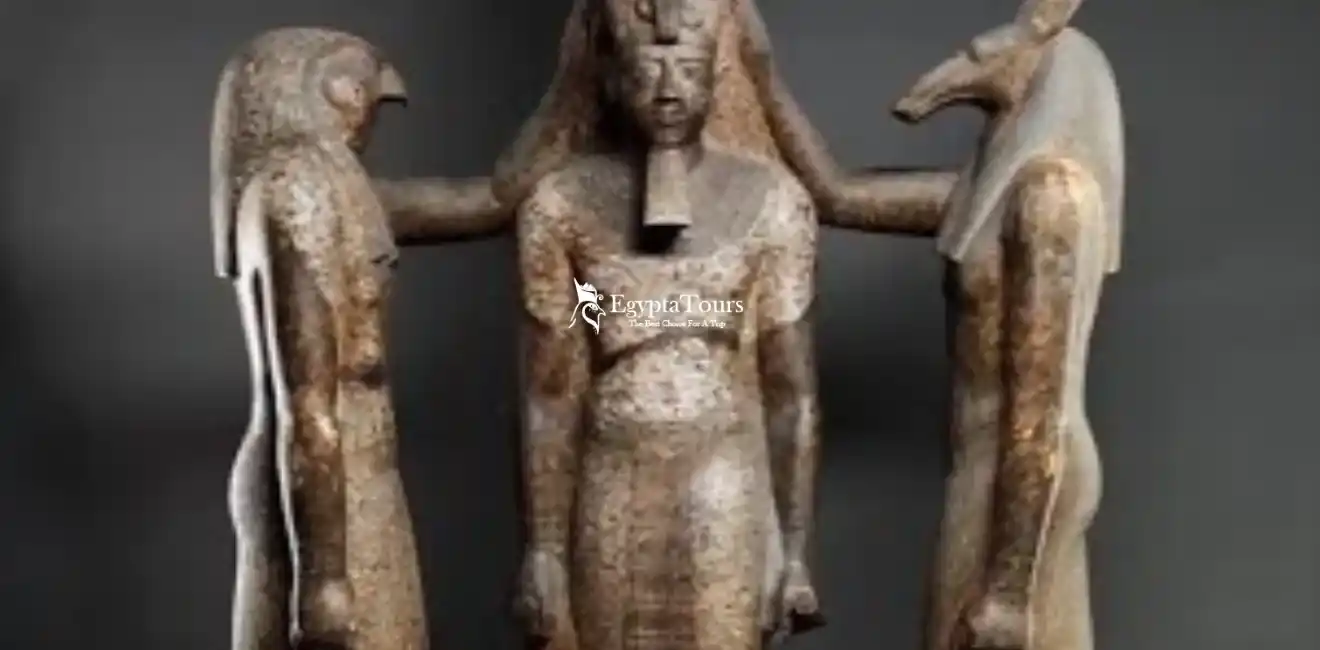
The -Divine -Family -Of -Seth
The divine family of Seth consists of Geb, the earth god and Nut, the sky goddess who are his parents. His siblings include Osiris, the god of the underworld, vegetation and fertility, Isis, the goddess of magic, marriage and wisdom, and Nephthys,
the goddess of darkness and decay. Seth married Nephthys and there is a debate about whether Seth is the father of Anubis, the god of the dead and mummification as some myths attribute his paternity to Osiris instead of Seth.
In addition, Seth was associated with the foreign goddesses Anat and Astarte and these relationships resulted in the birth of a crocodile god named Maga. Seth appears in some myths as both a brother and a nephew of Horus as Horus had multiple identities with blurred boundaries.
In Egyptian mythology, Seth is mentioned as the son of Geb and Nut and is considered a brother to Osiris, Isis and Nephthys.
Seth married Nephthys and this relationship is part of the myths surrounding the origins of the god Anubis with some myths attributing his paternity to Osiris instead of Seth. Seth was also associated with the goddesses Anat and Astarte and these relationships resulted in the birth of a crocodile god named Maga.
The ancient Egyptians believed that he was responsible for unleashing storms and drought upon their land. They also associated him with the planet Mercury and they recognized his potent influence over the cosmos.
Seth’s worship was widespread with numerous temples and altars dedicated to him throughout the land. The Egyptians also often offered sacrifices and prayers to Seth seeking his aid in times of war and conflict. They revered him as a powerful protector believing that he shielded them from harm and malevolence.
The Symbols Of Seth In Egyptian Mythology

The -Symbols -Of -Seth- In -Egyptian -Mythology
In ancient Egyptian art, Seth was shown in many different forms, often as a man with the head of a mysterious creature known as the Seth animal. This creature had a pointed snout, long rectangular ears, a slender body and a long forked tail.
His body was adorned with fur like markings resembling inverted arrows. Seth was typically shown holding an ankh in one hand and a sceptre in the other.
Seth was associated with a range of animals including the wild boar, antelope, crocodile, donkey and venomous creatures like snakes and scorpions. In some myths, he was said to take the form of a hippopotamus showcasing his versatility and power.
The Depiction of Seth as Animal
The Set animal is a mysterious creature depicted in ancient Egyptian art which cannot be identified with any known animal. It may resemble a greyhound, aardvark, African wild dog, donkey, hyena and jackal, pig, antelope, giraffe or fennec fox.
The animal has a downward curving snout, long ears with square ends, a thin, forked tail with tufts of fur resembling an inverted arrow and a slender, canine body. Sometimes, Set is depicted as a man with the head of the distinctive animal.
Some early Egyptologists proposed that the animal was a stylized representation of the giraffe due to the large, flat “horns” that correspond to a giraffe’s ossicones. However, the Egyptians themselves used distinct depictions for the giraffe and the Set animal.
During the Late Period, the depiction of Set underwent a significant transformation with him often being portrayed as a donkey or a man with a donkey’s head. In the Book of the Faiyum,
Set is shown with a flamingo head further emphasizing his changing image. The word for “donkey” was written using the Set animal hieroglyph and Set and the donkey became increasingly referred to as Typhon in the Late Period.
The earliest representations of what may be the Set animal date back to a tomb from the Amratian culture (“Naqada I”) of prehistoric Egypt (3790 – 3500 BCE) although this identification is uncertain. If these representations are excluded, the earliest Set animal appears on a ceremonial macehead of Scorpion II, a ruler of the Naqada III phase. The head and forked tail of the Set animal are clearly present on the mace.
Set “The villain”

Set -The -villain
Seth’s changing into a villain was a complex and multifaceted process. According to Herman te Velde, the demonization of Set took place after Egypt’s conquest by several foreign nations in the Third Intermediate and Late Periods. Set who had traditionally been the god of foreigners thus also became associated with foreign oppressors including the Kushite and Persian empires. It was during this time that Set was particularly vilified and his defeat by Horus widely celebrated.
Set’s negative aspects were emphasized during this period with him being portrayed as the killer of Osiris having hacked Osiris’ body into pieces and dispersed it so that he could not be resurrected.
The Greeks would later associate Set with Typhon and Yahweh, a monstrous and evil force of raging nature. Set and Typhon also had in common that both were sons of deities representing the Earth (Gaia and Geb) who attacked the principal deities (Osiris for Set and Zeus for Typhon).
But in some sayings, Set was still regarded as the heroic chief deity highlighting the complexities and nuances of his character. This dual nature of Set reflects the changing attitudes and cultural influences that shaped ancient Egyptian society during this period.
The Conflict Between Seth And Horus

The -Conflict -Between -Seth -And -Horus
This conflict was a central theme in ancient Egyptian mythology with multiple variations and interpretations. One version revolves around the struggle for the throne of the gods with Seth claiming rightful rule and Horus believing the throne is his by birthright.
In one account, Seth and Haroeris presented their cases before the divine court with Isis using her wisdom to sway the decision in favor of Haroeris. Seth’s anger led to his demand that Isis be banished but she returned in disguise and tricked him into confessing that he was the usurper of the throne.
The Conflict with Horus, the Younger
The conflict with Horus the Younger was related to Horus’s role as the avenger of his father Osiris. Seth had killed Osiris to take the throne and the accounts of his death vary. Isis and Nephthys gathered the pieces of Osiris’s body and Isis was able to revive Osiris for one night during which she conceived Horus. When Horus grew up, he fought Seth to avenge his father and the conflict lasted for decades.
In the end, Seth transformed into a hippopotamus and tried to destroy Horus’s boat but Horus stabbed him with a spear. The other gods prevented Horus from killing his uncle and thus Horus avenged Osiris’s death and gained the throne of the gods.
The Myth Of Osiris

The- Myth- Of -Osiris
The myth of Osiris is the most important myth in ancient Egyptian mythology and it portrays Seth as the usurper of the throne who killed and dismembered his brother Osiris. Isis, the sister and wife of Osiris, reassembled his body and revived him with the help of the goddess Nephthys. This resurrection lasted long enough for her to conceive their son and heir, Horus. Horus sought to avenge his father and many ancient Egyptian myths describe their conflicts.
The Symbolism Of Horus’ Eye and Seth’s Injury

The -Symbolism -Of- Horus’- Eye -and -Seth’s -Injury
The symbolism of Horus’ eye and Seth’s injury carries profound meaning in ancient Egyptian religion. Seth’s injury represents a loss of power and fertility but the removal of Horus’ eye is more significant representing various concepts.
As a sky god, Horus’ right eye is the sun and his left eye is the moon. The theft or damage to his eyes represents the phases of the moon or eclipses. Horus can recover his lost eye or other gods like Isis, Thoth and Hathor can return or heal it.
Egyptologist Herman te Velde suggests that the story of Seth’s lost testicles is a late distortion of Seth losing his semen to Horus and the lunar shaped disk on Seth’s forehead after fertilization is actually Horus’ eye.
If true, the episode of injuries and sexual assault forms a separate story where Seth attacks Horus and loses his semen then Horus retaliates and fertilizes Seth with Seth gaining Horus’ eye when it appears on his forehead.
Since Thoth is a moon god among his other roles, it is plausible according to Velde that Thoth produces the eye and tries to mediate the conflict between the rival gods. In any case restoring Horus’ eye represents the moon’s return to full brightness, Horus’ restoration to the throne and many aspects of Ma’at.
Sometimes, Horus’ recovery of his eye is accompanied by Seth’s recovery of his testicles so both gods are restored to completeness by the end of the conflict.
Seth As The Protector Of The God Ra

Seth -As- The -Protector -Of -The -God- Ra
The ancient Egyptian god Seth has a complex role in Egyptian mythology, sometimes appearing as a protector of the god Ra and other times as his enemy. In some myths, Seth helps Ra in his fight against the snake Apophis, the symbol of chaos standing at the prow of the sun’s boat to defend Ra. This role makes him a powerful and important god in the cosmic order.
However, the Egyptians’ view of Seth changed over time, especially after the Hyksos’ conquest of the Nile delta during the Second Intermediate Period. The Hyksos chose Seth as their patron god, which led the Egyptians to view him with contempt. After the Hyksos were expelled, Seth became a symbol of evil and chaos and his image was vilified.
The Worship Of Seth

The -Worship -Of -Seth
Seth was considered a powerful and important god in ancient Egyptian religion and the pharaohs respected his strength and legitimacy. Some pharaohs bore his name such as Seti I and used the symbol of the Seth animal in their royal emblems.
Seth was associated with two main festivals, one of which was one of the five extra days that preceded the beginning of the new year when the five Osirian gods were born. The Egyptians honored each god on their birthday. The other festival involved a dramatic ritual where the pharaoh or a priest would stab a hippopotamus model and then people would cut and eat a cake shaped like a hippopotamus reenacting Horus’s defeat of Seth.
Seth During The Second Intermediate Period, the Ramesside Period and Later Periods

Seth -During -The- Second -Intermediate- Period,- the- Ramesside- Period- and -Later -Periods
Set and Horus are depicted offering acts of worship to King Ramesses in the small temple at Abu Simbel.
During the Second Intermediate Period (1650–1550 BCE), a group of Near Eastern peoples known as the Hyksos literally “rulers of foreign lands” succeeded in extending their control over Lower Egypt.
They ruled the Nile Delta from their capital at Avaris. The Hyksos selected the god Set, who had originally been regarded as the chief deity of Upper Egypt and the god of foreigners as their patron deity since they perceived him as the closest equivalent to their own principal god, Hadad. As a result, Set once again attained the status of chief god during this period.
Texts record that the Hyksos king Apophis worshipped Set exclusively as indicated in the following passage:
“King Apophis chose the god Set as his lord and he did not worship any other god in the entire land except Seth.”
The scholar Jan Assmann argues that the ancient Egyptians were unable to conceive of a solitary god lacking a network of divine relationships. Consequently, the independent worship of Set, the god of the desert, came to represent a manifestation of evil.
When Ahmose I succeeded in overthrowing the Hyksos and expelling them from Egypt around 1522 BCE, Egyptian attitudes toward Asiatic foreigners became increasingly hostile and royal propaganda contributed to the discrediting of the Hyksos period.
Nevertheless, the cult of Set continued to flourish at Avaris and the Egyptian garrison left there by Ahmose became integrated into the priesthood of Set.
The founder of the Nineteenth Dynasty, Ramesses I, came from a military family based in Avaris that maintained strong connections with the priesthood of Set. Several Ramesside kings bore names derived from that of the god,
most notably Seti I (meaning “man of Set”) and Setnakht (meaning “Set is strong”). In addition, one of the military garrisons under Ramesses II regarded Set as its patron deity. Ramesses II also erected the so-called “Year 400 Stela” at Pi Ramesses, commemorating the four hundredth anniversary of the cult of Set in the Nile Delta.
In ancient Egyptian astronomy, Set was commonly associated with the planet Mercury.
Seth in the New Kingdom
During the New Kingdom, Set also became linked with foreign deities, particularly in the Delta region. He was identified with the Hittite storm god Teshub as well as with the Canaanite god Baal and the two were worshipped together under the name “Set Baal.”
Set is also mentioned in portions of the Greek Magical Papyri, a collection of texts that functioned as a manual for magical practices in the Greco Roman world during the fourth century CE.
The Demonization of Seth

The -Demonization -of -Seth
A relief dating to the late New Kingdom at Karnak shows the figure of Set with his image erased during the period of his demonization.
According to the Egyptologist Herman te Velde, the demonization of Set occurred after Egypt came under the control of several foreign powers during the Third Intermediate Period and the Late Period.
Since Set had traditionally been associated with foreigners, he also became linked with foreign oppressors including the Kushite and Persian Empires. During this time, Set was especially vilified and his defeat at the hands of Horus became a widely celebrated theme.
In this period, the negative attributes of Seth were emphasized. He was portrayed as the murderer of Osiris having dismembered Osiris’s body and scattered its parts throughout the land in order to prevent his resurrection.
The Greeks later associated Set with Typhon and Yahweh regarding them as destructive forces embodying the violent aspects of nature. All three were depicted as donkey-like creatures and their worshippers were classified as practitioners of onolatry.
Set and Typhon were also similar in that both were sons of earth deities (Geb and Gaia) and attacked principal gods (Osiris and Zeus, respectively).
Nevertheless, throughout this same period, Set continued to be regarded as a heroic chief deity in certain outlying regions of Egypt.
The Egyptologist Dr. Kara Cooney presented an episode entitled “The Birth of the Devil” in the documentary series Out of Egypt. In this episode, she describes the process by which Set was demonized and positioned as an embodiment of absolute evil drawing parallels with broader religious transformations across regions from Rome to India where the concept of divinity increasingly came to be defined as the representation of absolute goodness.
The Temples of Seth

The -Temples- of -Seth
A limestone architectural fragment and a door jamb from the temple of Set built by Thutmose III at Nubt/Ombos dating to the Eighteenth Dynasty, is now housed in the Petrie Museum.
Seth was worshipped at several sites including Ombos (Nubt near Naqada and Nubt near Kom Ombo), Oxyrhynchus in Upper Egypt and parts of the Fayyum region.
In particular, Seth was venerated in the relatively large but provincial city of Sepermeru, especially during the Ramesside Period. There, he was honored in an important temple known as the “House of Set, Lord of Sepermeru.” One of the epithets of the city was “Gateway to the Desert” which corresponded closely with Set’s role as a deity of frontier regions.
The temple enclosure at Sepermeru included a small subsidiary shrine called the “House of Set, Powerful Is His Mighty Arm.” Ramesses II also built or modified a second land owning temple dedicated to the goddess Nephthys, known as the “House of Nephthys of Ramesses Meri Amun.”
The temples of Seth and Nephthys at Sepermeru were administered separately, each with its own priests and estates. Another moderately sized temple of Set is attested in the nearby town of Pi Wayna. This close association between temples of Seth and Nephthys suggests that additional “Houses of Seth” and “Houses of Nephthys” likely existed in the town of Su at the entrance to the Fayyum.
Papyrus Bologna preserves the text of a formal complaint submitted by a priest named Pra em hab, Prophet of the “House of Set” in the now lost town of Punodjem. In the papyrus, Pra em hab laments the excessive taxation imposed upon his temple and further complains that he was also burdened with responsibility for the ship, the House of Nephthys and the remaining district temples.
Little is known about the specific theologies of the closely associated temples of Seth and Nephthys in these regions, particularly in light of Nephthys’s apparent Osirian affiliations. When the demonization of Seth was formally instituted during the Twentieth Dynasty,
his cult was either eliminated or increasingly marginalized while Nephthys continued to flourish as part of the Osirian pantheon throughout Egypt. In the Late Period, she even attained the status of tutelary goddess of an independent nome.
Despite this, the cult of Set persisted into the final phases of ancient Egyptian religion in outlying yet significant locations such as Kharga, Dakhla, Deir el Hagar, Mut and Kellis.
In these areas, Set was revered as “Lord of the Oasis” or “Lord of the Town” while Nephthys was worshipped alongside him as “Mistress of the Oasis” without this being seen as contradictory to their roles within Osirian religious practices.
Seth in Popular Culture

Seth -in -Popular -Culture
In the TV series Doctor Who, Seth appears as Sutekh, an alien entity hell bent on destroying all life. He first appears in the 1975 serial Pyramids of Mars where he schemes to escape an Egyptian pyramid where he has been imprisoned for millennia by Horus. Sutekh returns after nearly 50 years in the 2024 Series 14 two part finale “The Legend of Ruby Sunday”, “Empire of Death” as the God of Death in the Pantheon.
In the role playing game Vampire, The Masquerade, Seth is depicted as an antediluvian vampire which was believed to be one of the oldest undead beings.
He was revered as the founder of the enigmatic Followers of Set (now known as The Ministry in the game’s fifth edition). Imprisoned in a state of torpor, Seth remains a focal point for his followers who strive to awaken him from his slumber. He commands powers intertwined with manipulation, darkness and serpentine cunning, epitomized by his unique Discipline, Serpentis which is dedicated to mastering the art of serpents.
In the 1992 Nintendo Entertainment System video game Nightshade, the villain’s public persona is that of “Sutekh”, a crime lord who unites the gangs of the fictional Metro City. In line with Egyptian mythology,
Sutekh reigns supreme over all violence in the city. Interestingly, Sutekh is also the god of foreigners in Egyptian mythology but in the game, the villain is not of Egyptian descent, but rather a historian named Waldo P. Schmeer who is obsessed with Egyptian lore.
Sutekh is an antagonist in some films and other material in the Puppet Master universe, portrayed as the otherworldly owner of the secret of life which animates the eponymous puppets and stalks anyone who steals it.
The Australian band King Gizzard and the Lizard Wizard released the first three songs from their 25th studio album, The Silver Cord with the third song, “Set” describing Set’s killing of Osiris and his subsequent conflict with Horus.
Fighting Between Seth And Apophis

Fighting -Between -Seth -And -Apophis
Seth was the opposite of Osiris, the lord of vegetation and fertility and the two gods were necessary to maintain balance in Egypt. Seth was also the opposite of the god Ra with Ra being the god of order and Seth the god of chaos. Some myths mention that they fought each other at night with Ra emerging victorious.
The End of Set’s Myth And Worship

The- End -of- Set’s- Myth- And- Worship
The worship of Set disappeared after the 20th Dynasty with no new temples being built in his honor and no new royal names invoking him. It is believed that Egypt in the Third Intermediate Period experienced increased aggression and conflicts with Asiatics including the Assyrians and Persians leading to a decline in Set’s reputation as a foreign god. Set became associated with foreign invaders and was increasingly demonized.
By the 26th Dynasty, Set had become a symbol of evil and aggression no longer considered a revered deity. According to Turner, the Assyrian invasion of Egypt had greatly impacted the population particularly due to the destruction of Thebes making Set be seen as a defeated foreign ruler.
As a result, Set’s images and statues were destroyed and sometimes repurposed to honor another god such as Khnum or Amun. Set was no longer a part of ancient Egyptian worship.
FAQs
How was the Conflict Between Seth And Horus?
The legendary conflict between Seth and Horus is a central theme in ancient Egyptian mythology with multiple variations and interpretations. One version revolves around the struggle for the throne of the gods with Seth claiming rightful rule and Horus believing the throne is his by birthright.
In one account, Seth and Haroeris presented their cases before the divine court with Isis using her wisdom to sway the decision in favor of Haroeris. Seth’s anger led to his demand that Isis be banished but she returned in disguise and tricked him into confessing that he was the usurper of the throne.
How was the end of Set’s myth and worship
The worship of Set disappeared after the 20th Dynasty with no new temples being built in his honor and no new royal names invoking him. It is believed that Egypt in the Third Intermediate Period experienced increased aggression and conflicts with Asiatics including the Assyrians and Persians leading to a decline in Set’s reputation as a foreign god. Set became associated with foreign invaders and was increasingly demonized.
By the 26th Dynasty, Set had become a symbol of evil and aggression no longer considered a revered deity. According to Turner, the Assyrian invasion of Egypt had greatly impacted the population particularly due to the destruction of Thebes making Set be seen as a defeated foreign ruler.
What was the Symbolism Of Horus’ Eye and Seth’s Injury?
The symbolism of Horus’ eye and Seth’s injury carries profound meaning in ancient Egyptian religion. Seth’s injury represents a loss of power and fertility but the removal of Horus’ eye is more significant representing various concepts.
As a sky god, Horus’ right eye is the sun and his left eye is the moon. The theft or damage to his eyes represents the phases of the moon or eclipses. Horus can recover his lost eye or other gods like Isis, Thoth and Hathor can return or heal it.
What was the Demonization of Seth?
According to the Egyptologist Herman te Velde, the demonization of Set occurred after Egypt came under the control of several foreign powers during the Third Intermediate Period and the Late Period. Since Set had traditionally been associated with foreigners, he also became linked with foreign oppressors including the Kushite and Persian Empires. During this time, Set was especially vilified and his defeat at the hands of Horus became a widely celebrated theme.
How was the fighting between Seth and Apophis?
Seth was the opposite of Osiris, the lord of vegetation and fertility and the two gods were necessary to maintain balance in Egypt. Seth was also the opposite of the god Ra with Ra being the god of order and Seth the god of chaos. Some myths mention that they fought each other at night with Ra emerging victorious.
About EgyptaTours

EgyptaTours is a name synonymous with trust, excellence, and unforgettable travel experiences, proudly standing as one of the leading travel agencies in Egypt. Renowned for its deep expertise, personalized service, and carefully crafted itineraries, EgyptaTours serves as the ultimate gateway to discovering Egypt in its most authentic and inspiring form.