





The Bent Pyramid of Dahshur: A Unique Step in Pyramid Evolution
The Bent Pyramid at Dahshur in Egypt is one of the oldest and most mysterious monuments in the world. It has been shrouded in mystery since its construction over 4,000 years ago – but now, thanks to recent archaeological discoveries, we can finally unlock some of its secrets. In this article, we take a visit to Dahshur and explore the history and secrets of the famous Bent Pyramid.
Introduction to the Bent Pyramid of Dahshur
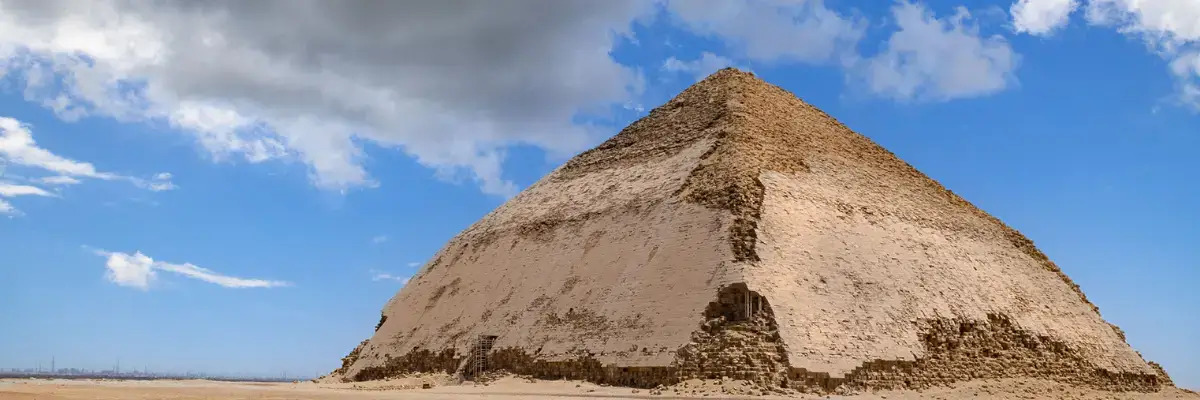
The-Bent-Pyramid
The Bent Pyramid of Dahshur is one of the most famous pyramids in Egypt. It is located in the Dahshur Necropolis, about 40 kilometers (25 miles) south of Cairo. Pyramid was built for Pharaoh Sneferu, the founder of the Fourth Dynasty of Egypt. It is thought to have been constructed around 2560 BC.
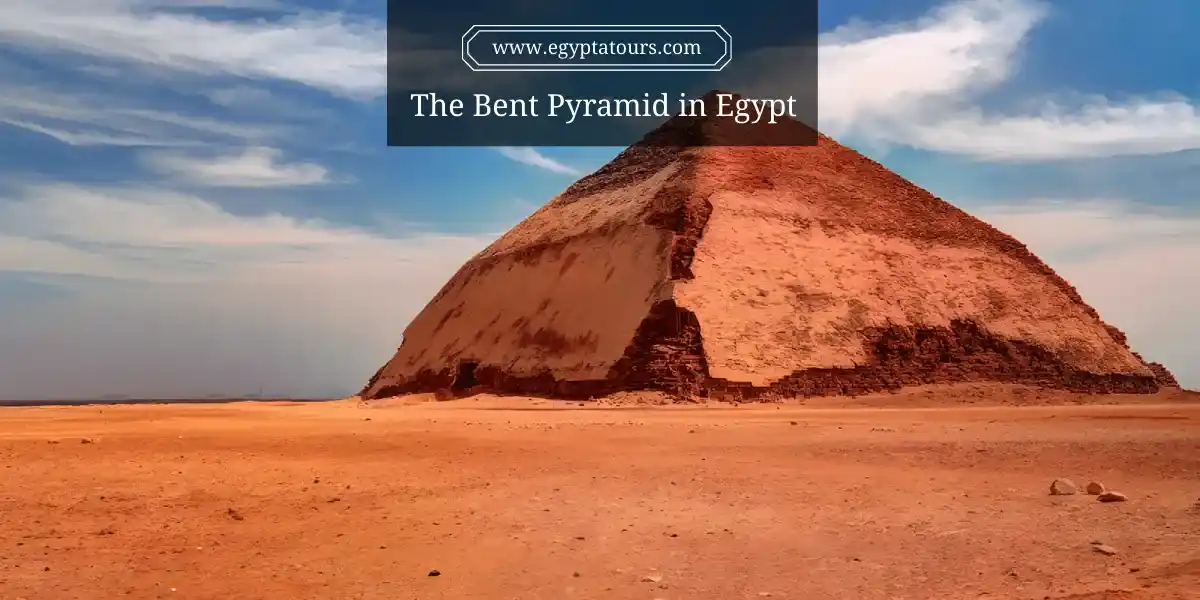
The Bent Pyramid gets its name from its unusual shape. It is bent at an angle of approximately 43 degrees near the middle of its height. This gives it a very distinctive appearance compared to other Egyptian pyramids, which are mostly straight-sided.
The pyramid was originally built with stepped sides. However, these were later filled in with limestone casing stones to give it a smooth outer surface. The Bent Pyramid was also originally covered with a white limestone coating, which has now mostly worn away.
Egypt Bent Pyramid has two entrances: one on the north side and one on the west side. These lead to two separate chambers inside the pyramid: the Queen’s Chamber and the King’s Chamber respectively.
There is also a third, smaller chamber known as the Satellite Pyramid, which is located above the King’s Chamber and was probably used as a tomb for Pharaoh Sneferu’s wife, Queen Hetepheres II.
The Reason the Bent Pyramid Was Given This Name
One of the most important facts about The Bent Pyramid in Egypt is the reason The Bent Pyramid Was Given This Name. The pyramid is called the “Bent Pyramid” because of miscalculations and engineering problems with the structure and the stone blocks. The total weight of the pyramid was not distributed properly, which caused the lower part to slope at 54 degrees while the upper part slopes at 43 degrees, giving it the name “Bent Pyramid”.
Recent studies suggest that the slope change was not due to structural defects but because of geometric considerations. The steep angle at the beginning made it difficult to build stable ramps as the pyramid grew taller so the builders reduced the angle to create a stable ramp, especially since they didn’t have precise models or calculations at that time. These geometric considerations also influenced the pyramids built later, which never exceeded a 53° angle.
Bent Pyramid Construction
onstructed around 2600 BCE, the Bent Pyramid represents a critical juncture in ancient Egypt’s pyramid-building techniques. Initially intended as a true smooth-sided pyramid, its design took an unexpected turn, quite literally.
The lower section of the pyramid rises at a steep 54-degree angle, but midway up, the angle abruptly shifts to a gentler 43 degrees, giving the structure its characteristic bent appearance.
The sudden change in angle has sparked various theories about why the pyramid was altered mid-construction. Some suggest that the builders realized the pyramid’s steep angle might cause it to collapse under its own weight. Others believe the change was a deliberate choice to complete the pyramid more swiftly while ensuring its stability.
Regardless of the reason, the outcome was a unique monument, unlike anything seen in Egypt before or since.
The purpose of the Bent Pyramid
The Bent Pyramid is one of the most unusual and important constructions in Egypt and probably in the world. It was built as the tomb of Pharaoh Sneferu (2575-2551 BC), the father of King Khufu. This was Sneferu’s second pyramid, as part of his plan to develop pyramid construction and increase architectural innovations of his era.
The pyramid is not just a tomb but it also reflects changing spiritual and architectural concepts in ancient Egypt. Its bent shape has great historical significance because of its unique features and symbolic purposes. Although it was designed as a burial place, its shape shows the shift from step-sided pyramids to smooth-sided ones, symbolizing the sun cult and the sun god Ra. The bent shape also highlights architectural experimentation for stability. Additionally, the pyramid symbolizes the union of heaven and earth, reflecting ancient Egypt’s cosmic and religious beliefs.
Inside the Bent Pyramid
Inside-the-Bent-Pyramid-EgyptaTours
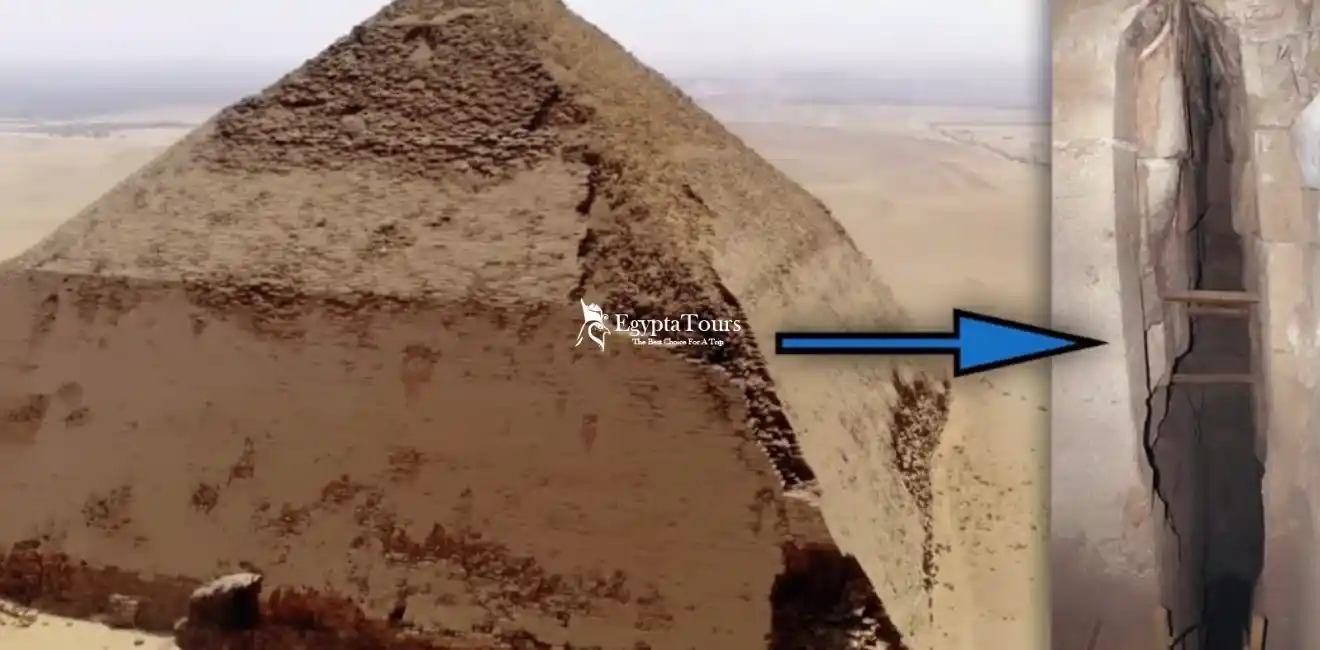
The Bent Pyramid gives a unique and fascinating view of ancient Egyptian architecture because it is one of the few pyramids that still keeps much of its original smooth limestone casing which makes it look very distinct. Inside, the pyramid has a complex structure with several chambers, passageways and unusual architectural designs. Visitors can walk through the narrow tunnels and go down steep passageways to explore the two main chambers.
The first chamber is about 12 meters above the base, while the second chamber is directly beneath it, at the heart of the pyramid. These chambers are connected by different passageways and each one has a high corbel-vaulted ceiling designed to hold the heavy stone blocks above.
The quiet inside the pyramid is very captivating and the difference in temperature between the hot, dry outside and the cool stone interior is striking. The Bent Pyramid also has a special feature: a secondary entrance on its northern face, which is unusual compared to other pyramids and makes its architecture very interesting. The northern chamber has a hole in the roof that can be reached by a long, unstable ladder, leading to a rough passage that connects to the western entrance.
The western entrance passage is blocked by two stone blocks that slide down ramps, unlike the vertical lowering seen in other pyramids. One block was lowered in ancient times and has a hole cut through it while the other is still supported by cedar wood. Inside the chambers, a row of cedar beams caused debate. Some people see them as structural supports but they were actually part of a funerary support system and had no real structural function, especially since some beams are set in mortar.
Bent Pyramid Chambers, Tunnels and Tomb
The interior of the Bent Pyramid is known for its complex system of chambers, tunnels and passageways, reflecting the early development of pyramid construction in ancient Egypt. The pyramid has two main entrances: one on the north face and another on the west face and each entrance leads to different parts of the pyramid.
Northern Entrance and Upper Chamber:
One of the most important facts about The Bent Pyramid in Egypt is the northern entrance that is about 11 meters above the ground and leads to a descending passage ending in an antechamber. Visitors can reach the upper chamber which has a corbelled ceiling. This chamber is spacious and was likely designed to hold the pharaoh’s sarcophagus, although no burial remains have been found.
Western Entrance and Lower Chamber:
One of the most important facts about The Bent Pyramid in Egypt is the western entrance which leads to the lower chamber at the pyramid’s base, accessed by a steep descending passage. This chamber is smaller and less elaborate than the upper chamber but also has corbelled vaulting. It is connected to the upper chamber through a sloping passageway.
Passageways and Tunnels:
The passages between the chambers are narrow and steep, making exploration challenging. They were probably designed this way to protect the tomb from robbers. The tunnels also show the structural challenges the ancient builders faced when carving out internal spaces while supporting the pyramid’s massive weight.
Tomb or Burial Site:
Despite the elaborate design, no sarcophagus or human remains have been found inside the Bent Pyramid. Some scholars suggest that Sneferu may not have been buried here or the tomb was looted long ago. It’s also possible that the pyramid was never meant to be his final resting place and was abandoned once the Red Pyramid was completed.
The Origin of the Casing Stones
One of the most important facts about The Bent Pyramid in Egypt is that a study by several authors explored where the casing material of the Bent Pyramid came from and whether it was natural dressed stone or an early form of concrete. By studying the NMR spectra, it was discovered that the stones are made of limestone from the Tura quarries which were transported from the opposite bank of the Nile. These stones were held together using an artificial calcium-silicate binder, most likely made with diatomaceous earth from Fayium. This supports the idea that the casing was an early form of concrete rather than simple carved stone.
Graffiti
The graffiti found in the Bent Pyramid’s temple was mostly red and located in the corners of the inner parts of the temple. Some graffiti was also found on the pyramid’s enclosure and the offering temple. This graffiti is very important because it gives us information about the tomb, including dating. It shows that the graffiti and quarry marks date back to the time of Sneferu.
The Satellite Pyramid of the Bent Pyramid
One of the most important facts about The Bent Pyramid in Egypt is the satellite pyramid which is located 55 meters south of the Bent Pyramid and was probably built to house the pharaoh’s ka (spirit). It stands 26 meters high and 52.8 meters long, with faces inclined at 44°30′. It is made of thick limestone blocks in horizontal layers, covered with fine Tura limestone.
Its burial chamber is accessed through a descending corridor starting 1.1 meters above ground on the northern face. The 11.6-meter-long corridor slopes at 34° and leads to a short horizontal passage, then to an ascending corridor sloped at 32°30′, finally reaching the central burial chamber. This design is similar to the corridor system of the Great Pyramid of Giza.
Inside the burial chamber, there is a corbel-vaulted ceiling and a 4-meter-deep shaft in the southeast corner, likely dug by treasure hunters. Like the Bent Pyramid, the satellite pyramid had an altar on its eastern side, flanked by two stelae.
Who Built Bent Pyramid of Dahshur
The-Bent-Pyramid-Dahshur-EgyptaTours
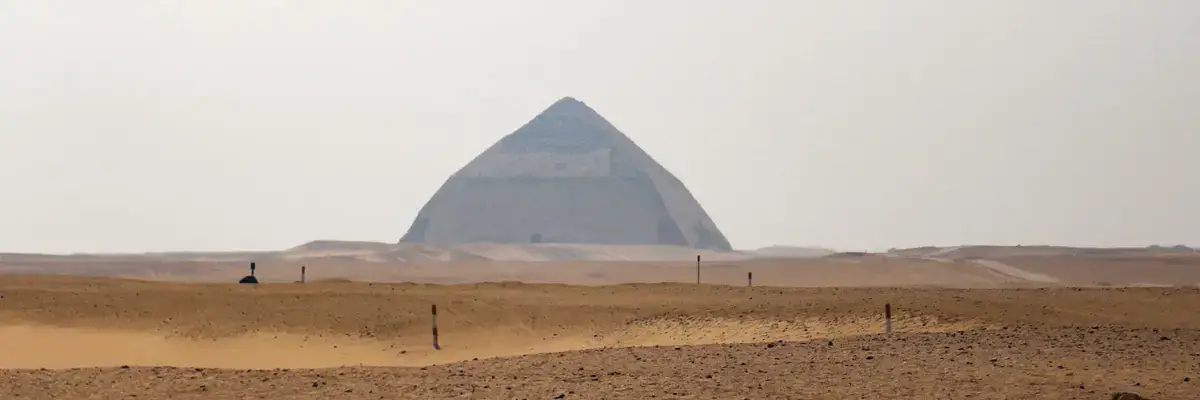
Also known as the Rhomboidal or Blunted Pyramid) is the most significant ancient Egyptian pyramid ever built. It was built by Sneferu, who was the first king of the 4th dynasty of Egypt. He ruled from 2613 BC to 2589 BC. The Pyramid is located at Dahshur, just south-west of Cairo.
It is considered to be the world’s oldest true smooth-sided pyramid (all other smooth-sided pyramids are later).
Egypt Pyramid has a square base and four steps, with each step being slightly more than one third of its height. At its completion, it would have been about 71 meters tall – making it about half as high as a modern day skyscraper!
The sides are also very steep, with an angle at the top corner of 53 degrees (the same angle as modern day skyscurgers). This makes it easier for builders to work on such steep angles without having to worry about them collapsing under their own weight.
History of the Pyramid
The Bent Pyramid is one of the most iconic structures in Egypt. It is believed to have been built around 2600 BC for the Pharaoh Sneferu. The pyramid gets its name from the fact that its upper section is bent, creating an angle of 54 degrees. This is in contrast to the more well-known Pyramids of Giza, which have an angle of 51 degrees.
The reason for Egypt Bent Pyramid’s unusual shape is not known for sure, but there are several theories.
One theory is that the builders ran into problems during construction and had to change the angle of the pyramid halfway through. Another theory is that the bent shape was intentional, and was meant to symbolize the rays of the sun.
Whatever the reason for its shape, the Bent Pyramid is a fascinating structure that continues to puzzle archaeologists and historians today. If you find yourself in Egypt, a visit to Dahshur to see this unique pyramid is definitely worth your time!
Legacy and Preservation
Despite being overshadowed By <strong>the Most famous pyramids of Giza</strong>, the Bent Pyramid holds a special place in Egypt’s architectural history. It represents a transitional phase—a bridge between the earlier step pyramids and the later, perfected smooth-sided pyramids. Sneferu’s bold experimentation paved the way for his successors, including his son Khufu, who would go on to commission the Great Pyramid.
In modern times, the Bent Pyramid has attracted considerable attention from tourists and researchers alike.
In 2019, for the first time in decades, authorities reopened the interior of the pyramid to visitors, allowing them to explore the ancient passages that lead to a chamber deep within its stone heart.
This reopening has revitalized interest in Dahshur, reminding the world that Egypt’s wonders are not limited to the well-trodden paths of Giza.
The Bent Pyramid stands as a silent witness to an age of ambition, experimentation, and the relentless pursuit of perfection.
Its unique shape, the mysteries it holds, and the chambers waiting within its walls ensure that it remains an essential chapter in the story of Egypt’s ancient monuments.
A Dual Entrance Mystery
Adding to the intrigue, the Bent Pyramid is unique in having two entrances—a rarity in Egyptian pyramid design.
The primary entrance, located on the northern face of the pyramid, was the standard for most pyramids of the time. However, the Bent Pyramid also features a secondary entrance on its western side, a feature that has perplexed scholars.
Both entrances provide access to an internal system of corridors and chambers, with the northern entrance leading to a burial chamber and the western entrance offering an alternate route that leads to a chamber further within the structure.
This dual entryway may have served a ceremonial purpose or perhaps was a contingency plan in case the primary entrance became inaccessible. Whatever the reason, it underscores the innovative and experimental spirit of the pyramid’s builders.
A Look at the Architecture of the Bent Pyramid
The-Bent-Pyramid
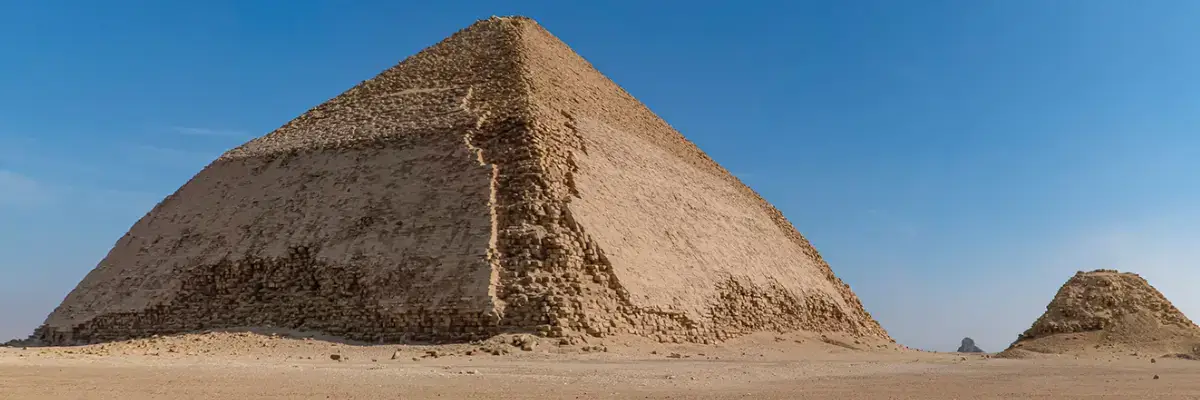
The Bent Pyramid at Dahshur is one of the most fascinating and unique structures in all of Egypt. It’s an architectural wonder, and it has a long and fascinating history.
Egypt Bent Pyramid was built for Pharaoh Sneferu, the first king of the 4th Dynasty. It was constructed around 2560 BC, during the Old Kingdom period. The Bent Pyramid is thought to be the first pyramid ever built with a smooth outer surface.
The pyramid gets its name from its unusual shape. It’s actually two pyramids in one, with each half having its own entrance and stairway. The upper part of the pyramid is smaller than the lower part, giving it a bent appearance.
Egypt Bent Pyramid was originally designed as a traditional step pyramid, but construction was halted when the pyramid began to collapse. The builders then changed course and finished the pyramid with a smooth outer surface. This choice saved the structure from further collapse, but it also created an interesting design feature that makes the Bent Pyramid stand out from all other Egyptian pyramids.
If you ever find yourself in Egypt, a visit to Dahshur to see the Bent Pyramid is definitely worth your time!
The Secrets Behind The Bent Pyramid
The Bent Pyramid is one of the most famous and recognizable pyramids in Egypt. It is also one of the most mysterious, as its strange shape has baffled archaeologists for centuries.
Now, a new study has shed light on the secrets behind the Bent Pyramid, revealing how its builders achieved its unique shape.
The study, published in the journal Nature, used a technique called muon radiography to peer inside the pyramid. Muons are high-energy particles that are produced when cosmic rays collide with atoms in the atmosphere.
When muons pass through material, they are scattered in all directions. By measuring how muons are scattered as they pass through the pyramid, the researchers were able to create a 3D image of the internal structure of the pyramid.
This revealed that Egypt Bent Pyramid was built in two stages. In the first stage, the pyramid was built with a shallower angle of incline (54 degrees). This was then increased to its current angle of incline (43 degrees) in the second stage.
The researchers believe that this two-stage construction process explains why the Bent Pyramid has such a strange shape. It is thought that the builders changed the angle of incline in order to prevent the pyramid from collapsing as it grew taller.
The Secrets Behind The Bent Pyramid: A Visit To Dahshur In Egypt
The Bent Pyramid at Dahshur is a unique pyramid in Egypt. It was built by Pharaoh Sneferu, father of Khufu and Khafre, who are better known as the builders of the Great Pyramids at Giza.
The Bent Pyramid is also known as the false or rhomboidal pyramid due to its unusual shape.
Egypt Bent Pyramid is thought to have been an attempt by Sneferu to build a true pyramid but he was forced to alter his plans due to structural problems. Today, it stands at just under 60 metres tall with a base length of 105 metres and an angle of 43 degrees.
It’s located about 5km south-west of Dahshur’s Red Pyramid and 2km north-east of the Black Pyramid (also known as Amenemhat III) – both belonging to Pharaoh Sneferu.
The Bent Pyramid was constructed from limestone blocks taken from nearby quarries and weighs more than 10 million tons!
The Bent Pyramid is an ancient Egyptian pyramid located at the royal necropolis of Dahshur, approximately 40 kilometers south of Cairo, built under the Old Kingdom Pharaoh Sneferu (2575-2551 BCE). It is also known as the Rhomboidal or False Pyramid because its lower section has a large angle to the rest of the pyramid.
Egypt Pyramid was the second attempt by Sneferu to build a pyramid after his first design proved too ambitious. Construction began in 2700 BCE and was abandoned shortly after it started due to technical difficulties. The Bent Pyramid’s present-day appearance is a result of centuries of vandalism and natural erosion.
The Bent Pyramid’s interior consists of two chambers: A burial chamber with a sarcophagus and a small subsidiary chamber with three niches for statues.
The Pyramid’s outer casing stones were removed by treasure hunters over time, leaving just its core made up of limestone blocks which were covered with fine limestone plaster which has eroded away leaving only small patches on some walls.
Location & How to Visit the Bent Pyramid
The Bent Pyramid is located in the royal necropolis of Dahshur, about 40 kilometers (25 miles) south of Cairo. It sits in a quiet desert area near the more famous pyramids of Giza and Saqqara, making it a perfect stop for travelers who want to explore beyond the usual tourist routes. Dahshur is home to several important pyramids, including the Red Pyramid, which was also built by Pharaoh Sneferu.
The easiest way to visit the Bent Pyramid is by private car or guided tour from Cairo or Giza. The drive usually takes around 45 minutes to one hour, depending on traffic. Many visitors combine Dahshur with a tour of Saqqara and Memphis for a full day of pyramid exploration.
Unlike some other pyramids in Egypt, the Bent Pyramid is less crowded, offering a more peaceful and immersive experience. Visitors can also enter the pyramid and explore its internal chambers, which remain remarkably well preserved. It is recommended to visit in the morning, especially during warmer months, and to bring water, sun protection, and comfortable walking shoes.
If you are interested in ancient engineering and the evolution of pyramid construction, a visit to the Bent Pyramid in Dahshur is a rewarding and unforgettable experience.
Bent Pyramid Tickets
Tickets to enter the Bent Pyramid are available at the Dahshur archaeological site entrance. The ticket usually includes access to the Bent Pyramid exterior, and in most cases, entry inside the pyramid is permitted. Prices may vary depending on nationality and student status, so it’s always recommended to check updated ticket fees before your visit.
Unlike the Great Pyramid of Giza, the Bent Pyramid is far less crowded, meaning you can explore the interior chambers with fewer visitors. Keep in mind that the internal passageways are narrow and steep, so comfortable shoes are recommended. Tickets are typically purchased on-site, and opening hours generally follow standard archaeological site timings in Egypt.
Dahshur Pyramids Tour
A Dahshur pyramids tour is one of the best ways to explore Egypt’s early pyramid evolution. Most tours include the Bent Pyramid and the nearby Red Pyramid, both built by Pharaoh Sneferu. Some itineraries also combine Dahshur with Saqqara (Step Pyramid of Djoser) and Memphis for a full-day historical experience.
Tours usually depart from Cairo or Giza and take around 45–60 minutes by car. You can choose between private tours for a more personalized experience or small group tours for a more budget-friendly option. A licensed Egyptologist guide will explain the architectural innovations that led from step pyramids to the smooth-sided pyramids seen later at Giza.
Visiting Dahshur offers a quieter and more authentic atmosphere compared to the Giza Plateau, making it ideal for travelers interested in ancient engineering and less crowded historical sites.
Conclusion
Tucked away in the royal necropolis of Dahshur, approximately 40 kilometers south of Cairo, stands one of Egypt’s most enigmatic structures: the Bent Pyramid.
This architectural marvel is a testament to the experimentation and ambition of Pharaoh Sneferu, the first king of Egypt’s Fourth Dynasty.
Unlike its more famous counterparts, such as the Great Pyramid of Giza, the Bent Pyramid is distinguished by its curious shape a design that both puzzles and fascinates historians and archaeologists alike.
Bent Pyramid FAQ
What is the Bent Pyramid?
The Bent Pyramid is an ancient Egyptian pyramid located in Dahshur, built during the reign of Pharaoh Sneferu around 2600 BC. It’s unique because its slope changes halfway up, giving it a bent appearance.
Why does the Bent Pyramid have a bent shape?
The Bent Pyramid has a bent shape due to changes in its construction plan. The lower part was built at a steep 54-degree angle. Concerns about stability led builders to switch to a shallower 43-degree angle for the upper portion.
Who built the Pyramid?
Pharaoh Sneferu, founder of the Fourth Dynasty, commissioned the Bent Pyramid. His reign marked a significant period in pyramid construction, with several attempts refining the design before the Great Pyramid.
What is inside the Pyramid?
The Bent Pyramid houses two entrances leading to separate chambers. One entrance is on the northern face, and another on the western side. Both chambers are connected by a corridor and have corbelled ceilings.
Can you visit the Pyramid?
Yes, visitors can explore the Bent Pyramid. Egypt reopened it to the public in 2019 after restoration work. Visitors can enter its interior chambers and experience its architectural ingenuity firsthand.
How does the Pyramid differ from other pyramids?
Unlike traditional straight-sided pyramids, the Bent Pyramid’s distinctive shape results from its angle change. Its dual entrances and two internal chambers also set it apart from other pyramids of its time.
What is the significance of the Pyramid?
The Bent Pyramid is a critical link in the evolution of pyramid construction. It shows the transition from step-sided forms to the smooth-sided pyramids, culminating in the Great Pyramid of Giza.
What other pyramids are near the Bent Pyramid?
Nearby, you’ll find the Red Pyramid, also commissioned by Sneferu. It’s considered Egypt’s first successful attempt at a smooth-sided pyramid and represents an important step in pyramid development.
Is the Bent Pyramid still intact?
Yes, the Bent Pyramid remains largely intact, including its original limestone casing. This makes it one of the best-preserved pyramids, providing valuable insights into ancient construction techniques.
About EgyptaTours

EgyptaTours is a name synonymous with trust, excellence, and unforgettable travel experiences, proudly standing as one of the leading travel agencies in Egypt. Renowned for its deep expertise, personalized service, and carefully crafted itineraries, EgyptaTours serves as the ultimate gateway to discovering Egypt in its most authentic and inspiring form.