





The Tomb of King Ramses IV: KV2
The tomb of King Ramses IV is one of the greatest discoveries. Known by the royal title “Haqa Maatre,” he was a great king in the history of ancient Egypt.
He was also one of the most powerful kings.
Despite being the youngest son of Ramses III and the one furthest from inheriting the throne fate chose him to ascend to power in his forties having become crown prince in the twenty-second year of his father’s reign. Historians differ on the exact date of his reign.
Some accounts indicate that it began in 1155 BC and continued until 1149 BC while others say he ruled from 1151 BC until 1145 BC.

Tomb-of-King-Ramses-IV-EgyptaTours
In the Valley of the Kings in Luxor specifically at Gebel el-Qurna we find one of the most magnificent royal tombs in ancient Egypt. This is the tomb of King Ramses IV known as KV2.
This tomb is a complete story of art and genius from the time of the pharaohs specifically during the Twentieth Dynasty which was part of the New Kingdom known as the Ramesside period.
Ramses IV was one of the most important rulers of his time ruling Egypt between 1163 and 1156 BC.
During his reign his tomb was excavated and built, and it remains one of the most popular tourist attractions on the West Bank of Luxor a city that contains approximately one-third of the world’s antiquities.
The tomb of King Ramesses IV located between KV1 and KV7 is not only famous for its location, but also for its inscriptions that tell tales and legends from the world of the pharaohs.
Its fame was recently heightened by the transfer of the mummy of Ramesses IV from the Ancient Egyptian Museum to the National Museum of Egyptian Civilization as part of the Golden Parade of Royal Mummies in which 17 kings and four queens participated.
The Genealogy and Family Background of Ramesses IV
Ramses IV also known by his full name “Haqa maatre,” was one of the kings of the Twentieth Dynasty of the New Kingdom specifically during the Ramesside period who were known for their strength and great achievements.
He was the son of the great king Ramesses III one of the most famous kings of Egypt at the time.
His mother was Queen Isetamgert one of Ramesses III’s wives.
Speaking of the tomb of King Ramses IV it is clear that King Ramses IV did not bear the throne and its responsibilities alone. Rather he had a life partner Queen Duwatentopet who was his primary wife.
From this marriage, his son Ramses V, was born who succeeded him to the throne. He continued the royal family’s legacy after his father’s death.
This family was one of the most important in Egyptian history because it ruled during a sensitive and eventful period.
It was an effort to establish its presence and preserve the glory of the pharaohs in the face of numerous challenges besetting Egypt during the late New Kingdom.
Key Features of the Tomb of King Ramses IV

Key-Features-of-the-Tomb-of-King-Ramses-IV-EgyptaTours
In the Valley of the Kings in Upper Egypt lies one of the most magnificent royal tombs in the history of Pharaonic civilization the tomb of King Ramses IV.
This tomb is a living testament to the grandeur of ancient Egyptian architecture and art.
The tomb is not merely a burial place, but rather a symbol of immortality.
It was specifically designed to protect the king’s body and commemorate his eternal journey into the afterlife.
The tomb of King Ramses IV is distinguished by its unique design and meticulous details which tell a complete story of the faith and art of the reign of Ramses IV.
We will now review the secrets and features of this tomb:
- The entrance to the tomb is a long, sloping staircase that leads you to the first reception room which prepares visitors for the grandeur of the remaining details of the tomb.
- The burial chamber is a large rectangular hall containing a huge royal sarcophagus made of alabaster.
- The surrounding walls are covered with stunning engravings that tell the myths and beliefs of death and the afterlife.
- The Corridors: The tomb includes three main corridors (B, C, and D), each of which takes you to different scenes and ideas from the afterlife.
- Religious texts: The walls are decorated with texts from the most important pharaonic funerary books such as: the Book of Gates (in the burial chamber) the Book of Caverns (in Corridor D and Corridor K), the Book of Nut, the Book of the Night, and the Book of the Earth, and the Book of the Dead (in Room E).
- Royal burial furniture (in the side chamber, Kb).
- Side passages and compartments (Ka, Kc, and others) depict scenes of gods and the deceased.
- The Imedat, a rare text found in the burial chamber carries magical rituals to ensure immortality.
Details of the tomb of King Ramesses IV

Details-of-the-tomb-of-King-Ramesses-IV-EgyptaTours
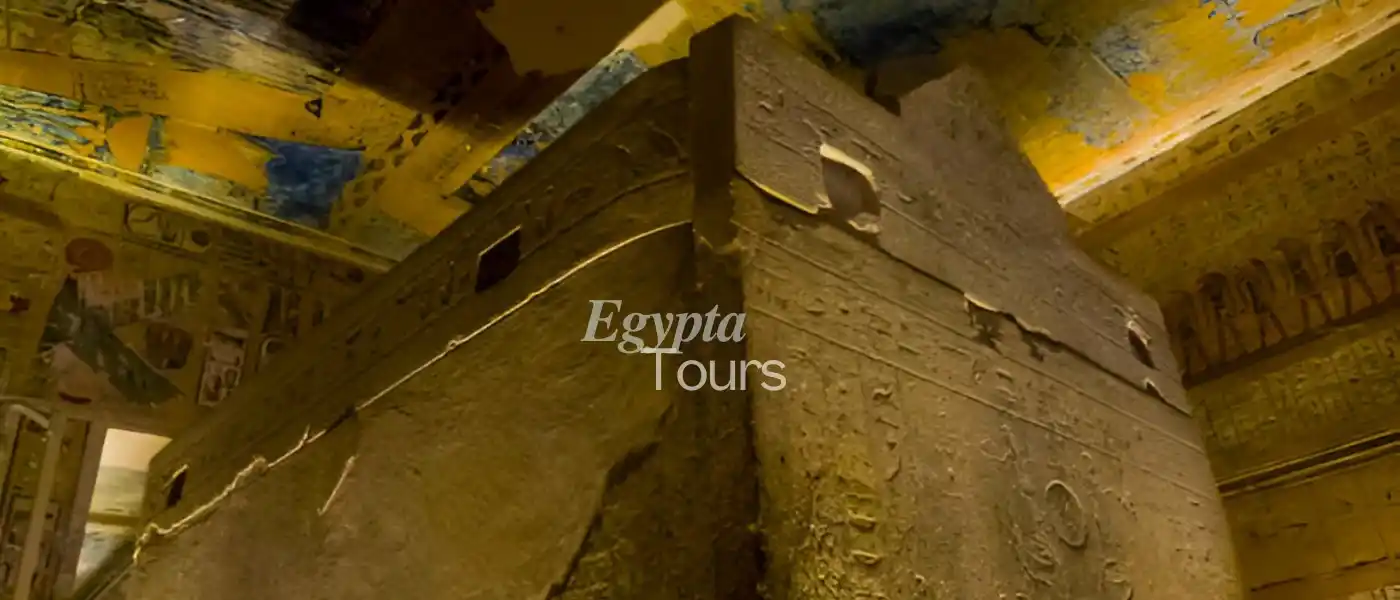
In Room E of the tomb of King Ramesses IV there is a ramp leading to the burial chamber which contains a massive three-meter-high sarcophagus symbolizing the beginning of the afterlife.
On the walls of the chamber are scenes from the Book of the Dead depicting the king’s journey toward immortality while the ceiling is decorated with scenes of stars and the king’s punishments embodying a new life after death.
The scenes around the coffin are inspired by the Book of the Earth and depict the sun tree on its nightly journey.
The figure of Anubis surrounds the coffins guarding the king. On the ceiling, the sky goddess Nut appears representing the entire universe.
The air god Shu raises the sun disc signaling a new beginning.
The celestial texts depict the planetary cycles and the movement of the stars within a distinctively harmonious framework.
Is it possible to visit the tomb of King Ramses IV?
Is-it-possible-to-visit-the-tomb-of-King-Ramses-IV-EgyptaTours
Yes, it is possible to visit the tomb of King Ramses IV one of the royal tombs open to visitors in the Valley of the Kings in Luxor southern Egypt. This tomb also known as KV2, is among the tombs that attract tourists due to the beauty of its inscriptions and unique architectural details.
King Ramses IV was one of the kings of the Twentieth Dynasty of the New Kingdom.
He took great care to construct his tomb in a lavish manner that reflected his royal status despite his early death.
The Works of King Ramesses IV During His Life
With the beginning of the reign of King Ramesses IV one of the greatest building campaigns Egypt had ever witnessed was launched in an attempt to restore the glory of Ramesses II.
He doubled the number of craftsmen and engineers in the village of Deir el-Medina to 120 skilled artists.
His works include the following:
- The king sent successive expeditions deep into the Wadi Hammamat Valley in search of the rare stone.
- The largest expedition ever undertaken in his third year the expedition included more than 8,000 men reflecting the extent of the royal ambition to reshape Egypt’s architectural landscape.
- The journey was not easy as more than 900 men lost their lives demonstrating the magnitude of the challenge these arduous explorations entailed.
- The king did not limit himself to quarries his ambitions extended to Sinai where he dispatched teams to the turquoise mines to support the economy and decorate temples with precious stones.
- The Temple of Khonsu at Karnak built by his father underwent massive expansions by Ramesses IV transforming it into an even more magnificent and magnificent edifice.
- On the west bank of Thebes, the king began constructing a massive funerary temple reflecting his desire for immortality alongside his royal ancestors near the Temple of Hatshepsut.
- Ramesses IV left behind rare historical documents most notably the Harris Papyrus I which glorified the achievements of his father Ramesses III, and provided a detailed account of his gifts and generosity to the country’s temples.
- The geological “Turin Map,” the first known mining map in history also has survived reflecting the technological advancements and scientific interest of this king’s reign.
The Assassination of Ramesses IV’s Father and His Ascension to the Throne
A conspiracy was hatched against King Ramesses III, and his blood was shed by a group of conspirators who sought to overturn the balance of power hoping to place the son of one of his secondary wives on the throne of Egypt.
However the legitimate heir to the throne Ramesses IV would not allow the monarchy to collapse.
He asserted his authority with force and decisiveness thwarting this coup attempt and affirming his right to rule.
At the beginning of his reign when he was already over forty years old he began pursuing those involved and holding them accountable, a clear message that justice would take its course. Although his reign lasted only seven years it was full of achievements.
FAQs
Who is King Ramses IV?
Ramses IV was one of the kings of the Twentieth Dynasty of the New Kingdom. He assumed power after the death of his father Ramses III. He was known for his architectural reforms and efforts to revive the dynasty’s glory.
The tomb of King Ramses IV was one of the greatest tombs.
Where was Ramses IV buried?
King Ramses IV was buried in tomb number KV2 in the Valley of the Kings in Luxor.
This tomb is one of the tombs currently open to visitors and is distinguished by its religious inscriptions.
How many times did King Ramses IV marry?
Ramses IV married Queen Tantuyt.
In conclusion, the tomb of King Ramses IV remains a testament to the king’s greatness and his status among the pharaohs. Its walls reflect the spirit of ancient Egyptian civilization and its fine details.
It is an open-air museum that demonstrates the power of belief in the afterlife and the art of funerary architecture at its most brilliant.
A visit to this tomb is not only a journey through time, but an experience that blends history amazement, and deep contemplation of the genius of the pharaohs.
About EgyptaTours

EgyptaTours is a name synonymous with trust, excellence, and unforgettable travel experiences, proudly standing as one of the leading travel agencies in Egypt. Renowned for its deep expertise, personalized service, and carefully crafted itineraries, EgyptaTours serves as the ultimate gateway to discovering Egypt in its most authentic and inspiring form.