



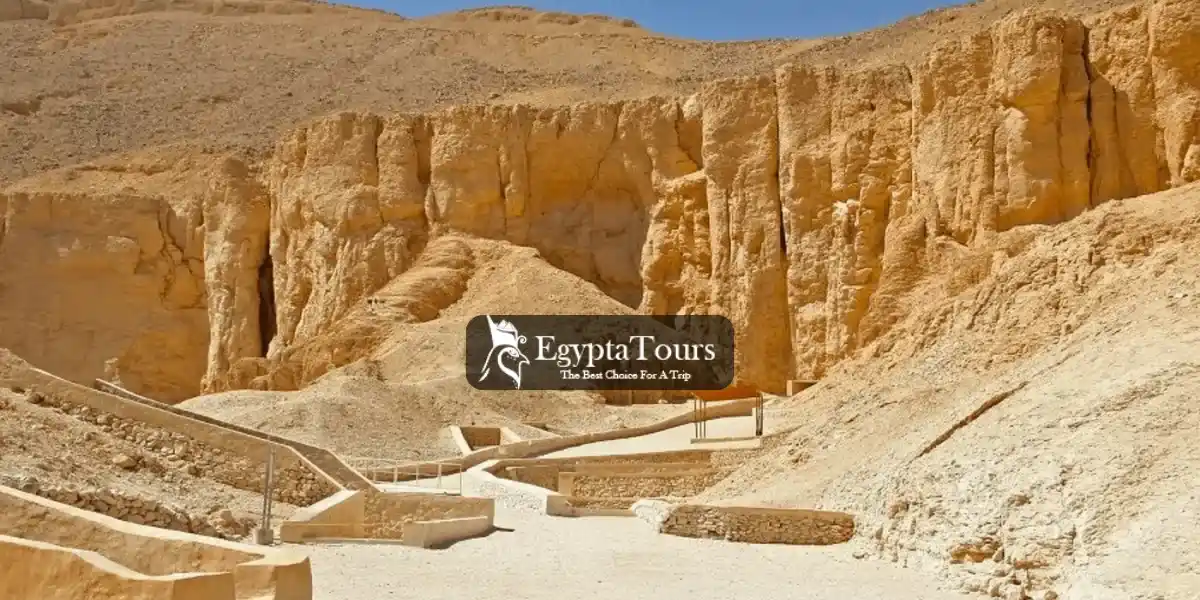
Valley of the Queens in Luxor
The Valley of the Queens, called Champollion, is located to the southwest of the Valley of the Kings and contains the tombs of many of the wives and children of kings. Although it was used as a burial site in the Eighteenth Dynasty, it was only during the reign of the Nineteenth Dynasty pharaoh Ramesses I that royal wives were buried here. Of the nearly 80 tombs inhabiting the valley, the most famous is that of Queen Nefertari, only a few of which are open to the public at any given time.
Ancient builders chose this valley because it was quiet and had a special, sacred landscape. Over time, it became the main burial place for queens of the 18th, 19th and 20th Dynasties. Today, archaeologists have found more than 90 tombs there.
Skilled workers from nearBy <strong>Deir El-Medina</strong> carved and decorated these tombs. They painted colorful scenes on the walls showing the afterlife. Many of the paintings show gods giving protection and guidance to the people buried there.
Because the artists used natural mineral colors, many of the paintings are still bright today. Visitors can still see beautiful blues, reds and golds even after thousands of years.
Valley of the Queens Location

Valley-of-the-Queens-Location-EgyptaTours
The Valley of the Queens is situated in the city of Luxor on the west bank of the Nile River and is part of a group of tombs called ancient Thebes and its tombs alongside the Valley of the Kings.
The Tomb of Amunherkhepshep
The elegant and well-preserved tomb of Prince Amunherkhepshep (Amun), son of Ramesses III, was a highlight of the Valley of the Queens until the reopening of Nefertari’s tomb. Amun could have succeeded his father as pharaoh, but he died when he was a child and was buried in this royal cemetery.
From the entrance, stairs lead to the tomb hall, which contains beautiful, brightly colored frescoes of Ramesses accompanying his young son on a visit to honor the gods of the underworld.
Amun is easily recognizable because he is wearing the special braided hairstyle of a prince. A corridor decorated with the Keepers of the Gates leads to the burial chamber, where the skeleton of a five-month-old fetus is on display in a glass cupboard. Fetuses have been found in other burial chambers and may have been placed there as part of the ceremonial rebirth.
Amon is easily recognizable as he wears the prince’s signature braided hairstyle. A decorated corridor guarding the gates leads to the burial chamber, where the skeleton of a five-month-old fetus is displayed in a glass cabinet. Fetuses have been found in other burial chambers and may have been placed there as part of rebirth rituals.
The Tomb of Tanedjemet

The-Tomb-of-Tanedjemet-EgyptaTours-in-the-valley-of-the-queens
Although archaeologists and Egyptologists have shed a lot of light on ancient Egypt, the truth is that in many cases it remains a real mystery. It is not unusual for them to find from time to time hidden places, strange manuscripts, or even unknown tombs of unknown people, which slightly changes the order of the kings and queens of the dynasties.
This is the case of Tanedjemet, the princess and queen believed to have lived in the Nineteenth Dynasty, although this fact cannot be confirmed.
This name was not fully known until they found a small tomb in the Valley of the Queens. Grave QV33. There was absolutely no document or representation of this mysterious woman, and nothing that could help Egyptologists determine the location of the mummy in a specific period. For this reason, it was initially thought to date back to the Twentieth Dynasty, although they eventually chose the Nineteenth Dynasty.
Her name seems to indicate that she could be the daughter of Horemheb, the last pharaoh of the Eighteenth Dynasty in Egypt, the result of his union with the great royal wife, Queen Mutenjmet.
If these data are correct, as they are only hypotheses, Tanedyemy would have played an essential role in changing the dynasty, because she would have married a pharaoh from the next dynasty.
This would be due to the truth that her father did not have any male children. Therefore, changing the throne could only take place through his minister, Ramesses I. Although the king could easily appoint his successor, the truth was that in the relationship between the two there must be some kind of family relationship. For this reason, it was not strange in these circumstances for the chosen man to marry one of Pharaoh’s daughters.
The problem Is that although you can see in his tomb that he held the title of Great Royal Wife, the truth is that Ramesses I was too old to raise offspring, plus he was only known by his wife Sitra, his mother. Wife for life.
Thus, it is possible that Tanedjemet, instead of marrying Ramesses, married his son Sethy I.
Once again, the passage of time becomes insurmountable in order to spot some light on this story, which, like many others, is set centuries ago in the tomb-filled valleys of ancient Egypt.
The Tomb of Khaemwaset in the Valley of the Queens

The-Tomb-of-Khaemwaset-in-the-Valley-of-the-Queens
The tomb of Khaemweset, one of the sons of Ramesses III, No. QV 44, in the Valley of the Queens on the western mainland of Luxor – formerly Thebes. It was discovered in the early twentieth century, and contains a large number of coffins accumulated in the entrance corridor. This was a clear sign that they were used for shared burials.
One of the most important roles of Khaemweset was the priest of Ptah in Memphis. His important titles were “sem priest”, as indicated by the reliefs in the Medinet Habu temple.
It Is possible that he was the eldest son of Ramesses III, and the latest information indicates that his mother may have been Queen Tyti, but it is unknown because he did not ascend to the throne; Khaemweset probably died not during the reign of Ramesses III, but later during the reign of his brother Ramesses IV
The walls of the tomb are distinguished by relief decorations, and the painted colors remain in exceptional and very elegant condition. This tomb follows a straight axis with a descending entrance corridor leading to the first main hall and vestibule. Upon entering the vestibule, on the left is an portrait of Ptah followed by a scene of Ramesses III and Khaemwaset in front of Anubis and Re Harajty. On the right wall of this room is the king carrying sacrifices to Ptah Sokar, along with a representation of him and Khaemwaset offering incense offerings to Geb before the god Shu receives him.
From here one enters the burial chamber, and the first thing one finds are chapters 145 to 146 to the left of the Book of the Dead. Another scene shows Ramesses III followed by the prince, and several scenes of the geniuses who were guarding the gates of the kingdom of Osiris.
The Tomb of Nefertari

The-Tomb-of-Nefertari-in-the-valley-of-queens-EgyptaTours
Nefertari’s tomb is located in the Valley of the Queens in Luxor, and it is extremely beautiful, deserving of its place in history. The decorations on the walls and ceilings are mythological and deal with life in the underworld, encounters with gods, goddesses, jinn, and monsters, and entry into the kingdom of immortality.
Nefertari appears wearing white clothes, wearing a golden eagle headdress with two long feathers, and decorated with precious jewelry such as bracelets and a wide gold necklace.
At the entrance door to the cemetery, Isis and Nephthys appear in the form of a falcon on the left, and Nejgbet and Wadjet on the right.
The outer hall is square in shape, with a bench to support the funeral apparatus, and above it is an inscription from the Book of the Dead and various scenes.
On the left, the Queen is shown on the throne, holding what looks like a magic wand in her right hand. In another scene, a bird with the head of a queen appears, which is the Egyptian representation of the individual soul.
In the scene, the queen appears kneeling, with her hands raised in worship towards two lions, between which the disk of the sun appears. The two lions represent the past and the future, and the bird “Benu” represents the sacred bird of Heliopolis.
The temple Is surrounded by representations of the goddesses Isis and Nephthys, showing scenes with a coffin in the center containing a jackal, surrounded by mummy figures.
On the western wall there are pictures, showing Nefertari paying respect to the god Thoth, and on his left side there is a large text from the Book of the Dead.
From the outer hall one enters the corridor leading to the tomb, which appears beautifully decorated and the upper parts of the corridors are arranged in the same way, where Nefertari offers two bowls of milk to the goddesses Isis and Hathor.
This corridor leads to the cemetery, after the funeral ceremony and where the final transition to the burial chamber takes place.
The burial chamber is a large rectangular room with four large columns, on one side two rooms and a small inner room whose function is unknown.
The walls of the entrance to the burial chamber are decorated with four deities and texts from the Book of the Dead. On one of the walls of the room, Nefertari appears in the shape of a mummy.
Queen Tyti Tomb
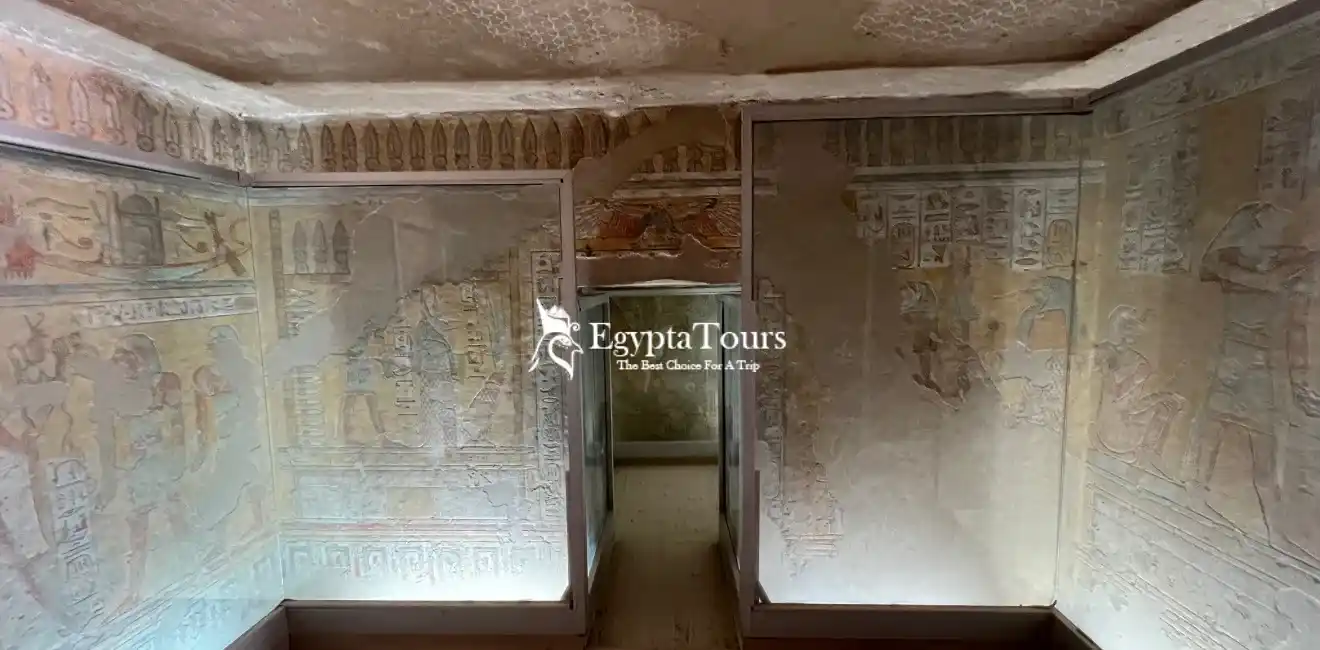
Queen-Tyti-Tomb-EgyptaTours
The tomb of Queen Titi is the second closest tomb to the main entrance. However, if you do not have much time, you may choose to skip it.
If you have never seen an Egyptian tomb before, you might think it is amazing. But when you compare it to the tombs in the Valley of the Queens, the Valley of the Nobles and the Valley of the Kings, the paintings and decorations in Titi’s tomb are not in very good condition.
Again, the walls in all the rooms except one are covered with glass from the floor to the ceiling. Although many of the paintings are damaged, you can still understand most of the scenes.
Experts do not know much about Queen Titi, but they believe she was the wife of one of the Ramesses kings. Most think she was the wife of Ramesses III, because her tomb is located between the tombs of two of his sons.
This tomb is also cooler in temperature than many other tombs in the Valley of the Queens which makes it a nice and refreshing stop during your visit.
Queen Tiye Tomb
Queen Tiye was the wife of Amenhotep III and the mother of Akhenaten. She has a tomb in the Valley of the Queens.
Her tomb is not as large or as beautiful as Nefertari’s tomb, but it is still very important. Queen Tiye was one of the most powerful and respected queens in Ancient Egypt.
The writings and carvings inside her tomb show her high position in the royal family. Over time, the tomb may have been used again for other purposes. Although some of the paintings were damaged, they still help us understand the life of a strong queen who lived during one of Egypt’s richest and most successful periods.
Tomb of Aset
The tomb of Aset, sometimes spelled Asat, is a small but important tomb in the Valley of the Queens. Aset is thought to have been either the daughter or the wife of a pharaoh from the 19th Dynasty.
The tomb shows pictures of gifts being offered to the gods and scenes of Aset in different roles, sometimes with gods standing beside her. The paintings are very beautiful, but much of the inside of the tomb is not as well kept as the tombs of more famous queens like Nefertari.
Even though the tomb is small, it helps us understand the art and religious symbols that were used in royal burials in Ancient Egypt.
Tomb of Queen Meryt-Amun
Meryt-Amun, the wife of Amenhotep I, has a tomb in the Valley of the Queens. Her tomb is quite simple compared to other tombs there.
The tomb is important because it links the rule of the 18th Dynasty to the later New Kingdom period. Inside, there are a few pictures showing offerings to the gods and images of the queen.
Even though the tomb is not very large or richly decorated, it is important because of the role Meryt-Amun had in Egypt’s religious and political life as the wife of a strong and powerful pharaoh.
Tomb of Tausert
Twosret was the wife of Setnakhte and the last ruler of the 19th Dynasty. She first ruled as a regent, then later became pharaoh herself.
Her tomb in the Valley of the Queens is important because she was a rare female ruler. The decorations in her tomb are simpler than those of more famous queens before her, but it still has writings and pictures showing her giving offerings to the gods and entering the afterlife.
Tausert’s tomb helps us understand the final years of Egypt’s New Kingdom and shows the difficulties she faced ruling in a society mostly led by men.
Tomb of Meritamen
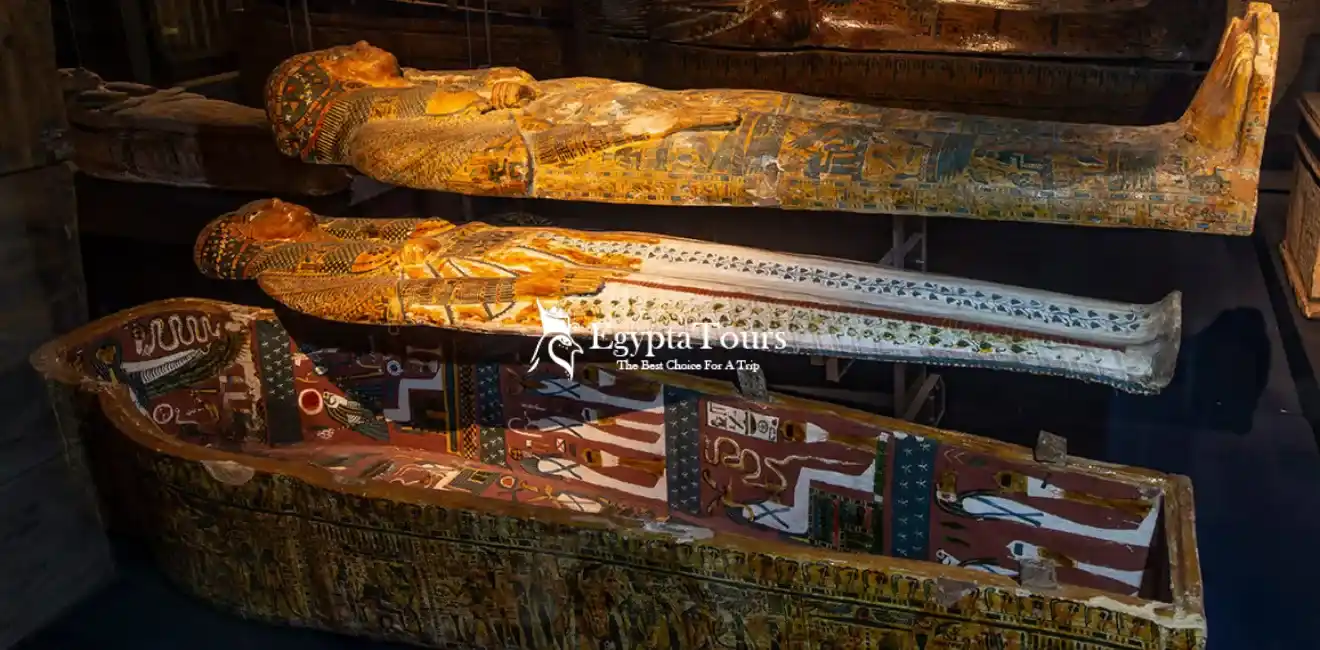
Tomb-of-Meritamen-EgyptaTours
Meritamen, the daughter of Ramesses II, has a tomb known for its beautiful artwork. The walls of the tomb show Meritamen in different holy scenes, often with the goddess Hathor. This shows her strong connection to the gods. The paintings inside are of very high quality and show scenes of the afterlife and her journey to the next world.
Meritamen’s tomb shows how important royal daughters were in Ancient Egypt. Even after death, they were given special religious and ceremonial roles.
Why Visit the Valley of the Queens
Unlike the Valley of the Kings, the Valley of the Queens is quieter. This lets visitors explore the area slowly and without rushing.
The paintings inside the tombs are one of the main reasons to visit. They are very well done and also show the religious beliefs about life after death.
The site also helps visitors understand how important royal women were in Ancient Egypt. Overall, the Valley of the Queens combines history, beauty and meaning in one special place.
Why the Valley of the Queens Was Chosen as a Royal Burial Place
Two nearby places helped decide why the Valley of the Queens was chosen as a royal burial site.
Deir el-Medina, where the skilled workers who built and decorated the tombs lived, was only about 1 km away. This made it easy for them to reach the valley through the Valley of the Dolmen.
The location also created balance in the royal burial areas. Kings were buried in the north in the Valley of the Kings while queens were buried in the south. Both places were inside sacred land.
Religious reasons were also important. A small cave at the entrance of the valley was connected to the goddess Hathor. She represented protection, motherhood and new life. This made the valley a meaningful place where royal women could be reborn in the afterlife.
Tomb Design and Wall Paintings in the Valley of the Queens
Most tombs in the Valley of the Queens follow a similar layout. They usually have an entrance corridor, a few small rooms and a burial chamber with a stone coffin.
Some larger tombs include two big rooms connected by a hallway, along with extra side rooms.
This layout represents the soul’s spiritual journey. Each room had an important part in the burial ceremonies. Walking through these quiet rooms symbolizes how the soul travels from life on earth to eternal life with the gods.
The tombs in the Valley of the Queens show beautiful ancient art in their bright wall paintings.
Egyptian artists used natural colors taken from the earth. They crushed these materials into a fine powder and mixed them with substances such as gum arabic to make paint.
The bright blue color seen in many tombs was not natural. Artists made it by heating a mix of sand, lime, sodium carbonate and copper materials.
Each color had a special meaning. Black meant fertility and new life. White stood for purity. Red showed strength and life energy. Green meant renewal and yellow was linked to eternal life.
The Best time to visit the Valley of the Queens

The-Best-time-to-visit-the-Valley-of-the-Queens-EgyptaTours
Is not as crowded or busy as the Valley of the Kings, so you can visit the valley at any time. In summer, it is best to visit the Queen Valley in the early morning or later afternoon. During the winter, whenever you want, from 07.00 a.m. to 17.00 p.m. Consider having water, comfortable shoes, sunscreen, a hat, and sunglasses.
Tickets
During your visit to the Valley of the Queens, you will need to purchase an entrance ticket to the Valley of the Queens, including entry to 3 tombs. The ticket office is at the entrance to the parking lot or the first shop in the shop line in the area.
Entrance fees to the Valley of the Queens
Adults: 100 Egyptian pounds ($)
Students with valid cards: 50 Egyptian pounds ($)
Children from 6 to 12 years: 50 Egyptian pounds ($)
Children under 6 years: free.
Conclusion
The Valley of the Queens, located near Karnak in Luxor, served as the burial site for members of the royal family during the 19th and 20th dynasties of ancient Egypt. This necropolis is most famously associated with Ramses II, one of the most powerful pharaohs, who built a grand mortuary temple nearby.
The Valley was designed to honor queens and royal consorts, distinguishing it from the Valley of the Kings, which primarily housed pharaohs.
Here, the tombs are richly decorated with intricate paintings and inscriptions that depict the journey to the afterlife, offering a glimpse into the beliefs and customs of the time.
The 20th dynasty saw the construction of several notable tombs, reflecting the artistic and architectural achievements of the period. Today, the Valley of the Queens remains a testament to the grandeur of ancient Egyptian civilization and its reverence for royalty.
FAQ about Valley of the Queens
Where is the Valley of the Queens?
It’s on the west bank of the Nile near Luxor, across from the Valley of the Kings in Egypt.
What is the Valley of the Queens?
A necropolis where Egyptian royal wives, mothers, and princesses of the New Kingdom were buried.
How is it different from the Valley of the Kings?
The Valley of the Queens contains tombs of royal women; the Valley of the Kings contains tombs of pharaohs.
Which dynasties are represented there?
Primarily 18th to 20th Dynasties (c. 1550–1070 BCE), with some later royal women buried nearby.
What is the most famous tomb in the Valley of the Queens?
The tomb of Nefertari (often celebrated for its exquisite wall paintings).
Are all tombs open to visitors?
No. Only a subset is open at any given time; opening hours and accessible tombs vary seasonally and by conservation needs.
How do I visit the Valley of the Queens?
Tours typically depart from Luxor; you’ll often combine it with the Valley of the Kings and other nearby sites.
What should I expect to see inside the tombs?
Painted reliefs and scenes from ancient Egyptian life and funerary texts, though many tombs are partly damaged or unfinished.
How long does a typical visit take?
About 1–2 hours, depending on how many tombs you enter and the walking pace.
What’s the best time of year to visit?
October–April, when daytime temperatures are cooler and more comfortable for walking outdoor routes.
Is photography allowed?
Photography is often restricted inside tombs; outside areas usually permit it, but follow the guide’s directions.
Are there any conservation or access restrictions I should know about?
Yes. Tombs are protected sites; some floors or passages are restricted for preservation and safety.
How far is it from Luxor temple or Karnak?
Roughly 5–7 miles (8–12 km) from central Luxor; typically included in a day trip with other west bank sites.
What should I wear and bring?
Lightweight, respectful clothing; sturdy shoes; water; hat and sunscreen; a small flashlight can help in dim tombs.
Is the Valley of the Queens part of a UNESCO World Heritage Site?
Yes. It’s part of the “Ancient Thebes with its Necropolis” inscription, comprising the Theban necropolis and Karnak.
About EgyptaTours

EgyptaTours is a name synonymous with trust, excellence, and unforgettable travel experiences, proudly standing as one of the leading travel agencies in Egypt. Renowned for its deep expertise, personalized service, and carefully crafted itineraries, EgyptaTours serves as the ultimate gateway to discovering Egypt in its most authentic and inspiring form.