




Wadi El Natrun Monasteries: Sacred Desert Treasures of Egypt
The Wadi El Natrun monasteries are considered to have a special and unique significance. At the beginning of our talk, the word Natrun refers to salt, as the Pharaohs used salt in this valley to mummify mummies.
The city of Wadi El El is an Egyptian city affiliated with the Beheira Governorate and is located on the northeastern edges of the Egyptian Western Desert.
This place enjoys a special sanctity due to the passage of the Holy Family through it in ancient times, and therefore monasteries abounded in it.
It is a very famous area in church history, as monastic gatherings began there in the fourth century AD, and the first monastery was built in the region. Let us get to know the pages of the Coptic history of the Wadi El Natrun monasteries and take a comprehensive look at them.
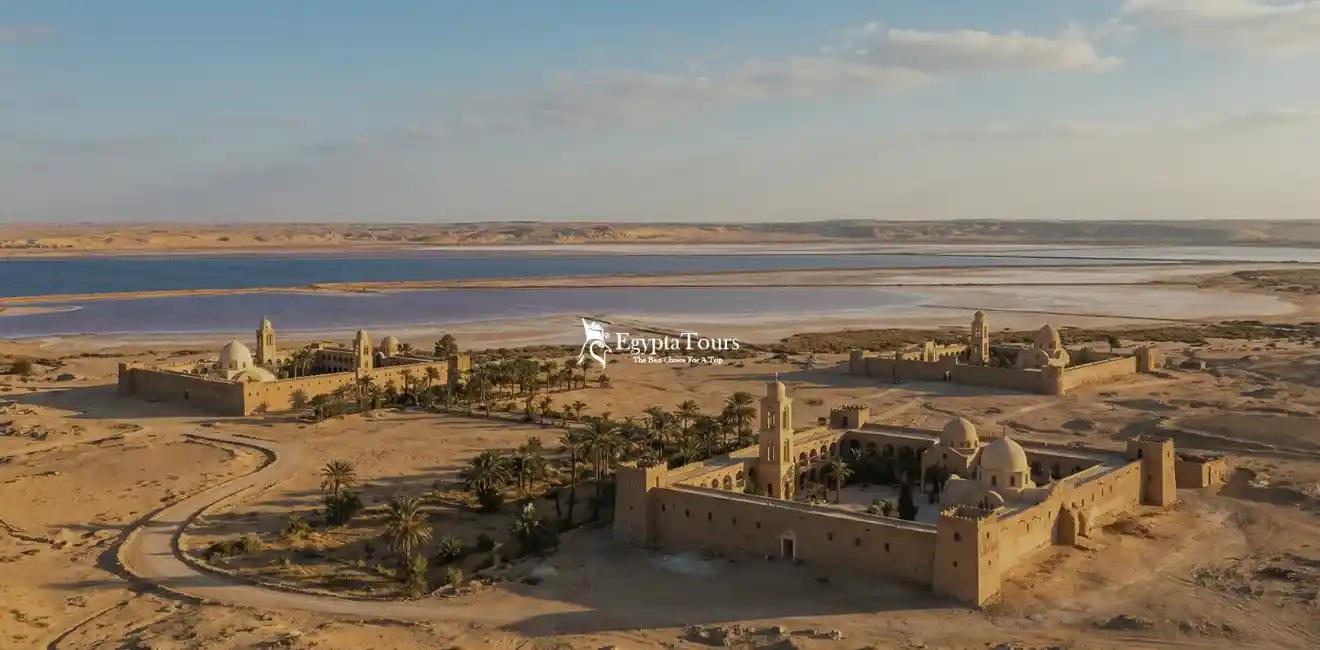
Wadi-El-Natrun-Location-and-What-it-is-like-EgyptaTours
Wadi El Natrun is a famous valley located about 23 meters (75 feet) below sea level and about 38 meters (125 feet) lower than the level of the Nile River. The valley is easy to reach and the best way to get there is by driving from Cairo by car.
Wadi Natrun was called the Desert of Scetis or Scete in old Christian writings. This name referred to the monks who lived there to pray and live a simple life and also to the very dry desert around the area. However, Wadi Natrun is actually a valley located between the Western Desert and the Nile Delta. In this valley there are several lakes that become dry during the summer.
Wadi Natrun is part of the Beheira Governorate. The monasteries in this area are located about halfway between the cities of Cairo and Alexandria around 100 km from Cairo and about 120 km from Alexandria. The region has small villages spread out across it, with nearly 80,000 people living there. Many of them work on farms and take care of the agricultural land. The closest town to the area is Bir Hooker.
History of Wadi El Natrun
Almost everything you will see when visiting Wadi Natrun is connected to Coptic Christianity. However, the history of this place started long before this religion appeared and even much earlier in ancient times. Fossils of prehistoric animals have been found in this area, both recently and in the past and these discoveries were also mentioned in Greco-Roman period writings.
These fossils may be related to similar discoveries in nearby places, such as Valley of the Whales near Fayoum Oasis. This means that the fossils could be tens of millions of years old. At that time, this area looked very different. First, it was under the Tethys Sea and later it became a wet land with lots of plants and vegetation.
How Wadi El Natrun became a Spiritual Refuge
The Nile Valley was the birthplace of ancient civilization, but Egypt’s deserts also played an important role in Christian history. This quiet and empty land gave early Christians what they wanted most: silence, isolation and freedom from the distractions of daily life.
Macarius the Great began his journey to Wadi El Natrun around 330 AD. By 333 AD, he founded the first monastic settlement there. Because of his strong spiritual reputation, many other people came to live near him and built their small huts and cells nearby. These early hermits believed the desert was a holy place where they could feel closer to God, following the example of Christ who also spent time in the desert.
The community grew very quickly. By the 4th century, thousands of hermits were living in caves and on the cliffs. The people who came there had many different backgrounds. Some were philosophers, some were farmers; some were rich nobles and others were simple workers. The monasteries welcomed people from many places such as Egypt, Greece, Ethiopia, Armenia, Nubia, Palestine, Italy, Gaul and Spain.
Over time, the separate hermit groups became organized communities with shared buildings and clear rules. By the end of the century, four main monastic centers had appeared: Monastery of the Romans (Baramus), Monastery of Saint Macarius the Great, Monastery of Saint Bishoy, John Kolobos’s monastic center.
This desert region later became one of the most important spiritual areas in Christianity. At its height, there were about 700 monasteries. Between the 4th and 7th centuries, hundreds of thousands of people joined the monastic movement in this peaceful desert.
Visiting Wadi El Natrun Today
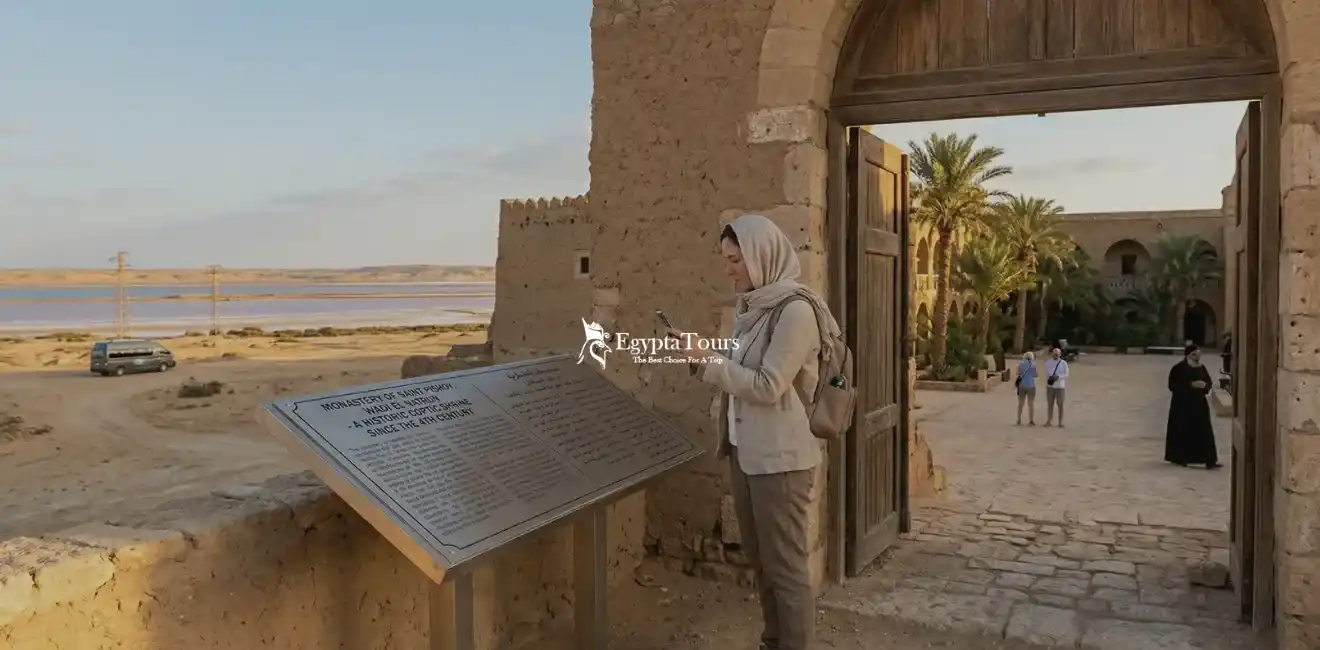
Visiting-Wadi-El-Natrun-Today-EgyptaTours
Wadi El Natrun is about 100 km northwest of Cairo and 120 km from Alexandria. You can reach this peaceful desert area by car in 1.5 to 2 hours. The drive is easy and comfortable.
The best time to visit is from October to April. The cool air in late winter makes it great for taking photos in the desert.
Visitors should remember some important things. Respect the religion by wearing modest clothes shoulders and knees must be covered inside the monasteries. Women should bring a light scarf in case they need to cover their hair in the sacred areas.
Each monastery has its own rules for photos. You can usually take pictures outside, but many holy areas do not allow cameras to protect the old icons and keep the spiritual atmosphere.
Monasteries welcome hundreds of visitors every day, but some access is limited during Coptic fasting times, like Lent or Holy Week. Most people visit several monasteries because they are spread over 25 km.
The area is perfect for a day trip from Cairo or Alexandria, although places to stay nearby are few.
From Ancient Salt mining to sacred
Wadi El Natrun has a special geology that made it perfect for creating natron a natural mineral like sodium bicarbonate. Ancient Egyptians used natron for mummifying pharaohs and important people. The mineral-rich lakes gave the materials needed to preserve bodies which made this valley very important for the economy of ancient Egypt.
Later, the Romans used natron to make glass and created trade routes that connected the valley to the Mediterranean markets. In the 19th and early 20th centuries, the Egyptian Salt and Soda Company built railways into the area to mine natron on a large scale. Eventually, man-made substitutes replaced natural natron, making it less valuable.
Archaeologists have found fossils from the Pliocene era, showing that this dry desert used to be the bottom of the ancient Tethys Sea. Long ago, animals like Euthecodon and Paracamelus lived in this area which later became a place for Christian prayer and meditation.
The change from a place for mining and trade to a spiritual desert started when Macarius the Great went to live in these deserts around 330 CE, looking for peace and quiet during times of Roman persecution. His example inspired other desert fathers who helped build the first organized monasteries.
The Most important information about the Wadi El Natrun monasteries
This area included about 700 monasteries in the second half of the fourth century AD, and therefore the area is considered one of the most important areas honored by Christians, and the area was known by several names the most famous of which are: the salt field Shehit Al-Isqit, and Bir Hooker.
We also note that there are many monasteries in Wadi El Natrun, but the five most famous ones are the largest of them, the Monastery of Baramous. The most famous monastery in Wadi El Natrun is the Monastery of Anba Bishoy where the body of Pope Shenouda III is located.
The latter is distinguished by being an architectural masterpiece with a unique style. The number of monasteries at that time was large reaching approximately 50 Coptic monasteries that existed in the past.
These four monasteries were registered as Coptic antiquities, but only four of them remain.
The four monasteries of Wadi El Natrun and what they contain of churches, fortresses, caves, grottos, walls, and archaeological materials from the fourth century AD represent a developed Coptic architectural style expressing an important period in the history of monastic architecture around the world, for followers of the Coptic Orthodox Church.
These four monasteries are:
- Monastery of Anba Macarius the Egyptian.
- Monastery of Anba Bishoy.
- Monastery of Baramous.
- Monastery of the Syrians.
Christians from all over the world are keen to visit these monasteries to pray and visit the ancient churches in these monasteries.
Monastery of Anba Macarius

Wadi-El-Natrun-Monasteries-Monastery-of-Anba-Macarius
It was established by Macarius the Great, and is known as Anba Macarius the Great. The Monastery of Anba Macarius is considered one of the landmarks of the monasteries of Wadi El Natrun.
It is one of the oldest spiritual and historical treasures that represent the sanctity of monastic life in Egypt. Its history extends back centuries, and it has remained a spiritual beacon for Christians to follow.
1. Geographical importance of the monastery
The Monastery of Anba Macarius is located in the middle of Wadi El Natrun. The valley is characterized by calm and tranquility, in an ideal environment for contemplation and reflection, and distance from worldly life. As for its distinguished location, it has been a haven for monks and spirituality since ancient times.
The monastery is located on the desert road from Egypt to Alexandria at kilometer 92 in front of Sadat City, and on the left side of those coming from Cairo, where the monastery appeared in the last third of the fourth century 385 AD.
The monastery began with the cell of Father Macarius then the disciples gathered around him and built their cells at different distances, then they started building a church for prayers, then the adjacent cells appeared as well as the stores as well as a nearby well, rooms for the sick, and wings for visitors.
2. Historical roots
Anba Macarius one of the most prominent spiritual fathers in the history of the Coptic Church, played a major role in establishing the monastery and spreading the culture of austerity and asceticism, due to his morals of dedication and sacrifice, and later became a model for successive generations of monks and ascetics.
3. Architectural style
It is characterized by simplicity and distance from extravagance, and it has been renovated and restored many times to preserve the religious and historical identity while the walls of the monastery are a symbol of steadfastness throughout the centuries.
4. Monastery of Anba Macarius Modern
Despite the challenges of time and the changes that the world is experiencing in the modern era it is still a spiritual institution that hosts pilgrims and visitors inside and outside Egypt, with concerted efforts to preserve and restore this unique heritage to remain a living beacon reflecting its ancient past and its present full of faith.
Monastery of Anba Bishoy

Monastery-of-Anba-Bishoy-Wadi-El-Natrun-Monasteries
The Monastery of Anba Bishoy is considered the most famous among the Coptic Orthodox monasteries, and it is one of the prosperous monasteries that played an important role in the monastic history of Egypt.
It is a spiritual institution of significant ecclesiastical importance, and the monastery is distinguished by its unique location in the heart of the Western Desert, where the holy fathers retreated to worship and contemplation, and it receives visitors from everywhere.
Geographical importance of the monastery
The Monastery of Anba Bishoy is also located in the heart of Wadi El Natrun, with its desert nature that calls for contemplation, isolation, austerity, and devotion to worship.
Who is Anba Bishoy?
He is one of the most prominent saints of Coptic monasticism, and he was given the title “Beloved of Christ”. He lived an ascetic and austere life, and was known for his great humility and love for people. The saint died in 417 AD.
Architectural style inside the monastery
Like all the monasteries of Wadi El Natrun, which are unique in their traditional designs in the old Coptic style, it includes:
The main church, the fortress tower, the monastic cells, and the Holy Lake: It is dedicated to the name of Saint Anba Bishoy, and contains the remains of the saint preserved inside a glass box.
The fortress tower: It was built in the Middle Ages to protect the monks from the attacks of invaders, and it is one of the most prominent landmarks of the monastery.
The monastic cells: These are residences designated for the monks, where they live a life of asceticism and contemplation.
The Holy Lake: It is a small lake with an ancient spiritual character.
Spiritual and Cultural Role
As we know, the Monastery of Anba Bishoy is a vast scientific and cultural edifice, and plays an effective role in copying manuscripts and preserving the Christian heritage, as is the case in the ancient monasteries of Wadi El Natrun.
To this day the monastery is still a destination for thousands of visitors from all over the world, whether for pilgrimage study, or to enjoy the unique spiritual atmosphere that distinguishes it.
Monastery of Baramous

Monastery-of-Baramous-Wadi-El-Natrun-Monasteries
In the middle of the monasteries of Wadi El Natrun, the Monastery of Baramous is one of the ancient Coptic monasteries, where the fragrance of history and the symbolism of deep spiritual life loom Here is a brief overview of this monastery:
Historical roots
The history of the monastery dates back to the early ages of monasticism in Egypt, as it contributed to highlighting the religious and spiritual culture of the region.
The monasteries of Wadi El Natrun without exception, have witnessed periods of prosperity and challenges over the centuries, but they have maintained their spiritual atmosphere and authentic traditions.
Architectural style
As is known about the distinctive architectural style of the monasteries of Wadi El Natrun, the Monastery of Baramous is distinguished by an architecture that reflects the asceticism and austerity followed by the monks.
The monastery is also considered a treasure trove of many ancient religious manuscripts and books, making it an important reference for the history of the Coptic Church and its cultural heritage.
The spiritual impact of the Monastery of Baramous
The Monastery of Baramous has been and still is a center for worship and spiritual contemplation throughout the ages. It welcomes visitors and seekers of peace and tranquility, where they find their desire for serenity and connection with the ancient spiritualities that characterize monastic life.
The Syrian Monastery
One of the most prominent of the four monasteries of Wadi El Natrun is the Syrian Monastery, which is one of the ancient monasteries with a spiritual and historical character in Egypt, as it was founded at the beginning of the Christian era.
1. The geographical importance of the monastery
The monastery is located in the heart of Wadi El Natrun in the quiet and isolated area that ascetics and spiritualists have resorted to for centuries, as it is considered the ideal refuge for worship and contemplation away from the hustle and bustle of worldly life.
The Syrian Monastery bears unique historical and architectural imprints that show the unique character of the monasteries of Wadi El Natrun, as it shows its Coptic character through its traditional buildings and religious decorations.
The monastery has witnessed periods of prosperity and renewal throughout the ages, and has also played an important role as a center for science and spiritual education, as it has embraced many manuscripts and icons that reflect the richness of the Christian heritage in the region.
FAQS
Where are the Wadi El Natrun monasteries located?
In the Wadi El Natrun area of Beheira Governorate, northwest of Cairo, Egypt.
Why is it called “Wadi El Natrun” (Natron Valley)?
The valley historically yielded natron and mineral resources used in ancient times.
Which major monasteries can visitors expect there?
The three best-known are Saint Bishoy Monastery, Saint Macarius Monastery, and Saint Samuel Monastery. There are additional smaller monasteries and hermitages in the valley.
How old are these monasteries?
They date back to early Christian times—Saint Bishoy and Saint Macarius trace to the 4th century, with Saint Samuel dating from the late 4th to early 5th century.
Can non-Coptic visitors visit the monasteries?
Yes, visitors are allowed, but you should dress modestly and follow each monastery’s visiting rules; some may have restrictions on certain days.
What is the best time of year to visit?
Winter to early spring (roughly November–April) for cooler weather; summers are very hot.
How do I get there from Cairo?
By road: a roughly 100–150 km drive, commonly via desert roads or through highways—organized tours or private car hire are popular options.
What can I see inside the monasteries?
Historic churches, ancient cellars and caves, monastic buildings, icons, manuscripts, and desert scenery surrounding the sites.
Are photography or videography allowed inside?
Policies vary by site; ask at the entrance, as some interiors restrict flash photography.
Are there places to stay near the monasteries?
Some monasteries offer guesthouses or basic lodging, but many visitors stay in nearby towns or book organized tours with included accommodations.
Can I participate in liturgical services?
Monastic liturgies are ongoing; visitors can often attend prayers, but respect for service times and rules is essential.
Is there any religious significance I should know?
Yes—these monasteries are key centers of Egyptian Christian monasticism and house historic saints and early Christian monastic traditions.
Are guided tours available?
Yes, many visitors use local guides or organized tours that cover the major monasteries and history.
Do I need a special permit to visit?
For regular tourism, no special permit is usually needed, but some sites may require church or monastery permission for particular access; check in advance.
What should I bring or prepare for the visit?
Modest clothing, a hat/hand fan for heat, water, comfortable shoes, and a camera if allowed.
About EgyptaTours

EgyptaTours is a name synonymous with trust, excellence, and unforgettable travel experiences, proudly standing as one of the leading travel agencies in Egypt. Renowned for its deep expertise, personalized service, and carefully crafted itineraries, EgyptaTours serves as the ultimate gateway to discovering Egypt in its most authentic and inspiring form.