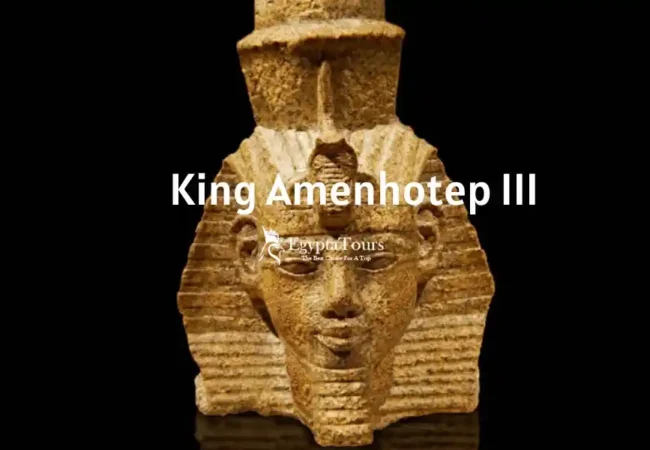
King Thutmose II (sometimes read as Tuthmosis or Tuthmosis II, Tuthmosis in older history works in Greek; Ancient Egyptian meaning “Thoth is born”) which known as “God without a mother “There are another story says that it Known as “self-created at first “. was the son of Thutmose I and a underage wife, Monforte.
He was, therefore, a minimum son of Thutmose I and chose to marry his completely royal half-sister, Hatshepsut, in order to secure his royalism.
While he successfully put down revolutions in Nubia and the Levant and defeated a group of nomad Bedouins, this campaigns were specifically take out by the king’s Generals, and not by King Thutmose II himself.
This is often explain as certificate that Thutmose II was still small at his accession. King Thutmose II fathered Neferure with Hatshepsut, as well as a male heir, the famous King Thutmose III, by a minimum wife called Iset before his death.
Archaeologists believe that Hatshepsut was the real power behind the throne during King Thutmose II’s rule because of the similar local and foreign policies that were later pursued under her reign and because of her demand that she was her father’s intended heir.
Hatshepsut is depicted in several raised relief scenes from a Karnak gateway dating to King Thutmose II’s reign both together with her husband and alone.
Hatshepsut later had herself crowned Pharaoh many years into the rule of her husband’s young heir Thutmose III; this is confirmed by the fact that “the queen’s agents actually replaced the king’s name in a few places with her own cartouches” on the gateway.
King Thutmose II in Hieroglyphs
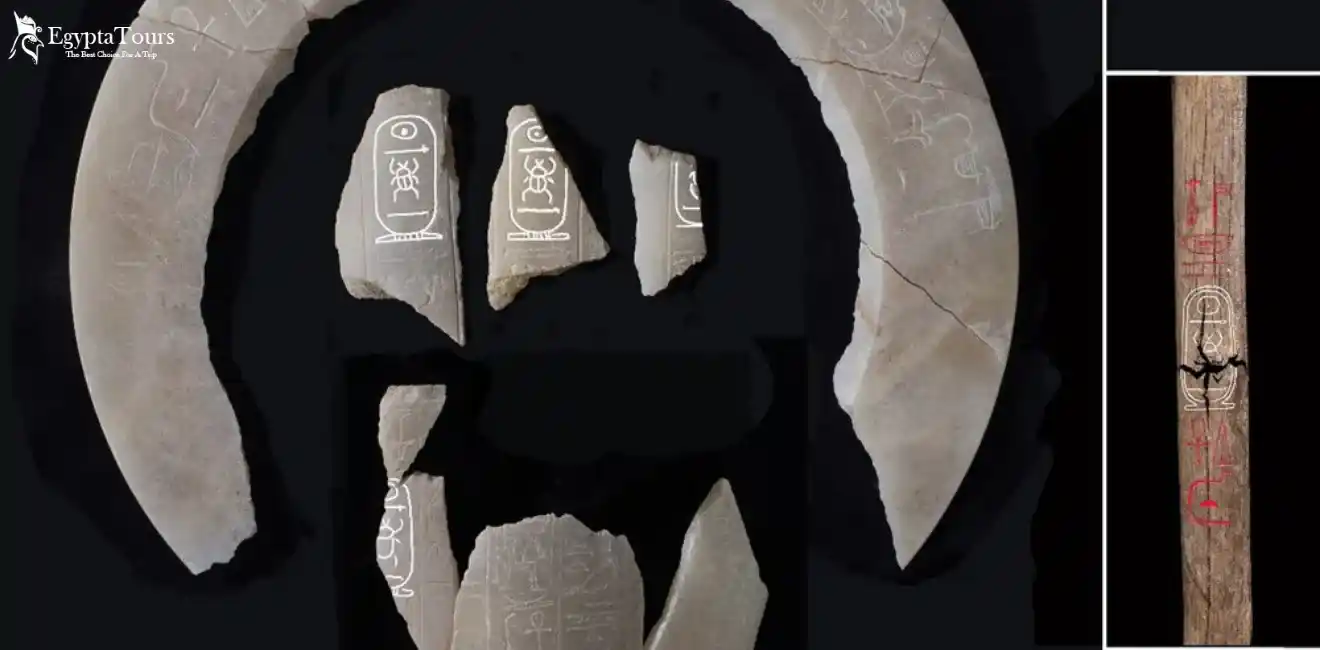
King-Thutmose-II-in-Hieroglyphs-EgyptaTours
The name of the god Thoth is derived from the ancient Greek transcription of the original Egyptian name, Djehuty. The name Thutmose, as used today, is a modern compromise between the Greek transcription Thutmosis and the original Djehutymes. In Manetho’s writings, he is also referred to as Khebron or Khebros.
According to Manetho, he was listed as the successor of Ahmose; however, in reality, he was not the second king of the 18th Dynasty but the fourth. It is important to note that Manetho’s order of reigns is considered quite unreliable for the entire 18th Dynasty. Thutmose II married his half-sister, Hatshepsut who would eventually rise to become pharaoh herself.
The Family of king Thutmose II
Thutmose I (on the right) and Thutmose II are shown in the Stela of Sennefer. The name Thutmose II is also written as Thutmosis or Tuthmosis II and in older Latinized Greek works as Thothmes. It comes from the Ancient Egyptian: /ḏḥwty.ms/ Djehutymes, meaning “Thoth is born.” Thutmose II was the son of Thutmose I and his secondary wife, Mutnofret who was most likely a daughter of Ahmose I.
Because of this, he was considered a lesser son of Thutmose I. To strengthen his claim to the throne, he married his fully royal half-sister, Hatshepsut. Since Mutnofret was a princess and Thutmose I was of common birth, it is likely that their marriage took place only after Thutmose I became king.
Therefore, their son Thutmose II was probably born after his father’s coronation and likely after Hatshepsut, who was the daughter of Thutmose I by his primary wife. This indicates that Thutmose II was likely still in his early teenage years when he came to the throne.
During his reign, Thutmose II succeeded in putting down uprisings in Nubia and the Levant and he also defeated a group of nomadic Bedouins. However, these military campaigns were largely carried out by his generals rather than by Thutmose II himself. Many historians interpret this as evidence that he was still a minor when he ascended to the throne.
Thutmose II had a daughter, Neferure with Hatshepsut, and a son, Thutmose III with a lesser wife named Iset. Some archaeologists believe that Hatshepsut held the real power during Thutmose II’s reign because many domestic and foreign policies under her later rule closely followed the patterns seen during his time and because she claimed to be the heir her father had intended.
She is depicted in several raised relief scenes on a gateway at Karnak from Thutmose II’s reign, both alongside her husband and alone. Later, she crowned herself pharaoh during the early years of her stepson Thutmose III’s reign. Evidence for this includes instances where agents of the queen replaced the king’s name with her own cartouches on the gateway.
If Thutmose II was indeed born after his father’s coronation, he would have been either in his early teens if he had a short reign or in his early twenties if he had a longer reign, at the time of his death.
Mummy of King Thutmose II
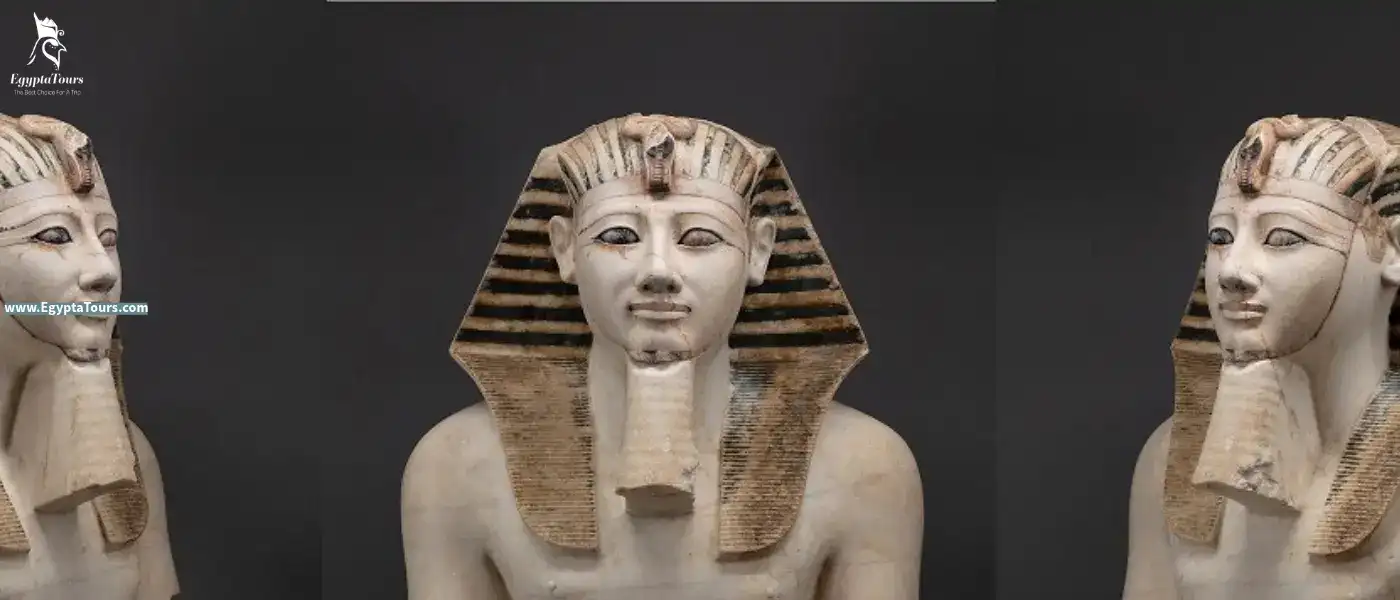
Experience-Ancient-Egypt-King-Thutmose-II
Thutmose II’s mummy was discovered in the Deir el-Bahri heading, discovered in 1881.
He was buried along with other 18th and 19th dynasty leaders including Ahmose I, Amenhotep I, Thutmose I, Thutmose III, Ramesses I, Seti I, Ramesses II, and Ramesses IX.
It included a label that showed it had been re-wrapped in the Twenty-first Dynasty. It’s mummy can be viewed today in the National Museum of Egyptian Civilization in Cairo.
On July 1 the mummy was unwrapped by Gaston Maspero .
There is a powerful familial similarity to the mummy of Thutmose I, his likely father, as the mummy’s face and shape of the head are very similar.
King Thutmose II body was suffered greatly at the hands of ancient tomb robbers, with his left arm broken off at the shoulder-joint, the forearm detached at the elbow joint, and his right arm chopped off below the elbow.
His anterior abdominal wall and much of his chest had been hacked at, maybe by an axe.
In addition, his right leg had been cut from his body. These injuries were discovered post-mortem, although the body also presented signs that King Thutmose II did not have an soft life.
James Harris and Fawzia Hussien (1991) conducted an X-ray survey on New Kingdom royal mummies and checked the mummified remains of King Thutmose II.
The results of the study determined that the mummy of Thutmose II had a craniofacial effect measurement that is joint among Nubian people .
Thutmose II mummy has the inventory number CG 61066.
Thutmose II mummy was moved from the Museum of Egyptian Antiquities to National Museum of Egyptian Civilization straight with those of 17 other kings and 4 queens in an event named the Pharaohs’ Golden Parade In April 2021.
It is difficult for historians to set the correct length of King Thutmose II’s reign. Historians think he ruled between 3 and 13 years. After King Thutmose II death, Hatshepsut had removed his name from monuments and temples.
Hatshepsut removed her husband’s name, and replaced it with her own. When Hatshepsut died Thutmose III took over as Pharaoh and no longer co-regent, he seeks for putting his father’s name back onto some of these buildings. Scolars have inconsistencies in pinpointing his reign to be approximately from 1493 BC to 1479 BC.
King Thutmose II Achievements

Experience-Ancient-Egypt-King-Thutmose-II-Achievements-EgyptaTours
The plurality of pharaohs known from the numerous monuments and they erected. However , Hatshepsut changed his name to her own and replaced it.
His son Thutmose III ordered the inscription of Thutmose II’s name on numerous monuments.
This makes it challenging for those researching King Thutmose II to understand what he in fact produced.
King Thutmose II buildings are still constructed at Semna , Kumma , and Elephantine.
His largest structure was a limestone doorway at Karnak that formerly set in the forecourt of the Fourth Pylon. Only Thutmose II’s son Thutmose III’s rule saw the completion of this monument. This indicates that Thutmose II’s reign was not long.
King Amenhotep III later destroy down the gateway and used its components to set the Third Pylon’s institution.
There was a Kush rebellion when King Thutmose II became king. The Thutmose I fortress was where the Egyptians left to hiding.
King Thutmose II send an army into Nubia despite being too young to share in combat.
The military generals of his father helped to set an end to the uprising quickly.
In the Sinai, Thutmose appears to have share in warfare with the Shasu Bedouin.
Although it was only a small attack, the troops travelled as far as Syria or Upper Retenu. This may submit that the operation against the Shasu was only done in while travelling to Syria.
Thutmose II, an ancient Egyptian pharaoh of the 18th Dynasty, is remembered as a significant ruler whose legacy lives on through artifacts housed in the National Museum of Egyptian Civilization, where he is honored as a symbolic lord of the collection.
His burial chambers, though modest compared to other pharaohs, revealed remarkable finds, including fragments of alabaster jars used for ceremonial purposes.
The Egyptian Ministry of Tourism highlights his contributions in exhibitions, often surrounded by decor featuring yellow stars, symbolizing eternity and divine protection in the afterlife.
The Reign of king Thutmose II
The Dates and Length of Reign
In The Epitome by Manetho, Thutmose II is referred to as “Chebron” and this source credits him with a reign of 13 years. The Greek name may represent a version of his prenomen, Aakheperenre. Modern Egyptologists still debate whether Thutmose II ruled for a long period or a short one.
Some suggest that his reign was very brief, around three years, based on the fact that the highest attested date for him is Year 1, II Akhet, day 8, recorded on a stele. Only a small number of documents survive from his time and very few scarabs have been found bearing his name.
Despite the limited evidence, it is possible to estimate the beginning of Thutmose II’s reign using astronomical observations such as the heliacal rise of Sothis during Amenhotep I’s rule. This method suggests a reign from 1493 to 1479 BC.
However, because interpreting the rise is not entirely certain, another possible range is from 1513 to 1499 BC. Additionally, uncertainty about the length of Thutmose I’s reign could place the start of Thutmose II’s rule even earlier. Nevertheless, scholars in the 20th century generally assigned him a reign from either 1493 or 1492 to 1479 BC.
On the other hand, some Egyptologists argue that Thutmose II may have ruled only for two or three years, roughly between 1482 and 1480 or 1479 BC.
Argument for a Long Reign
Thutmose II is depicted in front of an offering table in the mortuary temple of Hatshepsut at Deir el-Bahari, Egypt. This image is now housed in the Neues Museum, Berlin. He is also shown in depictions in his tomb. Traditionally, Thutmose II’s reign is given as 13 or 14 years.
While Ineni’s autobiography might be interpreted to suggest that Thutmose II ruled only briefly, it also describes him as a “hawk in the nest,” which implies that he may have been a child when he first became king.
Since Thutmose II lived long enough to father two children, Neferure with Hatshepsut and Thutmose III with Iset, this could indicate that he reigned for a longer period, around 13 years, to reach adulthood and establish a family.
German Egyptologist J. Von Beckerath uses this reasoning to support a 13-year reign for Thutmose II. Alan Gardiner noted that in 1900, Georges Daressy identified a monument dated to Thutmose’s 18th year, although the exact location of this site has not yet been identified. Today, this inscription is generally attributed to Hatshepsut, who is known to have ruled for at least eighteen years.
Von Beckerath points out that a Year 18 date appears in a damaged inscription belonging to an Egyptian official. He suggests that this date most likely refers to Hatshepsut’s prenomen, Maatkare, which had been changed from Aakheperenre, the name of Thutmose II, after mentions of the deceased king were deliberately removed.
Another point is that Hatshepsut celebrated her Sed Jubilee in her Year 16, which Von Beckerath believes occurred 30 years after the death of her father, Thutmose I. This timing would leave a gap of 13 to 14 years, which would accommodate the reign of Thutmose II between Hatshepsut’s and Thutmose I’s rule.
However, Kara Cooney argues that Hatshepsut may have been celebrating 30 years of her father’s dynasty11 years for Thutmose I, 3 years for Thutmose II and 16 years for Thutmose III, suggesting a shorter reign for Thutmose II.
Von Beckerath also emphasizes that Egyptologists currently lack conclusive methods to statistically evaluate Thutmose II’s reign based on the number of surviving objects from his time on the throne.
Catherine Roerig has proposed that tomb KV20, generally thought to have been commissioned by Hatshepsut, was originally intended as Thutmose II’s tomb in the Valley of the Kings. If true, this would have been a major construction project requiring several years, supporting a longer reign.
Additionally, recent archaeological work by French Egyptologists at Karnak has uncovered evidence of a pylon and an elaborate festival court belonging to Thutmose II in front of the Fourth Pylon as noted by Luc Gabolde. Further discoveries at Karnak include building blocks from a chapel and a barque sanctuary constructed by Thutmose II.
Zygmunt Wysocki has also proposed that Hatshepsut’s mortuary temple at Deir el-Bahari was originally begun as Thutmose II’s temple. Thutmose III later replaced depictions of Hatshepsut with those of Thutmose II in parts of the temple that may have been completed before Hatshepsut took over after Thutmose II’s death. Thutmose II is also credited with contributing to the decoration of the temple of Khnum at Semna.
A careful reconsideration of this archaeological evidence challenges many of the arguments previously used to support a short reign. The supposed absence of a tomb, the lack of a funerary temple and the perception that Thutmose II undertook no major projects are all addressed by these findings. The Karnak building projects and other works suggest that Thutmose II’s reign was closer to 13 years rather than a brief three years.
The Military Campaigns of king Thutmose II
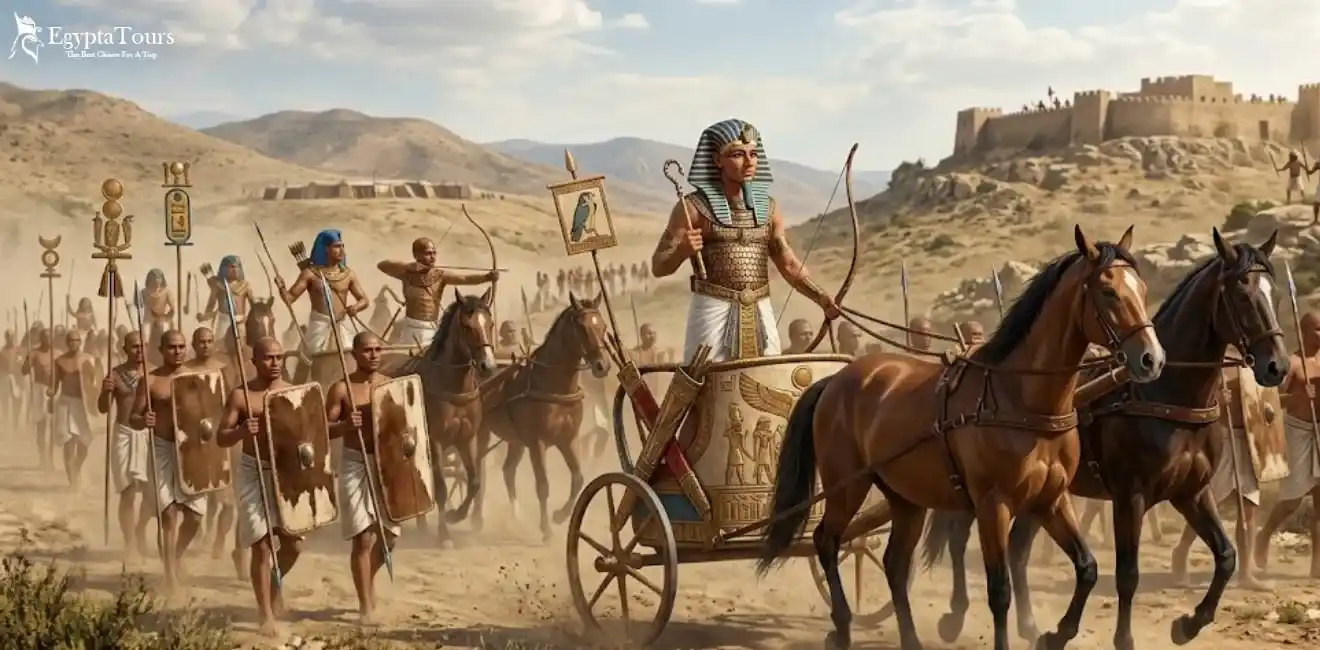
The-Military-Campaigns-of-king-Thutmose-II-EgyptaTours
A fragment of a painted relief from the Temple of Buhen shows Thutmose II wearing the Khat crown while being blessed by Horus.
The Nubian Rebellion
In the first year of his reign, Thutmose II’s coronation prompted Kush to rebel, following its usual pattern of uprising whenever a new Egyptian king took the throne. Under Thutmose I, Nubia had been completely subjugated. Rebels from Khenthennofer rose up, forcing the Egyptian forces to retreat into a fortress built by Thutmose I. Because Thutmose II was relatively young at the time, he did not personally lead the army.
Instead, he sent his generals to handle the campaign. With their assistance, the revolt appears to have been crushed swiftly and effectively. The historian Josephus later referred to this campaign as the Ethiopic War.
The Aswan Stela of Thutmose II provides a summary of the events: Kush began to conspire, encouraging subjects of the Lord of the Two Lands (nb-tawy) to contemplate revolt. Plundering occurred behind the fortifications built by Thutmose I to prevent uprisings from the foreign tribes of Ta-Seti in Khent-hen-nefer. The chief (wr) to the north of Kush initiated hostilities along with two sons of the chief of Kush, and the foreign lands were divided into five parts.
The Shashu Rebellion
In the Sinai region, Thutmose II conducted a campaign against the Shasu Bedouin as recorded by Ahmose Pen-Nekhbet. Some scholars describe this campaign as a minor raid.
Additionally, a fragment noted by Kurt Sethe mentions a campaign in Upper Retenu or Syria, reaching as far as a place called Niy, where Thutmose I reportedly hunted elephants after crossing the Euphrates. This evidence suggests that the campaign against the Shasu may have occurred en route to Syria rather than as a separate conflict.
The Attestations of king Thutmose II
A red granite fragment bearing the cartouche of Thutmose II, probably from the throne of a seated statue, was found at the Temple of Thutmose III in Koptos, Egypt, dating to the 18th Dynasty. Overall, there are relatively few monuments that refer directly to Thutmose II.
One reason for this scarcity is that his wife and successor, Hatshepsut, often placed her own name on monuments that were begun by Thutmose II. Additionally, Thutmose III later reassigned or altered some monuments that originally belonged to Thutmose II.
Aswan Stela
At Aswan, the “Aswan Stela” is dated to Year 1, II Akhet 8 of Thutmose II’s reign. This monument represents the highest dated attestation of the king and records a rebellion in Upper Nubia.
Karnak, Gateway
At Karnak, Thutmose II initiated the construction of a limestone gateway in the forecourt in front of the Fourth Pylon of the temple. However, the gateway was not completed during his reign and was only finished under Thutmose III. Later, during the reign of Amenhotep III, the gateway was dismantled and its building blocks were reused in the foundation of the Third Pylon.
Deir el-Bahari, Stone Chest
In March 2020, archaeologists from the Institute of Archaeology at Warsaw University, led by Andrzej Niwiński, discovered a treasure chest and a wooden box at the site of Deir el-Bahari, dating back approximately 3,500 years. The stone chest contained several items, all wrapped in linen.
Three bundles of flax were found: one contained a goose skeleton, sacrificed for religious purposes; the second held goose eggs and the third is believed to have contained an ibis egg, which had symbolic meaning in ancient Egyptian culture.
Inside one of these bundles, a small wooden trinket box was discovered, believed to bear the name of Pharaoh Thutmose II. Niwiński explained that the chest measures roughly 40 centimeters in length with a height a little smaller than that. It was cleverly hidden and designed to look just like a normal stone block, making it very hard to notice.
The Burial and The Tomb of king Thutmose II
The location of Thutmose II’s tomb remained uncertain until 2025 with several possible sites suggested over the years. One proposal was KV42 but the absence of royal funerary equipment indicated that this tomb was never used for a burial.
In 2020, a team led by Polish archaeologist Andrzej Niwiński suggested a location near the Temples of Thutmose III and Hatshepsut, following the discovery of a chest bearing Thutmose II’s cartouche.
In 2022, an Egyptian-British archaeological team discovered a new tomb in the Western Wadis, close to the Valley of the Kings. The mission was led by the Egyptian Ministry of Tourism and Antiquities in cooperation with the McDonald Institute for Archaeological Research at the University of Cambridge. The tomb, designated Wadi C-4, was compared by the excavators to KV5 because both tombs had been filled with rubble and debris from flash floods.
It was believed that the tomb had been constructed during the reigns of Hatshepsut and Thutmose III. While the tomb was discovered in 2022, Thutmose II’s supposed remains had been found much earlier, in 1881, in the Royal Cache of Mummies at Deir el-Bahari in the Theban Necropolis.
In 2025, Egyptian Egyptologists from the Ministry of Tourism and Antiquities confirmed that Wadi C-4 was indeed the tomb of Thutmose II. The tomb contained many features typical of a royal burial, including a ceiling painted blue with yellow stars, walls adorned with depictions from the Amduat and inscribed vessels bearing the names of Thutmose II and Hatshepsut as his Great Royal Wife. Fragments of alabaster jars with both their names were also discovered, further confirming the tomb’s ownership.
Wadi C-4 is the first royal tomb discovered in the Valley of the Kings since Tutankhamun’s tomb in 1922. The tomb was built beneath waterfalls, which led to repeated flash flooding over the centuries, causing significant damage.
Mohamed Abdel Badi, head of the Egyptian Antiquities Sector, explained that “The tomb is located in a poorly chosen spot, “The tomb is located under two waterfalls and at the base of a slope, a spot where water would naturally run and indeed did during the much wetter weather of the 18th Dynasty.”
Some time after his initial burial, Thutmose II’s mummy was moved to the Deir el-Bahari Cache, where it was eventually uncovered in the 19th century.
The story of discovering the mystery of Thutmose II’s Tomb
Mr. Sherif Fathy, Egypt’s Minister of Tourism and Antiquities, described the finding of Thutmose II’s tomb as “a major breakthrough” that helps us better understand how burials were done during the 18th Dynasty. For many years, experts and historians had debated where the pharaoh had been laid to rest and now this long-standing question has finally been answered.
Dr. Mohamed Ismail Khaled, Secretary-General of the Supreme Council of Antiquities, detailed how the archaeological team was able to identify the tomb’s owner and confirm it belonged to Thutmose II.
Inside, they found alabaster vessels engraved with the name of Thutmose II and the title “The deceased King.” Among these inscriptions was the name of his wife and half-sister, Queen Hatshepsut, indicating that she had personally overseen his burial.
The Impact of Time on king Thutmose II’s Tomb
Despite the remarkable discovery, the tomb itself had not escaped the effects of time.Mohamed Abdel-Badie, head of Egyptian Antiquities, said that ancient floods had badly damaged the site, probably not long after the king was buried. Water had rushed into the tomb, causing major destruction and the priests were forced to move its contents, including the king’s remains, to an unknown location.
Nevertheless, traces of the tomb’s original splendor have survived. Archaeologists uncovered delicate blue and gold decorations, remnants of celestial motifs and inscriptions from the Amduat, the ancient Egyptian funerary text that guides the pharaoh through the underworld to the afterlife. These fragments, though damaged, offer valuable insights into the grandeur of the tomb in its prime.
Dr. Piers Litherland, who co-led the excavation from the British side, mentioned that even though the tomb has a rather simple design, it still played an important role in shaping the style of royal burials that came later in the 18th Dynasty. It set the stage for later royal burials in the 18th Dynasty. The entrance opens into a long corridor covered with plaster which slopes down 1.4 meters into the burial chamber.
Researchers think this design might have affected how the tomb’s contents were moved after the flood, raising more questions about what happened after Thutmose II’s death.
The Ongoing Mystery of King Thutmose II’s Tomb and Treasures
Archaeologists are now focused on the biggest remaining mystery: where did the priests move Thutmose II’s remains and burial treasures? If the tomb was emptied after the flood, could there be another hidden chamber somewhere in Wadi C? Are more lost artifacts still buried under the sand?
As the excavation continues, each new discovery brings the team closer to answers. The story of Thutmose II is far from complete and every find helps rewrite our understanding of history.
With exclusive Egypt tours, visitors don’t just see the country, they feel its magic. Walk in the footsteps of the pharaohs, sail the legendary Nile and explore the secrets of ancient temples with expert guides. Witness the wonder of the pyramids, the grandeur of Luxor and Aswan and the vibrant life of Cairo, all in comfort. It’s more than a vacation, it’s a once-in-a-lifetime adventure where history, mystery and breathtaking beauty come together.
Conclusion
King Thutmose II, a significant ruler of the 18th Dynasty, is best known for his military campaigns and strategic alliances that bolstered his reign. To secure his kingship, he chose to marry his fully royal half-sister, Hatshepsut, a move that not only consolidated power but also aligned their claims to the throne.
Thutmose faced several challenges during his reign, including rebellions in Nubia and the Levant, where he successfully defeated a group of nomadic Bedouins, showcasing his military prowess. Despite his achievements.
Thutmose suffered greatly at the hands of ancient tomb robbers, leaving behind a fragmented legacy; he was found with his left arm broken off at the shoulder joint, the forearm separated at the elbow joint, and his right arm chopped off below the elbow.
These injuries highlight the struggles that kings faced in protecting their tombs and treasures.
The foundation of the real power behind the throne during Thutmose II can also be traced to the influence of Hatshepsut, who would later assume the throne herself.
Ultimately, Thutmose II laid the groundwork for his son, Thutmose III, and future pharaohs like Ramesses, ensuring the continuity of Egypt’s strength and influence.
King Thutmose II faced numerous challenges during his reign, including rebellions in Nubia and the Levant, which he successfully quelled, and he also defeated a group of nomadic Bedouins.
However, his reign was not without personal tragedy; Thutmose II suffered greatly at the hands of ancient tomb robbers, and his mummy shows that his left arm was broken off at the shoulder joint, his forearm separated at the elbow, and his right arm chopped off below the elbow.
Many scholars believe that the disease of the real power behind the throne was due to the influence of his powerful queen, Hatshepsut, who later assumed a more prominent role.
Thutmose III, his successor, eventually became one of Egypt’s greatest pharaohs, while Ramesses came from a later dynasty that also solidified Egypt’s power.
Pharaoh Thutmose II, an 18th Dynasty ruler of ancient Egypt, was recently the focus of renewed interest thanks to findings highlighted by the Ministry of Tourism and Antiquities.
According to Egyptologist Piers Litherland, while the original tomb of Thutmose II in the Valley of the Kings was likely robbed in antiquity, his mummy was later hidden in a royal cache to protect it.
This royal tomb concealment helped preserve his remains, offering valuable insight into the life and reign of this often-overlooked pharaoh
FAQ: King Thutmose II
Who was Thutmose II?
Thutmose II was the fourth pharaoh of the Eighteenth Dynasty of Egypt, ruling approximately from 1493 to 1479 BCE. He is known for his military campaigns, building projects, and for being the husband of Hatshepsut, who later became one of Egypt’s most famous female pharaohs.
What are the notable achievements of Thutmose II?
Thutmose II is recognized for his military expeditions into Nubia and the Levant, which helped expand Egypt’s territory and influence. He also contributed to various building projects, including temples and monuments, particularly in Karnak.
How did Thutmose II come to power?
Thutmose II ascended to the throne after the death of his father, Thutmose I. He was likely a co-regent with Hatshepsut for a time, which allowed for a smooth transition of power.
What was Thutmose II’s relationship with Hatshepsut?
Hatshepsut was Thutmose II’s principal wife and half-sister. After Thutmose II’s death, Hatshepsut became pharaoh and took on a more prominent role in ruling Egypt, even adopting male pharaonic titles and regalia.
How did Thutmose II’s reign impact Egypt?
Thutmose II’s reign helped solidify the military strength and economic prosperity of Egypt. His campaigns contributed to the wealth of the kingdom, and his construction projects left a lasting legacy in Egyptian architecture.
What is known about Thutmose II’s burial?
Thutmose II was buried in the Valley of the Kings, specifically in tomb KV38. His tomb was discovered in the early 20th century, and it contains inscriptions and artifacts that reflect his reign.
Did Thutmose II have any children?
Yes, Thutmose II had several children, including Thutmose III, who would later become one of Egypt’s greatest pharaohs and is often referred to as the “Napoleon of Egypt” for his military conquests.
What is the significance of Thutmose II in Egyptian history?
Thutmose II is significant for his role in the Eighteenth Dynasty, a period marked by artistic and architectural achievements as well as military expansion. His reign set the stage for the future successes of his son, Thutmose III.
How is King Thutmose II depicted in ancient art?
Thutmose II is often depicted in traditional pharaonic regalia, showcasing his authority. Statues and reliefs from his time often portray him with the symbols of power, such as the crook and flail, and wearing the nemes headdress.
What are some sources of information about Thutmose II?
Information about Thutmose II can be found in ancient Egyptian inscriptions, monuments, and artifacts, as well as in modern archaeological studies and historical analyses of the Eighteenth Dynasty. Key sources include temple inscriptions at Karnak and the writings of ancient historians like Manetho.