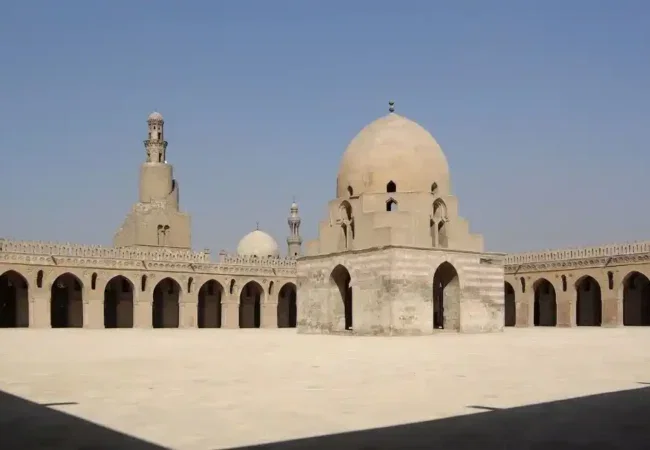
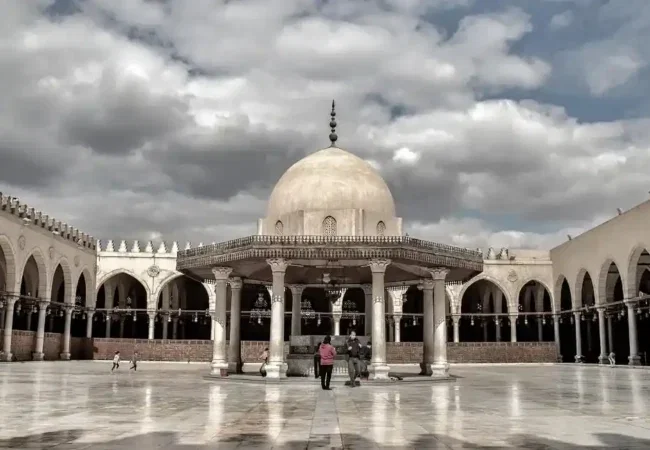
Al-Azhar is one of the oldest major mosques in Cairo and a must-see when visiting the Egyptian capital. This jewel of Islam is located in Cairo’s historic district and is therefore a UNESCO World Heritage Site.
Entering and visiting the mosque is essential for a better understanding of the relationship between politics, religion and historical development in Egypt.
- History of Al- Azhar Mosque
- Details and Architecture of the Al-Azhar Mosque
- Political importance of Al-Azhar Mosque
- Where to eat near the Al-Azhar Mosque
- Where to stay near the Al-Azhar Mosque
History of Al-Azhar Mosque
History-of-Al-Azhar-Mosque-EgyptaTours
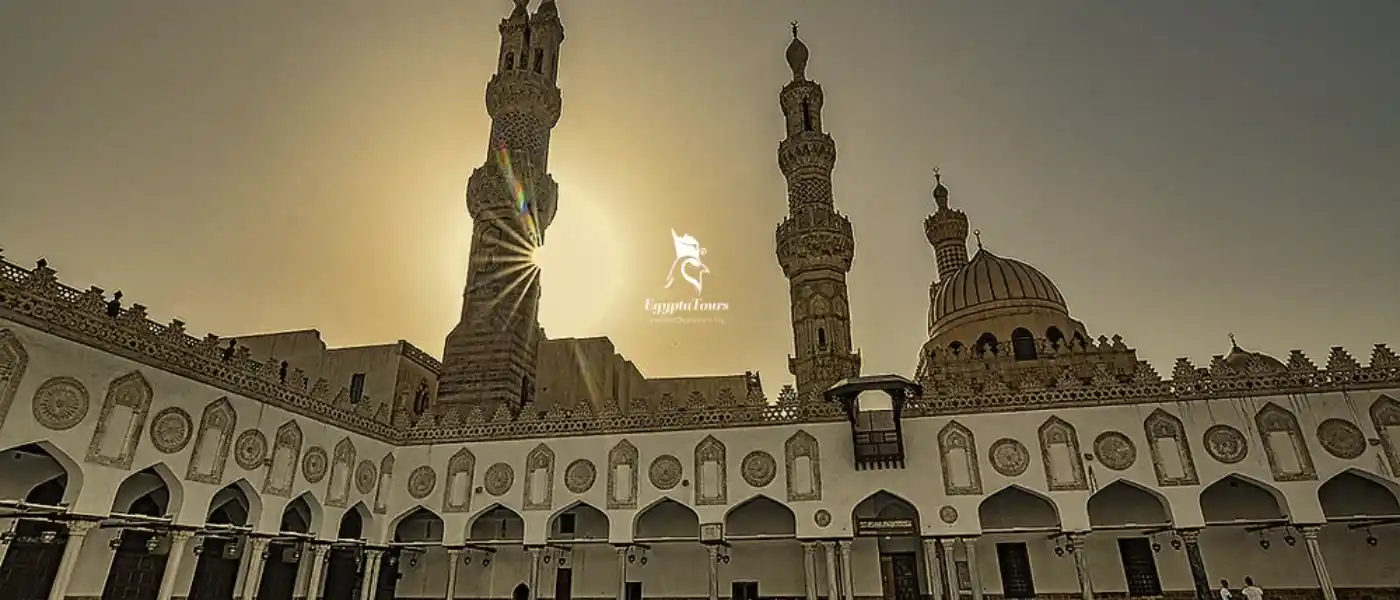
Al-Azhar Mosque was built between 970 and 972, during the period of the Fatimid Caliphate, which controlled all of North Africa from present-day Morocco to the Red Sea. The new capital of the caliphate, Cairo, was under construction and required a large mosque for prayer and training. The temple quickly became an important center of learning in the new city, and to this day it remains the oldest operating Islamic university in the world.
The passage of centuries and different historical periods in Egypt left their mark on the mosque, which grew and changed according to different rulers and influences.
It began as a large prayer hall with five corridors and a central courtyard, about 85 meters long and 69 meters wide. This was during the Mamluk era (1250-1517) when the mosque expanded and minarets and schools were added to it. However, it was in the later Ottoman period (1517-1867) when the complex saw its greatest expansion, doubling in size and adding new entrance gates such as Bab al-Muzainin (Barbers’ Gate), which is now the main entrance to the city.
Location of Al-Azhar Mosque
In the center of Cairo, on Al-Azhar Street, in the El Darb El Ahmar area to the south, is Al-Azhar Mosque. It is easy to get there! You can take a cab to the nearest metro station which is Al Ataba Station. Soon, you will arrive and the mosque will welcome you as a visitor!
The Construction of Al-Azhar Mosque
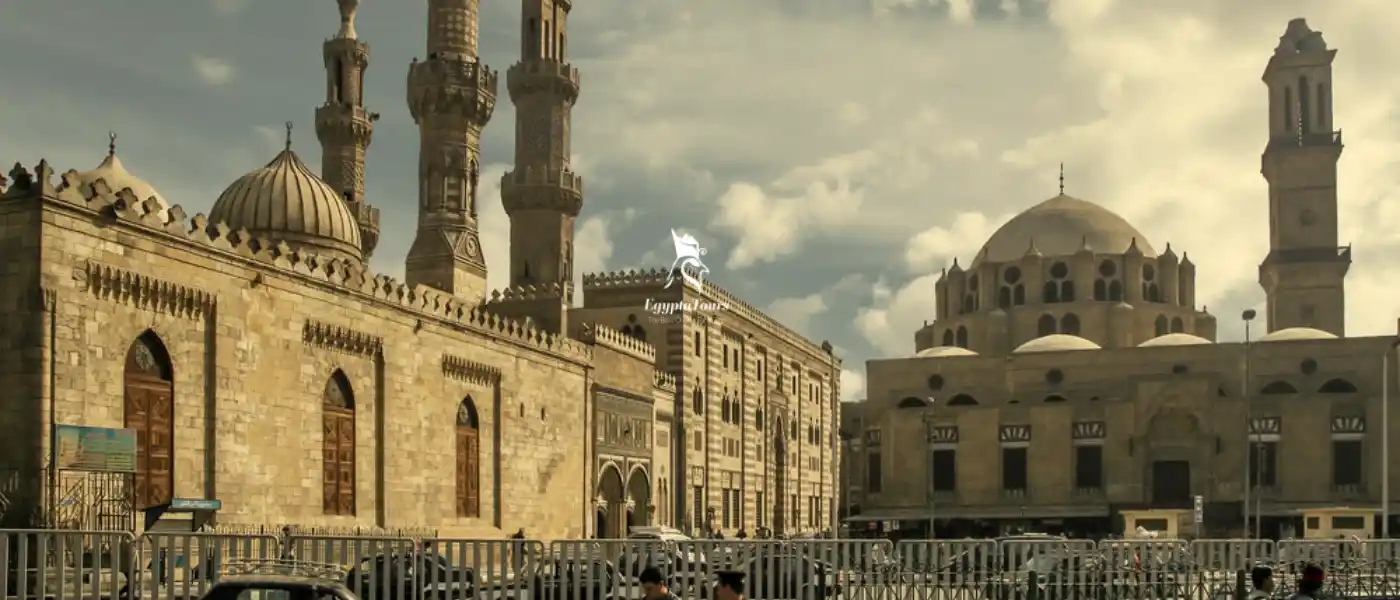
The mosque has been repaired and enlarged many times over more than a thousand years, surviving many political changes and different governments. The different designs of its five minarets show the various dynasties that ruled and controlled Al-Azhar.
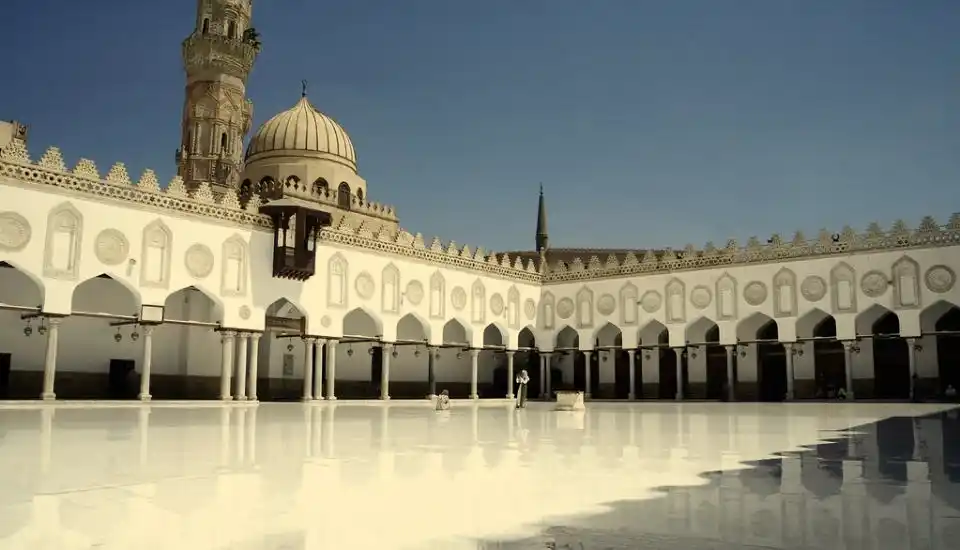
Besides the beautiful white marble courtyard which goes back to the mosque’s original construction, the building has a large covered prayer hall and two religious schools (madrassas).
Before Al-Azhar University expanded and moved mostly to another campus in the northern part of the city, students met their teachers in the main courtyard. Even today, lessons in Arabic and interpretation of the Quran are still taught there.
From the courtyard, you can see the three largest minarets. They were built in 1340, 1469 and 1510 (from right to left when looking from the courtyard). The minaret built in 1510 was constructed by Sultan Al-Ghuri who also built the Wikala Al-Ghuri and the Al-Ghouriyya Complex nearby. This minaret is easy to recognize because it has two spires.
Details and Architecture of the Al-Azhar Mosque
Details-and-Architecture-of-the-Al-Azhar-Mosque
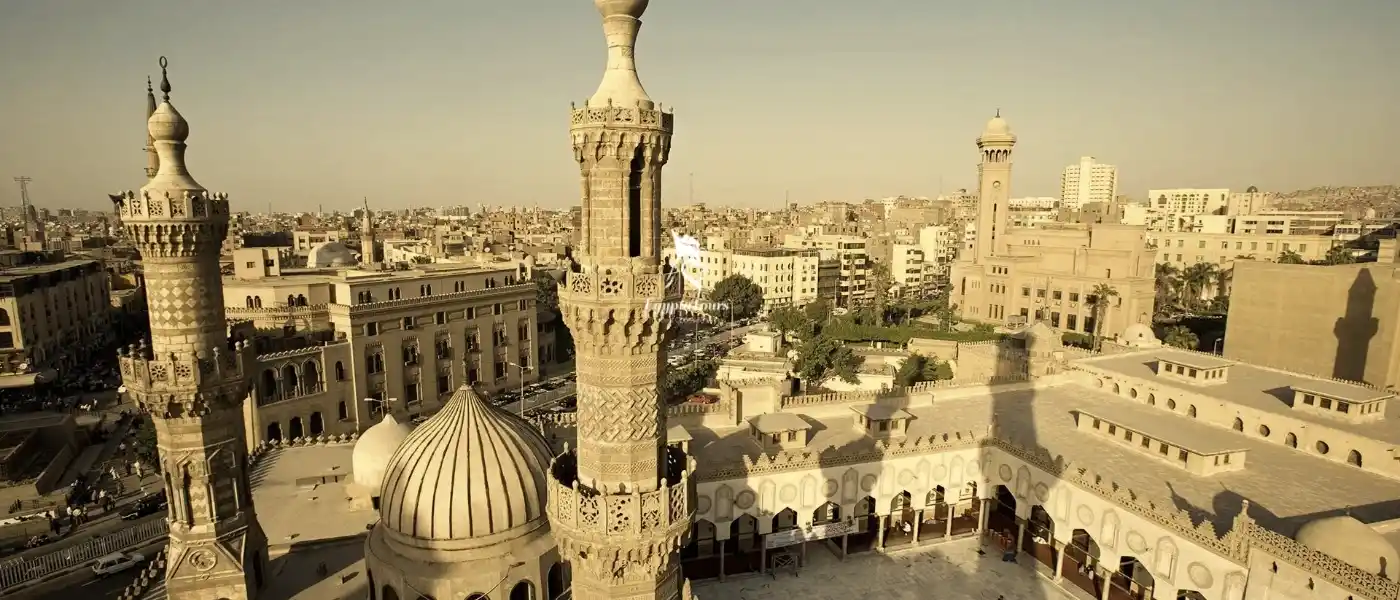
The mosque’s long history has left behind multiple architectural styles that reflect the various periods of rule in present-day Egypt, giving the ensemble a certain complex architectural nature. It contain everything from Roman and Greek columns to Byzantine mosaics. The architecture of Al-Azhar Mosque is closely linked to the history and development of both Cairo and Egypt.
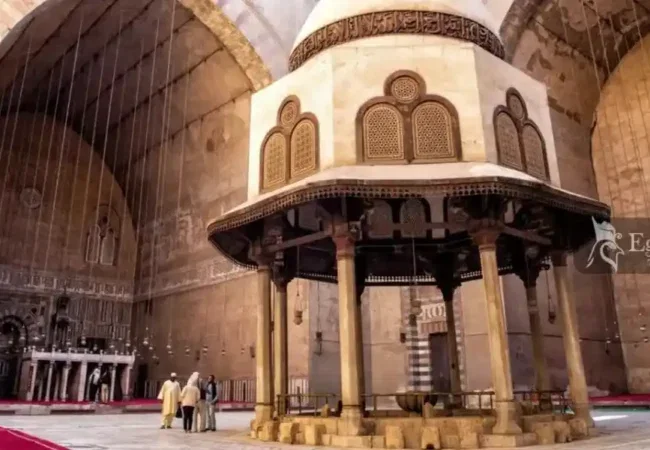
The area occupied by the current mosque is distinguished by its impressive white-washed main courtyard, which is surrounded by a large portico that completes its four sides.
The Mamluk period was one of the periods in which more constructions were added to the original mosque, with schools such as the Aqbugha, Al-Taybarsiyya and Al-Gawhariyya schools, with marble dreams and a stone dome with arabesque decorations. Some of the minarets that exist today were also built, such as the beautiful Qaytbay and al-Ghuri minarets, complete with a double capital.
Political importance of Al-Azhar Mosque
Political-importance-of-Al-Azhar-Mosque
Al-Azhar Mosque has greater influence in the Islamic world than other institutions. Its role within the country was the subject of constant debate about its independence from the state and the required liberal orientation against conservative and Salafist Islamic movements.
In addition to its political importance, the university founded there is today one of the most prestigious centers of education in the Sunni Islamic world, attracting an elite group of students from various parts of the Islamic world. In addition to teaching Sharia, or Islamic law, Al-Azhar also teaches a wide range of arts and sciences such as literature, grammar, theology, law, medicine, rhetoric, and philosophy.
In order to understand the size of Al-Azhar, its library includes about 100,000 copies, some of which are ancient manuscripts dating back to before the mosque was established.
The Madrasa of Al-Azhar Mosque
Al-Azhar Mosque has a special section called a madrasa (religious school). It was founded in 988 AD and over time it grew into a large university. Today, it is the second-oldest university in the world.
It began as a small school at Al-Azhar Mosque where children were taught Arabic and the Quran many years ago. Now, it is a major university that welcomes students from all over the world and offers many different subjects, in addition to Islamic studies.
This historic landmark is a must-see place in Cairo. When you visit Islamic Cairo, make sure to explore the beauty of Al-Azhar Mosque. You will learn a lot about the history of Islam in Egypt and enjoy the amazing architecture built over different periods. Visiting Al-Azhar Mosque is like taking a journey through history in one place.
Al-Azhar Mosque in the Fatimid Period
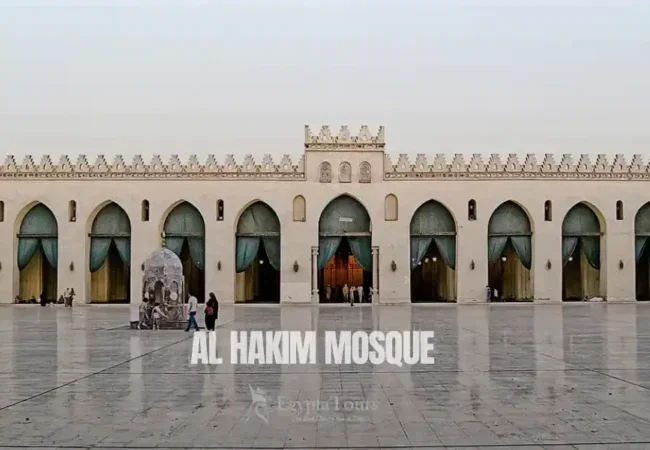
Al-Azhar Mosque changed a lot during the Fatimid period. Al-Hakim Bi-Amr Allah added 27 special silver lamps to the mosque. Today, one of the remaining works from his time is a small wooden door decorated with Kufic inscriptions which were common decorations in that era.
In 1125 AD, the Fatimid ruler Al-Amir bi-Ahkam Allah built a new mihrab (a niche that shows the direction of prayer toward the Kaaba). It was made of fine Turkish wood and decorated with many floral and geometric designs.
In 1149 AD, the Fatimid Caliph Al-Hafiz li-Din Allah decided to enlarge the mosque. He expanded the courtyard (sahn) and added more decorations and plaster designs to the mosque walls.
Al-Azhar in the Mamluk Period
In 1266 A.D., Al-Zahir Baybars ordered the construction of a beautifully decorated minbar (pulpit). Sadly, it no longer exists in its original form, except for its written inscriptions which are now preserved in a museum in Algeria.
Baybars Khazendar, the army leader during the rule of Al-Nasir Muhammad, built a new religious school called the Tabrisy Madrasa. It is located on the right side when entering Al-Azhar Mosque. This addition made the mosque larger for Islamic lessons and included a large Islamic library.
The Afghaweya Madrasa, built in 1340 A.D., is on the left side of the entrance. Today, it contains the library of Al-Azhar.
Al Gawhareya Madrasa, built in the southeast part of the mosque, is a small school made up of four iwans (rectangular halls with one open side) and a small courtyard.
Al-Azhar in the Ottoman Era
Al-Azhar went through a lot of growth during the Ottoman period. The most important work was done by Amir Abdel Rahman Katkhuda in 1753 A.D. He made the mosque bigger by adding a riwaq (covered walkway) behind the mihrab which was built higher than the rest of the mosque. He also added a new minbar (pulpit) and mihrab (prayer niche).
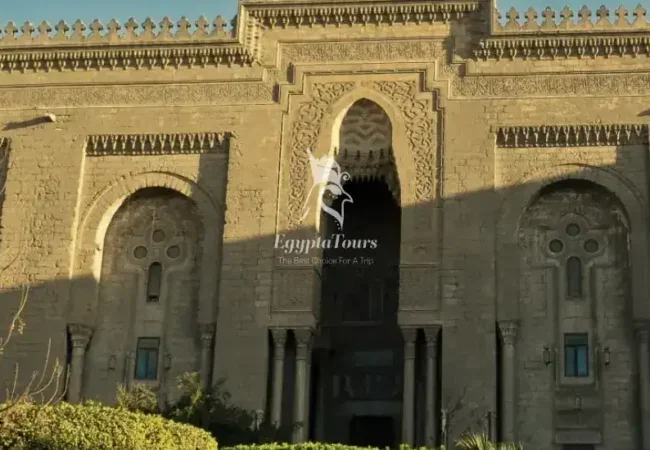
Katkhuda built two large gates: one in the south wall called the Sa’ayda Gate and the Shroba Gate in the east part of the mosque, with a minaret next to it. He also built the beautiful western gate with its amazing Islamic decorations which is now the main entrance of the mosque.
Inside Al-Azhar Mosque
Al-Azhar-Mosque-a-Great-symbol-of-Islamist-culture-in-Egypt
The Barbers Gate
The beautiful Barber’s Gate (Bab al-Muzayinin) was built during the time of the Ottoman expansion.
In the past, students used to come to this gate to cut their hair. Today, it is the main entrance of the mosque.
The Courtyard
The courtyard at Al-Azhar Mosque is covered with white marble and surrounded by minarets from the Mamluk period.
If you have never visited a mosque before, this is a beautiful place to start. It has bright stone walls, wooden ceilings, traditional mashrabiya windows and decorative details.
The Minarets
Al-Azhar Mosque has five detailed minarets that remain from different ruling periods and cultural influences in the city’s history.
Modern Restorations and Preservation
In 2014, a major renovation project paid for by King Abdullah bin Abdulaziz Al Saud helped update Al-Azhar Mosque while protecting its history. The project included careful inspection, strengthening the structure, and restoring the stone, wooden carvings, and written decorations.
Modern features like new lighting, fire protection and better drainage were added without changing the mosque’s historic character.
Today, Al-Azhar Mosque is still an active place of worship and also a living record of over a thousand years of Islamic art and architectural development.
Where to Eat Near The Al-Azhar Mosque?
Since the mosque is located in the center of historic Cairo, a highly rated tourist area, you will find many local restaurants nearby. Here are some of them:
Naguib Mahfouz: A nice café in the nearby Khan El Khalili market where you can eat traditional dishes or try shisha.
Studio Misr: A small restaurant in Al-Azhar Park overlooking Saladin Citadel and the city. A good recommendation if you want to have an enjoyable evening meal.
Al-Fishawy: A mirror-filled café, also located in the bazaar, where you can enjoy a tea or coffee during a break from the bustling market. Egyptian Nobel Prize winner Naguib Mahfouz used to go there.
Nafi Al Najahi: Located near Abdeen Palace, this popular local restaurant is an ideal choice for good meat dishes at reasonable prices.
Where to stay near the Al-Azhar Mosque?
The eastern bank of the Nile River is considered one of the best areas to stay in Cairo and is relatively close to Al-Azhar. It is home to some of the main points of interest in the city such as Tahrir Square, the Egyptian Museum, the Citadel, Abdeen Palace, Khan Al Khalili Bazaar and various shopping malls. This area is safe, tourist friendly and full of restaurants.
Alternatively, if the city area is less important to you, an excellent place to sleep in Cairo is the Barceló Cairo Pyramids, a gorgeous four-star hotel with 236 rooms located on Haram Street, the main road leading from Cairo. Downtown Cairo to the Pyramids of Giza.
Al-Azhar Mosque FAQS
Where is the Al-Azhar Mosque location?
Al-Azhar Mosque is situated in what is known as Historic Cairo or Islamic Cairo, the medieval area of the city before its modern expansion, which includes a rich historical heritage from the Islamic era.
Is It possible to visit the Al-Azhar Mosque?
Yes, Al-Azhar Mosque can be visited from 9 am to 5 pm. The entrance is located at the Barbers Gate.
How do I get to the Al-Azhar Mosque?
Al-Azhar Mosque is located in the Al-Darb Al-Ahmar neighborhood in historic Cairo, very close to the Khan Al-Khalili market, east of the city center. To get there, the nearest metro station is Attaba, on Line 2. From there it is a half-hour walk along Al-Azhar Street.
What is special about Al-Azhar Mosque?
Al-Azhar Mosque is one of the oldest mosques in Cairo, Egypt. The mosque was built in the 10th century by order of the Fatimid Caliph Sultan al-Muizz li-Din Allah, who ordered its construction to mark the location of his new capital, Cairo.
Who was the architect of the Al-Azhar Mosque?
The construction was supervised by Commander Jawhar al-Saqili, who conquered Egypt in 358 AH / 969 AD.
Who is the Sheikh of Al-Azhar Mosque?
Sheikh Ahmed Mohamed Al-Tayeb was appointed Sheikh of Al-Azhar in March 2010, after the death of his predecessor, Dr. Mohamed Sayed Tantawi.
Why did they name it Al-Azhar?
Historians have differed on the origin of the name of this mosque, and it is likely that the Fatimids named it Al-Azhar in reference to Fatima Al-Zahra, daughter of the Prophet Muhammad, and in tribute to her memory.
Can non-Muslims go to Al-Azhar?
Abanoub became the first recognized case of a Christian student enrolling as Al-Azhar accepted the first non-Muslim student in the modern era.