Ushabti in ancient Egypt
The ancient Egyptian civilization has always fascinated us with its numerous and...



In ancient Egyptian mythology, gods and goddesses played an important role in the lives of the people. One of the most intriguing figures is the Wadjet Egyptian Goddess, known for her mysterious and protective presence. Her symbols and influence appear in temples, religious rituals and ancient art, showing how much she was respected and feared.
In this article, we will explore the world of the Wadjet Egyptian Goddess, her place in ancient Egyptian religion and mythology and why she remains an important figure in Egypt’s history.
Wadjet, -Egyptian -Goddess- the -Protector- of Lower -Egypt -and -Pharaohs
Wadjet Egyptian Goddess (/ˈwædʒət/; Ancient Egyptian: wꜢḏyt, meaning “Green One”) was originally the local goddess of the city of Dep or Buto in Lower Egypt, an important place even in prehistoric times. Later, Wadjet became one of the main protective goddesses of ancient Egypt. Her worship started in the Predynastic period and grew over time, turning her from a local goddess into a widely respected patron goddess.
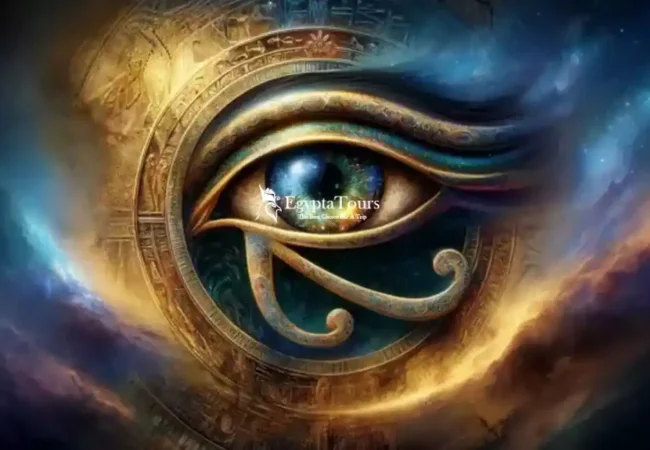
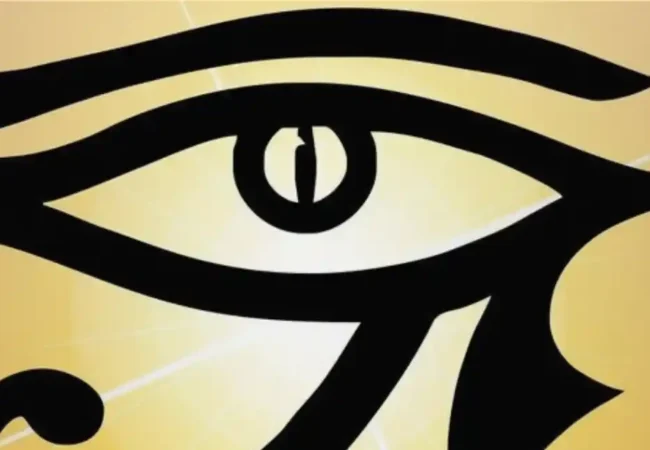
Wadjet, Egyptian Goddess, was closely linked to the Eye of Ra and the Eye of Horus, symbols of powerful protection. Sometimes, images show two eyes in the sky, but it’s not always clear which one is truly hers. The eyes are often shown in bright green or blue, reflecting her name, “the Green One.” People in ancient Egypt wore Wadjet-eye amulets for protection and fertility in daily life.
The name Wadjet comes from the papyrus, a symbol of Lower Egypt. Her hieroglyphs are almost the same as the Green Crown of Lower Egypt, except for a small detail: the crown has a picture of the crown itself, while the goddess has a rearing cobra. The Wadjet-eye, also called “the Intact-one,” shows her protective power. The “T” at the end of her name shows that she is female. Other names she was known by include Wedjat, Wadjit, Wadjyt, Uto, Buto, Uatchet and Edjo.
Wadjet Egyptian Goddess was known as the protector and guardian of Lower Egypt in her snake form. After the unification of Egypt with her sister Nekhbet, the goddess of Upper Egypt, they became together the protectors and patrons of all Egypt. Images of the two sisters as snakes can be found in the tomb of King Sety I In the Valley of the Kings, Wadjet is shown with a sun disk which is called the uraeus. This symbol appeared on the crowns of rulers of Lower Egypt. She also protected kings and women during childbirth, keeping them safe from any enemies.
The family history of Wadjet Egyptian Goddess is mostly unclear and comes mainly from myths and stories. In one myth, she was said to be the daughter of Ra, shown as his seeing eye (Eye of Ra). Her role was to find Shu and Tefnut for him, which she did successfully.
Her father was very proud of her and told her to stay with him to protect him from enemies. She took her most known form as a snake and attacked any enemies who tried to harm her father. She also carried out Ra’s orders. This myth appears in triadic seals, amulets and other objects, showing the family of gods together, including Ra as the father, Wadjet as the daughter and Seth as Ra’s bodyguard. A clear example of this triad was found on a triad amulet in Tel Azekah, near Jerusalem.
In another myth, Wadjet acted as the nurse of the baby god Horus. Together with his mother, Isis, they protected him from his deceitful uncle Set while hiding in the swamps of the Nile Delta.
Wadjet and Nekhbet were also shown as nurses to kings in the afterlife, breastfeeding them to keep their royal qualities. These goddesses appear in the Pyramid Texts, keeping the king’s divinity while he was in a child-like state.
A similar depiction was found in the tomb of Tutankhamun, on a pendant showing Wadjet breastfeeding the king, who was fully grown, dressed in his royal clothes, using the goddess’s milk to help him succeed as a king. This pendant was part of funerary rituals and had roles in both resurrection and coronation. A similar depiction is also found in the funerary temple of King Pepy II, showing a damaged relief of Wadjet nursing the king.
Temples- and- Worship -of -Wadjet, -Egyptian -Goddess
Wadjet, Egyptian Goddess, had her main oracle in the temple of Per-Wadjet, giving the city its name. From the Fourth Dynasty onwards, she was worshiped as the patron goddess and protector of Lower Egypt. She became closely associated with Nekhbet after the unification of Egypt, forming the “Two Ladies” (Nebty), representing the king’s rule over Upper and Lower Egypt.
She had a large temple at Imet (now Tell Nebesha) and was worshiped as the “Lady of Imet.” Later, she joined Min and Horus to form a triad. The Greeks also recognized her, calling her Buto, Uto, Leto or Latona showing her influence beyond Egypt.
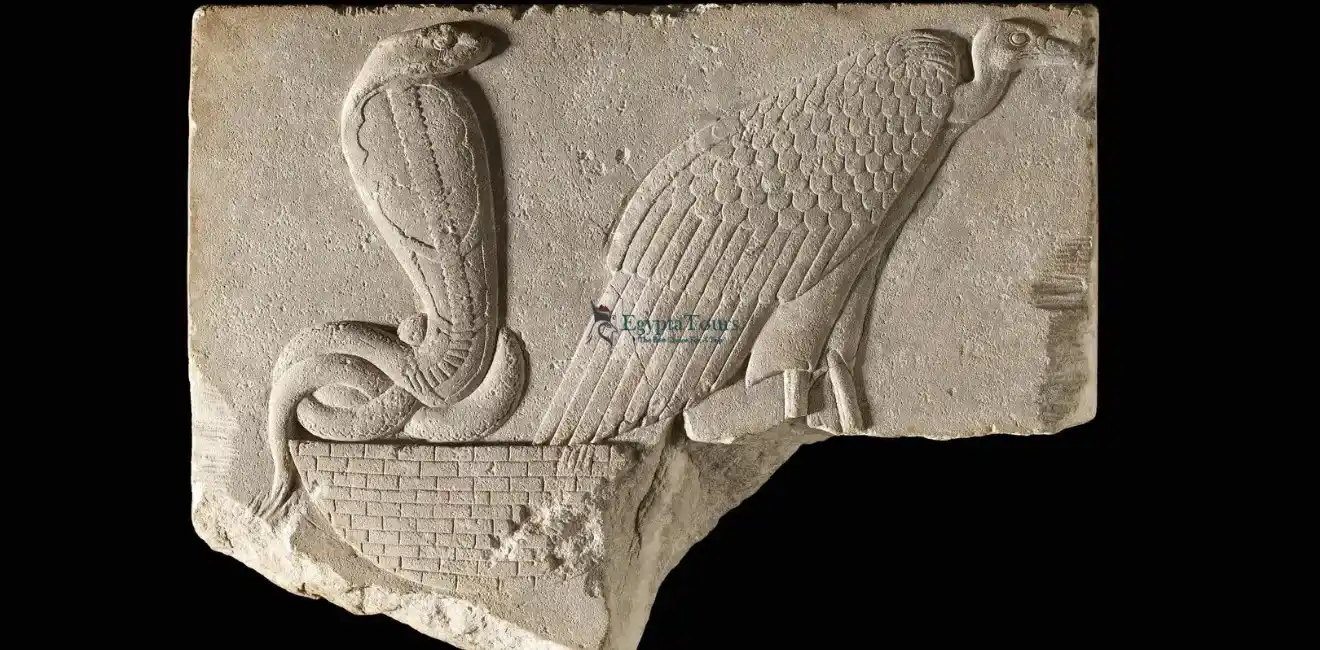
The temple of Wadjet Egyptian Goddess in Per-Wadjet had a famous oracle. The temple was dedicated to her worship and gave the city its name. This oracle may have been the source of the oracle tradition that later spread to Greece. From the 4th dynasty onward, Wadjet was considered the patron goddess and protector of all Lower Egypt. She became linked with Nekhbet, shown as a white vulture, who represented unified Egypt. After the unification, the image of Nekhbet joined Wadjet on the crown, forming part of the uraeus. The religious title for these patron goddesses of the whole country was “nebty” or “Two Ladies.”
As the goddess of Lower Egypt, Wadjet had a large temple at Imet (now Tell Nebesha) in the Nile Delta. She was worshipped there as the “Lady of Imet”. Later, she was joined by Min and Horus to form a triad of gods. In Tebtunis, in the Egyptian Faiyum, a temple dedicated to Wadjet was used for rituals in her honor.
According to ancient Greece, Wadjet Egyptian Goddess was also known in their mythology. She was called Buto, Uto, Leto, or Latona and she was one of the main symbols of the city of Buto as mentioned before.
Appearance -of- Wadjet,- Egyptian -Goddess
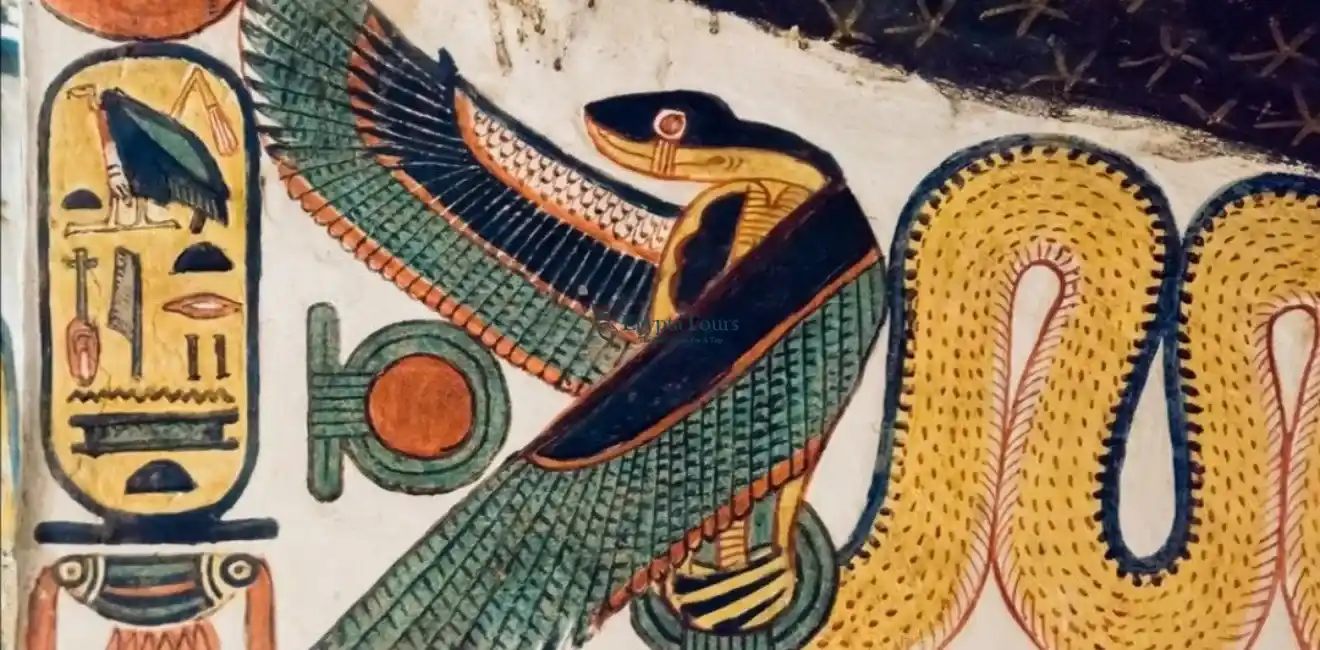
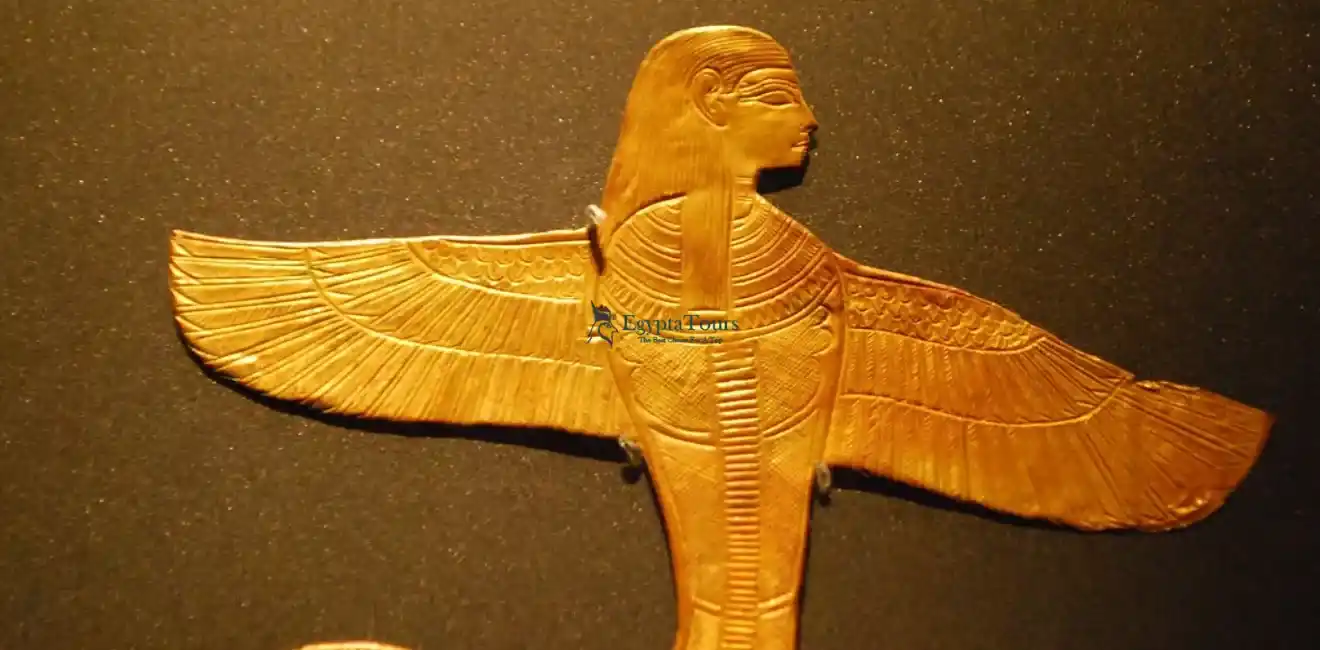
Wadjet, Egyptian Goddess, was usually shown as a winged cobra. One famous image of her appears in the tomb of Nefertari, above Anubis. The Egyptian word wꜣḏ means blue and green and it is also used for the well-known “Eye of the Moon”.
Wadjet was mostly shown as an Egyptian cobra, a venomous snake common in the region. Later, she was often shown as a woman with a snake head, a woman wearing the uraeus or as a lion-headed goddess often wearing the uraeus. The uraeus originally was just her body, coiled around the head of the pharaoh or another god. In her snake form, she would strike or bite anyone who tried to harm the king which is why she became a symbol of protection on crowns and amulets.
Sometimes, Wadjet, Egyptian Goddess, is shown as a cobra with large, colorful wings. Her snake hood and wing feathers are usually green and blue, her signature colors. She can also be shown in red and gold, which fade down to the snake’s tail.
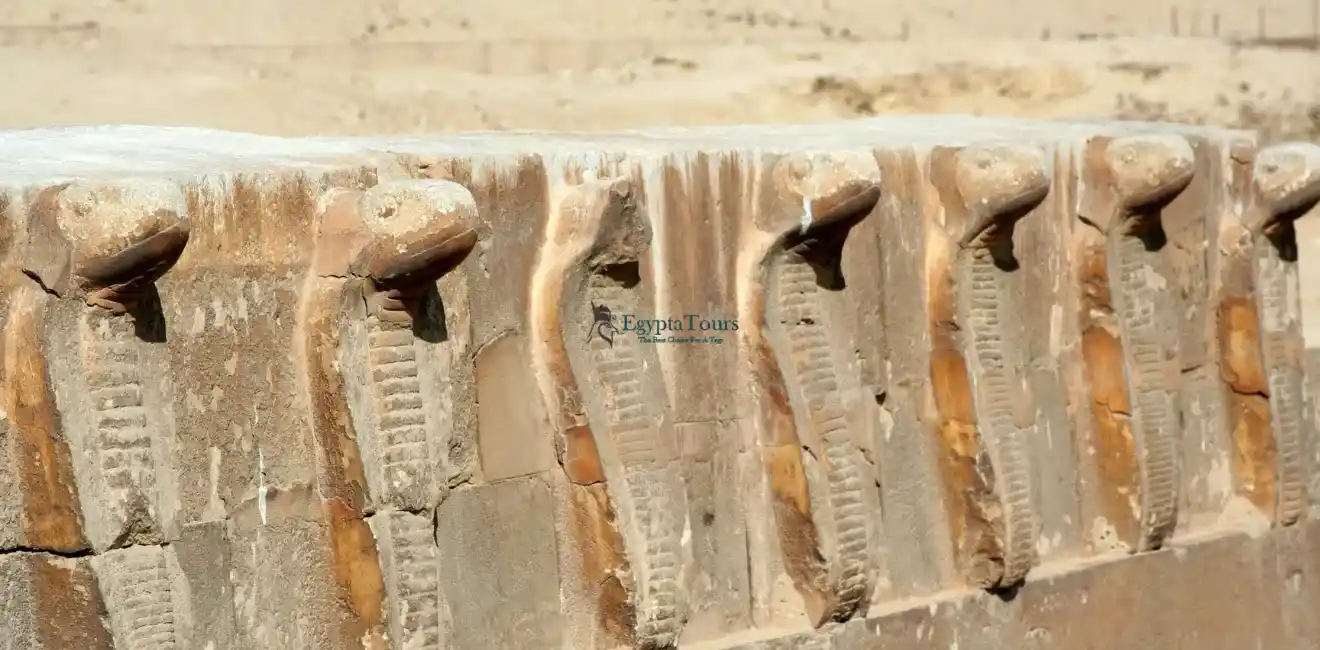
Gold often represented the eternal flesh of gods and goddesses, while red represented fire and danger. A decorative panel of Wadjet’s cobras was found in the Maru-Aten Temple, made of dark granite, which shows that yellow quartzite may have been used to represent the sun and the eternal flesh. Later, Wadjet is often shown coiled on the head of Ra, acting as his protector, which became the uraeus symbol on royal crowns.
Another early image of Wadjet, Egyptian Goddess shows her as a cobra wrapped around a papyrus stem. This started in the Predynastic era (before 3100 B.C.) and may be the first image of a snake wrapped around a staff. This became a sacred image used again in later myths and cultures around the Mediterranean, called the caduceus which might have separate origins. Wadjet also appears on the staffs or “flagpoles” that indicate deities in hieroglyphs, as seen in the symbols for uraeus and goddess.
Like her sister Nekhbet, Wadjet can sometimes appear as a vulture. This is less common because her cobra form is more popular as a symbol of protection. But some reliefs do show her as a vulture hovering over the heads of kings and pharaohs.
Wadjet, Egyptian Goddess can also appear with other animal heads or as other animals, like a lion or a mongoose. The mongoose may be shown as the opposite of the cobra because it naturally fights snakes. Some statues of Wadjet may contain mongoose remains, though it is unclear if this is confirmed or just visual observation.
When shown as a lion, Wadjet is usually seated in bronze statues, relaxed with her mouth closed and arms at her side. This is different from her snake form which strikes enemies. Her lion-headed form may connect her to Sekhmet as a powerful and dangerous goddess. Some historians are unsure if these lion statues are Wadjet or Sekhmet.
At times, Wadjet wore the Red Crown of Lower Egypt. She is often shown in her cobra form with Nekhbet who is in her vulture form, on wall paintings or on the pharaoh’s headdress.
In the Mortuary Temple of Hatshepsut at Luxor, there is a relief showing two images of Wadjet: one as the Uraeus with her head through an ankh and another preceding a Horus hawk wearing the pschent representing the pharaoh she protects.
Wadjet- Egyptian- Goddess- as- the -Protector -of -Country,- Pharaohs -and- Other -Deities
Wadjet Egyptian Goddess was closely linked to the Nile Delta region and was more connected to the world of the living than the dead. She was an important protective goddess for pharaohs.
Wadjet is shown in several royal tombs to symbolize protection. For example, in Queen consort Nefertari’s tomb, she appears in a rearing position wearing the double crown or Pschent which shows the unity of Lower and Upper Egypt.
These crowns are often found in royal tombs to show control over all of Egypt. Along with her crown, Wadjet holds a Was-sceptre, a symbol of authority and divine power. These sacred items show her role in protecting the royal family, in this case, King Ramesses II and Queen Nefertari.
Wadjet is also found in the tomb of King Sety I, alongside her sister Nekhbet. The two sisters appear on each side of the king’s name, fully protecting him as he rules Egypt. Their joint depiction shows that Sety I controlled all of Egypt, not just Lower or Upper Egypt.
Wadjet Egyptian Goddess is often shown as a winged cobra. Her wings serve two purposes: protection and creating the breath of life which is often connected to the Ankh symbol she is shown with. Both protection and life were important for surviving in the afterlife.
In the Temple of Kom Ombo, an engraving shows surgical tools including sets of Wadjet eyes, showing their use as medical items and Wadjet’s role as a protector goddess. The same relief shows a Roman pharaoh offering the Wadjet Eyes to the gods Haroeris and Senetneferet (the good sister), his consort. The inscription explains that the pharaoh wanted Haroeris to ritually cleanse the eyes, symbolizing the two halves of Egypt and restoring the country. This shows Wadjet’s role as a protector and unifier of Egypt.
Like many parts of Egyptian mythology, Wadjet appears in modern video games, movies and other media. Her symbolism is used in many ways:
Wadjet was the protective goddess of Lower Egypt and was known for protecting pharaohs and royal families. She is often depicted as a cobra or represented by the Wadjet Eye.
The name Wadjet means “Green One” because she is associated with the color green which appears in her eyes and symbols. This color is also linked to plants like papyrus in Lower Egypt.
Wadjet protected pharaohs by appearing as a cobra on their crowns or as the Wadjet Eye on amulets striking any enemy who tried to harm the king.
Wadjet was the goddess of Lower Egypt and Nekhbet was the goddess of Upper Egypt. After the unification of Egypt, they became the “Two Ladies,” protectors of the entire country and the kings.
Wadjet is usually shown as a cobra, sometimes with wings as a woman with a snake or lion head, wearing the Red or Green Crown and as the Wadjet Eye, symbolizing protection.
Her main temple was in Per-Wadjet which was named after her. Other temples were in Imet and Tebtunis. She also had an oracle and was worshiped as the protector of Lower Egypt.

Confidently choose your perfect Egyptian adventure from our selection of trusted, expert-curated tours.



Unlock the true wonders of Egypt with confidence. We combine expert local knowledge, seamless logistics, and round-the-clock support to deliver flawless, responsible, and unforgettable travel experiences.