





Ancient Egypt Dance
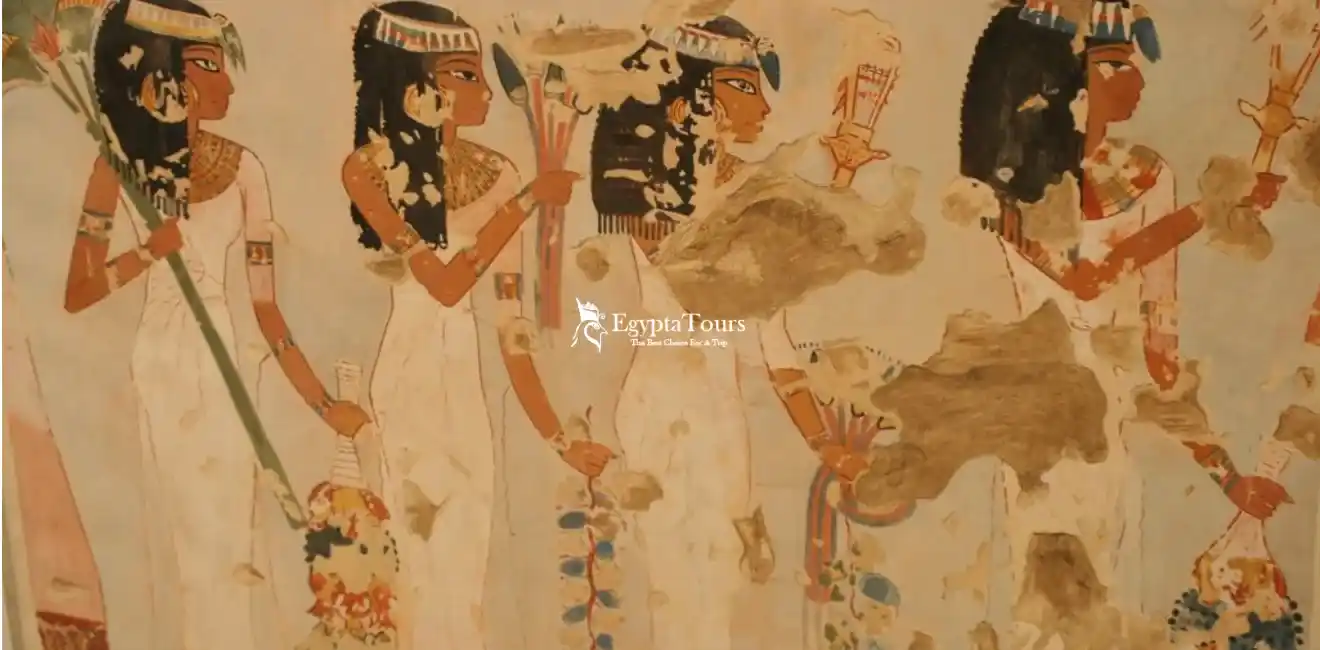
Dance occupied a prominent place in the lives of ancient Egyptians as it was an integral part of religious, social and daily practices. The inscriptions and drawings on the walls of temples and tombs in addition to pottery, show that dance was a widespread activity associated with various occasions.
Despite this, these scenes did not show men and women dancing together as each had separate roles within society. In the Old Kingdom era, a dance known as “trf” was known and was performed by two men together. There were also specialized dance troupes that were called upon to perform at feasts, dinner parties, homes and temples.
Some women from the harems of the wealthy received special training in music and dance and they would perform for the kings accompanied by male musicians playing instruments such as guitars, lyres and cymbals.
Despite the prevalence of dance, members of the upper classes did not participate in it publicly as dance in public places was considered an activity specific to the lower classes. Therefore, the wealthy relied on slaves and professional dancers to provide entertainment at their feasts and to delight their guests.
The forms of dance in ancient Egypt varied with the variety of occasions as the movements and rhythms differed according to the nature of the event. Dance associated with military occasions was different from religious or celebratory dance. Tomb scenes dating back to the New Kingdom era confirm the presence of dancers participating in religious ceremonies and celebrations regularly.
Ancient- Egypt -Dance
Dance was not just a means of entertainment, but a religious ritual and a vital necessity at the same time. Temples and tombs documented many dances with complex rhythms. A study issued by the Luxor Center for Studies, Dialogue and Development coinciding with the International Dance Day on April 29, points to the diversity of ancient Egyptian dances including the dwarf dance that was performed in the morning and the loud war dances in addition to dances by girls performing elegant and distinctive spinning movements.
Egyptian researcher Wissam Dawoud explained that “The Song of the Four Winds” is considered the oldest acrobatic dance scene known to the world which appeared in the Middle Kingdom era and was performed by girls. The study also showed that dance was present in religious rituals inside temples and in manifestations of daily life, as dance parties were held on multiple occasions such as the Sed festival, the Opet festival and even in funerals as the “Muu” dance was performed during burial ceremonies and dancers wore strange crowns made of reeds.
The researcher also pointed out that the pharaoh himself participated in dance in honor of the goddess Hathor in her festivals and that some gods such as “Bes” and “Ahi” son of Hathor were also associated with dance and celebrations.
She added that some dances performed by female dancers in Egyptian popular weddings and festivals who were known as “awalim”, have ancient roots recorded on the walls of temples and tombs.
The study mentions that the oldest dance scenes in Egypt were found in caves dating back to prehistoric times in areas near the Western Desert and these dances were associated with hunting and worship rituals. Images of dance also appeared on household tools and utensils in pre-dynastic eras.
In terms of the history of human dance in general, the oldest evidence dates back to the drawings discovered in the Bhimbetka rock shelters in India which indicate that dance dates back more than ten thousand years BC. In Egypt, the clear appearance of dance dates back to around 3300 BC as drawings were found in the tombs of pharaohs showing dance as a religious ritual especially in scenes of women raising their navels, a symbol of motherhood seeking the blessing of fertility from the gods.
The History Of Ancient Egypt Dance
Dance has existed in Egypt since very ancient times, even before the rise of the dynasties. Archaeologists have discovered the oldest depictions of dance on rock carvings, on cloth and linen shrouds, on wall paintings, clay models and pottery in Upper Egypt.
The earliest of these examples belong to the Badarian culture pottery from the fifth millennium BCE, followed by the Naqada I and II cultures in the fourth millennium BCE. Over time, scenes of dancing gradually became less common and rare in the late Naqada period indicating a decline in its importance during that era.
In ancient Egypt, the earliest clear depictions of dance appear in Old Kingdom tombs, especially in scenes involving performers who danced during funerary rituals and religious ceremonies. These scenes provide a clear picture of the role of dance in Pharaonic life, showing that it was an integral part of ceremonies related to death and religion. Researcher Irina Lexova wrote the first comprehensive study on ancient Egyptian dance, providing detailed information about its history and role in Pharaonic civilization and treating it as an independent field of study.
Oriental (Egyptian) dance also has a long history in Egypt with deep roots in the Pharaonic civilization. Despite moral restrictions imposed on this art at different times, these limitations did not stop its continuation or reduce its importance.
Over time, Oriental dance underwent significant transformations when it merged with foreign dance styles and entered new arenas such as cinema and stage performances. This helped it spread beyond Egypt, resulting in the emergence of different schools of Oriental dance while the basic principles remained consistent.
Oriental dance has clear Pharaonic origins as evidenced by the carvings and paintings on the walls of temples such as the temples of Thebes and Qurna. These depictions illustrate the dancing aspect of life in ancient Egypt, including religious celebrations, processions, and symbolic rituals where musicians and singers performed alongside dancers in positions and movements very similar to those seen today in Egyptian Oriental dance.
Sahar Helmy Hilali observed that dance in the Arab world remained marginalized for long periods. Historians, scholars and intellectuals paid little attention to it, and Arabic literature rarely documented dance movements, despite the high level of historical awareness in Arab civilization. Unlike literature, poetry, architecture, decoration and calligraphy, dance was not documented or developed, possibly due to strict moral attitudes toward this art.
The use of expressive movement in Arab heritage was largely limited to the Sufi context such as the dances of the dervishes, dhikr circles and spiritual rituals where the goal was achieving spiritual harmony with the universe.
Other forms of dance, especially Oriental or folk dance, known in the West as “belly shaking”, were left largely undocumented academically, despite being widespread in Egypt, North Africa and some Arab countries. This dance maintained general similarities across different societies over time due to cultural exchange rather than deliberate planning or organization.
Spread Despite Restrictions
Spread -Despite -Restrictions
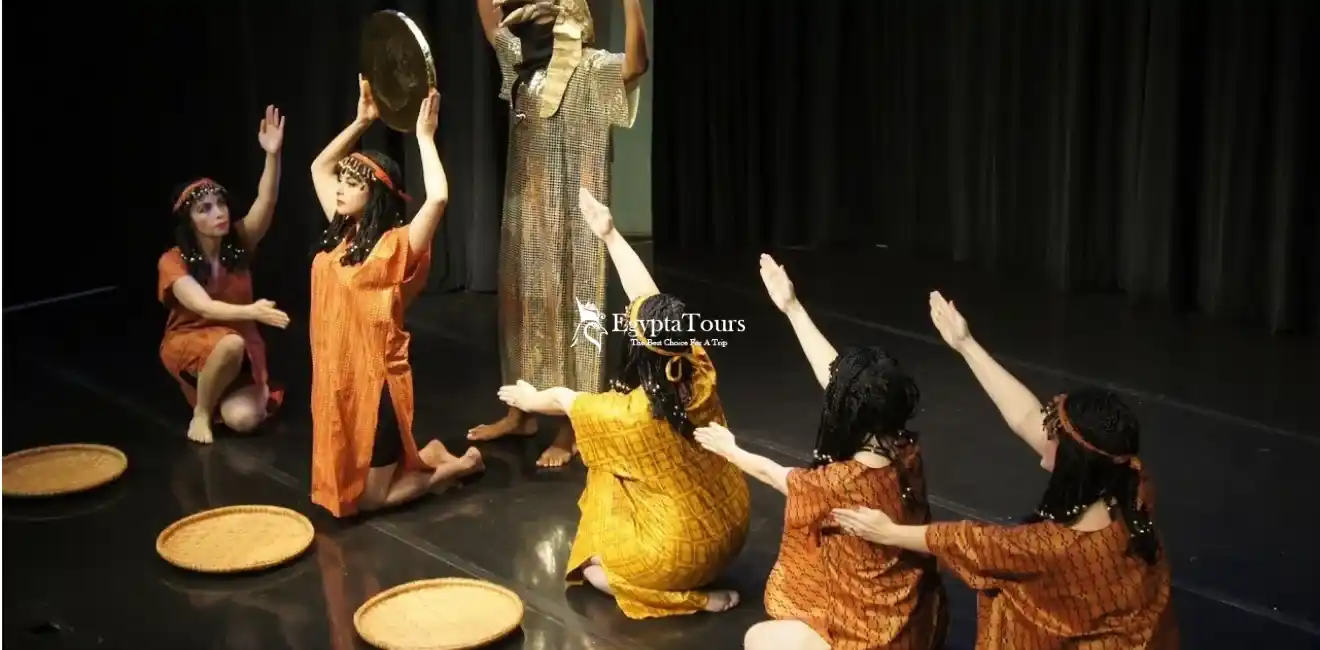
Authentic Egyptian Oriental dance managed to spread beyond Egypt without restrictions or oversight. Its success was due to the natural and spontaneous movements of the dancers and the improvisation in performance. This spontaneity and flexibility allowed the dance to reach wide audiences without prior planning or guidance.
Despite strict moral limitations, no scientific studies were recorded about Oriental dance or its development and its movements were not documented accurately. This isolation left it outside academic research and true artistic development and even without proper documentation, despite being one of the most important movement arts in the past and present centuries.
Hilali believes that art is a universal language of communication among peoples and dance is a medium of expression. Egyptian Oriental dance was able to find its place among global dances through its distinctive movement language without prior direction or oversight.
This situation led Hilali to question the history of Egyptian Oriental dance: its origins, emergence, use in ancient Egypt, its flourishing in the early twentieth century, the reasons for its decline later in the same century and how to preserve it and ensure its future continuity.
Hilali also notes that this curiosity led her to investigate the neglect and under-documentation of this popular cultural heritage, especially since it has a distinctive movement language and artistic character.
As a university professor, ballet specialist and ballerina at the Egyptian Opera House, her experience along with collaboration with directors and choreographers from countries such as the United States, Russia, Italy, France and Germany, allowed her to see how artists create, draw inspiration from their environment and culture and sometimes adapt movements from other peoples’ dances into their art.
She emphasizes that Egyptian Oriental dance has been able to survive and develop over centuries and across civilizations. It spread globally in its classic form, as seen in Egyptian classic films, especially black and white cinema, maintaining its aesthetics and movement techniques that give it a unique identity and artistic form key reasons for its global recognition and adoption.
One of the most distinctive features of Egyptian Oriental dance is the movement of the hips and waist, characterized by flexibility, smoothness and fluidity in performance. The controlled movement of the torso is also a unique feature which distinguishes it from many other dance styles such as classical ballet, where hip movements are strictly prohibited. This makes Oriental dance unique in its artistic and physical expression.
Dance Groups And Dancers In Ancient Egypt
Dance- Groups -And -Dancers -In -Ancient -Egypt
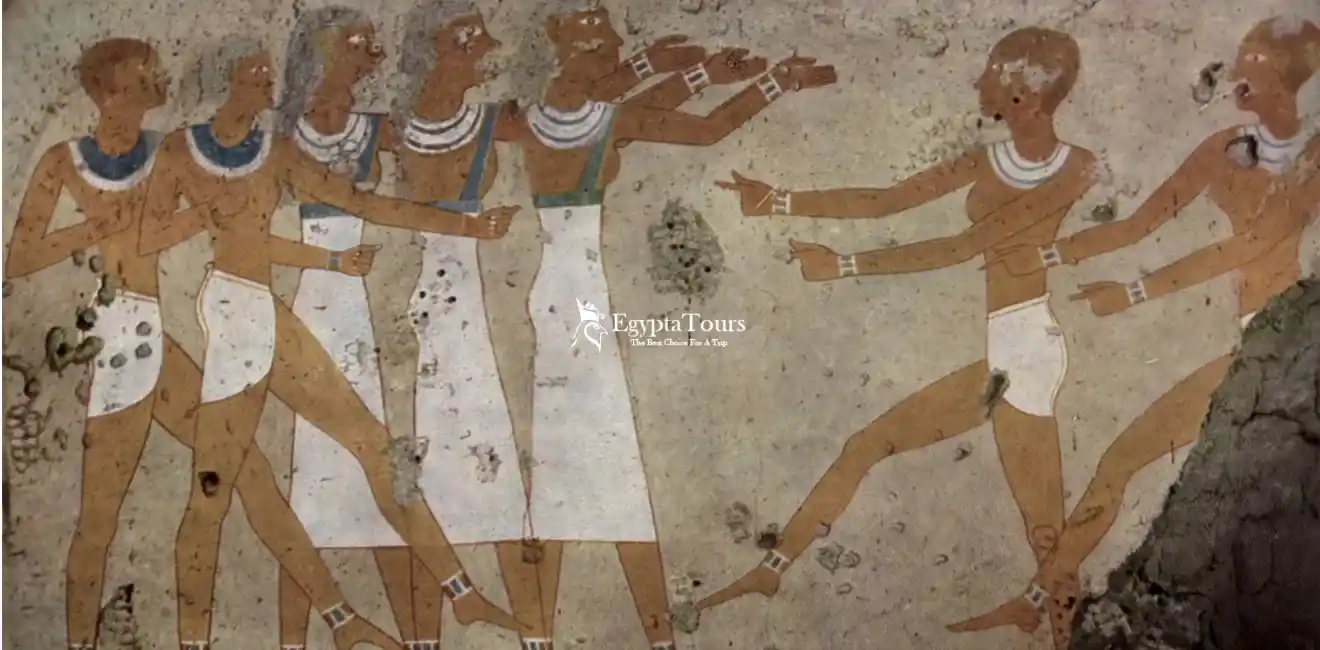
In ancient Egypt, there were organized groups of singers, musicians and dancers who usually performed at major festivals and funerary ceremonies. These groups were called ḫnr (Khenr) which roughly means “musical performers.”
Sometimes, the term ḫnr was used to describe a full troupe of singers and dancers, arranged and managed through an official office. Victorian-era researchers sometimes confused ḫnr with harem groups due to cultural differences and misunderstandings of the ancient images and inscriptions.
The role of the ḫnr was mostly in religious and funerary celebrations, providing entertainment for deceased kings, but their work was not limited to this. They also performed in important temples such as those of Hathor, Bat, Bawet and Horus Iunmutef. Some ḫnr members were itinerant, traveling from place to place to perform and dancers sometimes took additional work outside of performances to support themselves.
The main types of ḫnr were associated with temples, religious cults, the king and funerary estates. Most of these groups were led by women, especially until the end of the Old Kingdom. During the New Kingdom, more foreign dancers and musicians appeared. Their origins can be identified through clothing, hairstyles and names in texts, although their participation in ḫnr was probably limited.
As for the dancers themselves, they usually performed in groups of the same gender with very little evidence of men and women dancing together.
Each dancer had their own special movements but the performance was organized and coordinated so that the group moved in harmony. Some temple scenes show that certain performances were reserved only for elite Egyptian women reflecting the organization of performances according to gender and social status.
Types Of Ancient Egypt Dance
Types- Of -Ancient- Egypt -Dance
Researchers have studied and classified ancient Egyptian dances in many ways. Irina Lexova described types such as pure movement dances, gymnastic dances, mimetic dances, pair dances, group dances, war dances, dramatic dances, lyrical dances, unusual dances, funerary dances and religious dances. Another researcher and dancer, Elizabeth “Artemis” Murat, divided dances into six main categories: religious dances, non-religious dances, party dances, harem dances, war dances and street dances.
Religious Dances
Religious dances were probably the earliest type of dance in Egypt. They were used to mourn the dead and to honor the goddess Sekhmet, who, according to legend, almost destroyed all humanity when Ra, the sun god, asked her to punish those who forgot him. We may not know the exact meaning of each movement but it is clear that these dances were fully religious. They were performed to honor, celebrate, mourn or calm the gods and most ceremonies were done in the name of one or more deities who were believed to help humans daily and over long periods of time.
Individual, Pair and Group Dances
Egyptian dancers performed individually, in pairs, or in groups depending on the occasion and type of dance. Individual dances were often performed by the king or priests acting as his representatives. The king could perform the “sun dance” or dance during the harvest festival to honor Min, the god of fertility.
Pair dances involved two dancers of the same gender performing together, a tradition that began in the Sixth Dynasty. Some Fifth Dynasty images show female dancers holding each other’s hands in harmony, using symmetrical and dramatic movements to express emotions such as longing or sadness.
Group dances took two main forms. One form emphasized individual movements to highlight a theme or idea, often performed spontaneously with dancers sometimes competing in groups. The other form involved pairs or rows of dancers performing repeated movements in a circle, commonly seen during festivals and public events.
The Funerary Dances
Funerary dances were closely connected to rituals for the dead and the afterlife, including specific gestures, positions and sometimes secular movements. In the Old Kingdom, a specialized group of female dancers called the “House of Acacia” performed dances linked to embalming, honoring Sekhmet and mourning the deceased. These dancers entertained the newly deceased while offerings were presented. During the Middle and New Kingdoms, funerary dances dedicated to Hathor guided the deceased to the afterlife.
Movements included jumping or leaping, accompanied by prayers, singing, clapping and rhythmic use of sticks. Another group of sacred dancers which was known as “Moo dancers” performed at different times during funerals wearing skirts and cone shaped crowns made from woven reeds or palm fibers,
symbolizing their role as guides to the underworld. These dances symbolically delivered the deceased to the afterlife. One dance mentioned in the story of Sinuhe, called the “Dance of the Weary,” represented the deceased’s ancestors. Funerary dances also influenced later traditions such as Coptic shield dances symbolizing rebirth and acrobatic performances during wedding processions continuing a long-standing cultural tradition.
The Ancient Egypt Dance in Celebrations
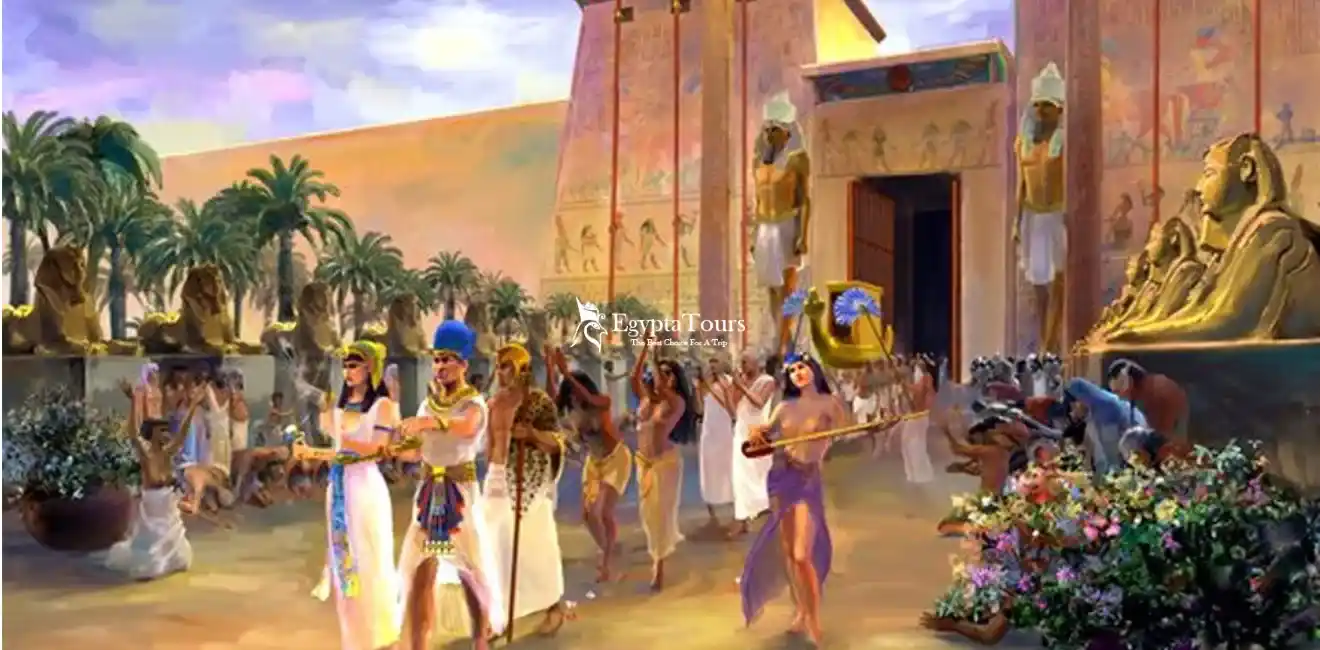
Celebratory dances were shown at festivals and public ceremonies. During the Sed Festival, dances celebrated the king’s renewal and varied according to religious importance and local myths. The Beautiful Valley Festival in Thebes saw families dancing as Amun traveled from Karnak Temple to visit the tombs on the west bank, passing by Hathor’s temple.
The Opet Festival featured acrobatic dances performed by women alongside dark-skinned dancers, possibly Nubians moving in time with drums. The Festival of Min celebrated the god of fertility and renewal with priests and symbolic representations like monkeys dancing. During the Nile Flood Festival which marked the New Year, dances played a vital role in transforming the dangerous Sekhmet into the gentle Hathor protecting the land. These dances included acrobatics and exotic foreign movements.
The Ancient Egypt Dance during Wars
War dances were common during the New Kingdom (1558 – 1305 BCE). Egyptian mercenary soldiers including Nubians, desert tribes from the east and Sardinians, performed war dances both as entertainment and military training.
These dances combined acrobatic and combat-like movements, teaching precision, speed and skill. Colored soldiers performed free-style movements accompanied by shouts and large drums to guide dancers while Libyan soldiers executed organized sequences with curved wooden sticks, imitating attack and defense. The god Bes, associated with dance, is often depicted holding a shield and sword and tattoos of Bes were applied on female temple dancers to symbolize protection and performance skill.
Pair and Group Dances
Pair dances involved two dancers of the same gender performing together, starting in the Sixth Dynasty. They often used sticks or held hands with symmetrical and expressive movements conveying emotions. Group dances could highlight a theme with individual movements or involve rows of dancers performing repeated circular motions, commonly seen at festivals, parties and religious events often with trained pair dancers participating.
Ancient Egyptian dances were diverse, structured and symbolic. They served religious, funerary, celebratory and military purposes and performers ranged from specialized temple dancers to soldiers and court dancers. Movements were expressive, conveying emotions, stories or religious devotion. Dance was not only a form of entertainment but also a vital cultural and spiritual practice throughout Egypt’s long history.
Ancient Egyptian Dance Costumes
Ancient -Egyptian- Dance -Costumes
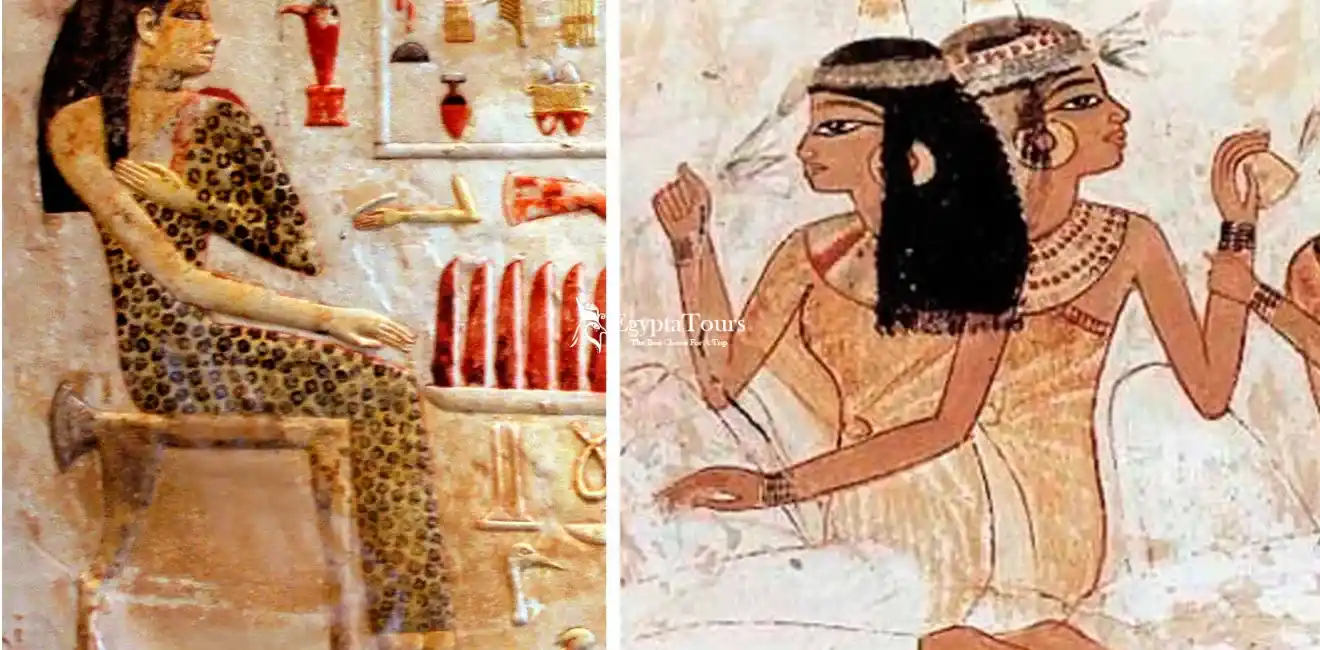
Unlike many cultures that had very specific and elaborate dance costumes, ancient Egyptian dancers hardly wore anything that could be called a full dance outfit. In many surviving scenes, female dancers in particular are shown moving their arms and legs freely without being restricted by clothing, wearing at most a small decorated shirt or tunic, and not always both together. At other times, dancing took place with almost no clothing, sometimes only a single loose band tied around the waist.
Clothing and Headgear
Dancers rarely wore the usual tight-fitting dress, which was a white sheath extending from the chest to the ankles. The main exception was in the Old Kingdom for funerary dances. Old Kingdom dancers are shown wearing not only dresses but also male aprons with sashes or skirts.
Middle Kingdom and New Kingdom dancers no longer wore male skirts but continued to use aprons without sashes. In the New Kingdom, adult dancers often wore minimal clothing, usually a belt or sash around the waist and sometimes a transparent robe to show their bodies. Dancers of this period also used different forms of everyday clothing under their long, loose, sheer robes, with dresses often leaving the right breast uncovered.
Dancers adorned themselves with bracelets, headbands or crowns. Old Kingdom dancers wore bands around their chests, while New Kingdom dancers added collars, earrings and cone-shaped decorations made of semi-solid scented fat or beeswax, giving off a pleasant fragrance during performances. Eyes were heavily lined with kohl.
In the Old and Middle Kingdoms, women’s hair was distinctive, cut evenly, smoothed with two thin braids hanging over the shoulders to the chest and a wide braid covering the upper back. Dancers without long hair wore wigs styled in the same manner. Female dancers were also depicted with tattoos or painted symbols on their thighs of Bes, the god associated with fertility, birth, music and dance. It is unclear whether these decorations were exclusive to dancers or more commonly used among women.
Male dancers wore short hair and standard male clothing, such as kilts. In the Old and Middle Kingdoms, they also wore aprons with rounded fronts. Accessories included collars or necklaces and young boys often wore anklets.
Lexova also noted that dancers of this era used short sticks or curved rods during performances, a prop that continues to be used by modern Egyptian dancers.
Musical Instruments Of Ancient Egypt Dance
Musical -Instruments- Of- Ancient- Egypt -Dance
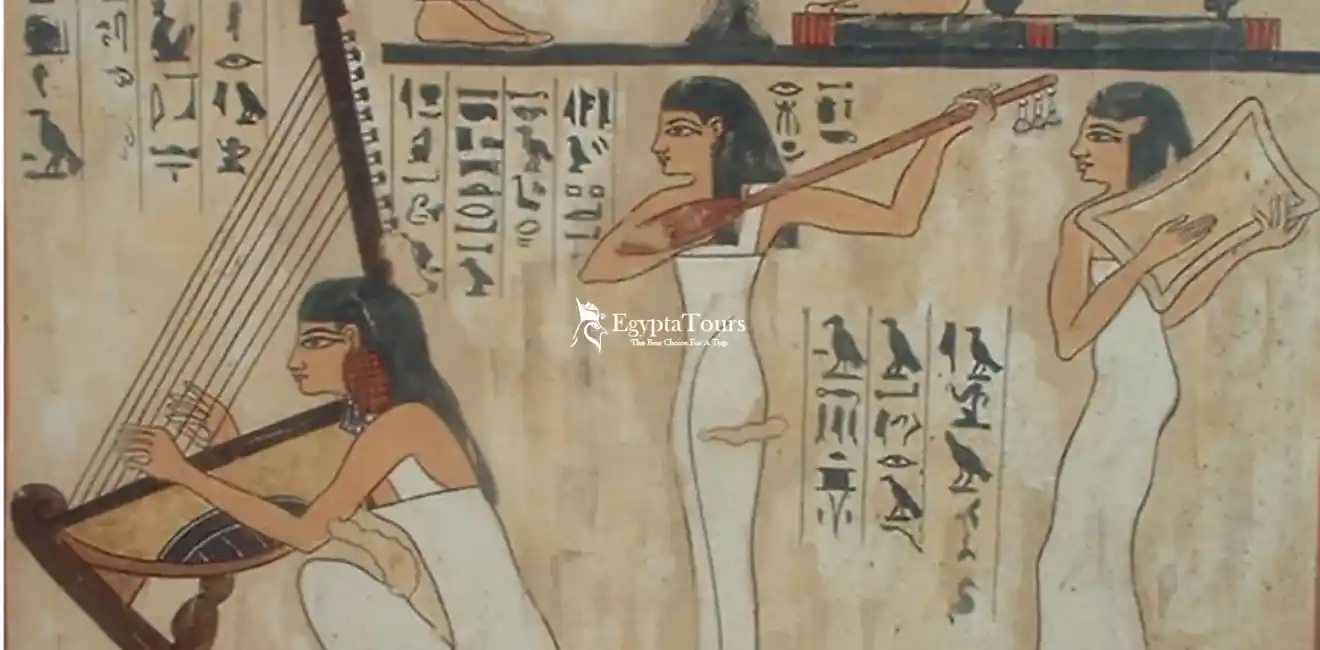
The ancient Egyptians used many different musical instruments in their dances and celebrations such as cymbals, lyres, drums, flutes, clappers, small gongs and tambourines. Music was an important part of their performances.
Before the New Kingdom, dancers usually performed with simple percussion instruments, like clappers. Later, string instruments such as the lute and lyre were added, allowing dancers to perform to a wider range of music. Musicians were almost always shown near the dancers showing how closely dance and music were connected in ancient Egyptian culture.
Dwarfs and Pygmies in Ancient Egypt Dance
Dwarfs and pygmies were known in the Old Kingdom and were valued for their rarity. They were often employed as dancers in special ceremonies. Their dances were connected to the departure of the sun as it was believed that dwarfs represented the sun due to their halted growth. Evidence shows that during the Twentieth Dynasty, dancing dwarfs replaced regular dancers at the entrances of tombs. Some depictions show them wearing crowns similar to traditional ones.
After the New Kingdom, tomb decorations changed, and funerary dances were no longer depicted on tomb walls but appeared in temples instead. Temple dance scenes reflected both royal and divine celebrations, and most of these scenes featured the official procession of the sacred bark carrying a deity.
Pharaonic Dance In “A New Book”
A new book titled “Egypt Taught the World” by Dr. Waseem El-Sisi explores the lives of the creators of Egyptian civilization in a storytelling style. In his introduction, the author states: “We have the greatest history, described by James Henry Breasted as “The Dawn of Conscience” because human history was dark before Ancient Egyptian civilization. Breasted was not the only one fascinated by this history; Jean-François Champollion also said: ‘Imagination collapses and falls motionless before Ancient Egyptian civilization.’”
The book also discusses the pharaohs’ relationship with sacred animals. According to the Egyptian historian Manethon: “Our zoological knowledge included animals, birds, and reptiles such as cobras and snakes.
Some insects were sacred as well, like the scarab, which reproduces parthenogenetically. We addressed the deity: ‘O creator who brought yourself into being,’ which is why we revered the scarab as we did the cat, calling it a messenger of divine care. We noticed the plague disappeared when their numbers increased. We also used their fat on rat paths and made surgical threads and strings for the lyre and harp from their intestines.”
The book also lists eleven types of Pharaonic dances: group dance, theatrical, athletic, partner, mimicry, acrobatics, religious, death dance (which included cheek-slapping and women jumping in rings), war dance, solo dance and expressive dance. The book is published by the Egyptian Lebanese Publishing House.
The Importance Of Dance In Ancient Egypt
In ancient Egypt, celebrations were not limited to religious or athletic events: they also included social and cultural occasions. Musical performances, theatrical shows and artistic displays were held in public squares and royal palaces bringing together people from all social classes and strengthening their connections.
These events were diverse and attractive, drawing many people to participate. One of the main features of celebrations was music and dance. Musical groups and dancers performed lively shows using instruments such as drums, lyres, ouds, anats and harps. People enjoyed watching and listening, and also joined in singing and dancing.
In Lower Egypt, arts and culture flourished and dance became an essential part of daily life. It combined artistic expression with spirituality and was linked to worship, religious ceremonies and public celebrations. Dance took place during festivals, weddings and prayers and was more than just movement, it expressed deeper emotions.
Dance was also used to communicate with the gods and higher spirits and to express joy, sorrow, love, war and even for healing purposes. Dances followed specific musical rhythms to coordinate the movements of the dancers. There were also musical groups specialized in playing instruments such as the oud, drums and wings.
Some dances were traditional, specific to certain regions or religious groups. Over time, dance evolved and was influenced by other cultures. The most popular types of dance in ancient Egypt included group dances, partner dances and spiritual dances.
The Influence Of Ancient Egypt Dance
The legacy of ancient Egypt remains alive through monuments, sculptures, inscriptions and the living traditions of the Egyptian people. Many young people and dance groups participate in performances and celebrations today, drawing inspiration from the techniques and styles of ancient Egyptian dance.
Dance held an important role in cultural, religious and social life and was considered both a sacred art and a way to express joy and happiness. Wall paintings and tomb inscriptions depict dancers performing elegant movements, highlighting the significance of dance in ancient society, a tradition that continues to this day.
Ancient Egyptian dance also influenced the arts and culture of neighboring regions with some of its movements and styles adopted in dance and music across the Middle East and North Africa.
The Reverse Change And The Transformation of Ancient Egypt Dance from Religious Ritual to Entertainment Dance
In the middle of the 16th century, Gypsy tribes arrived in Egypt, mostly coming from India and passing through Iraq on their way. They lived a simple, isolated life far from traditions and customs and introduced a type of dance called “entertainment dance.”
In her book “In the Name of Egypt” which talks about life in Egypt before 1952, researcher Reem Abu Eid said that the Gypsies performed dances to entertain people using fast and exaggerated movements.
Before the French occupation of Egypt at the end of the 18th century, another group of Gypsies came from India and Iran. Gypsy women would dance at gatherings to attract men and earn money. At that time, Egyptian people knew Eastern dance only as movements for fun, not as a full art form like today.
The Bee dance, The Dance Forbidden by Muhammad Ali Pasha
At the beginning of the 19th century, cafés appeared in Egypt during Ottoman rule. These cafés were centers for thought and art. Here, “bee dances” were performed by Gypsy women to loud music. The most famous was Kutchuk Hanem of Syrian origin, admired by the French writer Gustave Flaubert.
The bee dance was like a small play. The dancer would act as if bees were stinging her and would take off her clothes piece by piece in pain. Then a large sheet would cover her body and the drums would beat to end the dance.
The British traveler Edward Lane wrote in his book “Manners and Customs of Modern Egyptians” (1836) that men often performed Eastern dance because society allowed men to dance but did not allow women to dance in front of men. For this reason, dancers were forbidden from performing in Cairo. When Gypsy groups spread, people rejected their dances and Muhammad Ali Pasha ordered the bee dance to be banned in Cairo’s cafés.
The Sacred Dance
Eastern dance as we know it today was not fully formed until the 19th century. Some historical sources say that the Dutch woman Mata Hari who was later executed, was the first to perform belly dance, based on Hindu religious rituals.
Mata Hari traveled with a Dutch military officer to Indonesia, where she saw how Hindus worshiped the god Shiva through “sacred dance.” Each movement in this dance had a special meaning. The costume of Eastern dance today is very similar to the dress of Hindu women shown in temple paintings.
Mata Hari brought the full style of sacred dance—including the movements and costumes—to theaters in France, performing in front of a statue of Shiva. She became very famous in Europe. During World War I, because many soldiers visited theaters, she became involved in spying for Germany. She was arrested, tried, and executed by firing squad in Paris in 1917.
International Dance Day
International- Dance -Day
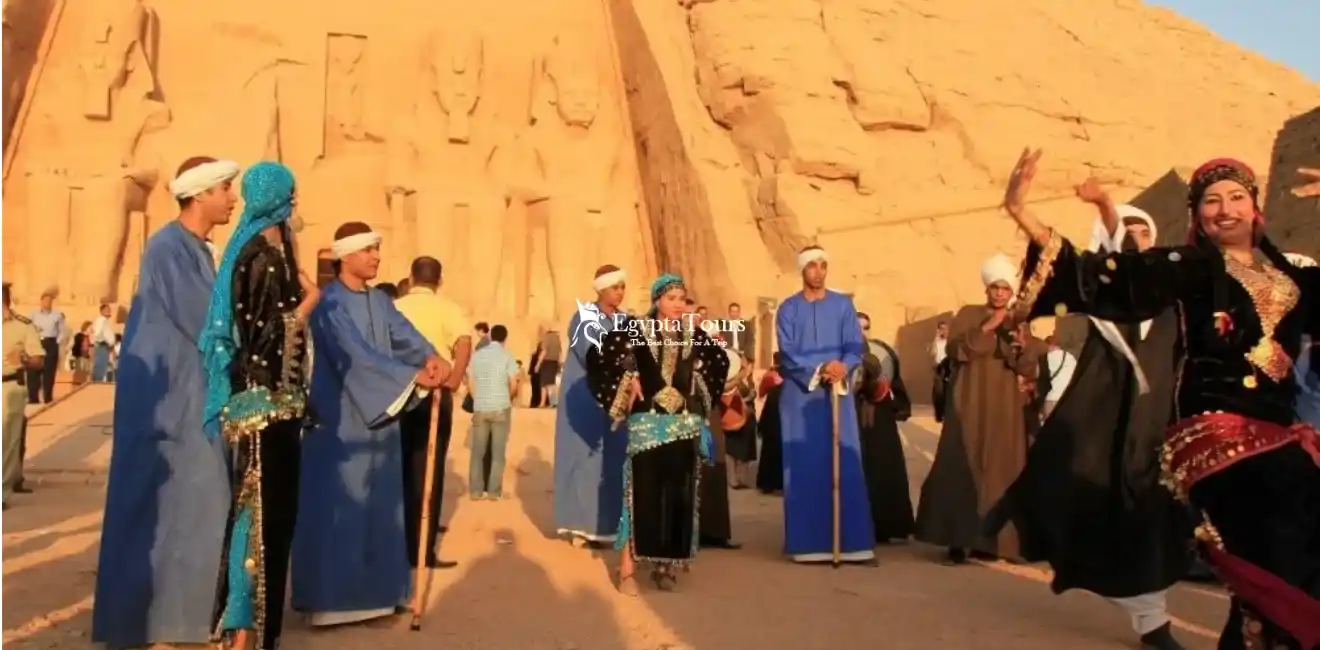
The world celebrates International Dance Day every year on April 29. A study by the Luxor Center for Studies, Dialogue, and Development said that ancient Egyptians knew about dance performances and even established schools to teach dance thousands of years ago.
Archaeological sites and temples in Abydos, Luxor, and Edfu show evidence that ancient Egyptians taught dance in temple schools and used it dramatically. This made Egypt advanced in dance compared to other countries.
Egyptian archaeologist Mona Fathy, chief inspector at Karnak temples, said that Egypt had many dance games in history. One of the most important is the stick dance or “Tahtib.” It started as a combat game and later became a performance dance. Special festivals are still held for it, gathering skilled players from all governorates, and it comes from ancient Pharaonic origins.
Pharaohs painted this game on temple walls and taught it to soldiers. The game today is a little different from the past. The sticks were made of soft papyrus in ancient times which did not hurt or kill opponents, unlike today.
Stick dance is closely related to horse riding because it involves two riders meeting in a circle. It requires strength, quick reaction, and skill to strike in rhythm. The game combines adventure, bravery, skill, and honor and any mistake can lead to being hit by an opponent.
Researcher Naglaa Abdel Aal Al-Sadiq said that besides dance, ancient Egyptians knew two types of drama: ritual celebrations and religious drama. Ritual celebrations were held by priests in temples. Egyptian drama appeared about 3,000 years before Greek drama and was more developed. The first Egyptian theater was in the Temple of Osiris and the first play was about the death and return to life of Osiris.
International Dance Day has been celebrated since 1982, proposed by the World Dance Council which operates under UNESCO and supports all types of dance.
The Relationship Between Ancient Egyptian Dance, Theatre and Drama
There is clear evidence that shows the connection between dance and theatre in ancient Egypt dating back to the early second millennium BCE. This evidence is a stone tablet discovered in Edfu in 1922 during excavations by the French Institute of Oriental Archaeology in Cairo.
The tablet contains a dedication to the god Horus by a man named “Imhab” who worked as an assistant to a traveling performer. After the usual prayers related to food and comfort in the afterlife, the text mentions a mime performer.
A mime performer depended on movement and gestures to express abstract ideas and emotions. The word “mime” comes from the Greek word mimesis, which means imitation. It originally referred to traveling groups of actors, clowns and acrobats who performed in markets, public squares, and during festivals. Some of these performers were skilled in expressive movement and gesture. In modern times, especially in France, mime developed into silent performance, represented by artists such as Jean-Louis Barrault and Marcel Marceau.
The evidence shows that ancient Egypt knew two main types of drama. The first type was ritual celebrations. These were held by priests inside temples. Priests in ancient Egypt established schools attached to temples to teach dance.
Dance was used in a dramatic way which can be understood from its role in secret temple performances held around the sacred lake inside the holy sanctuary. In this field, Egypt preceded many other civilizations.
These ritual celebrations were not theatre in the modern sense. They depended mainly on performance style. They used ritual gestures and symbolic movements that followed a fixed order, accompanied by spoken words that gave the ceremonies a mythical meaning.
These performances were intellectual dramas based on symbols. One example is the coronation ceremony of the king, where a servant offers him a light meal during long celebrations and says, “I present to you your Eye, satisfied.” The courtiers then reply, “Place it upon your face.”
The second type was religious theatre. This was true theatre as we understand it today. It presented full reenactments of past events using actors, dance movements and dialogue. It did not depend on symbols or indirect meanings. For this reason, it was a theatrical performance and not just a ritual.
Many sources indicate that theatrical performances were held inside temples, which were also places where dance was performed. Egyptian theatre was closely connected to religion and religion was deeply linked to dance. This connection was very strong and inseparable.
Dance drama was one of the earliest serious forms of communication between people. It existed before spoken language, music, and other arts. Dance movement was strongly connected to dramatic feeling from the beginning of civilization. Its roots lie in emotion, rhythm and expression.
Dance is the oldest artistic tool and the most direct way to express dramatic feeling. It carries the physical experiences of the human body since the creation of mankind.
Over long periods of time, simple dance movements of early humans developed into complex rituals. These rituals became connected to every idea and feeling in the life of the community. Around 4000 BCE, many dance dramas existed in Egypt and other ancient civilizations.
These performances lasted for several days and were longer and more intense than later forms. People communicated with their gods through dance and shared their stories using dance, music and poetry.
This development reached its peak in ancient tragedies. These performances included groups of singers, chanters (chorus) and dancers. Together, they created a complete dramatic experience based on movement, voice and rhythm.
Conclusion
Ancient Egypt Dance was an essential part of life in ancient Egypt. It was used in religious rituals, festivals, funerals, wars and daily celebrations. Dance was closely connected to music and followed clear rhythms and movements.
Men and women usually danced separately and professional dancers often performed in temples, palaces and celebrations. Dance was a way to express joy, sadness, love and worship and it helped people communicate with the gods. This tradition continued to influence Egyptian and Oriental dance and remains part of Egyptian culture today.
FAQs
What was The History of Ancient Egypt Dance?
Dance has existed in Egypt since very ancient times, even before the rise of the dynasties. Archaeologists have discovered the oldest depictions of dance on rock carvings, on cloth and linen shrouds, on wall paintings, clay models and pottery in Upper Egypt. The earliest of these examples belong to the Badarian culture pottery from the fifth millennium BCE, followed by the Naqada I and II cultures in the fourth millennium BCE. Over time, scenes of dancing gradually became less common and rare in the late Naqada period indicating a decline in its importance during that era.
What was the ancient Egypt dance?
Dance was an important part of ancient Egyptian life. It was used in religious rituals, festivals, funerals, and daily celebrations. Men and women usually danced separately, and professional dancers often performed for the wealthy. Dance styles varied with the occasion, including war dances, spinning dances, and acrobatic dances. Pharaohs and gods were also linked to dance. Ancient evidence shows dance has existed since prehistoric times, and in Egypt, it was often a ritual seeking blessings, joy, or celebration.
What was The Dance that was Forbidden by Muhammad Ali Pasha?
It was the Bee dance. At the beginning of the 19th century, cafés appeared in Egypt during Ottoman rule. These cafés were centers for thought and art. Here, “bee dances” were performed by Gypsy women to loud music. The most famous was Kutchuk Hanem of Syrian origin, admired by the French writer Gustave Flaubert.
The bee dance was like a small play. The dancer would act as if bees were stinging her and would take off her clothes piece by piece in pain. Then a large sheet would cover her body and the drums would beat to end the dance.
The British traveler Edward Lane wrote in his book “Manners and Customs of Modern Egyptians” (1836) that men often performed Eastern dance because society allowed men to dance but did not allow women to dance in front of men. For this reason, dancers were forbidden from performing in Cairo. When Gypsy groups spread, people rejected their dances and Muhammad Ali Pasha ordered the bee dance to be banned in Cairo’s cafés.
What is the Influence of Ancient Egypt Dance?
The legacy of ancient Egypt remains alive through monuments, sculptures, inscriptions and the living traditions of the Egyptian people. Many young people and dance groups participate in performances and celebrations today, drawing inspiration from the techniques and styles of ancient Egyptian dance.
Dance held an important role in cultural, religious and social life and was considered both a sacred art and a way to express joy and happiness. Wall paintings and tomb inscriptions depict dancers performing elegant movements, highlighting the significance of dance in ancient society, a tradition that continues to this day.
Ancient Egyptian dance also influenced the arts and culture of neighboring regions with some of its movements and styles adopted in dance and music across the Middle East and North Africa.
What is the importance of Dance in Ancient Egypt?
In ancient Egypt, dance was an important part of celebrations, including religious, social, and cultural events. People of all classes joined music and dance performances in public squares and palaces. Dancers and musicians used instruments like drums, lyres, ouds and harps to entertain and express emotions.
Dance was part of festivals, weddings, prayers and rituals, combining art and spirituality. It communicated with gods, expressed joy, sorrow, love, war, and was sometimes used for healing. Some dances were traditional while others evolved over time and were influenced by different cultures. Popular dances included group dances, partner dances, and spiritual dances.
About EgyptaTours

EgyptaTours is a name synonymous with trust, excellence, and unforgettable travel experiences, proudly standing as one of the leading travel agencies in Egypt. Renowned for its deep expertise, personalized service, and carefully crafted itineraries, EgyptaTours serves as the ultimate gateway to discovering Egypt in its most authentic and inspiring form.