





Top 60 Egyptian Ancient Gods
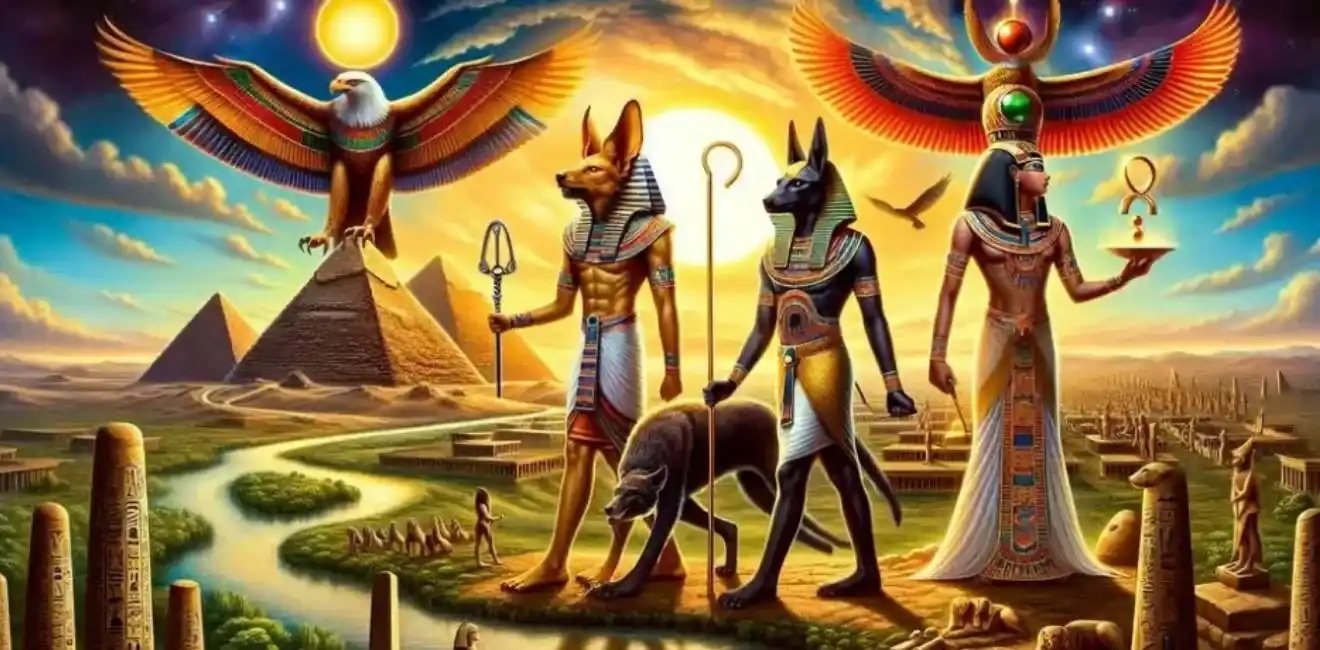
The Egyptian ancient gods were varied, representing natural incidents, social aspects, and abstract concepts. The gods emerged from the beginning of civilizations and continued until the introduction of monotheistic religions. There are over 1,500 known gods, and many ancient Egyptian texts showed the gods without describing their attributes, characteristics, or roles. Other texts defined the attributes without mentioning the name, making it challenging to compile a comprehensive list of all the names. There were different gods with similar attributes, as if they were a single god.

Egyptian -Ancient -Gods
The origins of the Egyptian ancient gods date back to the earliest written source about the Egyptian gods to the Early Dynastic Period (3100-2686 BCE), and it is said that the gods appeared in a period of the Predynastic Period, concurrent with prehistoric religions.
Various images depicting humans and animals are repeated in the art works of the Predynastic Period, and some of these images (such as stars and cattle) are reminiscent of images that recur in the ancient Egyptian religion that developed later,
but there is no strong evidence as to whether these images are associated with the gods or not, and the manifestations of the Egyptian religion became clearer with the development of Egyptian society.
The earliest appearance of temples was in the last centuries of the Predynastic Period, alongside the symbolic images associated with the known gods; the falcon symbolizes the god Horus and a number of other gods, and the crossed arrows symbolize the goddess Neith, and the “Set animal” symbolizes the god Set in particular.
Gustav Jéquier believes that the Egyptians initially revered the primitive forms of idols such as fetishes, then idols with animal forms, and then evolved to worship gods with human forms, while Henri Frankfort suggests that the first conception of the gods was in the image of humans.
Contemporary researchers see these theories as overly simplistic, but modern theories are difficult to prove, such as the theory of Siegfried Morenz, which says that the gods appeared in the Egyptians’ attempts to distinguish themselves from nature and began to personify it as well.
The council of Top 60 Egyptian Ancient Gods.

The -Council- Of -Egyptian -Ancient -Gods
The council of all Egyptian ancient gods may have formed when disparate societies merged into larger states, leading to the spread of the worship of ancient local gods, but some other researchers see that the most important gods of the pre-dynastic period were like other elements of Egyptian culture, that is, they were widespread throughout Egypt despite the political fragmentation.
The unification of Egypt was the final step in the formation of the religion of ancient Egyptians, when the rulers of Upper Egypt appointed themselves pharaohs ruling all of Egypt, and then those sacred kings and their entourage monopolized the right to contact the gods, and the monarchy became the pillar around which religion revolves.
Places and concepts suddenly inspired the Egyptians to create idols that express them, and some idols were created to be a counterpart of the opposite sex to the dominant gods and goddesses.
It was believed that the kings were sacred, but the worship of those kings did not continue after their death except rarely, while some commoners who did not sit on the throne became famous for being pleased with the gods and were revered for this reason, and this reverence usually continued for a short time, but the royal architects such as Imhotep and Amenhotep son of Hapu, as well as some state officials, were transformed in the eyes of the Egyptians into gods for centuries after their death.
The Roles of Top 60 Egyptian Ancient Gods.
The roles of the gods were flexible, and each of them could expand their attributes or acquire new traits, making it difficult to classify or define the roles of the gods. However, the power of the gods was limited and restricted to spheres of influence, and even the creator god himself could not influence beyond the boundaries of the universe he created, and even Isis, who was described as the wisest of the gods,
was not all-knowing. But Richard H. Wilkinson sees that some texts dating back to the late New Kingdom suggest that the beliefs centered around the god Amun had developed to the point where he was almost omniscient and omnipresent, and that he transcended the boundaries of the world, distinguishing himself from other gods.
Isis, the mother goddess, and patron of kings, with Pharaoh Seti I sitting on her lap.
Most Egyptian deities represented natural or social phenomena, and the gods were generally immanent in these phenomena, that is, they were united with nature. These phenomena included places, things, forces, and abstract concepts. For example,
the god Shu was the god of the winds, while Mertseger was only concerned with the Theban necropolis, while the goddess Sia was an embodiment of the abstract concept of “perception”. The main gods often occupied multiple roles and embodied different types of phenomena; for example, Khnum was the lord of the island of Philae,
located in the middle of the Nile, which was the lifeblood of Egyptian civilization, and Khnum was also credited with bringing the annual Nile flood that fertilized Egyptian agricultural land, and perhaps his life-giving power was the reason for the belief that he breathed the spirit into all living creatures, after creating their bodies from clay on a potter’s wheel.
Some Egyptian ancient gods shared the same role in nature, and the title of sun god, for example, was shared by Ra, Atum, Khepri, Horus, and other deities. But despite the diversity of the roles of the gods, they were united by a single umbrella,
which is the preservation of Maat, that is, the cosmic order, which is the core of ancient Egyptian religion and was embodied by a goddess of the same name.
On the contrary, some gods represented the disruption of Maat, most notably Apophis, the god of chaos, whose arrival is feared to disrupt the cosmic order, while the god Set had no specific role, being both the enemy of chaos and its source.
Actions of Top 60 Egyptian Ancient Gods.
The ancient Egyptians believed that divine actions controlled all aspects of nature, except for the actions of the gods that disrupted the divine order. The gods maintained Maat, created all living things, and sustained their souls through a force called “Heka”, which is translated as “magic”. Heka was the main force used by the creator god to create the world, and even the gods themselves.
Characteristics Of Top 60 Egyptian Ancient Gods.
The characteristics of the Egyptian ancient gods were complex and connected, featuring myths, family relationships, free groups, and hierarchical relationships. They also combined separate gods into one god, and their forms varied, being animals, humans, objects, or a combination of different forms. Over time, they attained a higher status in the divine society, and the supreme deity was credited with the creation of the universe.
The ancient Egyptians acknowledged a single, hidden force behind the universe, yet they did not abandon the concept of multiple gods, except during the time of Akhenaten.
The Varied Groups of Ancient Egyptian Deities

The- Varied- Groups -of -Ancient -Egyptian -Deities
With the multitude of ancient Egyptian deities, their roles diversified, and they were divided into many groups, and they were not a unified group. Each group had its own characteristics, roles, beliefs, and methods of worship, as well as different myths. Some deities were local to specific regions, cities, or specific temples only, while on the other hand, there were some deities who were worshipped throughout Egypt. Among these groups are those that fall under the name of families, such as
The Ennead Group:
which is a celestial group consisting of nine deities and their center of worship is Heliopolis. This group consists of Atum, the god of creation, Shu, the god of air, Tefnut, the goddess of moisture, Geb, the god of earth, Nut, the goddess of the sky, Osiris, the god of the underworld and resurrection, Isis, the goddess of magic and healing, Set, the god of chaos and storms, and Nephthys, the goddess of mourning and protection. The relationship between these deities is either by blood or marriage, and they had an important role in creating and adjusting the world according to the belief of the ancient Egyptians. This group was also associated with royalty, morality, and cosmology.
The Ogdoad group:
This group consists of eight deities who are the primary forces of chaos and creation, and their center of worship is the city of Hermopolis. They were described as four pairs in the form of frogs and snakes. This group includes Nun and Naunet, the deities of the primordial waters, Amun and Amaunet, the deities of mystery and hiddenness, Kuk and Kauket, the deities of darkness, and Huh and Hauhet, the deities of infinity. According to ancient Egyptian beliefs, it was believed that this group existed before creation to prepare the world when it was just dark, formless water, and they were the source of the life-giving energy for the creation of Ra, the sun god. The myth says that they created the lotus flower, which later opened and brought out Ra, and then Ra created the rest of the gods and the world. These deities were also associated with the underworld, as they guarded the entrance to the Duat, the realm of the dead.
The Group of the Judges of Maat:
There was a group of ancient deities who presided over the judgment of the dead in the Hall of Truth under the command of Osiris, the ruler of the underworld. This group consists of 42 judges associated with Maat, who represented the goddess of truth, justice, and order. She was often depicted with an ostrich feather on her head. The feather was used as a symbol of Maat and a measure of the heart of the deceased in the Hall of Truth, with the blessings of the gods. The judgment of the dead was a difficult trial in which the soul of the deceased had to prove its innocence before Osiris and the court.
The heart was weighed against the feather, and if the heart was heavier than the feather, the soul was considered guilty and would be devoured by Ammit, a creature with the head of a crocodile, the body of a lion, and the hindquarters of a hippopotamus, like a real beast. But if the heart was lighter than the feather, the soul was pure, chaste, and truthful, and would enter the paradise of the Field of Reeds, which is a complete reflection of life on earth. Against the 42 judges, the soul had to recite 42 sins it had not committed. This number also refers to the dismemberment of Osiris’ dead body, where Set cut him into 42 pieces and scattered them across the Nile, with each piece representing a ruler.
The judges differed in their names and origins, some representing specific places in Egypt, and others representing nature and morality. They represented the values that every Egyptian had to follow to achieve eternal life.
The Gate Deities:
The Gate Deities were a group of ancient Egyptian gods and goddesses who were tasked with guarding the gates of the underworld. They were intricately linked with the 12 hours of the night and the 12 signs of the zodiac, with each gate bearing a distinct name and being protected by three deities: one facing east, one facing west, and one facing inward. The names and attributes of these deities varied across different sources, adding to the complexity of their roles.
The role of the gate deities
These Gate Deities played a pivotal role in the journey of the deceased through the underworld. They served as gatekeepers, testing the soul’s knowledge and purity by posing questions or demanding passwords. If the soul successfully passed the test, it was permitted to proceed to the next gate. However, if it failed, it would be devoured by Ammit, the fearsome Eater of Hearts.
The minor gods, acting as true guardians, were depicted in various temples and tombs, including the Valley of Kings and the Valley of Queens. Their images and roles were also meticulously documented in the Book of the Dead and the Book of the Gates, ancient funerary texts that provide detailed descriptions of these deities. These texts reveal the gates of the House of Osiris in the underworld and the 21 portals of the House of Osiris in the Field of Reeds, highlighting the significance of the Gate Deities in ancient Egyptian funerary practices.
1-Ra: The Ascendancy Of The Sun God.

Ra -The- Ascendancy- Of -The -Sun -God
Attribute:
God of the Sun
Center of Worship:
Heliopolis since the Fifth Dynasty and in Thebes during the New Kingdom
Symbols:
Obelisks in Heliopolis, Karnak, and the Temple of Abu Simbel.
The myth of the daily cycle
The myth of the daily cycle describes Ra’s nightly struggle against the forces of evil, represented by a large snake called Apophis, so that the sun can finally appear the next morning. In the evening, the sun god Ra rides the sacred boat and crosses the Nile underground. The god Set helps him by standing at the bow of the boat and threatening the snake to keep it away.
The Worship of Ra.
The worship of the sun spread since the Old Kingdom era, perhaps because the kings of the Fifth Dynasty, who ruled from 2560 BC to 2420 BC, belonged to the priests of this god (Ra), making this deity the most revered among them.
Throughout the second millennium BC, it is noticeable how the name Ra became added to the name of almost every god (Khnum-Ra, Sobek-Ra, Montu-Ra… etc.), attempting to add new power to the capabilities of these gods in the form of the ram, crocodile, and bull.
2-Hapi, The God Of The Nile.

Hapi -The -God -Of -The- Nile
Hapi is the god of the annual Nile flood in ancient Egyptian religion. The flood deposited rich silt on the riverbanks, allowing the Egyptians to grow crops. Hapi was greatly celebrated among the Egyptians.
Hapi, The Lord. 7
Some of Hapi’s titles were “Lord of the Fish and Birds of the Marshes” and “Lord of the River who Brings Vegetation”. Hapi is usually depicted as a person with a feminine appearance, with a protruding belly and large, drooping breasts, wearing a loincloth and a false ceremonial beard. He is also depicted as an androgynous person, carrying manifestations of both femininity and masculinity.
Hapi was not considered the god of the Nile itself, but rather the god of the flood event. He was also considered a “friend to Geb”, the Egyptian ancient god of the earth, and “Lord of Neper”, the god of grain.
Depiction of Hapi.
Hapi is depicted with large breasts and a large belly, representing the fertility of the Nile. He is also often given blue or green skin, representing water. Other features varied depending on the region of Egypt where the depictions are found.
In Lower Egypt, he is adorned with papyrus and accompanied by frogs, present in the region, and its symbols. While in Upper Egypt, the lotus and Nile crocodiles were more present in the Nile, and thus these were the symbols of the region, and those associated with Hapi there.
Hapi is often depicted carrying offerings of food or pouring water from an amphora,
but he is rarely depicted as a hippopotamus. During the 19th Dynasty, Hapi was often depicted as a pair of figures, each holding and tying together the long stems of two plants representing Upper and Lower Egypt, symbolizing the binding of the two halves of the country around the hieroglyphic sign for “union”.
3-Amun, The God Of The Sun.

Amun-The -God -Of -The -Sun
Amun, god of the sun, wind, and fertility; one of the main gods in ancient Egyptian mythology (religion of ancient Egyptians), and the meaning of his name is the hidden one.
It is difficult to know exactly how his name was pronounced because ancient Egyptian hieroglyphic writing used consonants, so his name was written “Amn” and it is possible that it was pronounced “Amin” with a slight inclination towards “Aman”.
The Union of Amun and Ra.
After the Eleventh Dynasty, Amun, the local god of Thebes, began to transform into Amun-Ra, and the sun god became known as the King of the Gods, enjoying the highest degree of reverence and fame. After the Eighteenth Dynasty (1800 BC), Amun-Ra became the official god of the empire.
Amun, united with Ra, the sun, manifested himself to creation, and thus Amun-Ra combined in himself the two divine opposites: as Amun, he was hidden and mysterious, separate from the world, and as Ra, he was manifest, apparent, and giver of daily life.
Union of Amun and Ma’at
By the same logic, his connection with Ma’at, the Egyptian concept of justice and balance in the universe, was established. Amun’s hidden nature facilitated his association with other gods. In Thebes, Amun was initially associated with Montu,
its ancient god, and then came his association with Ra, followed by his association with other gods, and he was known by the names Amun-Ra-Atum, Amun-Ra-Montu, Amun-Ra-Horakhty, and Min-Amun.
Here, it should be noted that Amun did not merge with other gods to create a new god, but rather his association was a unification of divine power.
Amun’s Elevation and the Glory of Thebes.
The rise of Amun to the status of national and universal god coincided with the increasing importance of Thebes. This rise accelerated with the accession of Amenemhat I (Sehetib-Ra) to the throne in Thebes and his establishment of the 12th Dynasty, and reached its peak in the New Kingdom era when he was celebrated in the Opet festival.
4-Anubis, The Protector Of Tombs.

Anubis- The- Protector- Of -Tombs
Anubis, in Egyptian Ancient mythology, served as the deity of funerary rites, the protector of tombs, and the guide to the afterlife, often portrayed either as a canine or as a man with a canine head. Similar to many other Egyptian gods, Anubis assumed different responsibilities depending on the context.
By <strong> the Middle Kingdom</strong> (c. 2055–1650 BC), his role as lord of the underworld was largely taken over by Osiris. Nonetheless,
he retained a key function as the god who guided souls into the afterlife, attending the weighing of the heart ceremony, which determined whether a soul was permitted to enter the realm of the dead.
Depiction of Anubis.
Anubis is one of the most frequently shown and mentioned gods in the Egyptian pantheon; however, few major myths involve him.
Anubis was depicted in black, a color that symbolized regeneration, life, the soil of the Nile River, and the discoloration of the corpse after embalming. Anubis is associated with Wepwawet, another Egyptian god portrayed with a dog’s head or in canine form,
but with grey or white fur. Historians assume that the two figures were eventually combined. Anubis’s female counterpart is Anput. His daughter is the serpent goddess Kebechet.
Anubis Role.
- As jmy-wt (Imiut or the Imiut fetish) “He who is in the place of embalming”, Anubis was associated with mummification.
- In the Osiris myth, Anubis helped Isis to preserve Osiris.
- The Opened Mouth ceremony being performed on a mummy before the tomb. Anubis attended to the mummy of the deceased. Extract from the Papyrus of Hunefer, a 19th-Dynasty Book of the Dead (c. 1300 BC)
- Anubis was a protector of tombs and cemeteries.
- “The Lord of the sacred land”, which indicates him as a god of the desert necropolis.
- Anubis protected the body of Osiris from Set.
- The legend of Anubis brand identity, the hide of Set in leopard form, was used to explain how the leopard got its spots.
- Anubis is represented as guiding the deceased forward and handling the scales, under the scrutiny of the ibis-headed Thoth.
- Though a similar role was sometimes shown by the cow-headed Hathor, Anubis was more commonly chosen to fulfill that function.
- One of his roles was as the “Guardian of the Scales.
5-Geb, The God Of The Earth.

Geb-God-of-the-Earth-Ancient-Egyptian-gods-and-goddesses-EgyptaTours
Geb is one of Egyptian Ancient Gods and belongs to the “Ennead of Heliopolis”. According to ancient Egyptian mythology, he is the brother and husband of Nut, goddess of the sky, and both are the children of Shu, god of the air, and Tefnut, goddess of moisture and water, although archaeologists now describe her as a goddess of “fire” because she carries the eye of Ra (the sun).
Geb, the god of the earth, is represented as a man lying on the ground with his sister Nut, goddess of the sky, above him, adorned with stars. The rest of the scene shows their parents, Shu, god of the air, raising his arms, and Tefnut, goddess of moisture, mentioned only by name, and the god Ra riding the solar boat.
The Role Of Geb.
Geb is considered one of the most important Egyptian Ancient gods symbolizing the earth, alongside Sokar and Aker, who were worshiped in some regions of ancient Egypt.
He gives humans the earth and its riches, and sometimes causes earthquakes, as believed by ancient Egyptians.
He is the source of water, and everything that comes out of the earth, making him a fertility god, as the plants and grains grow on his back.
He is considered the successor to his grandfather Atum and his father Shu, who withdrew to their heavenly pastures. Geb remained on earth, guarding the right of kingship.
Geb was sacred in Heliopolis as the father of the gods, especially Osiris. He was also worshiped in Memphis and Kom Ombo, and is mentioned on the walls of the Temple of Amun in the city of “Hibis”.
The Depictions of Geb.
Depictions of Geb show him as a seated man, colored green. In most depictions, he is lying on the ground, with his sister and wife Nut, goddess of the sky, above him. Sometimes he is depicted as a standing man, holding a war sceptre and an ankh, the symbol of life, in his right hand. He is also sometimes depicted as a man with a goose on his head, and his name is written with two hieroglyphs: a goose and a man, where the man is pronounced as the letter “b”. The goose chosen by ancient Egyptians to write the name “Geb” is the Nile goose, which they domesticated in early times.
6-Aten, The Monotheistic God.

Aten-The -Monotheistic -God
The Egyptian ancient god Aten proclaimed by King Akhenaten and considered the monotheistic god of the sun, with no partner, and the light of Aten benefits all races. Aten is represented in the form of the sun disk, with its rays ending in human hands, to give life and prosperity to the royal family. After Akhenaten’s death, Amun returned to his former position as one of the Egyptian gods.
Worship places of aten.
Aten is the monotheistic god with no partner, and his temple in Tell el-Amarna, Akhenaten’s capital, and his temple in Karnak, were without a roof, to allow sunlight to penetrate inside.
7-Sekhmet, The First Human Vampire.

Sekhmet -The -First -Human -Vampire
Sekhmet is one of the gods in ancient Egyptian mythology. She is often depicted as a woman with the head of a lioness, sitting on a throne or standing. She is a member of the Memphis Triad.
Titles Of The Goddess Sekhmet.
She is a female goddess with many titles, including the lioness, Great Lady, beloved of Ptah, Eye of Ra, Lady of War, Lady of the Two Lands (Upper and Lower Egypt), Lady of Libya, and the Powerful One.
The lioness is the sacred animal of Sekhmet, and her name means “the powerful one”. She symbolizes war, epidemics, and the desert.
Sekhmet and Ra Curse.
Ra, the sun god, was angry with humans for mocking him, so he sent Sekhmet to take revenge on them, the vengeful image of Hathor, to kill these humans. However, Sekhmet enjoyed this task too much and slaughtered people to the point of almost wiping out all humans. Here, Ra tricked Sekhmet by offering her large quantities of red-colored beer that resembled blood, and she drank it, got drunk, and calmed down until she stopped killing.
8-Goddess Nut, The God Of The Sky.

Goddess -Nut-The -God- Of -The -Sky
Amidst the myths, the goddess Nut emerges as one of the most mysterious and magical symbols in ancient Egyptian belief. Nut was not just a goddess; In ancient Egyptian civilization, the sky was personified as the goddess Nut, making her the embodiment of heavens.
The Description Of Goddess Nut:
Nut was personified in a stunning and symbolic form. She is typically shown as a slender woman, her body adorned with stars, stretching in a majestic arch over Geb, the earth god.
Her hands and feet touch the ground, creating a boundary between the heavens and the earth.
This pose represents not only the sky but also her role as a protective covering for the world. Her starry body houses celestial bodies, and the constellations are her children.
Another significant depiction of Nut is as a heavenly cow, representing the celestial vault, with stars and planets adorning her underbelly.
The Book of the Heavenly Cow, a sacred text, describes this imagery and tells the story of how Shu lifted the cow to become the heavens.
The Depiction Of Goddess Nut.
Ancient Egyptian art reflects the intellectual depth of the ancient Egyptians, as this appeared through their depiction of Nut, which came as follows:
Egyptian art depicted Nut as a woman with a long body symbolizing the night sky, so her body took on a dark blue or bluish-black color.
Her body was filled with many golden dots that formed the stars, each one representing a son or daughter of hers.
Nut also appeared in some drawings as if the sun disk was in her mouth at the moment of sunset, and at its birth during sunrise, it appeared in her womb.
Nut appeared in funerary art as a protector of the dead. Therefore, she was painted inside the coffin lid as if embracing the deceased and protecting him, or as if she were giving him water and food, being a source of eternal life.
9-Nephthys, The Goddess Of Death.

Nephthys- The- Goddess -Of -Death
Nephthys is considered one of the most elusive and mysterious deities in ancient Egyptian mythology, and she was of exceptional beauty, as if she were from another world, and is depicted with great wings indicating her association with the falcon.
Nephthys Myths.
Myths about Nephthys are numerous and varied, including that she helped her sister Isis gather the parts of the god Osiris who was killed by his brother Set, and it was also said that she protected the deceased on their journey to the afterlife and is a protector of kings and pharaohs, and the inscriptions in the temple have proven this myth.
It is also said that she was associated with childbirth and magic, and among the myths is that she was a sorceress who had a great healing ability and had great power in magic, as she knew many spells that enabled her to revive the dead and protect them from harm.
The Role Of Nephthys In Funerary Rituals:
Nephthys played a significant role in the funerary rituals, as the ancient Egyptians believed she was one of the gods of death, darkness, and the unknown.
She protected the bodies of the dead and assisted them in their journey to the afterlife. Nephthys was the goddess of death and mourning, and she and her sister were depicted as guardians of the head and feet, standing on either side of the funerary bed to mourn the deceased or as two kites.
The Symbolism Of Nephthys.
The symbolism was very important in depicting Nephthys, as the ancient Egyptians always depicted her accompanied by a falcon or a Benno bird, indicating her association with protection and power. She was also depicted with a basket or a house, which is why she was called the Lady of the House and its protector and guardian.
10-Sebek, The Crocodile God.

Sebek,-The -Crocodile -God
Sebek (also pronounced as Sebk, Sokhet, Sobki), is an ancient Egyptian god with a multifaceted nature, being a god associated with Nile crocodiles, represented either in the form of a crocodile or as a human with a crocodile head. Sobek is also associated with royal power, fertility, and military prowess, and is considered a protective god against dangers, particularly those associated with the Nile and its floods.
Sobek enjoyed a long existence in the Egyptian pantheon, and first acquired his role as a sun god through his relationship with Horus, but this was reinforced in later periods with the emergence of the god Sobek-Ra, a combination of Sobek and the main sun god Ra. Sobek-Horus continued as a character in the New Kingdom (1550-1069 BCE), but Sobek-Ra did not dominate the scene until the late Egyptian dynasties or in the Late Period.
This understanding of the god continued after the fall of the last Egyptian dynasties in the Ptolemaic and Roman periods of Egypt (332 BCE – 390 CE). The prestige of both Sobek and Sobek-Ra increased during this time period, and he was given great importance – either through the expansion of his temples or through religious research to make this god at the height of his power in the doctrine itself.
11-Maat, The Goddess Of Truth.

Maat -The- Goddess -Of -Truth.
Maat is the goddess of truth, justice, and order in the universe, represented as a woman with an ostrich feather on her head, symbolizing justice. She is shown holding the ankh (key of life) in one hand and the sceptre in the other.
Maat is the goddess of truth and justice in ancient Egypt, symbolizing cosmic order and balance. She was the daughter of Ra, and was responsible for maintaining cosmic order and justice on earth.
Maat was the goddess of harmony, justice, and truth, represented as a young woman. Sometimes she is depicted with wings on each arm or as a woman with an ostrich feather on her head. The meaning of this symbol is uncertain, and it is known that the god Shu, who in some myths is Maat’s brother, also wears it.
12-Hathor, House of Horus.

The Goddess Hathor
Hathor is the goddess of the sky, love, beauty, motherhood, happiness, music, and fertility. She was formerly known as Bat and was found on the Narmer Palette. She was symbolized by the cow Amunet.
Description and Naming
Hathor is an Egyptian ancient goddess, depicted sometimes as a cow, and sometimes as a woman with cow ears or horns on her head. She was a symbol of motherly love and nurturing. Her name, Hathor, means “House of Horus” or “Temple of Horus”,
indicating her role as a protector and nurturer of the god Horus, the son of Isis. She became a mother figure to Horus and to nature as a whole, as a symbol of the sky. She was then made a guardian of the dead, and her spirit was believed to reside in the sycamore trees planted near their graves, from which she was depicted emerging, offering shade and nourishment to the thirsty dead in the afterlife.
13-Horus, The Symbol Of Good And Justice.

Horus-The -Symbol -Of- Good -And -Justice.
Horus is mentioned in one of the ancient Egyptian myths as a symbol of good and justice. His father, Osiris, was the god of resurrection and accounting in ancient Egypt. According to the myth, Horus’ uncle, the evil Set, killed his father and scattered his body parts throughout Egypt. His mother,
Isis, gathered the parts of his body, which is considered the first mummy, and Horus was born afterwards. Horus sought to avenge his father’s death and became known as the “Protector of his Father”. He lost his left eye in the battle and became the king of Egypt.
The Depiction Of Horus.
Horus is depicted as a falcon standing on the palace facade, and is mentioned in ancient times alongside Hathor and King Scorpion I. He is shown standing on the palace facade, surrounding the king’s name.
Horus is also depicted on the Narmer Palette, holding the heads of defeated enemies and presenting them to the king.
Until the 4th dynasty, the pharaoh’s title consisted only of the name Horus, and during that dynasty, the title “Golden Horus” emerged as a second title for the king.
14-Isis, The Guide Of The Dead.

Isis-Goddess-of-Motherhood-Ancient-Egyptian-gods-and-goddesses-EgyptaTours
Isis is a major goddess in ancient Egyptian religion whose worship spread throughout the Greco-Roman world. She was first mentioned in the Old Kingdom (2686-2181 BCE) as one of the main characters in the myth of Osiris, where she revived her slain husband, the divine king Osiris, and gave birth to and protected his heir, Horus.
The Role Of Isis.
Isis was believed to guide the dead to the afterlife, just as she helped Osiris, and was considered the divine mother of the pharaoh, who was likened to her son Horus. Her maternal assistance was represented in a healing spell to help the common people.
Originally, Isis played a small role in royal hymns and temple rituals, but she was more important in burial rituals and magical texts. She was often depicted in art as a human woman wearing a throne-like symbol on her head.
During the New Kingdom, Isis took on the attributes of the prominent goddess Hathor, and was depicted wearing Hathor’s clothing and the sun disk between cow horns on her head, as Hathor was previously represented.
15-Osiris, The God Of Resurrection.
Osiris- The- God- Of -Resurrection
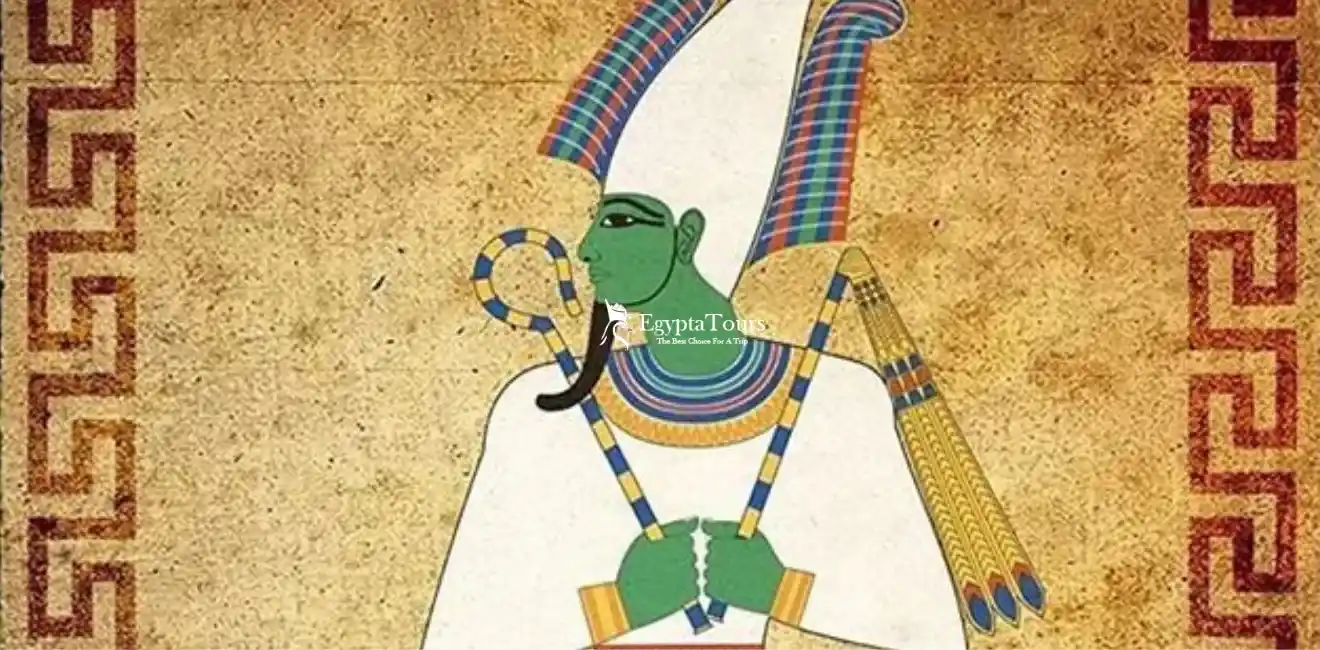
Osiris is the god of resurrection and accounting, and the chief of the dead in ancient Egyptian religion. He is one of the main gods of the sacred Ennead in ancient Egyptian religion, and the only god who rivaled the worship of the god Ra.
Myth of Osiris.
According to the ancient Egyptian myth, Osiris was the brother of Isis, Nephthys, and Set, and married Isis. Their parents were Geb, the god of the earth, and Nut, the goddess of the sky. The ancient Egyptian myth says that Osiris was the first Egyptian king to rule in prehistoric times.
Zedu was his sacred city, and it took its name from his spell. As for the riverbanks, Osiris was the lord of floods, greenery, and the lord and ruler of the dead. His worship in Abydos was mixed with other worships, where it was believed that his head was buried there.
The reason for this is that the Egyptian gods did not have a designated place of residence like the Olympians did in Greek mythology.
The ancient Egyptian believed that Horus would bring the dead after passing the test of the scale and present him to Osiris, and he would be given beautiful clothes and enter the garden “paradise”.
Before that, the process of weighing the deeds of the dead in the world must be done by placing his heart in one of the scales and placing the feather of Maat, the symbol of “justice and good morals”, in the other scale.
If the feather is heavier than the heart of the dead, it means that the dead was good in his life and had good morals, and he would be given beautiful clothes and enter the garden “paradise” to live there happily.
But if the heart of the dead is heavier than the feather, it means that he was arrogant and disobedient in his life. Then the heart and the dead would be thrown to a mythical animal standing next to the scale – called Ammit; its head is a crocodile’s head, its body is a lion’s body, and its lower part is a hippopotamus – and this animal would devour him instantly, and that would be his eternal end.
16-Ptah, The Creator God.

Ptah -The -Creator- God
Ptah is considered the creator god of the ancient Egyptians who existed before all other things, and by his will, he created the world through thinking about it; he conceived the world with his thoughts and brought it into existence through his word:
Ptah conceives the universe with the thoughts of his heart and gives life to them with the magic of his word. Everything was created by Ptah’s command, which included the elements of nature, the animal kingdom, and the plant kingdom. Ptah also plays a role in preserving the world and perpetuating royal rule.
Titles of Ptah.
Ptah bears many titles that describe his role in ancient Egyptian religion and his importance in society at that time: Ptah of the beautiful face, Ptah Lord of truth, Ptah Lord of justice, Ptah who listens to prayers, Ptah Lord of festivals, Ptah Lord of eternity, Ptah the god who made himself god, Ptah of dual existence, Ptah the sole one of the first beginning.
Depiction of Ptah.
Ptah is depicted holding the Was sceptre, with the Ankh sign of life, and the Djed pillar symbol of stability and endurance. In art, Ptah appears as a wrapped, bearded man, often wearing a cap, and his hands are holding the Ankh, Was, and Djed, which are symbols of life, power, and balance, respectively. He is also believed to have embodied himself in the Apis bull.
17-Thoth, The God Of Wisdom.

Thoth -The -God- Of- Wisdom
Thoth or Tut is the god of wisdom in ancient Egypt, one of the cosmic Ogdoad of Hermopolis. He is considered one of the most important Egyptian ancient gods, depicted with the head of an ibis. His female counterpart is the goddess Maat. His main shrine was in Ashmunein, where he was the principal deity.
The ancient Egyptians believed that Thoth taught them writing and arithmetic. He is always depicted holding a pen and a writing tablet. He plays a crucial role in the underworld, where the deceased is brought after resurrection to undergo the weighing of his heart against the feather of truth, Maat. Thoth records the result of the weighing.
Roles of Thoth.
- Thoth had several important rules in ancient Egyptian religion. He was first the mediator in the conflict between good and evil forces, and he had to ensure that neither one dominated the other. He is also credited with teaching the Egyptians writing,as the scribe of the gods. In the underworld, Duat, he appears as an ibis, the god of the scales, who records the result of weighing the heart of the deceased against the feather of truth (representing the teachings of Maat).
- The ancient Egyptians believed that Thoth was a self-created god. He represented divine law and morality, and it was his duty to uphold Maat. At the same time, he was the master of calculations for the creation of the heavens, stars, earth, and all that is in them. The goddess Maat was the guardian of cosmic order. He is credited with moving celestial bodies.
- Without his words, the ancient Egyptians believed, the gods could not exist. His power was limitless in the underworld, rivaling that of Ra and Osiris. The ancient Egyptians attributed to him the possession of all sciences, arts, religion, philosophy, and magic. The Greeks considered him the inventor of astronomy, numbers, astrology, mathematics, surveying, medicine, agriculture, rituals, and writing.
18-Tefnut, The Goddess Of Fire.

Tefnut -The -Goddess -Of -Fire
Tefnut is one of the Egyptian ancient gods and belongs to the Ennead of Heliopolis. According to the myths of the ancient Egyptians, this Ennead founded the world of water, land, sky, and creation. Tefnut was also called the “Nubian cat” and sometimes referred to as “truth”. She represented fire. Previously, archaeologists believed she represented moisture, but her description has been established as symbolizing fire.
19-Atum, The Complete.

Atum -The- Complete
Atum is an Egyptian ancient god, one of the most important deities in Egyptian mythology, his name means “the complete” or “the perfect”. His name is associated with several major Egyptian deities, such as Ra, Ptah, and eventually Osiris.
Physical Description
Atum is usually depicted as a man wearing royal attire, sometimes wearing the white and red crowns of Upper and Lower Egypt, and occasionally depicted as a snake, holding a long staff in his right hand and the ankh symbol of life in his left hand.
His Role in Egyptian Mythology.
In one of the ancient Egyptian myths of creation, they believed that Atum created himself on the primordial mound, making him the creator of the world, then created “Shu the air and Tefnut the moisture” through spitting or semen, and is described as both male and female.
He is at the head of the Ennead of Heliopolis, the nine original deities, including Amun, Mut, Hathor, Isis, and Osiris. He merged with Ra and was known as “Atum-Ra”.
20-Ash, The God Of Oases.

Ash- The -God- Of- Oases
Ash was the god of the oases in ancient Egyptian religion, as well as the god of vineyards in the western Nile Delta region, and was therefore considered a benevolent and generous god.
Flanders Petrie found several references to Ash in the Old Kingdom in 1923 during his trip to Saqqara, for example, on wine jar seals: “Refreshed by Ash” was a common and widespread inscription.
Description.
Ash was usually depicted as a human with the head of a desert animal (lion, vulture, falcons, snake, or the unknown animal of the god Set). In fact, the depiction of Ash is one of the earliest known depictions of gods in ancient Egyptian art, showing the god in the form of a human with an animal head.
Ash also appears in some inscriptions and drawings as a multi-headed god, unlike other Egyptian gods, although some such composite representations appear with the god Min, and some scholars have linked this multi-headed representation to the Scythian gods.
21-Shai, The God Of Fate.

Shai -The -God -Of -Fate
Shai (also written as Sai, and in Greek as Ψαις, Psais or Ψοις, Psois) is the deification of the concept of fate in ancient Egyptian religion. Being an abstract concept, without a specific reason to associate it with a particular gender, Shai was sometimes considered female, rather than the more common understanding as male, in which case he was referred to as Shait.
His name reflects his function and role among the gods, literally meaning “(what is) destined”. As the god of fate, he was said to determine the lifespan of each human, as well as attend the trial of the deceased’s soul in the Duat.
Role and Associations.
As a result, he was sometimes considered the husband of Meshkhenet, the goddess of birth, or, in later times, Renenutet, who determined the ren, and became considered a goddess of good luck. Due to the power associated with the concept, Akhenaten, when introducing his monotheistic doctrine, said that Shai was an attribute of Aten, while Ramses II claimed to be the lord of Shai (i.e., lord of fate).
Depictions and Associations with Other Gods.
During Ptolemaic Egypt, Shai, as the god of fate, was associated with the Greek god Agathodaemon, who was a god of prediction of good fortune. Thus, since Agathodaemon was considered a snake, and the word Shai was also the Egyptian word for pig (sai, not shai), in the Hellenistic period, Shai was sometimes depicted as a pig with a snake’s head, the composition known to Egyptologists as the “Shai animal”.
22-Ishtar, The Goddess Of Love.

Ishtar- The- Goddess -Of -Love
Ishtar is the goddess of love and beauty, war and sacrifice in the wars of the civilizations of the Mesopotamian region and its surroundings. She is Inanna to the Sumerians, Astarte to the Phoenicians, Aphrodite in ancient Greece, and Venus to the Romans.
The Sumerians called her the Queen of Heaven, and her temple was located in the city of Uruk. She is the star of morning and evening (Venus), her symbol is an eight-rayed star standing on the back of a lion, with the flower on her forehead, and a bouquet of flowers in her hand.
Symbolism.
Her depictions and symbols have varied, and she has appeared in most ancient myths, poets have sung of her love, and artists have excelled in depicting her in painting and sculpture.
The Ishtar Gate in the Pergamon Museum. Ishtar and other gods of femininity and fertility in all primitive religions were symbolized and referred to by symbols such as the eternal flame, the eight-pointed star, the rose, and the moon,
and she was sometimes depicted riding a lion (which is a symbol of her beloved Tammuz) and sometimes tending to cows (and her horn is depicted as a crescent moon) and she is depicted holding a snake as a symbol of medicine and healing.
23-Qadesh, The Lady Of The Stars

Qadesh -The -Lady -Of -The -Stars
Qadesh or Qetesh is a goddess adopted in ancient Egyptian religion, but she is actually of Canaanite origin, and her worship spread in the New Kingdom as a goddess of fertility, sacred ecstasy, and sexual pleasure.
Her titles.
The name was probably pronounced in ancient Egyptian as Qatisha, from the Canaanite root Q-D-Sh, meaning sacred, and the center of her worship was in the city of Qadesh.
Qadesh was called “Lady of all the gods”, “Lady of the Stars of Heaven”, “Beloved of Ptah”, “Great of magic”, “Lady of the stars”, and “Eye of Ra, without equal”. Qadesh is also used as an epithet of the Canaanite great mother goddess.
24-Mut, The Great Mother Goddess.

Mut -The- Great- Mother -Goddess
Mut, is the great mother goddess. Her name literally means “mother” in ancient Egyptian language. She was considered the lady of the sky, and was called “Mother of the Sun” from whom she rises. She had a male and a female organ.
Mut had many different aspects and attributes that changed and evolved greatly over thousands of years in ancient Egyptian culture. Mut was considered a primordial goddess associated with the primordial waters of “Nu” from which everything in the world was born. It was sometimes said that Mut gave birth to the world through virgin birth, but more often it was said that she had a husband, the solar creator god Amun Ra.
Depiction in art.
Mut was depicted as a woman with vulture wings, holding an ankh, wearing the united crown of Upper and Lower Egypt and a dress of red or light blue color, with the feather of the goddess Maat at her feet.
Alternatively, as a result of her assimilation, Mut is sometimes depicted as a cobra, cat, cow, lioness, or vulture. Before the end of the New Kingdom, almost all female figures wearing the double crown of Upper and Lower Egypt were images of the goddess Mut, who here bears the title “Lady of Heaven, Lady of All Gods”.
25-Anhur, The War God.

Anhur -The- War -God
Anhur (also pronounced as An-Her, Ain-Hert, or Onuris in later periods) was originally a war god who was worshiped in the Abydos region of Egypt, especially in Thinis. Ancient Egyptian religious stories tell us that he brought his wife, Mehit, who is his female counterpart, from Nubia, and his name reflects this, meaning “he who brings the distant one” or “he who leads to the distant”.
One of his titles was “Slayer of Enemies”, and Anhur was depicted as a bearded man wearing a robe and a headdress with four feathers, carrying a spear or a long harpoon, or sometimes depicted as a lion-headed god (the lion symbolizing strength and power), and in some scenes, his robe is more like a kilt.
His roles:
War god
Amulet representing the god Anhur from the 26th Dynasty – Walters Museum
Given his status as a war god, he was the patron of the Egyptian army, and the embodiment of the royal warriors, and during the festivals held in his honor, mock battles were organized.
During the Roman period, Emperor Tiberius was depicted on the walls of Egyptian temples wearing the distinctive four-feathered crown of Anhur.
Sky bearer.
The name Anhur may also mean “sky bearer”, and due to the similarity of their headgear, Anhur was later identified with the god Shu in Egyptian history to become “Anhur-Shu”, and he was the son of Ra and the brother of Bastet in this merger with Shu.
26-The 4 Sons Of Horus.

The- 4 -Sons -Of -Horus
The Sons of Horus in ancient Egyptian religion are the four sons of “Horus the Elder” (Harwer) and are: Imsety, Hapi, Duamutef, and Qebehsenuef, and they were born from Isis.
They occupy a sacred position like gods, and it is their duty to preserve the organs of the deceased and his body until the time of resurrection. They also represent the four cardinal directions: east, west, north, and south.
They are depicted in the form of canopic jars. Their names are also written on the four corners of the coffin to protect the deceased since the Middle Kingdom.
Their representation.
The canopic chest of Tutankhamun; the column to the right has the name of the goddess Neith, and the column to the left is the name of Isis.
The Sons of Horus were depicted as humans until the 18th Dynasty and were responsible for preserving the viscera of the deceased. They protect the viscera of the deceased as seen in the lids of the canopic jars found in Tomb 62 of Tutankhamun, as well as in Tomb 55, and others.
27-Shu, The God Of Air And Life.

Shu -The -God -Of -Air -And -Life
The oldest myth related to the god Shu indicates that he and his sister, the goddess Tefnut, were born from the semen of the god Atum or from the mucus of his nose.
The god Shu is associated with the goddess Tefnut and is usually mentioned together with her in texts. His name appears to be derived from the root Shu, meaning dry or empty. Thus, the god Shu was associated with heat, dryness, sunlight, and the dry space that fills the gap between the sky and the earth.
Depiction.
The ancient Egyptian god Shu is depicted as a man with a feather on his head, as he is associated with light and air. The feather is also a hieroglyphic sign for his name. Shu can also be represented as a lion.
28-Bastet, Guardian of Women In Childbirth

Bastet -Guardian -of- Women -In -Childbirth
Bastet is one of the Egyptian ancient gods. She was worshiped in the form of a gentle cat, and was merged with the goddess Sekhmet in the New Kingdom, where Sekhmet is represented in the form of a ferocious lioness. When Bastet becomes angry, she becomes Sekhmet, and takes revenge on enemies and those with bad morals.
The city of Bubastis (Tell Basta) was the center of her worship. The cat symbolizes the goddess Bastet, the daughter of the sun god Ra, who was depicted in paintings as a woman with a cat’s head. Thus, “Bastet” is considered a goddess of affection and gentleness, and she was closely associated with women.
Depiction.
The ancient Egyptians domesticated the cat because they noticed that it hunted mice that entered the granaries and ate from them and spoiled them. The ancient Egyptians also raised cats in their homes. When they died,
they were mummified just as they mummified their dead. In Egypt, one of the large tombs was found containing about a million mummified cats, with very precise and meticulous mummification, indicating great respect for her.
29-Khonsu, The Moon God.
Khonsu or Khons is the moon god in ancient Egyptian religion. His name means “the traveler”, and this may be related to the noticeable nightly journey of the moon across the sky. Along with Thoth, he was a sign of the passage of time. Khonsu had an effective role in creating new life in all living things. In Thebes, he formed part of a family triad (“Theban Triad”) with Mut his mother and Amun his father.
30-Bes, The Dwarf.

Bes -The- Dwarf
Bes is one of the Egyptian ancient gods, and he was very popular during the New Kingdom. He is represented as a dwarf with swollen cheeks and a fan-like beard, and his face bears signs of sternness to inspire terror in the hearts of the wicked. Sometimes, especially from the 18th Dynasty onwards, Bes is depicted with a pair of falcon wings.
The name of the god Bes was mentioned in the south of the Old Kingdom, and his image was depicted on beds, but it is believed that he was only worshiped in the New Kingdom era in Thebes. He was frequently mentioned in the Temple of Dendara, and Bes was worshiped in the Roman era as the healer who was armed with a shield and a sword.
31-Taweret, The Motherhood Goddess.

Taweret- The- Motherhood -Goddess
Ipet or Ipe or Epe is a hippopotamus-shaped goddess and was a goddess of protection and abundance in ancient Egyptian religion. In the Pyramid Texts, the king is fed from her breast, so he will never be thirsty or hungry again forever. In late funerary papyri, she is called “Lady of Magical Protection”.
Her name means “harem” or “favorite place”,
and under the title Ipet Weret, meaning Ipet the Great, the goddess is merged with the goddess Taweret (whose name also means “the great one”) while at the same time retaining some distinction from her. Some researchers consider her to be the same goddess as Bes in the Old Kingdom, and that Taweret did not appear until the Middle Kingdom.
32-Serket, The Goddess Of Fertility.

Serket -The- Goddess -Of -Fertility
Meaning and Symbolism of Serket.
Serket (also known as Selkis) was a goddess of fertility, nature, animals, medicine, magic, and healing from venomous stings in ancient Egyptian religion, originally being a deification of the scorpion.
Artistic Depiction Of Serket.
In ancient Egyptian art, Serket was depicted as a scorpion (a symbol found in very early periods of Egyptian civilization, such as the Predynastic era), and also as a woman with a scorpion on her head.
Importance Of Serket.
Her importance is due to the presence of the most dangerous types of scorpions in North Africa, and their stings could kill a person, so Selket was considered a very important deity, and was sometimes considered a patron of pharaohs, and her close association with early kings meant she was their protector.
Protective Role of Serket.
As a protector against poisons and snake bites, Serket was often said to be the protector of the gods from Apophis, the evil serpent demon, and sometimes described as the guardian when Apophis was captured.
33-Nekhbet, The Patron Deity Of Upper Egypt.

Nekhbet-The -Patron- Deity -Of -Upper- Egypt
Nekhbet (/ˈnɛkˌbɛt/; also Nekhbi) was a local goddess (vulture goddess) in early predynastic Egyptian mythology, who was the patron of the city of Nekhbet. Eventually, she became the patron of Upper Egypt and one of the two patron deities of all of ancient Egypt when it was unified.
Nekhbet was the patron deity of Upper Egypt. She often appeared with her counterpart, the Lower Egyptian goddess Wadjet, as the “Two Ladies”. One of the titles of each ruler was the Nebty name, which began with the hieroglyphs for “[s/he] of the Two Ladies”.
The Depiction Of Nekhbet.
In art, Nekhbet was depicted as a vulture. Alan Gardner identified the species used in divine iconography as the griffon vulture. However, Arielle P. Kozloff argues that the vultures in New Kingdom art, with their blue beakheads and slack skin, better resemble the lyman’s vulture.
In the New Kingdom, the vulture appeared alongside the uraeus on the headdresses with which kings were buried. The uraeus and vulture are traditionally interpreted as Wadjet and Nekhbet, but Edna R. Russmann has suggested that in this context they represent Isis and Nephthys, two major funerary goddesses, instead.
Nekhbet was usually depicted hovering, with her wings spread above the royal image, grasping a shen symbol (representing eternal encircling protection), often in her claws.
34-Wadjet, The Cobra Goddess.

Wadjet -The- Cobra- Goddess
Wadjet (/ˈwædʒət/) is the cobra goddess of ancient Egypt, known in the Greek world as Uto or Buto and Wadjet, Uadjet, and Uto. She was originally the patron deity of the city of Dep. She became part of the city that the Egyptians called Per-Wadjet (“House of Wadjet”) and the Greeks called Buto (now Desouk), which was an important site in prehistoric Egypt and cultural developments of the Paleolithic era.
The Role Of Wadjet.
There was also a Per-Wadjet in Upper Egypt. Wadjet was said to be the patron and protector of Lower Egypt, and upon unification with Upper Egypt, the common protector and patron of all Egypt. The image of Wadjet with the sun disk is called the uraeus, and it was the emblem of the crown of the rulers of Lower Egypt.
Role and Associations.
She was also a protector of kings and women in childbirth. Wadjet was said to be the nurse of the infant god Horus. With the help of his mother Isis, they protected Horus from his treacherous uncle, Seth, when they retreated to the swamps of the Nile Delta. Wadjet was closely associated in ancient Egyptian religion with the Eye of Ra, a powerful protective deity.
Depictions and Symbols.
The hieroglyphics for her eye are shown below; sometimes the two appear in religious images. Per-Wadjet also contained a sanctuary of Horus, the child of the sun god who would be interpreted as representing the king. Much later, Wadjet became associated with Isis as well as with many other goddesses. In the inscription shown on the right, which is on the wall of the funerary temple of Hatshepsut at Luxor, there are two images of Wadjet: one as the uraeus with her head through an ankh and another where she precedes a falcon Horus wearing the double crown, representing the king she protects.
35-Kherty

Kherty-God
Meaning and Symbolism
Kherty is an Egyptian Ancient god, and was a god in the Duat (underworld) of ancient Egypt. The earliest mythological descriptions of Kherty’s role do not appear until the Sixth Dynasty in the Pyramid Texts.
Artistic Depiction
The earliest representations of Kherty appear during the early Second Dynasty, under the kings Hetepsekhemwy and Raneb. He is usually depicted as a recumbent, mummified ram. In rare cases, he was depicted as a bull or a lion. His image is always associated with the hieroglyphic signs including the stone slab 𓌨 and the bread loaf 𓏏, giving a reading of “Kherty”.
Worship
Kherty was worshiped since the early Second Dynasty, and his name first appears on stone vessels of King Seneferka. The inscriptions on stone vessels from the reign of King Peribsen first mention the title “Servant of the god Kherty” (Egyptian: Hem-netjer Kherty). The main center of worship of Kherty was located in Letopolis (modern Ausim), and a second cult center was later established in Nisa (the exact location is unknown).
36-Nefertum, A God Of The Lotus Blossom.

Nefertum- A God -Of -The -Lotus -Blossom
Nefertum is a god in ancient Egyptian religion, and the son of Ptah and Sekhmet. He was depicted as a young boy with a lotus flower on his head and two tall feathers. His worshipers imagined him as an open lotus flower.
37-Rennutet, the Goddess of Nutrition and Harvest

Rennutet -the -Goddess- of- Nutrition- and- Harvest
Meaning and Symbolism
Rennutet (also translated as Ernutet and Renenutet) was a goddess of nutrition and harvest in ancient Egyptian religion. The importance of harvest to the Egyptians led them to offer many sacrifices to her during the harvest season.
Artistic Depiction
Her worship was centered in the area of Kom Abu Billo in the western Delta, and she was depicted as a cobra or as a woman with a cobra’s head.
Role
She was the female counterpart of the god Shai, “destiny”, who represented the positive destiny of children, and alongside that, Rennutet is also Thermuthis or Heruthis in Greek civilization.
Association with Other Gods
Rennutet was associated with Isis as well as with many other goddesses, and was considered an alternative form of Wadjet, whose gaze was said to slain enemies.
38-Heka, the God of Magic and Medicine

Heka -the -God -of -Magic- and -Medicine
Meaning and Symbolism
Heqa or in Coptic: ϩⲓⲕ Hek; also written Hekau) was a personification of magic and medicine in ancient Egypt. The name is the Egyptian word for magic. According to Egyptian literature (Coffin Texts, spell 261), Heka existed “before duality had yet come into being”.
Name and Importance
The name Heka is itself the Egyptian word hekau, meaning “magic” or literally “capacity”. This hieroglyphic spelling includes the symbol for the word ka, which is the ancient Egyptian concept of the vital force or moving spirit.
Association with Other Gods
The goddess Isis is sometimes associated with Heka, being titled Weret Hekau, meaning “Great of Magic” or “Great of Capacities”.
Beliefs
The Pyramid Texts of the Old Kingdom portray Heka as a supernatural force possessed by the gods. The “Eater of the Gods” must devour the other gods to obtain this magical power. Eventually, Heka was raised to the status of a god in his own right, and a cult dedicated to him developed.
Creation Myths
By the time of the Coffin Texts, Heka is said to have been created at the beginning of time by the creator god Atum. He is sometimes personified as a god-creator, presented as a man or a child, and in some images carries two snakes. Heka is also said to be one of the three aspects of the creator, along with Sia and Hu.
39-Aker, God Of Earth And Death.

Aker- God- Of -Earth -And -Death
Meaning and Symbolism
Aker was a god of earth and death in ancient Egyptian religion. He was originally depicted as a sitting lion with a wide open mouth, and later as two sitting lions with their backs to each other, looking in opposite directions.
Artistic Depiction
In the Middle Kingdom and later, Aker appeared as a pair of twin lions, one named Duai (meaning “yesterday”) and the other named Ma Sefer (meaning “tomorrow”). Thus, Aker was always called “the one who looks forward and backward”.
Association with Other Gods
When depicted as a pair of lions with the hieroglyphic sign for “horizon” (two merged mountains) and the sun disk above it, the lions sat back to back, joined. In later times, Aker could appear as two sphinxes in the same position, with human heads.
40-Bennu, The Phoenix God

Bennu -The -Phoenix- God
Bennu (/ˈbɛnuː/) is an ancient Egyptian deity associated with the sun, creation, and rebirth. He was probably the original inspiration for the phoenix myths that developed in Greek mythology.
Meaning and Symbolism
Bennu is an ancient Egyptian god, associated with the sun, creation, and rebirth. His name is written in hieroglyphics, and he wears the Atef crown.
41-Khepri, God Of The Beetle.

Khepri- God- Of -The -Beetle
Khepri is the god with the face of a scarab in ancient Egyptian religion, who represents the rising sun and its appearance in the eastern sky. He also represents creation and renewal of life.
Meaning and Symbolism
Khepri (ḫprj) is a word derived from the Egyptian verb (ḫpr) meaning “develop”, “be”, or “create”. The god was associated with the scarab beetle, because the beetle rolls balls of dung across the ground, which led the Egyptians to see symbolism in the forces that move the sun across the sky.
Role
Khepri was also the theology of the sun. After mating, the female dung beetle lays her eggs in the dung, which hatches into beetles after completion. Thus, Khepri is considered an image of creation and birth, and is associated with the rising sun and the mythological creation of the world.
Worship
There was no worship dedicated to Khepri, and he was largely subject to the great sun god Ra. Often, Khepri and another sun god, Atum, were seen as aspects of Ra. Khepri was the morning sun, Ra was the midday sun, and Atum was the evening sun.
Artistic Depiction
Khepri was primarily depicted as a scarab beetle, although in some tomb paintings and funerary papyri, he was represented as a human with a scarab head, or as a scarab with a human head emerging from the beetle’s shell. He is also depicted as a scarab in a solar bark, standing on the primordial waters of Nun. The Egyptians used scarabs as jewelry and seals, representing Khepri.
42-Montu: God of War.

Montu- God -of- War
Meaning and Symbolism
Montu was a god of war in the form of a falcon in ancient Egyptian religion, and as shown in the hieroglyphic writing on the left below, is written (M – N – T – W), and cannot be pronounced correctly due to the absence of vowel marks in the ancient Egyptian language, so he can also be referred to as Mont or Mentu.
His Name and Merger with Ra
Montu was an ancient god, and his name means the nomad or (more accurately) the wanderer, and originally, he was a manifestation of the effect of the scorching sun (Ra), and in this vein, he is often represented under the name (Montu-Ra), and the destructive property of the scorching sun gave him the characteristics of a warrior, to become ultimately the god of war.
His Relationship with the God Buchis
Due to the association of raging bulls with strength and war, Montu showed himself in the form of a white bull with a black face, which is called Bakha (or Buchis), and the greatest kings of Egypt called themselves “the mighty bull, son of Montu”, and in the famous story of the Battle of Kadesh, it is said that when Ramses II saw the enemy, he “attacked them with violence like Montu, Lord of Thebes”.
His Depiction
In ancient Egyptian art, Montu is depicted as a man with the head of a falcon or a bull, wearing a sun disk between two feathers or plumes on his head, representing the falcon as the sky and the bull as strength and war, and he was also depicted holding various weapons in his hands, including swords, bows and arrows, and knives.
43-Wadj-wer, the God of Mediterranean Sea

Wadj-wer- the -God -of- Mediterranean -Sea
Meaning and Symbolism
Wadj-wer is a god of fertility and the Mediterranean Sea in ancient Egyptian religion, whose name means “the great green”. He symbolizes the richness of the waters of the Nile Delta.
Artistic Depiction
Wadj-wer is usually depicted as a man with his body filled with water ripples, similar to the god Hapi.
Role Of wadj-wer
Wadj-wer was considered a personification of the Mediterranean Sea, but also represented the lagoons and lakes in the northernmost Nile Delta. Some texts describe the “great green” as dry lands that could be crossed on foot, possibly referring to pathways between two or more lakes.
Earliest Attestation
The earliest known attestation of Wadj-wer dates back to the 5th Dynasty, in the mortuary temple of the pyramid of Sahure, at Abusir.
44-Nemty, The Falcon God

Nemty -The -Falcon -God
Meaning and Symbolism
Nemty is a god in ancient Egyptian religion, whose worship was centered in Qaw el-Kebir, located in the northern part of Upper Egypt. Nemty appears to have been originally a patron of the old region around Badari, which was a center of worship for Horus.
Role of Nemty
Nemty appears in the story of the conflict between Horus and Seth, which describes the settlement of Osiris’ inheritance, and is considered a metaphor for the conquest of Lower Egypt by Upper Egypt. In this story, Seth tries to gain power by gathering the gods and presenting strong arguments, which convinces them all (and in later traditions, all except Thoth) of his right to the throne.
Punishment
Nemty is punished for his mistake by having his fingers cut off, a severe punishment considering that as a falcon, he would not be able to stand on the boat.
Association with Kings
Two kings bore names associated with Nemty during the 6th Dynasty at the end of the Old Kingdom, namely Merenre Nemtyemsaf I and Merenre Nemtyemsaf II.
45-Neper: God Of Grain

Neper -God- Of -Grain
Meaning and Symbolism
Neper (or Neb-ra) is a god of grain in ancient Egyptian religion. He is depicted in human form, often as a child being nursed by Renenutet. His body is covered with dots representing grains.
Role
Neper is considered the “Lord of the Mouth”, referring to the function of grains as food. He is particularly associated with the most commonly used grains, barley and wheat.
Association with Other Gods
His mother is known as Renenutet, who gives the ren, the true name of the person, and is also considered a source of nourishment. Neper is associated with Osiris, god of agriculture and the dead, and has acquired the title (who) lives after death.
46-Hu: God Of The Spoken Word

Hu -God- Of -The -Spoken- Word
Hu is the god of the spoken word in ancient Egyptian religion. He is seen as the embodiment of the first word spoken by Ra (Atum) during the dawn of creation, which made everything real.
Association with Other Gods
Hu is closely associated with the concept of Sia and Heka. Sia represents the heart, Heka represents the tongue, and Hu is the primary force that gives them their power. Hu represents Atum’s power and is depicted in many funerary texts as guiding the soul to the afterlife.
47-Imhotep: God of Reasonable Thinking

Imhotep -God -of -Reasonable -Thinking
Imhotep was the great vizier of Pharaoh Djoser (2667-2600 BC) and was the main figure behind the design and construction of the Step Pyramid. He was a polymath in countless fields of study, and his name means “he who brings peace”.
Role
Imhotep was seen as the god of medicine and wisdom, and was very popular among the Greeks, such as Aesculapius, who was famous for his healing spells. All of his medical treaties strongly opposed the traditional belief that illness was a punishment from the Egyptian gods, and that illness was originally natural due to his talent.
48-Menhit: Goddess of Warfare

Menhit -Goddess -of- Warfare
Menhit is the goddess of war in ancient Egyptian religion, seen as the embodiment of the vengeful side of the Eye of Ra. She is depicted as a roaring lioness, associated with the moon.
Role
Menhit was a protector goddess, worshiped in Abydos and the Delta region, alongside Wadjet and Neith. She is believed to be the embodiment of the Eyes of Ra, pursued and brought back by Onuris.
49-Mafdet: Goddess Of Judgment

Mafdet -Goddess- Of- Judgment
Mafdet is the goddess of judgment in ancient Egyptian religion, seen as a symbol of justice. She was known as “She Who Runs” due to the speed with which she dispensed justice.
Role
Mafdet appeared as a judge in the afterlife and was very popular from the Early Dynastic Period (3150-2613 BC) to the New Kingdom (1570-1069 BC). She was the main protector from poisonous scorpion bites. She was represented as a woman with the face of a cat, a lynx, a panther, or a leopard, holding a rope and an executioner’s blade.
50-Anuket: Goddess of the Nile

Anuket- Goddess -of- the- Nile
Anuket is a goddess and personification of the Nile River in Egyptian mythology, meaning “the embracer” or “the encompasser”. She was worshiped in Elephantine, at the beginning of the Nile’s journey in Egypt, and in nearby Nubia.
Role
Anuket was part of a triad with the god Khnum and the goddess Satis. She is depicted as a woman with a crown of feathers, usually holding an ankh symbol. Her sacred animal is the gazelle.
51-Seshat: Goddess of Wisdom and Writing

Seshat -Goddess -of -Wisdom -and- Writing
Seshat is the goddess of wisdom, knowledge, and writing in ancient Egyptian religion. She is the guardian of texts and records, and her name means “the one who writes”. She was worshiped as the goddess of architecture, astronomy, construction, mathematics, and surveying.
The Role of Seshat
Seshat played a crucial role in assisting the pharaoh in important rituals, such as “stretching the cord” and “recording speeches”. She was responsible for recording speeches, prisoners, and spoils in military campaigns. She was also considered the goddess of history, recording the time left for the pharaoh in this life on earth.
Association with Other Gods
Seshat was a prominent goddess in ancient Egypt, associated with the moon god Thoth, and became his wife in some myths. She was depicted with a crescent moon on her head, which transformed into a pair of horns, and sometimes with two cobra snakes on her head.
Worship of Seshat.
Seshat was worshiped in Heliopolis, and her cult center was there. Her priestesses were of lower ranks, but after her association with Thoth, they were replaced by priests of Thoth.
52-Meskhenet: Goddess of Birth and Fate

Meskhenet -Goddess- of -Birth -and -Fate
Meskhenet is the goddess of birth and fate in ancient Egyptian religion. She is considered the creator of the (ka) of each child, a part of the soul that she breathes into the child at birth.
Role of meskhenet
Meskhenet was associated with the process of childbirth, and is sometimes depicted as a brick with a woman’s head and a cow’s womb on her head. She was responsible for creating the (ka), and was linked to a person’s fate.
Mythology
Meskhenet occupies a prominent place in popular tales on papyrus fragments. In the story of the birth of kings Userkaf, Sahure, and Neferirkare Kakai, Meskhenet predicts that they will become kings of Egypt.
Association with Other Gods
Meskhenet was a prominent goddess in ancient Egypt, associated with the god Shai, who became the god of fate after the development of deity from abstract concept.
53-Khnum, a creator god of humans

Khnum- a -creator -god -of -humans
Khnum is an Egyptian ancient god depicted as a ram, or a man with a ram’s head and horns. According to ancient Egyptian belief, Khnum created humans from the clay of the Nile on a potter’s wheel. Some accounts say he shaped children from the Nile clay available at Aswan and placed them in their mothers’ wombs.
Worship of khnum.
He was worshipped in various places in Egypt, such as Aswan, Esna, and Memphis (Menf), as the god who brought the Nile to establish life on its banks. His history dates back to the Old Kingdom, where he was known in ancient Egyptian religion as “Neb-qbehu”, meaning Lord of the waters, and he continued to be worshipped during the New Kingdom, with Elephantine being the center of his worship.
Importance of khnum.
Khnum is considered a creator god of humans, and the ancient Egyptians in some parts of Egypt believed that Khnum created people, animals, and plants from the Nile clay and gave them life with a magic wand. He was considered a fertility god, and his wife was Heqet, making him the lord of reproduction and childbirth.
In the Old Kingdom, particularly, Khnum was considered the protective god of Elephantine Island and the region around the cataracts of Aswan, earning him the title “Lord of the Cataracts” (Neb-qbehu).
54-Satis: The Goddess Of The Flood.

Satis -The -Goddess -Of -The -Flood
Satis is an ancient Egyptian goddess, considered a deification of the Nile flood.
She was depicted as a woman wearing the White Crown of Upper Egypt, with antelope horns on her head.
Satis was considered a goddess of war, hunting, and fertility, and was worshiped in the city of Swenet (Aswan) in southern Egypt.
Role of Satis as an Egyptian ancient goddess.
Satis was considered a goddess of war, and was depicted as holding a bow and arrows.
She was considered a goddess of fertility, and was believed to give life to the land through the Nile flood.
Satis was considered a guardian of the southern border between Egypt and Nubia.
Depiction of Satis
Satis was depicted as a woman wearing the White Crown of Upper Egypt, with antelope horns on her head.
She was depicted as holding a bow and arrows.
Satis was depicted as holding an ankh symbol.
Satis’ Association with Other Gods
Satis was considered the wife of Khnum, the god of the Nile’s source.
She was considered the mother of Anuket, goddess of the Nile.
Satis was part of the Elephantine Triad, along with Khnum and Anuket.
55-Min: God of Fertility and Reproduction

Min -God -of -Fertility- and -Reproduction
Min is an ancient Egyptian god, considered the god of fertility and reproduction. He was depicted as a human male with an erect phallus, and was considered the creator of all things. Min was considered a god of male sexual power, and was revered during the coronation rituals of pharaohs.
Role of Min
Min was considered a god of harvest, and his statue was carried from the temple to the fields in the festival of Min’s Departure. He was also considered a god of sexual potency, and was revered during wild sexual rituals.
Depiction of Min
Min was depicted as a human male with an erect phallus, wearing a crown of feathers. He was also depicted with a white bull, a barbed arrow, and a bed of lettuce. Min was considered a powerful and influential god, and was revered by ancient Egyptians.
Min’s Association with Other Gods
Min was associated with the god Horus, and was also considered a god of sexual potency. He was also associated with the god Amun, and was considered a god of fertility.
56-Resheph: God Of War And Plague

Resheph -God -Of- War- And -Plague
Resheph is a god associated with war and plague, originally worshiped in Ebla in the third millennium BCE.
He was one of the main members of the local pantheon, and was worshiped in numerous hypostases, some of which were associated with other nearby settlements.
Role Of Resheph
Resheph was considered a god of war and plague, and was worshiped in various cities in Syria and beyond.
He was also considered a god of commerce, and was worshiped in the Hittite Empire.
Resheph was considered a protective god, and was worshiped in Egypt during the Ramesside period.
Depiction of Resheph
Resheph was depicted as a man armed with a bow, arrows, and a shield.
He was also depicted with a gazelle or a horse.
Resheph’s Association with Other Gods
Resheph was associated with the god Nergal, and was considered a god of war.
He was associated with the goddess Shapash, and was considered her doorkeeper.
Resheph was associated with the god Apollo, and was considered a god of plague and protection.
57-Sokar: God Of Death And Fertility

Sokar -God- Of -Death- And -Fertility
Sokar is an ancient Egyptian god, considered the god of death and fertility.
He was depicted as a man with the head of a falcon, and was considered the god of the earth and protector of miners.
Sokar was associated with the god Ptah, and was considered a god of workers.
Role Of Sokar
Sokar was considered a god of death, and was worshiped in Memphis since ancient times.
He was associated with Osiris, and was considered a god of death and fertility.
Sokar was considered a god of workers, and was worshiped by workers in ancient Egypt.
Depiction Of Sokar
Sokar was depicted as a man with the head of a falcon.
He was also depicted as a mummy of Osiris with the head of a falcon.
Sokar’s Association With Other Gods.
Sokar was associated with the god Ptah, and was considered a god of workers.
He was associated with Osiris, and was considered a god of death and fertility.
Sokar was associated with the triad: Ptah-Sokar-Osiris.
58-Babi: God Of Baboons

Babi- God- Of -Baboons
Babi is an ancient Egyptian god, considered a deification of the sacred baboon.
He was depicted as a man with the head of a baboon, and was considered a god of fertility for the dead.
Babi was also considered a god of judgment, and was depicted as standing beside a lake of fire.
Role of Babi
Babi was considered a god of judgment, and was depicted as devouring the souls of the wicked.
He was also considered a god of fertility, and was depicted as using his phallus as a mast to ferry the righteous to the Fields of Aaru.
Babi was considered a powerful and influential god, and was worshiped in ancient Egypt.
Depiction of Babi
Babi was depicted as a man with the head of a baboon.
He was depicted as having an erect phallus.
Babi was depicted as standing beside a lake of fire.
Babi’s Association with Other Gods
Babi was considered the eldest son of Osiris, god of the dead.
He was considered a god of fertility, and was depicted as using his phallus as a mast to ferry the righteous to the Fields of Aaru.
59-Dedun: God Of Incense.

Dedun -God- Of -Incense
Dedun is an ancient Nubian god, considered a god of incense.
He was depicted as a lion, and was considered a god of prosperity and wealth.
Dedun was worshiped in Nubia before 2400 BCE.
Role of Dedun
Dedun was considered a god of incense, and incense was used in funeral rituals.
He was considered a protector of deceased Nubian rulers.
Dedun was considered a god of prosperity and wealth.
Depiction of Dedun
Dedun was depicted as a lion.
He was depicted with incense.
Dedun’s Association with Other Gods
Dedun was associated with the god Osiris.
60-Wepwawet: The God Of Roads And Conquests

Wepwawet -The- God -Of -Roads -And -Conquests
Wepwawet is an ancient Egyptian deity, considered a god who opens the paths for the king in battles and in the afterlife. He was depicted as a wolf, and his role as an opener of paths made him an important symbol in the Egyptian army, where he was placed on the standards that preceded them in battles.
Wepwawet’s Role in Battles and the Afterlife
Wepwawet was considered an opener of paths for the king in battles, and he opened the way to the necropolis and the afterlife for the deceased king to ascend to the afterlife. He was also considered an opener of paths for the sun god in his journey in the sky.
Depiction of Wepwawet
Wepwawet was depicted as a seated or standing wolf, and in rare cases, he was depicted in human form with a wolf’s head. He can be distinguished from Anubis, the god of mummification, by his color, as Anubis is always depicted in black, while Wepwawet is depicted in gray.
Wepwawet’s Association with Other Gods
Wepwawet was also associated with the god Amun-Ra, and the sun god in the form of (Wepwawet-Ra).
FAQs Top 60 Egyptian Ancient Gods
1-Who was Dedun?
Dedun is an ancient Nubian god, considered a god of incense.
He was depicted as a lion, and was considered a god of prosperity and wealth.
2-What was the depiction of Wepwawet?
Wepwawet was depicted as a seated or standing wolf, and in rare cases, he was depicted in human form with a wolf’s head. He can be distinguished from Anubis, the god of mummification, by his color, as Anubis is always depicted in black, while Wepwawet is depicted in gray.
3-What was the role of Babi?
Babi was considered a god of judgment, and was depicted as devouring the souls of the wicked.
He was also considered a god of fertility, and was depicted as using his phallus as a mast to ferry the righteous to the Fields of Aaru.
Babi was considered a powerful and influential god, and was worshiped in ancient Egypt.
4-What was the role of Sokar
Sokar was considered a god of death, and was worshiped in Memphis since ancient times.
He was associated with Osiris, and was considered a god of death and fertility.
Sokar was considered a god of workers, and was worshiped by workers in ancient Egypt.
5-What was the depiction of Resheph?
Resheph was depicted as a man armed with a bow, arrows, and a shield.
He was also depicted with a gazelle or a horse.
6-Who was Resheph?
Resheph is a god associated with war and plague, originally worshiped in Ebla in the third millennium BCE.
He was one of the main members of the local pantheon, and was worshiped in numerous hypostases, some of which were associated with other nearby settlements.
Resheph was associated with the goddess Adamma, who was his spouse in Eblaite tradition.
7-Who was Min?
Min is an ancient Egyptian god, considered the god of fertility and reproduction. He was depicted as a human male with an erect phallus, and was considered the creator of all things. Min was considered a god of male sexual power, and was revered during the coronation rituals of pharaohs.
8-What was the depiction of Satis?
Satis was depicted as a woman wearing the White Crown of Upper Egypt, with antelope horns on her head.
She was depicted as holding a bow and arrows.
Satis was depicted as holding an ankh symbol.
9-Who was the Goddess of Birth and Fate?
Meskhenet is the goddess of birth and fate in ancient Egyptian religion
10-How was the Worship of Khnum?
He was worshipped in various places in Egypt, such as Aswan, Esna, and Memphis (Menf), as the god who brought the Nile to establish life on its banks. His history dates back to the Old Kingdom, where he was known in ancient Egyptian religion as “Neb-qbehu”, meaning Lord of the waters, and he continued to be worshipped during the New Kingdom, with Elephantine being the center of his worship.
11-What was the Importance of khnum?
Khnum is considered a creator god of humans, and the ancient Egyptians in some parts of Egypt believed that Khnum created people, animals, and plants from the Nile clay and gave them life with a magic wand. He was considered a fertility god, and his wife was Heqet, making him the lord of reproduction and childbirth.
12-Who was the Goddess of Wisdom and Writing?
Seshat is the goddess of wisdom, knowledge, and writing in ancient Egyptian religion. She is the guardian of texts and records, and her name means “the one who writes”. She was worshiped as the goddess of architecture, astronomy, construction, mathematics, and surveying.
13-What was the Role of Imhotep?
Imhotep was seen as the god of medicine and wisdom, and was very popular among the Greeks, such as Aesculapius, who was famous for his healing spells. All of his medical treaties strongly opposed the traditional belief that illness was a punishment from the Egyptian gods, and that illness was originally natural due to his talent.
14-How did Nemty be punished?
Nemty was punished for his mistake by having his fingers cut off, a severe punishment considering that as a falcon, he would not be able to stand on the boat.
15-What was the meaning and symbolism of Neper?
Neper (or Neb-ra) is a god of grain in ancient Egyptian religion. He is depicted in human form, often as a child being nursed by Renenutet. His body is covered with dots representing grains.
16-What was the depiction of Nekhbet?
In art, Nekhbet was depicted as a vulture. Alan Gardner identified the species used in divine iconography as the griffon vulture. However, Arielle P. Kozloff argues that the vultures in New Kingdom art, with their blue beakheads and slack skin, better resemble the lyman’s vulture.
17-What was the Origin of Egyptian Ancient Gods?
The origins of the Egyptian ancient gods date back to the earliest written source about the Egyptian gods to the Early Dynastic Period (3100-2686 BCE), and it is said that the gods appeared in a period of the Predynastic Period, concurrent with prehistoric religions.
Various images depicting humans and animals are repeated in the art works of the Predynastic Period, and some of these images (such as stars and cattle) are reminiscent of images that recur in the ancient Egyptian religion that developed later, but there is no strong evidence as to whether these images are associated with the gods or not, and the manifestations of the Egyptian religion became clearer with the development of Egyptian society.
18-What were The Roles of Egyptian Ancient Gods?
The roles of the gods were flexible, and each of them could expand their attributes or acquire new traits, making it difficult to classify or define the roles of the gods. However, the power of the gods was limited and restricted to spheres of influence,
and even the creator god himself could not influence beyond the boundaries of the universe he created, and even Isis, who was described as the wisest of the gods, was not all-knowing. But Richard H. Wilkinson sees that some texts dating back to the late New Kingdom suggest that the beliefs centered around the god Amun had developed to the point where he was almost omniscient and omnipresent, and that he transcended the boundaries of the world, distinguishing himself from other gods.
19-What were the Actions of Egyptian Ancient Gods?
The ancient Egyptians believed that divine actions controlled all aspects of nature, except for the actions of the gods that disrupted the divine order. The gods maintained Maat, created all living things, and sustained their souls through a force called “Heka”, which is translated as “magic”. Heka was the main force used by the creator god to create the world, and even the gods themselves.
20-What were the Characteristics Of The Egyptian Ancient Gods?
The characteristics of the Egyptian ancient gods were complex and connected, featuring myths, family relationships, free groups, and hierarchical relationships. They also combined separate gods into one god, and their forms varied, being animals, humans,
objects, or a combination of different forms. Over time, they attained a higher status in the divine society, and the supreme deity was credited with the creation of the universe.
The ancient Egyptians acknowledged a single, hidden force behind the universe, yet they did not abandon the concept of multiple gods, except during the time of Akhenaten.
21-Where did Ra be worshiped?
Heliopolis since the Fifth Dynasty and in Thebes during the New Kingdom
About EgyptaTours

EgyptaTours is a name synonymous with trust, excellence, and unforgettable travel experiences, proudly standing as one of the leading travel agencies in Egypt. Renowned for its deep expertise, personalized service, and carefully crafted itineraries, EgyptaTours serves as the ultimate gateway to discovering Egypt in its most authentic and inspiring form.