Ancient Egypt Dance
Dance occupied a prominent place in the lives of ancient Egyptians as...



Law in ancient Egypt was primarily based on the concepts of justice and cosmic and social order, symbolically represented by the goddess Ma’at.
The Pharaoh, as the divine ruler, was the source of supreme legislative authority.
There was also an organized and centralized judicial system consisting of judges, priests and administrative officials.
A set of laws was enacted to regulate the daily lives of individuals, including matters of inheritance, marriage, trade and contracts.
Strict and graded penalties were imposed on violators of the law and order.
Law in ancient Egypt was a fundamental and central part of the stable political and social system, based on principles of truth, order and abstract justice.
These principles were collectively known as the laws of Ma’at, a goddess and symbol embodying these essential concepts of life.
Ma’at was also an ethical and religious principle that everyone theoretically adhered to, including the Pharaoh himself and represented the balanced social and cosmic order. Maintaining it and applying its principles was considered a sacred religious duty for all.
The Pharaoh, as the son of the god on earth, was directly responsible for applying the principles and laws of Ma’at.
He issued final judgments and decisions and delegated judicial and executive authority to high officials and priests for implementation.
There was a relatively developed judicial system which included courts of multiple levels and jurisdictions, with specialized judges working under the supervision of the state and its representatives. Additionally, texts or customs existed which served as civil and criminal laws regulating life.
These laws included regulating matters of marriage, inheritance, debts and commercial contracts, in addition to strict and deterrent penalties for crimes such as murder, theft, corruption and others.
The applied penalties ranged from execution, financial fines, hard labor and physical punishments like flogging and exile, depending on the type and severity of the crime.
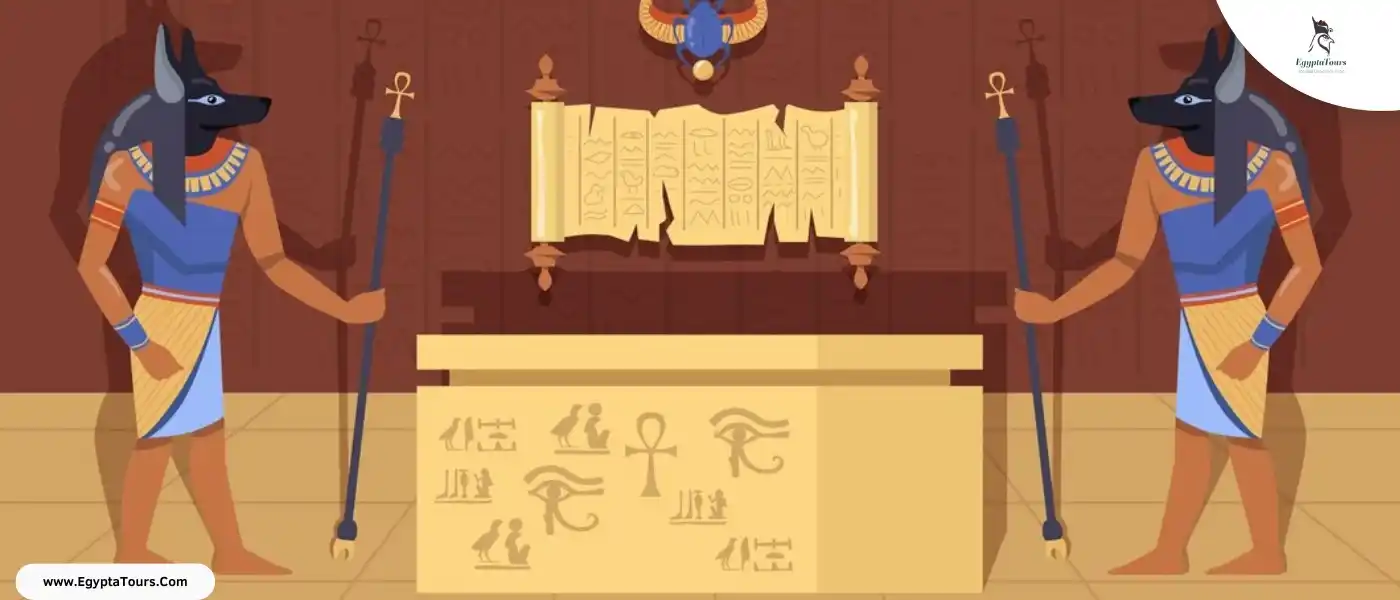
Structure-of-the-legal-system-Law-in-ancient-Egypt-EgyptaTours
The structure of the ancient Egyptian legal system was based on the central principle of Ma’at which promotes values of order, justice, truth and balance.
The Pharaoh held absolute supreme authority over enacting and applying laws and legislation, while priests, judges and administrative officials supervised the courts and the execution of their judgments.
Religious and local courts existed at that time to adjudicate various civil and criminal cases according to jurisdiction.
Important documents such as contracts and judgments were recorded and documented on papyrus scrolls for preservation and archiving.
The judicial and legal organization in ancient Egypt included at least two basic types of courts:
These were often located within the precincts of major or funerary temples, such as the Temple of Ptah in Memphis.
The high priest of the temple or his representative was considered the chief judge and ruled according to the principles of the law of Ma’at and religious teachings. He was then called, for example, the judge of the Temple of Ptah.
Civil courts were sometimes called the city court and consisted of a local judicial body headed by provincial officials or governors.
In the capital of ancient Egypt, such as Thebes or Memphis, it was headed directly by the vizier in his capacity as chief justice.
The vizier had the right to establish special courts to hear specific and important cases.
In ancient Egypt, the concept of “Ma’at” represented the essence of justice, truth, order and cosmic balance.
The ancient Egyptians believed that the stability of the universe and life on earth depended entirely on adherence to its lofty principles and values, whether in managing state affairs or in the daily lives of individuals.
The Pharaoh was the primary and direct person responsible for maintaining this ideal order to ensure the continuation of prosperity and peace in the country. Additionally, Ma’at was considered the basis and standard for judging the deceased in the court of the afterlife.

Types-of-crime-and-punishment-in-ancient-Egypt-EgyptaTours
The applied penalties varied strictly according to the types and severity of the crime as mentioned in some texts:
Legal symbols in ancient Egyptian art and architecture
Ancient Egyptian art and architecture embodied concepts of order, justice and law in various symbolic and artistic forms.
The goddess Ma’at was represented by the symbol of the light feather which symbolizes truth and honesty.
The Pharaoh was crowned with different crowns as the protector of law and order in the land.
Other symbols of authority and rule also appeared, such as the scepter and the scale which symbolizes justice and the crook staff in temple reliefs to affirm royal and divine authority.
The walls of some temples and tombs were also decorated with detailed reliefs depicting divine judgments in the afterlife.
This highlights the significant role of art and architecture in establishing and reinforcing concepts of legal and religious laws among the people at that time.

Evolution-of-Law-in-ancient-Egypt-EgyptaTours
Law in Egypt has continuously evolved throughout different eras up to our present time as follows:
Law in ancient Egypt was characterized by strictness, justice and the pursuit of ideal order. It granted individuals certain rights and duties.
The Pharaohs, as the supreme authority, were concerned with laying the foundations of laws and applying them through the state apparatus.
In the Pharaonic era, the Pharaoh played a major role in legislation and lawmaking, as he was considered the absolute ruler who issued legislation and supervised its implementation. Egyptian laws and judgments were written on stone tablets and papyrus scrolls.
Among the most important was the general principle of the law of Ma’at which theoretically obliged individuals to live in harmony with justice and the laws of nature. Courts were also established to adjudicate between people and resolve disputes among them.
Egypt was significantly influenced by Greek and Roman laws during this long period of occupation.
They gradually introduced new concepts and legislation such as written civil codes and organized criminal penalties.
During this time period, the dominance and complexity of the courts increased and there was a greater focus on regulating financial and commercial relations and inheritance according to their systems.
After the Islamic conquest, the legal systems in Egypt were radically influenced by Islamic Sharia. Jurists and legislators developed and established the provisions of Islamic Sharia in various fields, including criminal matters, financial transactions, inheritance and personal status.
Sharia provisions were applied in Sharia courts and this had a significant and profound impact on the economic, social and cultural life in Egypt.
With the increasing European influence and the impact of Western laws, especially French law, the legal system in Egypt was influenced again. During the Khedival and Royal periods, there was noticeable development and modernization in the legislation of civil liberties and human rights to some extent.
Even after the Egyptian revolution of 1952, many legal reforms and changes were introduced, including the Personal Status Law, the Penal Code, the Agrarian Reform Law and others.
In recent years, Egypt has witnessed numerous and successive legislative and legal developments, starting with the issuance of the new Egyptian Constitution in 2014 which laid the foundations for legal systems seeking compatibility with international standards in areas such as social justice and human rights.
Many important laws have also been amended to align with the requirements of the era and new challenges. Thus, Egypt has witnessed and continues to witness continuous evolution and change in its legal system throughout its long history.
The history of law in ancient Egypt demonstrates the development of legal and organizational thought among the ancient Egyptians.
This law focused on applying the concepts of justice, truth and order represented in the principle of Ma’at.
The Pharaoh was a symbol of absolute authority, with a legal and judicial structure established that ensured, to some extent, the rights of individuals and the punishment of offenders.
This ancient system was the cornerstone upon which the evolution of laws was later built in Egypt up to the present time.
The courts that enforced the law were the seru (a group of elders in a village), the kenbet (a court for the region or the whole country), and the djadjat (the imperial court). If a crime happened in a village and the seru could not decide, the case would go to the kenbet, and sometimes, it could go to the djadjat, though this was rare. Most of the time, village matters were handled by the seru.
The kenbet made laws and punished people at the district and national level. The djadjat gave the final decision on whether a law was fair and followed ma’at (justice and order).
In general, ancient Egyptians mostly followed the law, but there were still arguments about land and water, ownership of animals, or who had the right to a certain job or title. Bunson points out that:
Egyptians lined up every day to tell the judges their complaints or requests. Decisions about these issues were based on traditional legal rules, although written laws must have been available for reference.
The judges Bunson talks about were members of the kenbet, and each district’s main city had one meeting every day.
The vizier was the top judge, but most cases were handled by lower judges. Many cases were about property after the death of the family’s father or mother. There were no wills in ancient Egypt, but a person could write a document saying who should get which property or valuables. Even then, family members often argued over these papers in court.
There were also cases about domestic abuse, divorce, and cheating. Women could ask for divorce just like men, and they could also bring cases about land or business. Both men and women could file cases about cheating, and the punishment for the guilty was very serious.
Ancient Egyptian writings show that morality and punishing crime were very important, and different crimes had different punishments. There were two ways a person could be judged for breaking moral rules.
The first was a religious judgment in the afterlife, where the dead person was judged by Osiris for what they had done. The second was a civil court on earth, which helped keep order in the community.
All legal matters were under the control of the vizier, the king’s chief assistant. The local court, called the Kenbet (which worked at regional and national levels), was made up of community leaders who listened to cases and decided who was guilty or innocent.
There were also other courts that enforced the law, such as the Seru (a group of village elders) and the Djadjat (the imperial court), which worked alongside the Kenbet.
The vizier was the highest judge, but most cases were decided by lower judges. Courts could be held in marketplaces or on the street, and there was also a building called the judgment hall in every city.
During the New Kingdom of ancient Egypt, there were no lawyers or appeals. The priests of Amun made the final decisions because people trusted them to be fair and make the right judgments.
In the Old Kingdom of ancient Egypt (2613–2181 BC), the earliest regional legal system was mainly bureaucratic. Judges were often priests who asked their god for guidance instead of carefully examining evidence or listening to witnesses.
During the Middle Kingdom (2040–1782 BC), trained judges led the courts, and the legal system became more logical and familiar. This period also saw the creation of the first professional police force, which enforced the law, arrested suspects, and gave testimony in court.
The pharaoh was the highest authority in religion and law because he was seen as the messenger of the gods on earth. Egyptians believed he ruled with divine guidance and he was expected to apply ma’at in all matters.
Although the pharaoh made the laws, he did not handle everyday cases. He gave this responsibility to his closest helper, the vizier. The vizier acted as both a prime minister and a chief judge. He supervised the courts, chose the judges, and made sure justice was done. Judges and local officials then used the rules of ma’at to solve real problems, such as disputes about land, trade, inheritance, and crimes.
This system of leadership from the pharaoh, to the vizier, to the local courts helped ensure that the law followed the will of the gods and was fair and practical for ordinary people.
Legal Procedures and Rights
During court trials, it was the accused person who had to prove innocence, not the accuser. A person was usually considered guilty until proven innocent. Witness statements were very important, and giving false testimony was strongly punished. For example, someone who lied in court could be beaten in public or even have a body part cut off.
There were no modern lawyers. People defended themselves, but sometimes scribes or officials helped them prepare documents. Women in Egypt had many legal rights. They could own property, divorce their husbands, and bring cases to court. In fact, many records of women’s divorce agreements and property deals in Egypt are still well preserved today.
Egyptian law was not only about life on earth. Ma’at was also connected to life after death. Egyptians believed that after a person died, their soul was judged in the Hall of Ma’at. The heart was weighed against the feather of truth. If the heart was lighter, the soul went to eternal paradise. If not, it was eaten by Ammit, the monster of judgment.
Because of this belief, Egyptians followed ma’at not only to avoid punishment in this life, but also to gain a good afterlife. Religion and law were closely linked and could not be separated.
Although Egyptian law worked well for many centuries, corruption increased in its later periods. Officials began to take bribes, police abused their power, and false testimony became common. During the New Kingdom and the late period, judges were punished for being dishonest.
The legal system also started to weaken as Egypt lost political strength. Under Greek and Roman rule, Egyptian traditions mixed with foreign legal systems, and pure Egyptian law eventually disappeared. However, its legacy influenced later civilizations through its strong focus on justice, truth, and balance in the universe.
Compared to other ancient legal systems, Egypt’s law was special because it treated men and women equally. Women had the same legal rights as men in court and could buy, sell, and leave property to others. This equality continued during Greek rule in the Ptolemaic period.
However, when Egypt became part of the Roman Empire after the Battle of Actium in 31 BCE, these laws ended. Similar laws giving equal property rights did not appear again in Europe and America until the 19th century.
This equality also appeared in marriage laws. Husbands and wives could own property together. Both men and women could ask for a divorce. Men had to pay a fine if they divorced, but women did not. If divorce happened because of adultery, the guilty person lost their share of the shared property.
Even though these laws were advanced compared to other ancient civilizations, there was still a big difference between how men and women were treated in everyday Ancient Egyptian society.
Throughout Ancient Egyptian history, priests acted as judges because religion was very important in the legal system. Egyptians believed that the gods lived inside temples. Since priests were thought to communicate with the gods, they were trusted to decide legal cases.
By the time of the New Kingdom around 1550 BCE, oracles became important in law. Priests carried a public statue of a god, and the statue was believed to give answers by moving or pointing to a choice written on a document. Oracles were not only used in court cases but also to give guidance on major state matters, such as military decisions.
A papyrus from the second century BCE describes a land dispute trial where three priests served as judges. The trial took place during the Ptolemaic period, and a government official from the Ptolemaic state was present to supervise it. This shows that even after Alexander the Great conquered Egypt, older court traditions and legal practices were still used.
This trial is one of the earliest fully recorded trials and shows the difference between law in Ancient Egypt and Ancient Greece. In Greece, jury trials highlighted the importance of democracy in Athenian society. In contrast, the Egyptian legal system was based on the belief that priests could reach absolute truth.
One surprising fact about Ancient Egypt is that tomb-robbing was common by the Early Dynastic Period and was a serious problem for the state. The problem was so big that the design of King Djoser’s pyramid, the first pyramid ever built, included features to stop robbers.
A confession from a mason named Amenpanufer, recorded in the Papyrus Leopold-Amherst, shows how common tomb robbery was in the Middle Kingdom around 1110 BCE. Amenpanufer admitted paying bribes to avoid punishment and continuing to steal from tombs.
This confession is also interesting because it shows that people were ignoring Ma’at, the rules that guided law in Ancient Egypt. According to Egyptian beliefs, following Ma’at was necessary to pass through the Hall of Judgment and reach the afterlife.
Some historians think that less belief in religion in Ancient Egypt caused more tomb robbing. However, this idea is debated, because in many civilizations people often act against religious rules and are motivated by immediate personal needs instead.
The idea of divine justice in Ancient Egypt included mercy, but the main rule was still Everyone is guilty until proven innocent, because no one would have been accused without reason. This shows how much the Egyptians trusted their legal system and laws. Divine justice was very important in their religion and influenced their ideas about right and wrong, morality and how society should be organized.
Egyptians believed that the gods and goddesses kept order and justice in the world and would punish people who acted unfairly. They thought the gods would enforce justice and punish anyone who broke the moral and ethical rules of society. This punishment could include sickness, bad luck, or even punishment in the afterlife.
Maat is an Ancient Egyptian idea that stands for balance, harmony, truth, justice, morality, and order in the world. It was one of the main principles on which the universe was thought to be built, and it was shown as a goddess representing these ideas.
The word Maat comes from the Egyptian word “mꜣꜥt,” which means that which is straight or true. Maat was very important in Egyptian culture and influenced their religion, art and everyday life.
In Egyptian stories, the goddess Maat was shown as a woman with a feather on her head, which symbolized truth and balance. She was believed to weigh the hearts of dead people against her feather to decide if they could enter the afterlife. People who lived a fair and balanced life were allowed to go to the afterlife.
In Egyptian society, Maat also guided how people should behave and was the base of a fair and organized society. Her ideas influenced their laws, social rules, and even the way they built their buildings, which often showed balance and symmetry.
The main laws in present-day Egypt include the Constitution which is considered the highest legal authority, in addition to basic laws such as criminal and civil law.
Among the most prominent are the Penal Code, the Criminal Procedure Law, the Civil Code, Personal Status Laws, Commercial Law, Labor Law and Investment Law.
Islamic Sharia was applied extensively in Egypt after the Islamic conquest in many aspects of life such as commercial, financial, criminal, administrative, civil transactions, personal status and others.
Its application continued primarily approximately until the end of the nineteenth century.
During this period, Egypt began to be increasingly influenced by Western laws, especially French law, where criminal, civil and commercial laws were adopted and transferred from Western laws, while matters of personal status and inheritance largely remained subject to the provisions of Islamic Sharia.
Ancient Egypt was ruled by an absolute theocratic monarchy, where the Pharaoh was considered a god or the representative of the god on earth and was the supreme authority responsible for enacting laws in the country.
He controlled the army, religion and economy. He was assisted in governance by a council of high priests and senior administrative officials in managing the affairs of the vast state.


Explore our top-rated Egypt travel packages and embark on an unforgettable journey. From the Pyramids of Cairo to the magical temples of Luxor, Aswan, and Abu Simbel, discover expertly curated tours designed for your perfect Egyptian adventure