




Ramesses II – The Legendary Warrior Pharaoh of Egypt
Ramesses II was unquestionably the greatest pharaoh of the 19th Dynasty and one of ancient Egypt’s most powerful rulers.
This opulent pharaoh is most known for his exploits during the Battle of Kadesh, his architectural legacy, and his role in leading Egypt into its Golden Age.
He had his name and achievements engraved from one end of Egypt to the other, and there is almost no ancient Egyptian site that does not reference Ramesses the Great.
He ruled during the New Kingdom’s 19th Dynasty, a time when Egypt was rich, proud, and surrounded by rivals. People still talk about him because his reign had almost everything, a long time on the throne, famous wars, major peace deals, and building projects that still stun visitors today.
But there’s another reason his name never faded. Ramesses II didn’t just govern; he shaped how he would be remembered. Through monuments, inscriptions, and art that repeated his image again and again, he built a public story that outlived him.

Who-Was-Ramesses-II-Powerful-Pharaoh-Of-Ancient-Egypt-And-The-New-Kingdom-EgyptaTours
Ramesses II wasn’t an outsider who seized power. He was born into a royal family that had already rebuilt Egypt’s strength after years of unrest. By the time he became pharaoh, the system around him, the army, temples, and royal court, already knew how to project authority.
His reign mattered partly because it lasted so long. When one ruler stays in charge for decades, policies stick, borders stabilize, and a “style” of rule becomes normal. Ramesses used that time to stamp his name on Egypt’s landscape and memory.
Born in 1302 B.C., Ramses II (alternatively transcribed as Ramses II and Rameses) is one of the most famous Egyptian kings who ruled Egypt in its golden age.
He is the mightiest third pharaoh of the 19th dynasty of Egypt and the second son of pharaoh Seti I and his queen Tuya.
When Ramsses II was fourteen years old, his father made him Prince Regent. King Seti I gave the crown to Prince Ramses, who later turned into Ramses II.
He gave him a house and harem and let him participate in military campaigns with him so he could gain solid military and kingship experience before he became a king.
He is believed to have ascended to the throne in his early 20 and governed Egypt for 66 years and two months, from 1279 BC to 1213 BC.
He led several expeditions and focused on accomplishing his goals.
This reflected his vision of a great nation and got him the title of “ruler of rulers.” This is the reason why he is admired as “Ramsses II the Great” by history buffs. Also, Egypt was at its height of power and glory during his reign.
Ramesses lived to be ninety-six years old and had over 200 wives and concubines, 101 sons, and 51 daughters, most of whom he outlived.
The most memorable of Ramesses’ wives was Nefertari. Among the earlier wives of this king were Isetnofret and Mathur Neferure, Princess of Hatti.
His children include Bintanath and Meritamen (princesses and their father’s wives), Sethnakhte, Amun-her-khepeshef (the first-born son), Merneptah (Ramesses’ 13th son who would eventually succeed him), Prince Khaemweset (the second-born son), and Ramesses B (Ramesses Junior), who became the crown prince from Year 25 to Year 50 of his father’s reign after the death of Amen-her-khepesh.
What Egypt was like during the New Kingdom when he ruled
New Kingdom Egypt ran on the Nile, grain, and trade. The river was a highway, moving food, stone, and people. Temple estates held land and wealth, and religious festivals tied daily life to the gods.
Egypt also faced pressure from other powers. To the north, the Hittite Empire competed for influence in Syria and key routes. Those routes weren’t just lines on a map; they were paths for metals, timber, horses, and luxury goods.
A few simple examples show why control mattered:
- Temples weren’t only sacred spaces; they were economic centers with workers, storage, and land.
- Grain from the Nile valley fed cities and armies, which kept the state stable.
- River travel helped move building stone, which made massive projects possible.
This was the world Ramesses inherited: wealthy, organized, and ready to fight for influence.
The Legacy of Ramses II
The reign of Ramsses II has become somewhat controversial over the last century, with some scholars claiming he was more of a showman and a propagandist than an effective king and others arguing the opposite.
The records of his reign, however—both the written and the physical evidence of the temples and monuments—argue for a very stable and prosperous reign.
He was one of the few rulers to live and rule long enough to take part in two Heb Sed festivals, which were held every thirty years to rejuvenate the pharaoh.
He secured the country’s borders, increased its wealth, and widened its scope of trade, and, if he boasted of his accomplishments in his inscriptions and monuments, it is because he had good reason to be proud.
As the second-longest ruling king of ancient Egypt, he contributed to the flourishing and prosperity of the Egyptian culture in every way.
Some of his subsequent pharaohs are considered better rulers than he was; none of them, however, would surpass the grand achievements and glory of Ramesses the Great in the minds and hearts of the ancient Egyptians.
He was one of the rare kings who had lived and reigned long enough to participate in two Heb Sed festivals, which were performed every thirty years to rejuvenate the pharaoh.
Despite Ramsses II’s efforts to ensure his legacy lived on, there was one evidence to his power that he could not have anticipated.
After his death, nine subsequent pharaohs took his regnal name upon ascending the throne, solidifying his stature as “the great” among Egypt’s rulers.
Monuments, Temples, and Lasting Fame: Why Ramesses II Still Matters

Monuments-Temples-And-Lasting-Fame-Why-Ramesses-II-Still-Matters-In-Egyptian-History-EgyptaTours
If you want to understand Ramesses II quickly, look at what he left behind. His monuments weren’t quiet tributes. They were bold statements in stone: “I was here, I ruled, remember me.”
His building program also helped bind Egypt together. Temples supported local economies, employed workers, and tied far regions to the central state through religion and royal presence.
Big building projects like Abu Simbel, the Ramesseum, and Pi-Ramesses
Three sites show his strategy clearly:
Abu Simbel: These cliff-cut temples in Nubia feature colossal seated statues of the king. They signaled power at Egypt’s southern edge, aimed at both locals and travelers. The scale is the message.
The Ramesseum: Ramesses’s memorial temple at Thebes (near modern Luxor) linked his kingship to the gods and to ritual life. Memorial temples also helped keep a pharaoh’s cult active after death, which meant ongoing offerings and remembrance.
Pi-Ramesses: His royal capital in the Nile Delta was a political and military center placed for northern campaigns and trade. A well-located capital made it easier to move troops and manage relations with neighboring states.
Across these projects, the art follows a pattern: huge statues, repeated royal names, and scenes where the king appears larger than everyone else. That wasn’t just style. It taught viewers how to think about authority.
If you visit a museum, look for two clues of Ramesses’s self-promotion: his cartouche stamped on objects, and temple reliefs that show him favored by major gods like Amun, Ra, and Ptah.
The Great Architectural Endeavors of Ramsses II
Ramses II’s magnificent construction campaign, the biggest undertaken by any pharaoh, reflects the opulence of his reign. Ramsses II’s interest in architecture resulted in the creation of more monuments than any of the other ancient Egyptian pharaohs.
Perhaps the best-known achievements of Ramses II are his architectural endeavors, most notably the Ramesseum.
The vast tomb complex known as the Ramesseum at Thebes contains a massive library of some 10,000 papyrus scrolls.
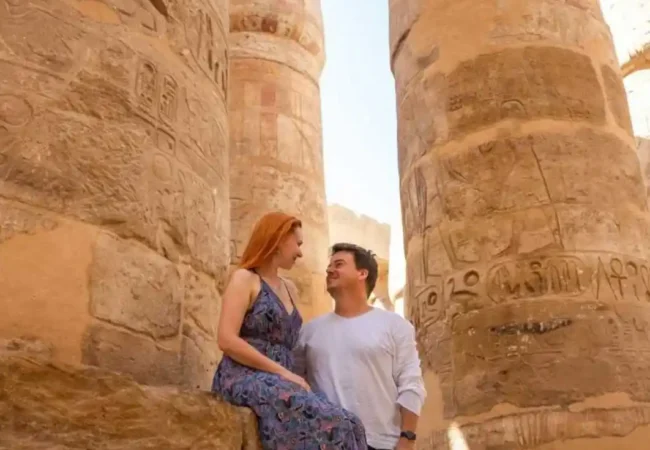
In addition to the temples at Karnak and Abu Simbel, which are among Egypt’s greatest wonders, Ramesses II built the temples at Abydos to honor both himself and his father.
At some point prior to the year 1275 BCE, he began construction of his great city, Per-Ramesses (“House of Ramesses”), in the Eastern Delta region near the older city of Avaris.
Per-Ramesses would be his capital (and remain an important urban center throughout the Ramesside Period), a pleasure palace, and a military compound from which he would launch campaigns into neighboring regions.
It was not only an armory, military stable, and training ground but was so beautifully constructed that it rivaled the magnificence of the ancient city of Thebes.
Many historians consider his reign the pinnacle of Egyptian art and culture, and the famous Tomb of Nefertari with its wall paintings is often cited as clear evidence of the truth of this claim.
Ramses II is credited with a significant number of architectural tributes that still significantly shape Egypt’s landscape.
The Military achievements of Ramsses II

The-Military-Achievements-Of-Ramesses-II-Victories-And-Expansion-Of-The-Egyptian-Empire-EgyptaTours
Ramsses II knew that diplomacy and a thorough public relations strategy might compensate for any military weaknesses. He was well-known for his exceptional command of the Egyptian army.
As a result, he was able to fight brutal wars to protect Egypt’s boundaries against Nubians, Syrians, Libyans, and Hittites.
In the second year of his reign (1281 BC, in particular), Ramesses II effectively fought the Shardana or Sherden sea pirates who were creating chaos along Egypt’s Mediterranean coast by assaulting cargo-laden vessels crossing the sea routes to Egypt Sherden Sea pirates were a major danger to Ancient Egypt’s maritime trade.
With remarkable chivalry and a brilliant strategic plan, Ramsses vowed to put a stop to this.
Ramesses set a trap for them by stationing a small naval force at the entrance of the Nile River to lure the Sherdan ships. He positioned ships and troops at strategic spots around the coast and patiently waited for the pirates to strike.
As their boats got closer, they were caught off guard in a fierce sea battle.
Ramesses had soon incorporated the competent Shreden troops who had survived the battle into his army, where they would play a crucial role in the battle of Kadesh and even serve as his elite bodyguard.
The Battle of Kadesh and the First-Ever Peace Treaty

The-Battle-Of-Kadesh-And-The-First-Ever-Peace-Treaty-In-Ancient-History-EgyptaTours
Ramsses III is regarded as a great warrior who fought many battles.
His victory at the Battle of Kadesh over the Hittites strengthened his reputation as a warrior.
The Hittites saw an opportunity to probe king ramses ii northern border while he was just 14 years old and had just taken the throne.
They invaded and occupied Kadesh, a significant commerce town in present-day Syria.
In May 1274 B.C.E., at the close of his fourth year in rule, king ramses ii launched a military campaign to restore the lost provinces of the north.
When Ramses II led his army to Kadesh, spies misled him into believing the Hittites were distant from the Egyptian camp. Instead, they waited nearby before attacking.
The Egyptians were about to be defeated when backup arrived just in the nick of time. Although Ramsses II won the battle, he did not win the war.
Because the Battle of Kadesh did not end in a decisive victory, two countries remained on the edge of war for several years.
Ramsses II claimed that the Battle of Kadesh was a success because he defeated his enemy. But Muwatalli II, the Hittite king, insisted that his people had won.
While the outcome of the Battle of Kadesh appears to have been controversial, the battle did result in king ramses ii and Hattusili III, Muwatalli II’s successors, signing the world’s first known peace treaty in 1258 BC.
As a result, he was the world’s first ruler to sign a peace treaty. Additionally, he was successful in establishing a peaceful northern frontier that lasted the whole of Ramses’ reign.
The first known peace treaty, and how Ramesses used diplomacy
After years of tension, Egypt and the Hittites reached a formal peace agreement. It’s often described as the earliest known peace treaty preserved in surviving records. In plain terms, it set rules for peace, pledged mutual support, and aimed to stop constant border war.
Ramesses also used marriage ties as diplomacy. A royal marriage could turn a former enemy into family, at least on paper, and it could smooth trade and travel.
Peace had a practical benefit: stability freed time and resources for projects at home. Armies are expensive. So are temples. A ruler who can keep the borders calm can put more energy into building, ceremonies, and a steady flow of goods.
Nubian Campaigns of Ramesses II
Ramesses II led many different military campaigns south of the first cataract of the Nile into Nubia. He was about 22 years old at the time and was accompanied by his sons, including Amun her khepeshef and Khaemwaset, in one of those campaigns. Nubia had been an Egyptian colony for 200 years and Ramesses II’s military campaigns in the region were commemorated in the temples he built at Beit El Wali, Gerf Hussein and Kalabsha.
The south wall of the Beit El Wali temple features a vivid depiction of Ramesses II leading a chariot charge against southern tribes with his young sons Amun her khepeshef and Khaemwaset riding in chariots behind him.
Egyptian Activity on the Libyan Coast
During the reign of Ramesses II, the Egyptians were evidently active along a stretch of the Mediterranean coast, extending at least as far as Zawiyet Umm el Rakham, where the remains of a fortress have been discovered. The texts associated with this fortress indicate that it was constructed on territory belonging to the Libyans. While the precise events surrounding the establishment of these coastal forts and fortresses are not entirely clear, it is apparent that the Egyptians must have exercised some degree of political and military control over the region to facilitate their construction.
There are no detailed accounts of Ramesses II undertaking large-scale military campaigns against the Libyans. The existing records are more general, mentioning his conquests and defeats of the Libyans which may or may not refer to specific events that have otherwise gone unrecorded. It is possible that some of these records, such as the Aswan Stele from his second year, are referencing Ramesses’ participation in his father’s Libyan campaigns rather than independent actions.
It may well have been Seti I who achieved control over the region and initiated plans to establish a defensive system, similar to his efforts in rebuilding and fortifying the eastern routes known as the Ways of Horus across northern Sinai.
Campaigns of Ramesses II against the Sherden Pirates
Ramesses II decisively defeated the Sherden pirates in the second year of his reign who were causing chaos in the Mediterranean coastal region of Egypt and attacking merchant ships coming to Egypt by sea. It is said that they came from the coast of Ionia, southwest Anatolia or from the island of Sardinia.
Ramesses II devised a clever plan to capture and defeat them so he deployed troops and ships along the coast and waited for the pirates to attack then ambushed them in a naval battle and captured them all in a single operation.
Many Sherden appeared among the pharaoh’s personal guard distinguished by their horned helmets with a clear ball in the middle and their round shields indicating that a naval battle took place near the mouth of the Nile.
Ramesses II also defeated the Lukka and the Shekelesh people in this battle.
Syrian Campaigns
First Syrian Campaign of King Ramesses II
This campaign took place in the fourth year of his reign and the first of the Commemorative stelae of Nahr El Kalb was erected to commemorate this event. However, no one has been able to read the inscription well due to its weathering.
In this year, Ramesses also captured the Hittite vassal state of Amurru during his campaign in Syria.
Third Syrian Campaign
Syria fell into the hands of the Hittites and the Canaanite princes began to revolt against Egypt encouraged by the Egyptian incapacity to impose their will and goaded on by the Hittites.
Ramesses prepared to contest the Hittite advance with new military campaigns.
Later Syrian Campaigns
In the eighth and ninth years of his reign, Ramesses II expanded his military successes. He crossed the Dog River and advanced north into Amurru where his armies reached Dapur and erected a statue of himself there. He reached Tunip, an area that had not been entered by an Egyptian soldier since the time of Thutmose III about 120 years earlier.
He besieged Dapur and captured it then returned to Egypt. By November 1272 BC, Ramesses had returned to Heliopolis.
But his victory in the north was not permanent. After reasserting his authority over Canaan, Ramesses led his army north again. There is a stele at the Dog River near Beirut which appears to be dated to the tenth year (1269 BC).
The territory between Amurru and Kadesh was not stable and it returned to the Hittites after one year. Therefore, Ramesses was forced to attack Dapur again in his tenth year.
This time, he claimed to have fought without armor even two hours after the start of the battle. Six of his young sons participated in this conquest. He captured cities in Retjenu and Tunip and recorded them on the walls of the Ramesseum.
But this second success was no more useful than the first, as neither power was able to decisively defeat the other. In the eighteenth year, Ramesses erected a stele at Beth Shean.
Children of Ramses II
Sons of Ramses II:
Amon-Her-Khepeshf, Ramses, Parherunemef, Khaemwaset, Mentuherkhepeshef, Nebenkharu, Meryamun, Seti A, Setepenre, Meryre, Horherunemef, Merneptah, Amenhotep, Itamon, Meryatum, Nebtaneb, Amenemopet, Senakhtenamun, Ramses Merenre, Djehutimes, Simentu, Montuimwaset, Sia Amun, Ramses Siptah, Mentuineqau, Astarteherunemef, Qiriqtawy, Merimontu, Nebin, Ramses, Ramses Maatyptah, Ramses Meritimi, Ramses Meryamun Nebwiben, Ramses Meryastarte, Ramses Merimaat, Ramses Meriset, Ramses Paitendjer, Ramses Siatum, Ramses Sikhepri, Ramses Osirikhpshef, Ramses Osirpehti, Seshensun, Setimher, Setimnekht, Shepsemion and Werm.
Daughters of Ramses II:
Bintanath, Bektamun, Nefertari, Meritamon, Nebtawy, Isetnofret II, Henuttawy, Werenro, Nedjmet, Pipui, Nebtiunet, Renpetnefer, Merit Khit, Nebt, Mut Tuya, Merit Ptah, Nubher, Shiher Youts, Henut, Merit Mihapi, Merit Its, Nub Imyon, Henut Sekhemu, Henut Pahoru, Nefer Uri, Merit Netjer, khbsed, Henut Pari, Nebt Nahat, tawrit, Henut Taneb, Tuya, Henut Dash, Hetep En Amun, Nebt Imon Edjem, Henut Mehu, Nebt Ananash, Sitamun, Tia Sitre, Tuya Nebtawy, Takhat and Nub Imosekht.
Is Ramses the Pharaoh of Exodus?
Although Ramesses has often been connected with the biblical Book of Exodus’ pharaoh, there is no evidence to back up this assumption. Following the popularity of Cecil B.
DeMille’s movie The Ten Commandments in 1956, the association of the name “Ramesses” with the nameless king of Egypt in the Bible became fairly prevalent.
Exodus 1:11 and 12:37, as well as Numbers 33:3 and 33:5, all cite Per-Ramesses as one of the places in which the Israelite slaves worked, as well as the city from which they escaped Egypt.
There is no indication of a huge migration from the city, or from any other city in Egyptian history, and no evidence to support the theory that Per-Ramesses was built using slave labor.
Furthermore, Ramesses was known for writing histories of his achievements and embellishing the events when they did not match the narrative he wanted to maintain.
It is exceedingly doubtful that such a ruler would fail to record the reported plagues that fell on Egypt or the departure of the Hebrew slaves.
However, one should not depend simply on the inscriptions ordered by Ramesses; the Egyptians kept comprehensive records from the moment they learned writing, around 3200 BCE, and none of them even hint to a huge community of Hebrew slaves in Egypt, let alone their exodus.
Additionally, the Egyptian literary works from the Middle Kingdom to the Late Period contain various themes, motifs, and actual events that were used by the later scribes who produced the Biblical texts.
king ramses ii association with the cruel, rebellious pharaoh of Exodus is undesirable since it overlooks the character of a great and honorable ruler.
When and how did King Ramses II Die?
Ramses II the Great was a true leader and a mighty king who earned worldwide acclaim for extending and sustaining the Egyptian kingdom‘s territory.
Contrary to the popular belief of death by drowning as mentioned in the Quran and Bible, while in pursuit of Moses, Ramesses II died a natural death at the age of 90 (most likely of old age or heart failure).
king ramses ii mummy shows that the great pharaoh had sharp features complemented by a pointed nose and a strong, chiseled jaw line. Standing about 6 feet high, it was also claimed that he was a redhead with a tall, muscular figure.
At the time of his death, he was suffering from severe dental problems and was plagued by arthritis and hardening of the arteries.
He was proven to have ankylosing spondylitis, an inflammation of the spine’s joints that might have caused him to walk with a hunch back in old age.
Ramses had a spectacular burial chamber, similar to Queen Nefertari’s tomb, which is one of the most recognized architectural wonders of Ancient Egypt.
Ramesses II was originally buried in the tomb KV7 in the Valley of the Kings, on the western bank of Thebes, Egypt. However, because of looters, priests had to move his body to a safer holding area, where he was rewrapped and placed inside the tomb of Queen Inapha.
In 1881, it was rediscovered in a hidden royal storehouse in Deir el-Bahri. Later in 1885, the mummy of the great pharaoh was placed in the Egyptian Museum, Cairo, where it remains as of 2007.
Today, his mummy is laid in the Grand Egyptian Museum.
One statue of the pharaoh Ramesses II, called the Younger Memnon, is housed in the British Museum, London. This statue, which dates back to around 1250 BC, shows him as a benevolent king and mighty warrior of all time.
Ramsses II’s mummy still stands the time!
The Cairo Museum‘s Egyptologists observed Ramses II’s mummy was fast decaying in 1974. It was decided to fly his mummy to Paris for thorough research and medical examination.
Ramesses the Great was issued an Egyptian passport, which listed his occupation as King of Egypt (deceased).
His mummy was received at Le Bourget airport, just outside Paris, with the full military honours befitting a king.
The mummy was then transported to the Paris Ethnological Museum, where it was examined.
The researchers discovered that the deterioration of the mummy was caused by a fungal infestation, and it was treated to mitigate the threat of detrioration.
Live Your Dream Tour With Egyptatours Throughout Our Egypt Classic Tours Packages, Nile Cruises, Day Tours Or At Least You Can send us a request To Build Your Tour.
conclusion
In the end, King Ramses II stands as Egypt’s great builder and storyteller. His temples at Abu Simbel and the Ramesseum still command awe and pride. He ruled for decades, shaped borders after the Battle of Kadesh, and signed a lasting peace treaty. Colossal statues, bold inscriptions, and city projects kept his name alive for millennia. Art, religion, and statecraft moved in step under his hand, clear and visible today. His record sets a benchmark for pharaohs and for ancient Egypt itself.
Hailed in history for signing the first-ever peace treaty, Ramsses II is one of the most powerful and influential pharaohs to have ruled Egypt in its golden age.
The Egyptian landscape still bears testimony to the prosperity of his reign in the many temples and monuments he had built in honor of his conquests and accomplishments.
Pharaoh Ramses, also known as Rameses II, was one of ancient Egypt’s most powerful and celebrated rulers.
He led military campaigns against the Hittite Empire and famously signed one of the world’s earliest known peace treaties.
Ramses the Great constructed magnificent monuments throughout Egypt, including the Great Temple at Abu Simbel.
His grand capital city, Pi-Ramesses, reflected the might and glory of his reign, marking a golden age in Egyptian history.
There is virtually no ancient site in Egypt that does not mention the name of Ramesses II.
If you want to experience Ramsses II’s magnificent legacy, make sure to book one of our Egypt tour packages.
FAQs
Who was Ramesses II?
Ramesses II, also known as Ramesses the Great, was one of ancient Egypt’s most powerful and celebrated pharaohs. He ruled from 1279 to 1213 BC during the Nineteenth Dynasty and is known for his military exploits, monumental building projects, and long reign.
What are some notable achievements of Ramesses II?
Ramesses II is renowned for his military campaigns, notably against the Hittites at the Battle of Kadesh. He signed the first known peace treaty with them. He also embarked on extensive building projects, including the construction of the temples at Abu Simbel and the Ramesseum. His reign marked a high point in Egyptian art, architecture, and power.
How long did Ramesses II rule?
Ramesses II ruled for 66 years, from 1279 to 1213 BC. His reign is one of the longest in ancient Egyptian history, allowing him to leave a lasting legacy.
Where is Ramesses II buried?
Ramesses II was originally buried in the Valley of the Kings in tomb KV7. His mummy was later moved to the Royal Cache in the Deir el-Bahari site to protect it from tomb robbers. Today, it is displayed at the Egyptian Museum in Cairo.
What was Ramesses II’s family like?
Ramesses II had a large family, with over 100 children from various wives and concubines. His principal wife was Queen Nefertari, and he also had other important wives like Isetnofret. His successors were drawn from this extensive family.
Why is Ramses II often called “the Great”?
Ramesses II earned the title “the Great” due to his long rule, military success, and immense contributions to Egyptian architecture. His ability to maintain the empire’s stability and prosperity further cemented his legacy as one of the greatest pharaohs.
How did Ramesses II impact Egyptian culture?
His reign significantly influenced Egyptian culture through art, architecture, religion, and literature. The monuments and statues he commissioned were designed to showcase his divine status and the power of the Egyptian state, leaving an enduring cultural legacy.
What is the significance of the temples at Abu Simbel?
The temples at Abu Simbel, which Ramesses II had carved into a mountainside, are significant for their grandeur and artistic achievements.
They were built to commemorate his conquest at Kadesh and honor himself and the gods.
They exemplify the engineering skill and artistic prowess of ancient Egypt.
How did Ramesses II’s reign end?
Ramesses II died of old age around 90. His death marked the end of an era of prosperity and stability, and while his immediate successors kept control, the state eventually declined.
What lasting effects did Ramesses II have on history?
Ramesses II’s legacy lives on through his monumental constructions and the art that has survived millennia.
His reign is often seen as the pinnacle of Egyptian culture and power, influencing later Egyptian kings and leaving a rich historical and architectural heritage for the world.
About EgyptaTours

EgyptaTours is a name synonymous with trust, excellence, and unforgettable travel experiences, proudly standing as one of the leading travel agencies in Egypt. Renowned for its deep expertise, personalized service, and carefully crafted itineraries, EgyptaTours serves as the ultimate gateway to discovering Egypt in its most authentic and inspiring form.