






Discover the Ankh Symbol: The Egyptian Symbol of life
The ankh, also known as the “key of life,” is an ancient Egyptian symbol that stands for the word life and is often used as a symbol of life itself.The ankh was a popular design in ancient Egypt and was also used by nearby cultures for decoration. The Copts changed it into the crux ansata, which has a circular loop instead of a droplet-shaped one, and used it as a version of the Christian cross.
In the 1960s, the ankh became widely known in Western culture, appearing as a symbol of African cultural identity, Neopagan beliefs, and later, the goth subculture.
The Ankh symbol is one of the most famous symbols in ancient Egyptian civilization, bearing profound meanings, and is known as the key of life or the Egyptian cross.
This symbol has a distinctive shape that combines a circular loop above a cross, and is believed to represent eternal life and immortality, and is an expression of the Egyptians’ aspirations for the afterlife.
The pharaohs used this symbol as a sacred amulet that indicated power and life, and it appeared in many inscriptions and paintings that show the gods granting life to kings, highlighting its high status in Egyptian religion.
Today, the Ankh symbol is considered a cultural and spiritual symbol that attracts those interested in the ancient Egyptian heritage, and sparks the curiosity of researchers and explorers.

The Ankh symbol, known as the key of life, is an ancient Egyptian hieroglyphic symbol that was used in writing and art to represent the word life, and it is an expression of the essence of existence.
The Ankh is considered a symbol of life itself, and was common in the hands of the gods, where it is granted to the pharaoh to represent his power in preserving life and resurrecting humans in the afterlife, emphasizing his role as a guardian of life.
The symbol has the shape of a cross but with an oval loop instead of the upper bar, and this unique design carries profound symbolic connotations.
The origins of the symbol are unknown, but it is believed that it represents a knot made of flexible material such as cloth or reed, and perhaps represents a primitive form of the sacred knot.
The Ankh was one of the most common decorations in ancient Egypt and was adopted by neighboring cultures as a work of art, indicating its widespread use and importance.
The Ankh symbol, often called the key of life, is one of the most iconic images from ancient Egypt. It represents eternal life and divine power, frequently seen in the hands of gods and pharaohs. Many scholars believe it also served as a pillar representing strength and the connection between the physical and spiritual worlds.
With its looped top and cross-like shape, the Ankh continues to be a powerful symbol of life, balance, and protection.
The History of the Ankh Symbol in Ancient Egyptian Civilization

The Ankh symbol has a long history in ancient Egyptian civilization, as its use dates back to the First Dynasty, around the 30th to 29th centuries BC, making it one of the oldest Egyptian symbols.
There is no significant agreement on the material object that the symbol initially represented, but it is believed that the symbol is a knot made of flexible material such as cloth or reed, which explains its distinctive and intricate shape.
The symbol was particularly common in the hands of the gods, or granted by them to the pharaoh, to represent their power in preserving life and reviving human souls in the afterlife, reflecting its close connection with power and immortality.
The use of the Ankh continued through the Coptic Egyptians, who adapted it as a cross, which is a version of the Christian cross with a circular loop similar to the loop of the Ankh, representing a continuation of ancient Egyptian heritage.
Since the late twentieth century, the symbol has been used in the Western world as a decorative element and a symbol of African cultural identity, in addition to its association with modern pagan belief systems and Gothic culture, demonstrating its global appeal.
The History Of The Ankh In Use
The ankh was important because its meaning was easily understood, even by those who couldn’t read. People could recognize the symbolism of objects like the djed or the ankh. While the ankh wasn’t only linked to Isis many gods are shown holding it; it became more connected to Isis and her worship as the djed became tied to Osiris.
By the time of the Old Kingdom (around 2613 – 2181 BCE), the ankh was already a strong symbol of eternal life. The dead were called ankhu (meaning having life or living), and coffins and sarcophagi, often decorated with the symbol, were known as neb-ankh (meaning possessing life). During the Middle Kingdom (2040-1782 BCE), the word nkh was used for mirrors, and many hand mirrors were made in the shape of the ankh, the most famous of which was found in Tutankhamun’s tomb.
The connection between the ankh and mirrors was not a coincidence. The Egyptians believed that the afterlife was like a mirror image of life on earth, and they thought mirrors had magical powers.
During the Festival of the Lanterns for the goddess Neith (another deity often shown with the ankh), all of Egypt would light oil lamps through the night to reflect the stars and create a mirror image of the sky on earth.
This was done to help open the way between the living and the dead, so people could communicate with their loved ones who had passed on to the afterlife in the Field of Reeds. Mirrors were also used for divination (fortune telling) from the Middle Kingdom onwards.
The ankh was also a popular amulet, worn during life and carried to the grave. Historian Margaret Bunson writes:
Called wedjau, these amulets were made from materials like metal, wood, faience, terracotta, or stone, and were believed to have magical powers. They were thought to bring the wearer supernatural benefits and protection. The power of the amulet depended on its material, color, shape, or the spell it was made with.
Living Egyptians wore amulets as pendants, and the deceased had them placed in their coffins wrapped in linen. Different types of amulets were used at different times and for different reasons. Some were carved with sacred symbols to attract the attention of a specific god, ensuring the god would help and protect the wearer.
The djed was a very popular amulet, but so was the ankh. While the most common amulet in Egypt was the sacred scarab (the beetle), the ankh was almost as widely used.
During the New Kingdom (1570-1069 BCE), when the cult of the god Amun was growing stronger, the ankh became linked with him. It was used regularly in temple ceremonies during this time and became closely connected with the worship of Amun and the royal family.
During the Amarna Period (1353 – 1336 BCE), when Akhenaten banned the worship of Amun and other gods, and made the god Aten the only god of Egypt, the ankh continued to be widely used. The symbol can be seen in paintings and inscriptions at the end of the rays of light coming from the solar disc of Aten, giving life to those who believe.
After Akhenaten’s death, his son Tutankhaten (whose name included the ankh symbol and meant living image of the god Aten) became king from 1336-1327 BCE. He later changed his name to Tutankhamun (living image of the god Amun) and brought back the old religion, keeping the ankh with its original meaning.
The ankh remained popular even though Akhenaten’s reign was hated, and his successor Horemheb (1320 – 1292 BCE) tried to remove all traces of the Amarna Period from Egyptian history. The greatest ruler of the New Kingdom, Ramesses II (1279 – 1213 BCE), used the ankh frequently in his inscriptions, and it continued to be used throughout the rest of Egypt’s history.
Use in religion and art
In Egyptian belief, life was seen as a force that flowed throughout the world. All living things, including humans, were considered part of this force and deeply connected to it. Life began when the world was created, and natural cycles, like the rising and setting of the sun, were seen as reenactments of the original creation events that kept life going in the universe.
The gods who controlled these cycles were believed to be responsible for sustaining life. That’s why the ankh was often shown in the hands of the gods, symbolizing their power to give life.
The Egyptians believed that when they died, their lives could be renewed in the same way as life in the world. Because of this, the gods were often shown in tombs giving the ankh symbol to humans, usually to the pharaoh. Since the ankh symbolized the power to give life, other people were rarely shown holding or receiving the ankh before the end of the Middle Kingdom, although this rule became less strict later on. The pharaoh was seen as a representative of all of Egypt, so by giving the ankh to him, the gods were giving life to the whole nation.
Because the ankh symbolized life, it could also represent air or water. In artwork, gods are often shown holding the ankh up to the king’s nose, offering him the breath of life. Hand fans were another symbol for air in Egyptian art, and sometimes the human servants who usually held the fans behind the king were replaced with ankh symbols that had arms.
In scenes of ritual purification, where water was poured over the king or a deceased person, the zigzag lines that normally stood for water could be replaced by chains of ankh symbols.
The ankh was probably used as a decoration more than any other hieroglyphic symbol. Mirrors, mirror cases, and floral bouquets were made in its shape, since the symbol was used in writing the names of these objects. Other items, like libation vessels and sistra, were also shaped like the ankh. The symbol was commonly used in decorating architectural features, like the walls and shrines inside temples. In these cases, the ankh often appeared along with the was and djed symbols, which together meant life, power, and stability.
In some temple decorations, all three symbols, or just the ankh and was symbols, were placed above the hieroglyph for a basket, which stood for the word “all.” This could mean “all life and power” or “all life, power, and stability.” Some gods, like Ptah and Osiris, were shown holding a was scepter that combined elements of the ankh and djed.
Amulets made in the shape of hieroglyphic symbols were meant to give the wearer the qualities represented by the symbol. The Egyptians wore these amulets in daily life and also placed them in tombs to protect the deceased in the afterlife. Ankh-shaped amulets first appeared towards the end of the Old Kingdom (around 2700 to 2200 BC) and were used until the end of the first millennium BC, although they were rare despite the symbol’s importance. Amulets shaped like a combination of the ankh, was, and djed symbols were more common.
In two dimensional art, ankh symbols were usually painted blue or black. The earliest ankh amulets were often made from gold or electrum, a mix of gold and silver. Later, Egyptian faience, a type of ceramic that was usually blue or green, became the most common material for ankh amulets. This may have been because the colors were associated with life and renewal.
The Connotations of the Ankh Symbol Among the Ancient Egyptians

The Ankh symbol among the ancient Egyptians was a profound embodiment of the meanings of eternal life and immortality, and reflected a close connection with the spiritual and religious concepts that formed the basis of their civilization, and it carried within it a comprehensive philosophy of life and death.
It had multiple connotations for the ancient Egyptians, which are:
- Life: The Ankh was a symbol of life itself, and often appears in the hands of the gods or granted to the pharaoh to represent their power in preserving life and resurrecting human souls in the afterlife, and it is a symbol of the divine power that gives life.
- Air and Water: The Ankh can symbolize air or water, where the gods would raise the Ankh to the king’s nose to give him the breath of life, and in scenes of ritual purification, the wavy lines that represent water can be replaced by chains of Ankh symbols, indicating its connection to the basic elements of life.
- Fertility: Some believe that the Ankh represents the male and female genitalia, making it a symbol of fertility and new life, and reflecting the importance of reproduction in the continuation of life.
- Continuity: The circle in the Symbol of Ankhizes continuity and eternity, reflecting the ancient Egyptian belief in eternal life and resurrection after death, and embodying the idea of immortality and the eternal cycle of life.
Uses of the Ankh Symbol
The Symbol of Ankh had multiple uses in ancient Egyptian civilization, and among the most prominent of these uses:
- The Ankh was used as a symbol of eternal life and resurrection, and often appears in the hands of the gods in inscriptions and statues, indicating its connection to the spiritual world.
- It was used in religious rituals and celebrations, where it was granted to the pharaoh or priests as a symbol of life and power, in order to confirm their religious and secular authority.
- It was used as a decorative element in jewelry and everyday tools, such as bracelets and necklaces, reflecting its status as a symbol with aesthetic and spiritual value.
- It was incorporated into the designs of temples and tombs as a symbol of eternal life, giving them an aura of sanctity and immortality.
- It was used in hieroglyphic texts to represent the word life, emphasizing its linguistic and scribal importance.
The Ankh Symbol in Ancient Egyptian Architecture
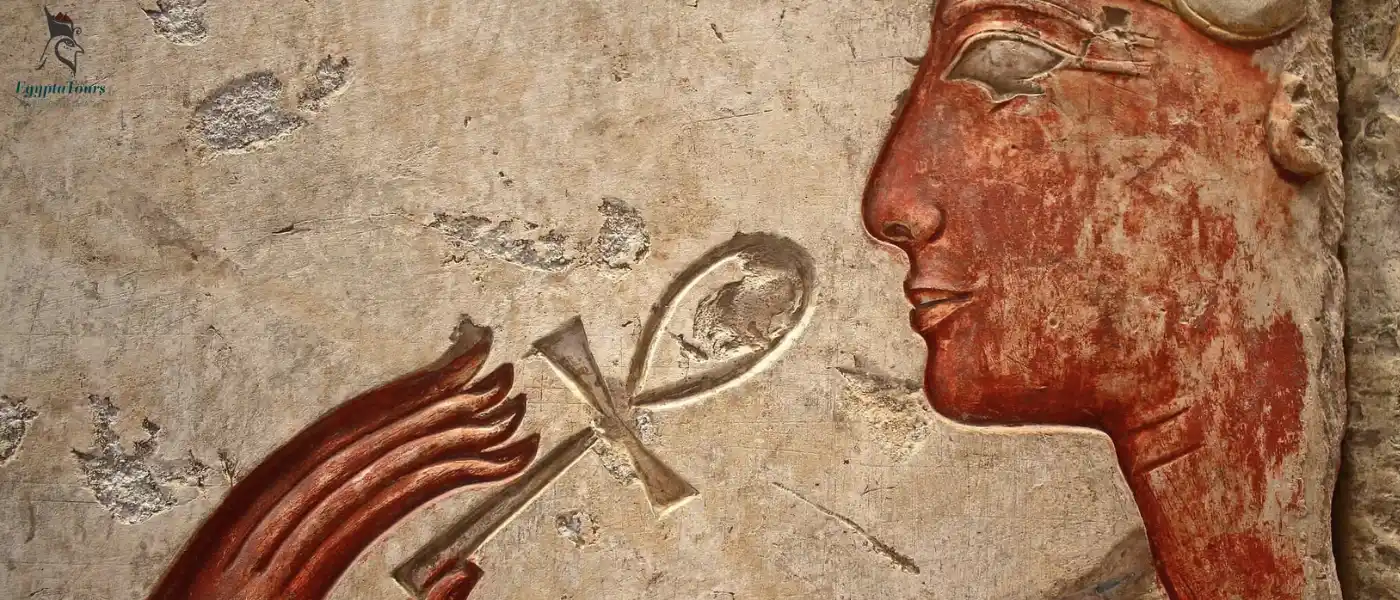
The Symbol of Ankh in ancient Egyptian architecture had a prominent role as a decorative and symbolic element that reflects the spiritual and religious meanings associated with eternal life, and represented an expression of the ancient Egyptian creed.
The ancient Egyptians widely used this symbol in the designs of temples, tombs, and monuments, adding to the architecture a sacred character and a strong connection to religious beliefs, and making it reflect the values of eternity and continuity.
The Ankh Symbol in Ancient Egyptian Religion
The Symbol of Ankh in ancient Egyptian religion was a sacred symbol representing eternal life and the spiritual connection between earth and heaven, and embodied the relationship between the divine and the human.
It was known as the key of life and was widely used in religious rituals, where it embodied the basic concept of life as a sacred value linked to the gods and the dead, making it a symbol of paramount importance in Egyptian religion.
In religious inscriptions, the Ankh symbol often appears in the hand of Egyptian gods, and was sometimes depicted as being granted to kings or humans as a symbol of granting them life and divine power.
The symbol also had great importance in funerary rites, where it was considered a spiritual tool that helps the deceased to transition to eternal life in the other world, and facilitates his journey in the underworld.
It was often placed in coffins and tombs to ensure the protection of the soul and to emphasize the continuity of life after death, and to provide spiritual safety for the deceased.
The ankh, also known as the crux ansata, is an ancient Egyptian symbol of life, often depicted as a cross with a loop at the top.
It represented life and immortality, and was closely associated with Egyptian deities.
Gods and goddesses like Osiris and Isis were frequently shown holding the ankh in their hands, symbolizing their power to give and sustain life. As a sacred symbol.
it was believed to convey eternal life to both mortals and gods alike in ancient Egyptian culture.
The ankh symbol, often called the ankh cross or the Egyptian ankh, is one of the most recognizable icons from ancient Egypt.
Shaped like a cross with a loop at the top, it symbolized life, immortality, and the divine power of the gods.
Frequently seen in the hands of deities, the Egyptian ankh was believed to offer protection and eternal life, making it a common motif in tombs, temples, and amulets.
Origins and Symbolic Meanings
The origin of the ankh is not known. The Egyptologist Sir Alan H. Gardiner (1879 – 1963 CE) believed it came from a sandal strap, with the top loop going around the ankle and the vertical line attached to the sole at the toes. Gardiner thought this because the Egyptian word for sandal was nkh, which came from the same root as ankh. Since sandals were an important part of daily life in Egypt, he suggested the ankh symbol also came to represent life. However, this theory has never been widely accepted.
The theory by Egyptologist E.A. Wallis Budge (1857-1934 CE) is considered more likely, though not fully accepted. He believed the ankh came from the belt buckle of the goddess Isis. Wallis Budge compared the ankh to the tjet, also called the “knot of Isis,” which was a ceremonial belt thought to represent female fertility.
This theory, that the ankh comes from a fertility symbol, fits with its meaning throughout ancient Egyptian history and even today. Egyptologist Wolfhart Westendorf (b. 1924 CE) agrees with Wallis Budge, pointing out the similarity between the ankh and the tjet, and the use of both symbols in early Egyptian history. The ankh has always been linked to life, the promise of eternal life, the sun, fertility, and light. Scholar Adele Nozedar writes:
The meaning of the ankh, despite being such a simple symbol, is truly amazing. It represents both male and female genitalia, the sun rising over the horizon, and the union of heaven and earth. Because of its connection to the sun, the ankh is usually drawn in gold – the color of the sun – and never in silver, which is linked to the moon. But what does the ankh actually look like? Its shape resembles a key, which gives us another clue about its meaning.
The ancient Egyptians believed the afterlife was just as important as life on Earth, and the ankh was thought to be the key to the gates of death and the world beyond.
This is why the ankh appears so often in tomb paintings and inscriptions. Gods like Anubis and Isis are often shown holding the ankh to the lips of the soul in the afterlife, to revive it and allow the soul to live again after death. The goddess Ma’at is often seen holding an ankh in each hand, and the god Osiris is shown holding an ankh in many tomb paintings. Because of its connection to the afterlife and the gods, the ankh was a common symbol on coffins, amulets placed in tombs, and sarcophagi.
Distinctive in its design, the ankh comprises a looped handle above a T-shaped cross.
The exact origins are still debated, but it is often thought to represent the union of masculine and feminine principles or to symbolize the horizon with the sun emerging above, signifying energy and vitality.
Some interpretations suggest it resembles a sandal strap, metaphorically representing the journey of life and eternity.
Essentially, the ankh is a symbol of life, renewal, and continuity core principles in Ancient Egyptian spirituality, where life was viewed not as an endpoint but a constant flow, extending into the afterlife.
Role in Egyptian Culture and Religion
Throughout Egyptian art and iconography, the ankh is frequently seen in the hands of gods, pharaohs, and nobles.
Deities like Isis, Osiris, and Anubis are often portrayed offering the ankh to pharaohs, illustrating the divine bestowal of life force necessary for the journey beyond death.
This practice enhanced the idea of pharaohs as divine entities on earth with an eternal bond to the gods.
The ankh also held an essential position in funerary practices and art, commonly appearing in tombs to reinforce the hope of renaissance and perpetual life, underpinning the Egyptian cultural emphasis on universal balance and the soul’s everlasting journey.
**Contemporary Significance and Popularity**
The ankh’s influence extends well beyond the boundaries of Ancient Egypt.
Its fascinating symbolism has crossed cultural and religious lines, being adopted by early Christians in Egypt as a token of life after death.
Nowadays, the ankh is embraced by various spiritual movements as a sign of life, equilibrium, and rebirth.
In modern popular culture, the ankh is often featured in fashion, jewelry, and artistic expressions, drawing individuals who connect with its rich symbolism of life’s continual path and transformation.
The Ankh & Christianity
As Christianity became more widely accepted in the 4th century CE, many symbols from the old religion were no longer favored, banned, or simply forgotten. The djed symbol, which was strongly linked to Osiris, was one of these, but the ankh continued to be used. Scholar Jack Tresidder writes about the ankh:
The shape of the ankh has been interpreted in different ways, such as representing the rising sun on the horizon, the union of male and female, or other opposites. It is also seen as a key to hidden knowledge and the afterlife. The Coptic Church in Egypt adopted the ankh as a form of the Christian cross, symbolizing eternal life through Christ.
While other parts of the old religion faded away, the ankh took on a new meaning but still kept its original connection to life and the promise of eternal life. Adele Nozedar writes, Strong symbols often cross into other cultures, no matter where they come from, and the ankh is no exception.
Because it symbolizes immortality and the universe, the ankh was adopted by the Coptic Christians in the 4th century. They used it to emphasize Christ’s message of life after death. Over time, the ankh’s loop at the top was removed, and it became the Christian cross. Like the ancient ankh, the Christian cross is still worn by believers today to connect with their God and the promises of eternal life.
Modern Interpretation and Influence
In contemporary culture, the ankh has transcended its original meaning, becoming an emblem of spiritual belief, African roots, and even modern fashion.
Its shape is instantly recognizable and has been adopted by various new-age spiritual and cultural movements.
The ankh’s design has also influenced popular culture, appearing in everything from jewelry and tattoos to logos and artwork.
Its continued association with life and the eternal has made it a meaningful symbol for people worldwide, eager to connect with the rich tapestry of human history.
Conclusion
The ankh, with its elegant and simple design, is much more than a cultural artifact of Ancient Egypt.
It embodies a universal quest for immortality, understanding, and connection.
As ancient Egyptians sought to transcend death and achieve eternal life, they left behind the ankh as a symbol, a reminder of their beliefs and hopes.
In today’s world, where the boundaries between cultures and history blur, the ankh stands resilient an enduring message of life, continuity, and the ever-present human desire for understanding the mysteries of existence.
As we continue to explore the past, the ankh remains a vibrant testament to the human spirit’s enduring quest for meaning and permanence.
In ancient Egypt, the ankh symbol was a powerful emblem representing life, immortality, and divine protection.
Often seen in the hands of gods and pharaohs, it symbolized eternal life and was closely associated with other sacred symbols like the Winged Sun, which represented protection and royal power.
The ankh was also believed to bring good luck and spiritual strength to its bearer.
Sometimes, it appeared alongside the Knot of Isis, a symbol of healing and feminine power, reinforcing the ankh’s connection to life, protection, and divine energy.
Common Questions About the Ankh Symbol
What does the Ankh symbol represent?
The Ankh is an ancient Egyptian symbol that stands for life and immortality. It also represents the union of male and female, and the balance between earthly and spiritual realms.
Where did the Ankh symbol come from?
It originated in ancient Egypt, appearing in their art and hieroglyphs thousands of years ago. It was used by priests, pharaohs, and in tombs to convey the idea of eternal life.
Why is the Ankh shaped like a cross with a loop on top?
The loop likely symbolizes the eternal soul or the sun rising, while the crossbar and vertical stick represent the physical world. Together, they combine spiritual and physical life.
How was the Ankh used in ancient Egypt?
It was often held by gods and goddesses in artwork, symbolizing their power to give life. People also wore it as a protective amulet or used it in rituals to promote health and vitality.
Is the Ankh related to the Christian cross?
The Ankh predates Christianity by thousands of years. While they look similar, the meanings and origins are different. The Ankh focuses on life and immortality, whereas the Christian cross centers on sacrifice and faith.
What materials were Ankh symbols made from?
Ancient Ankhs were crafted from stone, wood, metal, and faience (a glazed ceramic). Today, you’ll find them in jewelry made from silver, gold, and other materials.
Can the Ankh symbol be worn today?
Absolutely. Many people wear Ankh pendants or rings as symbols of life, protection, and spiritual connection. It also holds appeal in fashion and pop culture.
Does the Ankh have any meaning in modern spirituality?
Yes, some spiritual groups use it as a symbol of healing, rebirth, and unity. It’s also popular in New Age practices to represent energy flow and eternal life.
How do you pronounce “Ankh”?
It’s typically pronounced as “ank” (rhymes with “tank”). Some say “ahnk,” but the short, sharp sound is most common.
Are there variations of the Ankh symbol?
Yes, some designs include extra circles, ribbons, or are stylized slightly, but the basic shape remains the loop and crossbar on a vertical line. These variations can add different cultural or spiritual meanings.
Is the origin of the Ankh symbol from Egypt?
Yes, the origin of the Symbol of Ankh is from ancient Egypt.
The Ankh is considered an ancient Egyptian hieroglyphic symbol that was used in writing and art to represent the word life, and it is a symbol with purely Egyptian roots.
Is the Ankh symbol a good or bad symbol?
It is considered a positive symbol in ancient Egyptian culture, and it was used to represent eternal life and resurrection after death, and it often appears in the hands of the gods in inscriptions and statues, where it is granted to the pharaoh to represent their power in preserving life and resurrecting souls in the afterlife.
The Ankh symbol is not just an artistic or religious expression in ancient Egyptian civilization, but it is an embodiment of the idea of eternal life and the spiritual connection that has transcended time.
This symbol remained a witness to the greatness of ancient Egyptian culture and its belief in immortality, and their profound understanding of the nature of life and death.
It carried profound meanings that blended religion, art, and thought.
The Ankh symbol remains an eternal icon that reflects power, balance, and the continuous search for life and meaning, reminding humanity of the splendor of the cultural heritage created by ancient civilizations, and the importance of the search for meaning in human existence.
About EgyptaTours

EgyptaTours is a name synonymous with trust, excellence, and unforgettable travel experiences, proudly standing as one of the leading travel agencies in Egypt. Renowned for its deep expertise, personalized service, and carefully crafted itineraries, EgyptaTours serves as the ultimate gateway to discovering Egypt in its most authentic and inspiring form.