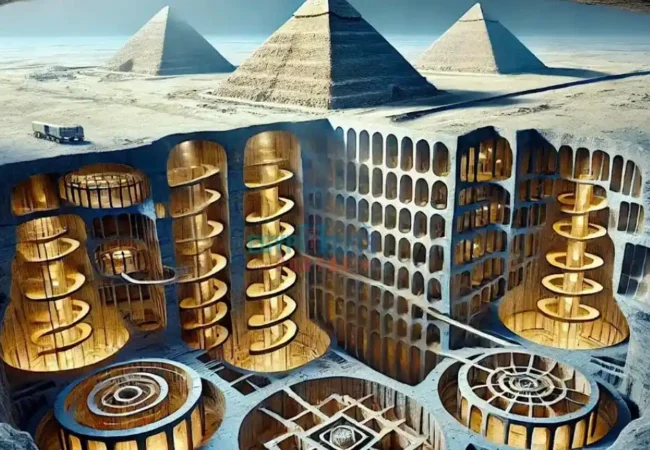
Study Finds Vast Underground Complex Under Giza Pyramids
A recent study by a group of Italian researchers claims the discovery...



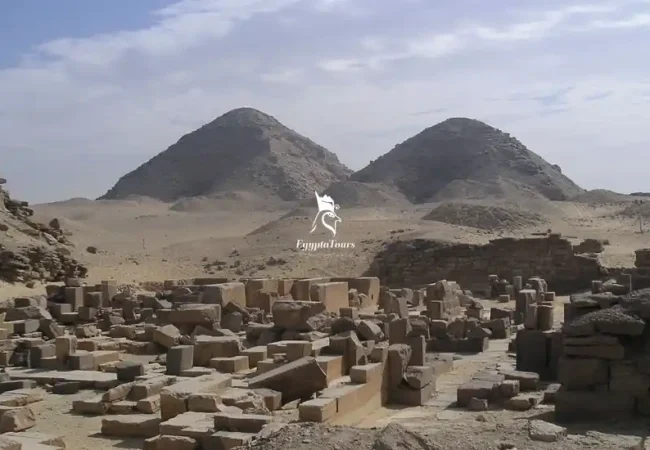
Pyramid of Sahure is an architectural masterpiece from the era of the Pharaohs. It was built during the reign of King Sahure one of the rulers of the Fifth Dynasty to immortalize his name in the record of greatness. This monument is located in the Abu Sir cemetery near Cairo.
It is distinguished by its wonderful design and decorations that tell stories from the lives of the ancient Egyptians.
It was not just a royal tomb, but rather a silent witness to many religious beliefs political visions and cultural thought that prevailed in that era making it an invaluable archaeological treasure in the pages of ancient Egyptian history.
Through our article, we will learn more details about this pyramid, so follow us.

Discoveries-of-the-Pyramid-of-Sahure-EgyptaTours
Pyramid of Sahure is an architectural masterpiece that testifies to the ingenuity of the ancient Egyptians. It was built on a high platform surrounded by massive walls giving it awe.
The accompanying funerary complex includes a stunning temple connected by a long corridor leading to another temple in the valley. Each corner is decorated with distinctive engravings that reveal amazing details about royal life and religious rituals.
Among the greatest discoveries that distinguish the pyramid is the huge number of elaborate engravings which surpass in their precision and beauty all that preceded them.
These engravings tell captivating stories from the majestic celebrations of the “Sed” festival to the overwhelming victories of the pharaoh over his enemies, and even scenes that show the flourishing economic activity of his kingdom.
As for the funerary temple located east of the pyramid it is an architectural gem that still retains its secrets despite the passage of thousands of years. It is decorated with unique columns with a design inspired by palm fronds and is one of the oldest examples of these decorative elements in the history of Egyptian architecture.
The complex’s charm extends to mysterious sub-pyramids and a huge pit for boats which were an important element in the design of pyramid complexes in the Old Kingdom, but the pit for the boat in the pyramid of Sahure was distinguished by its enormous size and extreme craftsmanship which raises questions about its role in religious rituals and funerary beliefs at the time.
Along the road leading to the pyramid intricately engraved inscriptions are lined up.
Sahure’s pyramid is built in the prime area of Abusir and was the first pyramid constructed there after King Userkaf’s sun temple. The site was closely connected to the worship of the sun god Ra and the temple of Ra in Heliopolis could be seen from this location. Choosing this spot for Sahure’s pyramid set an example, inspiring later pyramids in the area, including those of Neferirkare and Neferefre.

The-historical-importance-of-the-pyramid-of-Sahure-EgyptaTours
Sahure is considered a milestone in the development of Egyptian funerary architecture as it represents a turning point between the majestic style of the Fourth Dynasty and the more complex and ornate approach of the Fifth Dynasty.
It was not just a stone monument, but rather a testament to the greatness of this era as the pyramid has great historical importance including:
The Pyramid of Sahure was built by King Sahure of the Fifth Dynasty in the early 25th century BCE, around 2480 BCE. It helped start a wave of pyramid building after King Userkaf built his sun temple, leading to the development of the Abusir area. The pyramid is known as Khai-ba Sahura which can be translated as “The Rising of the Ba Spirit of Sahure,” “The Ba of Sahure Appears,” or “Sahure’s Soul Shines.”
The entire pyramid complex was excavated by Ludwig Borchardt between 1907 and 1908. Its design was later copied by several kings of the Fifth and Sixth Dynasties, showing creative planning despite the use of lower-quality materials and simpler construction methods which caused much of the pyramid to collapse over time. The site continued to be studied in modern times and in 1994 the Egyptian Supreme Council of Antiquities opened the Abusir necropolis to tourism.

Unlocking-Best-Secrets-The-Pyramid-of-Sahure-Explained-EgyptaTours
The Pyramid of Sahure was originally about 47 meters tall and around 78.5 meters wide at its base. It was built using local limestone for the main structure, while smooth white Tura limestone covered the outside, giving it a bright, shiny look under the Egyptian sun.
Unlike the massive pyramids of the Fourth Dynasty, Sahure’s pyramid focused less on size and more on detailed design and decoration. The whole complex was carefully planned. It included a valley temple connected by a long, decorated pathway (called a causeway) to a mortuary temple beside the pyramid. There was also a smaller pyramid nearby, used for religious rituals connected to the king’s afterlife.
This balanced design combining purpose, beauty and religious meaning became a model for later pyramids built during the Fifth Dynasty at Abusir.
The pyramid complex covers an area of about 10,000 m² (110,000 sq ft) and includes the main pyramid, a valley temple, a mortuary temple, a causeway, a smaller cult pyramid, as well as several enclosure walls and many artistic sculptures.
The complex is decorated with remarkable carved reliefs and designs, showing some of the finest examples of ancient Egyptian art, stretching for around 370 meters (1,214 feet) and including scenes like hunting and daily life. The structures were built using a mix of materials, such as granite, limestone, alabaster and basalt. The main parts of the complex include:
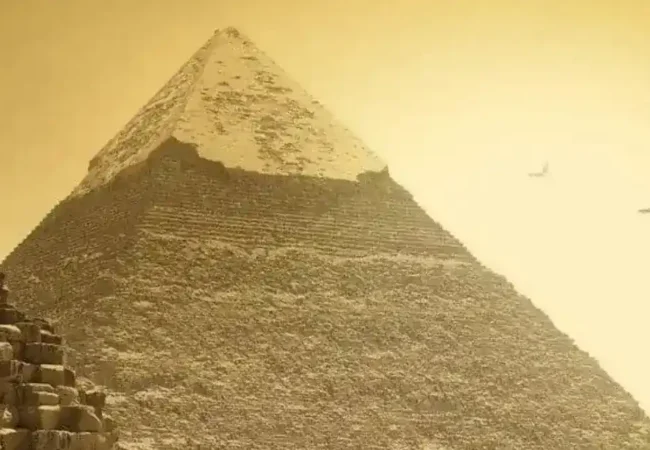
The Pyramid of Sahure, built during the Fifth Dynasty, is a true pyramid made of limestone. It originally stood about 47–48 meters (154–158 ft) tall, with a base roughly 78.5–78.75 meters (257–258 ft) wide, a volume of around 96,542 m³ (126,272 cu yd) and a slope of about 50°. The pyramid was constructed using limestone blocks, red granite, mud mortar and white Tura limestone for the outer casing. Over time, many of its stones were taken away.
The pyramid is built in six horizontal layers of limestone held together with mortar and its entrance is on the north side. Its measurements are somewhat uneven, likely due to limited architectural planning which contributed to its collapse over the centuries. Surrounding the pyramid is a limestone paved courtyard. Inside, the burial chamber is largely destroyed, though fragments of the king’s basalt sarcophagus remain.
The mortuary temple of Sahure’s pyramid was a key part of the complex, used for religious and funeral ceremonies. It was located on the eastern side of the pyramid, near the start of the causeway that led to the valley temple.
The temple was a large rectangular building, featuring an open courtyard surrounded by columns. Its main sections included an entrance hall, an offering hall, a five-niche statue chapel, storerooms and the courtyard itself.
Near the mortuary temple, there were additional structures, including a smaller cult pyramid, a sun court and a subsidiary pyramid. The columns in the courtyard had palm-leaf-shaped capitals and their shafts were inscribed with the king’s name.
By the 18th Dynasty, the temple became a center for the Cult of Sekhmet, which continued to be active until the Ptolemaic period around 30 BCE.
Names of pharaohs like Horemheb, Amenhotep III, Seti I and Ramesses II were later carved on the walls. Roman and other shrines were also found within the temple.
At the entrance stood a large red granite statue of Sahure, showing him as the god Horus, with arms crossed over his chest, a symbol of his power and connection to the gods. Inside, the temple had rooms for different purposes: the offering hall was for presenting gifts to the king’s ka, the storerooms held offerings and ritual items, and the sanctuary was a small inner room housing the pharaoh’s statue for private ceremonies.
Reliefs on the walls of the offering hall depict Sahure’s victories and voyages, reflecting both religious devotion and royal achievements.
The substructure of the Pyramid of Sahure includes an underground chamber, a pit and several tunnels and passageways. The entrance to this area is on the northern side of the pyramid above ground. The main chamber, located beneath the pyramid, was meant to hold the pharaoh’s mummy. It is rectangular and has a corbelled roof.
Near the chamber’s entrance is a pit which provides access to the burial chamber. A causeway connected the substructure to the valley temple. The tunnels and passageways linked the pit to the chamber, allowing the ancient Egyptians to place offerings and burial goods inside. They were also used by the workers during construction to move materials and tools in and out of the chamber.
The valley temple had two ramps at the edge of Abusir Lake, which was unusual because temples usually had only one ramp facing east. The eastern ramp led to a large portico with eight pink granite columns topped with palm-shaped capitals.
The ceiling above was painted blue and decorated with gold stars. The southern ramp led to a smaller portico with just four pink granite columns. Both ramps opened into a central room with a floor made of basalt and a ceiling showing astronomical designs.
The walls were beautifully decorated with pictures of the Pharaoh as a sphinx, trampling Egypt’s enemies. A small staircase led up to the roof terrace.
Today, only the limestone blocks of the causeway’s base ramp are still in place. But in the past, it had a roof with small windows to let in light and was decorated with beautiful reliefs. These showed gods leading the nine bows, which were Egypt’s traditional enemies, the delivery of the gilded capstone for the main burial pyramid, scenes of celebration when the pyramid was finished, and images of poor, hungry Bedouin people.
The cult pyramid is situated at the southeast corner of the main pyramid. It is now completely ruined, but it originally had a small entrance on the north side that led down to the burial chamber. This pyramid was largely symbolic, built to house the king’s spirit, or ka, and to support burial rituals. It also played a role in preparing the ka for rebirth during the Sed festival.
The pyramid embodies an amazing architectural masterpiece that demonstrates the ingenuity of the ancient Egyptians in the arts of construction and engineering.
This giant edifice was built using huge blocks of limestone as the builders relied on a core of cohesive raw stones while the pyramid was covered with an outer layer of soft white limestone which added to it a unique majesty and beauty.
This careful selection of materials was not random, but rather shows an advanced level of knowledge of the properties of rocks and carving and transportation techniques.
The construction of the pyramid complex was not just a stone project but an engineering feat that required careful planning and organization.
The astronomical precision with which the various structures were placed from the pyramid to the funerary temple and the connecting bridge to the valley temple reveals an amazing understanding of astronomy and advanced engineering measurement methods.
The ancient Egyptians left nothing to chance, but designed every corner with dazzling engineering harmony.
One of the unparalleled achievements in the complex is the boat hole which is one of the largest holes ever dug in the rock.
It was not just an ordinary hole, but a complex engineering project that required precise expertise in dealing with rocks as the hole was lined with tight stone blocks indicating a sophisticated engineering thought that was unparalleled in that era.
As for the palm columns that adorn the funerary temple they embody the pinnacle of architectural creativity of the ancient Egyptians.
These columns which mimic bundles of palm fronds are not just decoration, but are considered one of the oldest engineering innovations that preceded their time as the Egyptians combined beauty and function with a skill that amazes even the greatest architects of the modern era.

What-are-the-buried-artifacts-inside-the-Sahure-Pyramid-EgyptaTours
Excavations inside the Sahure Pyramid revealed an amazing archaeological treasure including a large collection of rare pieces and funerary items which shed light on the rituals of the ancient Egyptians and their deep-rooted beliefs in resurrection and the afterlife.
Within the walls of this ancient edifice pottery and stone vessels were found in amazing shapes, in addition to precious jewelry that reflects the greatness of Egyptian civilization and its spirituality.
The discovered pottery vessels varied in their designs and sizes which illustrates their multiple functions. Some were used in sacred rituals, and some were used to store food and drink to be provisions for the pharaoh on his eternal journey.
As for the stone vessels they were made with extreme precision indicating amazing skill in carving stones, and they may have been used to make offerings or in religious rituals that show respect and reverence for the dead.
When it comes to the discovered jewelry we find that it is not just an ornament, but rather carries deep spiritual symbols. It included finely carved beads amulets that the Egyptians believed provided protection, and seal impressions that were a symbol of identity and status.
The presence of these pieces next to the deceased reflects their belief that the soul needs a force to protect it in the world The Other World.

Newly-Discovered-secrets-in-the-pyramid-of-Sahure-EgyptaTours
Dr. Ahmed Amer a distinguished expert in Egyptology explained that the amazing discovery made by the Egyptian-German mission which is the discovery of a series of warehouses inside the pyramid of King Sahure opened the door to a deeper understanding of this ruler who took the throne of Egypt after King Userkaf and continued to rule for fourteen years.
In a special statement Amer indicated that Sahure was the first to pave the way of the Fifth Dynasty towards the Abusir area where he chose it as a site to build his pyramid near the Temple of Userkaf, and stressed that the era of the Fifth Dynasty witnessed a special architectural boom in the design and decoration of temples as the inscriptions on the walls increased and acquired a more detailed and diverse form.
King Sahure ruled during a time of peace and prosperity, around 2487 to 2475 BCE. During his reign, Egypt expanded its trade networks and sent sea expeditions to distant lands like Punt and Byblos. He was deeply devoted to the sun god Ra, and this religious devotion shaped much of the Fifth Dynasty.
Under Sahure, Egypt thrived both economically and artistically. Craftsmen made detailed statues and reliefs showing the king’s life and religious ceremonies. His pyramid, known as the Pyramid of Sahure or “The Ba (Soul) of Sahure Appears,” perfectly reflects his vision, combining religious devotion with careful art and architecture.
The pyramid was more than just a tomb. It was a statement of royal power and a model that later pharaohs would follow at Abusir and beyond.
In recent years, teams from the ARCE and the University of Würzburg have made significant progress in preserving the Pyramid of Sahure. Their work includes stabilizing weak passages, rebuilding collapsed limestone walls and digitally recording all parts of the pyramid.
They have created detailed records of the pyramid’s current condition using 3D models, photogrammetry and precise surveys. This ensures that even if some parts of the monument are lost over time, researchers still have accurate digital plans to study and use for restoration.
Their efforts not only protect an important part of Egyptian heritage but also allow tourists to safely visit areas of the pyramid that had been closed for nearly 200 years.
The Pyramid of Sahure is located in Abusir, between Saqqara and Giza, about 45 minutes south of Cairo. It is part of the quieter Abusir Necropolis, a peaceful archaeological area ideal for visitors who want to explore ancient Egypt without the crowds.
Visitors can see the pyramid’s ruins, parts of the causeway and sections of the mortuary temple. The best time to visit is between October and April when the weather is cooler. The Pyramid of Sahure is often visited alongside nearby sites like the pyramids of Neferirkare and Neferefre, as well as the Sun Temple of Abu Ghurab, usually as part of guided tours.
Tourism is managed carefully; visitors are asked not to climb on the ruins or remove any stones. Preserving these details helps keep the legacy of this remarkable monument alive for future generations.
It is the pyramid of Sahure.
The Abusir area was named by this name which means the seat of the god Osiris in ancient times.
Alexandria Governorate.
In the end, the Pyramid of Sahure remains one of the archaeological treasures that reveal the secrets of his era as it clearly shows the features of rule during the reign of this great pharaoh in addition to what it bears of firm imprints of society and religion in the heart of the Old Kingdom.
Its amazing structure it’s very distinctive decorations, and its inscriptions that reveal countless stories made it the most important of the ancient monuments, and we hope that you will like this article.


Explore our top-rated Egypt travel packages and embark on an unforgettable journey. From the Pyramids of Cairo to the magical temples of Luxor, Aswan, and Abu Simbel, discover expertly curated tours designed for your perfect Egyptian adventure