






Ancient Egyptian Gardens
The ancient Egyptians used ancient Egyptian gardens for entertainment and relaxation, and the ancient Egyptians at that time believed that there was a close relationship between man and nature. Therefore, they excelled in designing gardens in a unique way, as they included a variety of trees and plants that carried cultural and religious symbols for the ancient Egyptians at that time.
In this article, we will learn in detail about the ancient Egyptian gardens and their role in temples and tombs.

Symbolic-Plants-In-Ancient-Egyptian-Gardens – EgyptaTours
Ancient Egyptian gardens represented a fundamental aspect for the ancient Egyptians, especially the upper class, as gardens were attached to some palaces and were used by kings and princes for entertainment and relaxation. They were designed in wonderful geometric shapes, and ancient Egyptian gardens began as fruit orchards, then some flowers were added to them.
Ancient Egyptian gardens also held a part of the religious aspect for the ancient Egyptians. This was discovered through the wall paintings and inscriptions drawn on the walls of the temples, where the temple was surrounded by large gardens.
The Role of Gardens in Temples and Tombs

Temple-Garden-In-Ancient-Egypt-With-Palm-Trees – EgyptaTours
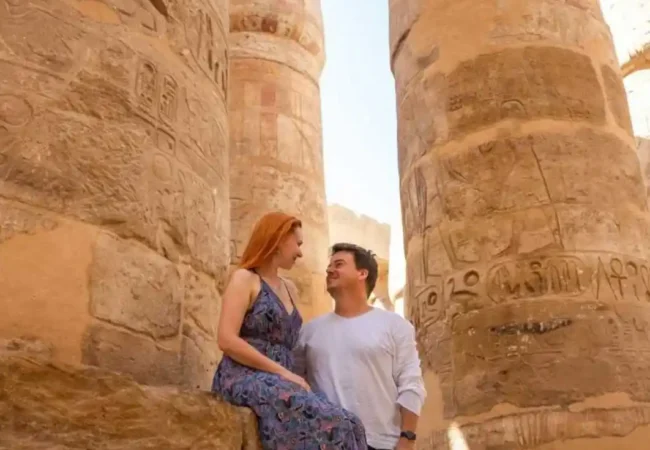
Ancient Egyptian temples, such as the Karnak Temple for the worship of the god Amun, contained gardens attached to them, as this temple contained 26 gardens that contained many plants and flowers, and the ancient Egyptians believed that they symbolized the divine land.
The gardens attached to the temples always contained sycamore and fig trees, and they believed that they were sacred trees at that time and symbolized the goddess Hathor. There were also some other trees such as palm and willow, and trees were used to connect several temples, and they dug many wells to care for these trees.
The Design of Ancient Egyptian Gardens

Ancient-Egyptian-Gardens-With-Ponds-And-Papyrus – EgyptaTours
The Egyptians paid attention to the design of ancient Egyptian gardens, as the gardens were designed using straight geometric lines. The garden was open, with a pool of water in the middle, and in this pool, some fish and lotus plants were placed.
This pool was surrounded by some flowering shrubs and herbaceous plants such as jasmine and narcissus. The garden was surrounded from the outside by rows of fig and sycamore trees, followed by palm and doum palm trees. Some statues might be placed in the garden, and then the garden was surrounded from the outside by a high wall.
The Symbolism of Palm Trees in Egyptian Civilization
Palm trees adorned the ancient Egyptian gardens, and the ancient Egyptians believed that the palm tree was a symbol of immortality and eternal life that one enjoys due to their belief in resurrection after death. The palm trees were a source of dates and were planted on the banks of the Nile River.
The ancient Egyptians used palm fronds in religious rituals and celebrations, and the Egyptians considered them offerings to the gods. The Egyptians believed in the connection of the pharaohs with the palm trees because they thought they were chosen by God to rule the country and lead the peoples.
The Use of Gardens for Medical Purposes
Ancient Egyptian gardens were not only a means of rest and relaxation, but in addition to their use for religious purposes by the ancient Egyptians, they were also used for therapeutic purposes, as some gardens were created that contained plants from which some types of medicines and perfumes were extracted.
The blue lotus flower was considered one of the most important plants from which perfumes were made. Some other flowers such as the pink and white lotus were also used. The ancient Egyptians also used the lotus flower as a calming tea and used its roots to treat many diseases, including diseases of the digestive system and respiratory system.
The lotus flower contains many vitamins and minerals such as iron, phosphorus, copper, and vitamin C. The ancient Egyptians used the papyrus plant to treat throat diseases, as it was worn around the neck.
The Role of Gardens in Social Life
Ancient Egyptian gardens greatly helped in strengthening social relations and bonds between members of the same family, especially among the upper class, as they were able to have gardens attached to their palaces, and all family members would gather in them and spend enjoyable time together.
The wealthy class enjoyed building pools and swimming pools within the gardens. These pools were made in the shape of a T, and the shaduf or hand was used to lift water to these pools, which were a habitat for some waterfowl.
The ancient Egyptians planted some types of trees that provided them with shade and color, such as grape trees supported by some columns. The scent of flowers and trees spread throughout the gardens, and the ancient Egyptians used them as a symbol of romance.
As for the lower class, it was a class of farmers and slaves, and this group did not own gardens in their homes, but they used to plant some trees around the Nile River.
Archaeological Evidence of Ancient Gardens

Luxor-Ruins-Showing-Ancient-Egyptian-Garden-Remains – EgyptaTours
The inscriptions on the walls of temples and gardens are among the most important evidence indicating the existence of gardens in ancient Egypt. This was also found in some funerary paintings, and in some ancient manuscripts, there were pictures of gardens that were attached to tombs.
There is an ancient Egyptian garden whose traces were found in the Pharaonic tombs in the Dra’ Abu el-Naga’ area, which is located in the city of Luxor, and the date of this garden goes back to about 4000 years ago.
This garden was a small courtyard about three meters long, divided into squares of equal size, and a specific type of plant and flower was planted in each of these squares.
The Influence of Egyptian Gardens on Other Civilizations
Egyptian gardens greatly influenced many civilizations, and through them, the concept of gardens was transmitted to many other ancient civilizations, as they reflected the creativity of the Egyptians in engineering and agriculture.
In the ancient world, there were some other gardens, the most important of which are the Hanging Gardens of Babylon, the Assyrian gardens, the Indian gardens, the Persian gardens, the Roman gardens, and the Greek gardens, but they were all greatly influenced by the ancient Egyptian gardens.
Conclusion
Ancient Egypt witnessed great development in many agricultural, commercial, and industrial fields. The ancient Egyptian gardens were among the first gardens to be made in the world. The ancient Egyptians paid great attention to them and excelled in their cultivation and design.
These gardens gained their status because they took some of the plants and trees in them as a religious symbol, and they were attached to the palaces of many kings, princes, and nobles.
FAQs
Were there gardens in ancient Egypt?
Yes, there were many gardens in ancient Egypt, and they were designed with a wonderful geometric layout. The ancient Egyptians used them for relaxation and recreation, and they also used them for religious and therapeutic purposes.
What are the famous ancient gardens?
There were many famous gardens in ancient Egypt, such as the palace gardens, temple gardens, funerary gardens, and other gardens. The ancient Egyptians excelled in planting and decorating these gardens and used them for many purposes. Among the most famous are the gardens of the Karnak Temple and the gardens established By <strong>Queen Hatshepsut</strong>, which contained a variety of plants and trees. There were also gardens in the city of Luxor.
What are the sacred plants in Egypt?
There were many sacred plants in ancient Egypt, the most important of which was the lotus flower, which was greatly associated with the god Ra and represented resurrection and immortality. The sycamore tree was associated with the goddess Hathor, the goddess of motherhood. The pomegranate tree was considered a symbol of life, and the palm tree was a symbol of eternal life and the gods. They used to offer parts of them as offerings to the gods and considered them a symbol of divine food.
About EgyptaTours

EgyptaTours is a name synonymous with trust, excellence, and unforgettable travel experiences, proudly standing as one of the leading travel agencies in Egypt. Renowned for its deep expertise, personalized service, and carefully crafted itineraries, EgyptaTours serves as the ultimate gateway to discovering Egypt in its most authentic and inspiring form.