Ramses and The Plagues
The story of Ramses and the plagues describes the plagues sent upon...



If there is one deity who truly captured the heart of ancient Egypt, it was Hathor. Far from just a rigid figure carved into stone, she was the vibrant, beating heart of the culture—the goddess of love, joy, music, and motherhood. Whether she was depicted as a fierce protector, a nurturing celestial cow, or a beautiful woman wearing her signature sun disk and horns, her presence was felt absolutely everywhere.
She guided pharaohs, protected the everyday people, and even comforted the dead on their journey into the afterlife. Today, her spirit is still incredibly palpable, especially if you wander through the breathtakingly preserved, colorful halls of her main sanctuary at the Temple of Dendera.
Key Takeaways
The Ultimate Goddess of Joy: Hathor wasn’t just about serious, quiet rituals; she was the life of the party. She ruled over music, dance, love, and celebration, making her universally beloved by everyone from royalty to commoners.
The Nurturing Celestial Cow: While it might seem unusual to modern readers, her depiction as a divine cow was the ultimate ancient symbol of motherhood, nourishment, and earthly abundance.
A Fierce Protector: Do not let the “goddess of love” title fool you. As the legendary “Eye of Ra,” she could transform into a fierce, unstoppable defender to protect the sun god and the royal family from chaos.
The Comforting “Lady of the West”: She played a surprisingly gentle role in the afterlife. The ancients believed she waited in the western hills to welcome passing souls, ensuring they were safely guided, fed, and protected for eternity.
You Can Still Visit Her Today: Her primary worship center, the Temple of Dendera, survived the centuries and remains one of the most vividly preserved, stunningly detailed archaeological sites you can explore in Egypt right now.
Hathor, an important Egyptian goddess, was worshipped from the Early Dynastic period as the goddess of joy, love, and music. She was often depicted as a woman wearing a headdress with cow horns and a sun disk. Revered as the wife of Horus and the mother of the pharaoh, her main cult center was at Dendera, where grand temples honored her divine role in protecting kingship and spreading happiness.
Religious myths and beliefs proliferate in the ancient Egyptian civilization, such as the multitude of revered deities like the god Ra, Osiris, Horus and the goddess Hathor.
Hathor is considered one of the main cults that originated at the beginning of the dynastic period in ancient Egyptian civilization.
Her distinctive form comes either as a celestial cow or as a woman who has horns above her head.
In this article, we will talk about the goddess Hathor in the beliefs of ancient Egypt and learn about her characteristics, some facts about her.
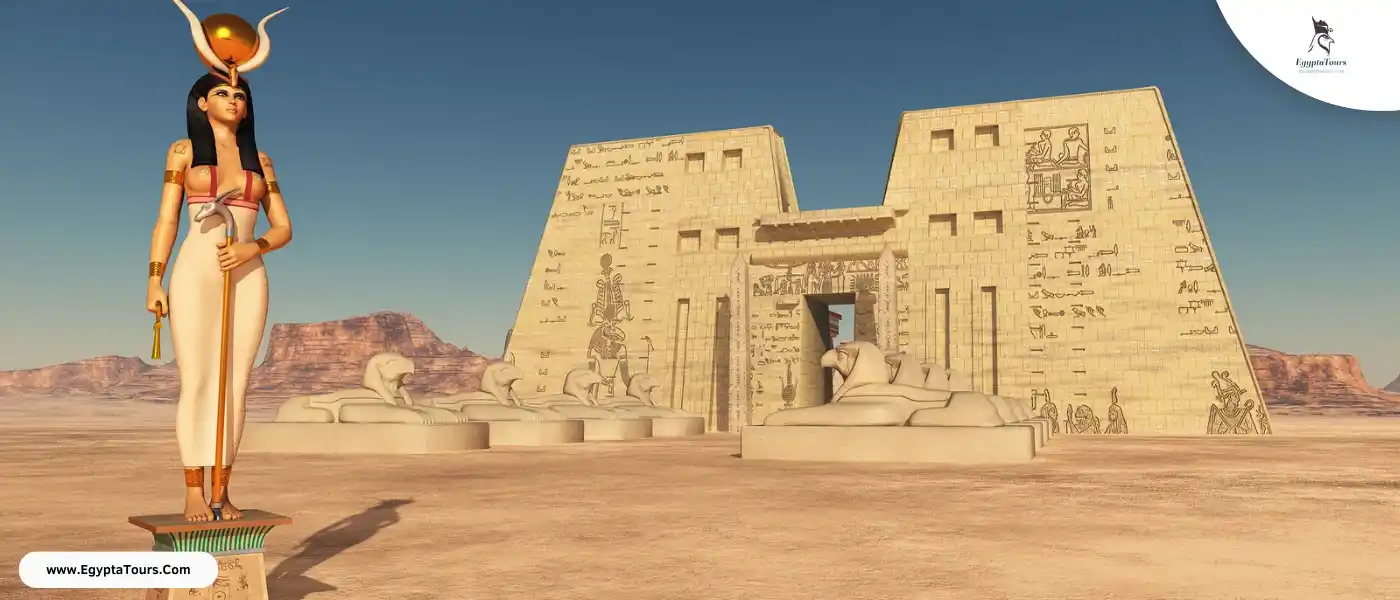
Who-is-Hathor-EgyptaTours
Hathor is the goddess of love, the sky, the mother, fertility and everything that signifies beauty, and she was previously named Bat.
She primarily symbolizes all the traits of the Egyptian lady as a mother, wife, daughter and sister.
She is considered the goddess who particularly protects singers and dancers and everything that spreads joy and delight in the universe.
Her worship was strongly concentrated between the city of Ashmunein which is near Fayoum and the sacred city of Abydos in Sohag.
Later, the worship spread until it reached the Greeks, Phoenicians, Romans and Mesopotamia.
She was discovered initially on the historical Narmer Palette.
The name Hathor literally means house of Horus. Scholars have explained this name in different ways. One common idea is that she was the mother of Horus, with “house” meaning womb.”
The hieroglyph for her name shows a square with a falcon inside. Some believe this means she was the wife of the falcon god, not his mother. It could also mean she was a sky goddess, because the falcon lives in the sky. Her name may also refer to the royal family, since she was considered their mythical mother through Horus.
The translation of ‘Sanctuary of Horus’ or ‘Lap of Mother Horus’ stems from myths where she is considered the safe haven or ‘Lap of Mother Horus,’ because in some myths, she is considered the safe haven that embraced the orphan Horus, son of Isis.
According to the accounts, she nursed and raised him.
She was an important goddess worshipped by the ancient Egyptians with veneration around the third millennium BC.
Some amulets dating back to her were discovered during excavations at Tel Sath Vincienti in Spain and it has been confirmed that they were indeed made in Egypt.
This discovery indicated early trade and cultural exchange between the two regions and indicated the existence of some form of trade and cultural exchange between the two countries.
ictures of cattle appear often in the art of Predynastic Egypt (before about 3100 BC), as well as images of women with raised, curved arms that look like cow horns. Both types of images may represent goddesses connected to cows.
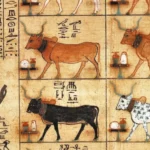
Cows were respected in many cultures, including ancient Egypt, because they symbolized motherhood and nourishment. They cared for their calves and gave milk to people.
The Gerzeh Palette, a stone palette from the Naqada II period around 3500–3200 BC, shows the outline of a cow’s head with curved horns and stars around it. This suggests that the cow was also linked to the sky, just like later goddesses who were shown in this form, such as Hathor, Mehet-Weret, and Nut.
Even though there were earlier hints, this specific goddess is not clearly mentioned until the Fourth Dynasty (2613–2494 BC) of the Old Kingdom. However, some objects that might refer to her could date back to the Early Dynastic Period (about 3100–2686 BC).
When Hathor appears clearly in art, her horns curve outward, unlike the inward-curving horns seen in Predynastic artwork.
A cow goddess with inward-curving horns appears on the Narmer Palette, one of the earliest Egyptian artifacts. She is shown at the top of the palette and also on King Narmer’s belt or apron. Egyptologist Henry George Fischer suggested that this goddess might be Bat, who was later shown with a woman’s face and curved horns that look like cow horns.
However, Egyptologist Lana Troy points to a section in the Pyramid Texts from the late Old Kingdom that links Hathor to the king’s apron, similar to the goddess shown on Narmer’s clothing. She suggests that the goddess on the Narmer Palette may actually be Hathor, not Bat.
During the Fourth Dynasty, Hathor quickly became very important. She replaced an early crocodile god who had been worshiped at Dendera in Upper Egypt and became the main goddess of that city. She also began to take over the cult of Bat in the nearby area of Hu, and by the Middle Kingdom (about 2055–1650 BC), the two goddesses had merged into one.
In the Old Kingdom, the religious beliefs about the pharaoh focused strongly on the sun god Ra, who was seen as the king of the gods and the father and protector of the pharaoh. As Ra became more important, Hathor rose with him and became his mythological wife, making her the divine mother of the pharaoh.
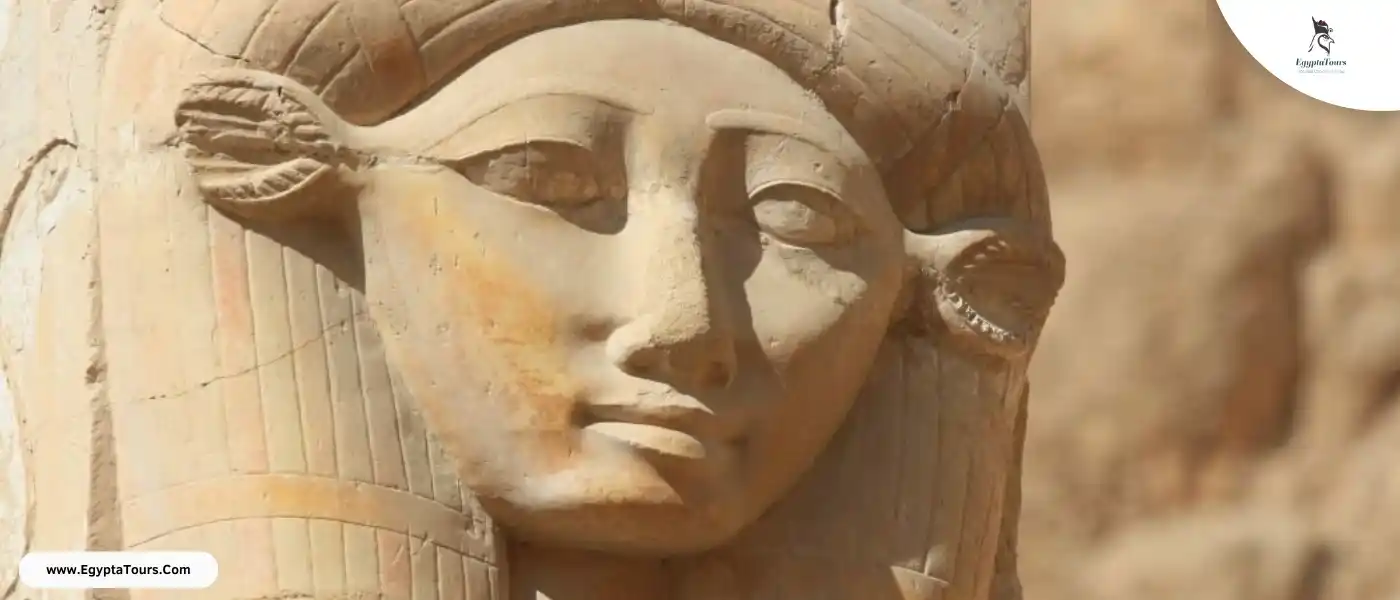
Facts-about-Hathor-EgyptaTours
She was embodied in the form of a cow that some worshipped. She strongly symbolizes motherhood, fertility, giving and the bounty that the earth produces.
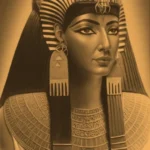
She also often appears as an elegant woman who has horns with the sun disk between them and her human image suggests beauty, fun and delight.
Her main religious center in Dendera is considered one of the most beautiful and famous ancient Egyptian temples that are exceptionally well-preserved.
She played an important and vital role in beliefs about the afterlife, as she received the deceased arriving in the west and offered them food and drink.
It was also believed that her spirit lingered in the sacred trees that adorned the tombs. She is among the goddesses who enjoyed great worship which extended beyond Egypt for thousands of years.
This deity is characterized by some diverse properties. She was a patron and protector of some foreign desert lands from which precious metals were extracted, such as the turquoise mines in Sinai and at Deir el-Bahri, therefore the Egyptians nicknamed her the “Lady of Turquoise”.
She is also distinguished by always being depicted as a beautiful and captivating woman.
She was also known as the strong protector, as she protected the tombs of the dead and provided them with spiritual help.
She was also characterized as the mistress and goddess of quarries, because she was associated with the source of the ancient Egyptian desert for the existence of stones and the building of tombs.
Her characteristics sometimes include that she might appear bloodthirsty. She was considered the daughter and companion of the sun god “Ra,” defending and protecting him against the evil serpent god.
Holding an important and pivotal position in major myths, she is frequently cited as the daughter of Ra
This is because she may appear in some important stories and events.
In many texts, she is considered the daughter of the god Ra, who is the supreme sun god.
She also embodies the Eye of Ra which fights his enemies fiercely, as she was mentioned with this attribute in the myth of the destruction of mankind. In another famous myth, she appeared in a positive role in treating and healing the precious eye of the god Horus after his battle with Set.
According to the myth, she used sacred gazelle milk to restore his sight.
She also sometimes has a strong relationship with the god Thoth, the god of wisdom and knowledge.
She also appeared in an important assistant role in the famous myth of Isis and Osiris, where she helped Isis in her search for her husband and his return to life.
The recurring embodiment as a sacred celestial cow pointed to deep religious concepts and symbolic concepts as they believed in ancient Egypt.
The cow strongly symbolized motherhood and care for its abundant production of nourishing milk which was considered an essential source of life and food.
These qualities led to her titles as the bringer of love, goodness, and prosperity.
The curved cow horns indicated power and protection and this appears when she protected and defended other important gods like Ra.
The radiant sun disk between the horns directly symbolized the god Ra, her heavenly father, whose favorite daughter she was considered, deriving her power from him.
In addition, the cow was considered in Egyptian culture to be a loyal, giving and useful animal and this highlights the positive and beloved aspect of Hathor as a popular goddess of love and beauty.
She was a very popular goddess in ancient Egypt and was strongly linked to the royal family. The kings supported her because she was seen as their divine mother, caretaker, and even their wife. granting her massive influence over both nobles and commoners. In the Theban region, there are images of pharaohs like Amenhotep II, Hatshepsut, and Thutmose III shown under a cow-goddess, drinking from her udders or standing beside her cow form.
Hathor’s sacred status came from three main stories: she was the daughter of the sun god Ra, she helped the dead in the underworld, and she protected trade. These three roles strengthened her importance in the Egyptian group of gods.
There were many shrines for Hathor all across Egypt and in other regions like Nubia, Sinai, and Byblos, places where Egypt had power and influence. In Egypt, her major temples were in Atfih, Cusae, Deir al-Medina, and Dendera. The temple at Dendera was her most important and famous religious center.
Hathor’s biggest festival was her yearly meeting with Horus, held in the third month of the Egyptian summer. After a large procession, her statue from Dendera was brought to the temple of Horus in Edfu. There, the two statues took part in several rituals and were placed together in a room overnight to reunite. Thousands of people came to watch and then joined in the celebrations that continued for fourteen days.
Another well-known festival for Hathor was held on New Year’s Day, which people believed was her birthday. Before sunrise, her priestesses carried her statue out of the temple and raised it toward the rising sun. After that, people celebrated with music, drinking, and dancing.
The epic mythological romance between the goddess of love and the falcon god is beautifully preserved in stone. Step out of the myths and walk through the towering halls of these ancient sanctuaries for yourself.
Hathor was a key figure in the early days of ancient Egyptian religion. Even when her importance decreased, she was still respected and worshiped in many places. As a creator goddess, it is easy to see why she was held in such high regard.
Hathor, more than any other Egyptian goddess, had many temples built for her. The most important one is the temple at Dendera. But during the Old Kingdom, the main place where she was worshiped was Memphis. In Memphis, she was known as the daughter of Ptah, the city’s most important god.
As the kings expanded their kingdoms and built cities, Hathor’s influence grew in Middle and Upper Egypt. She was often linked to burial places, and temples for her could be found at the Theban Necropolis and at Deir el-Bahari. The workers who built the tombs lived nearby in Deir El-Medina, which also had a temple for Hathor.
At first, most of Hathor’s priests were women. Royal women often acted as priests, and other women helped too. Later, when religion became more focused on men, non-royal women stopped being priests. However, women still worked as musicians and performers in the temples.
People gave Hathor gifts like clothes, food, beer, wine, sistra (musical instruments linked to her), and meant necklaces. During the Ptolemaic period, they also started offering a pair of mirrors to represent the sun and the moon.
Hathor was the main goddess of the city of Dendera, and the temple there is the oldest one for her in Upper Egypt. The temple was regularly expanded and maintained by the Egyptian pharaohs and is still one of the best-preserved temples in Egypt.
Besides the halls and shrines, the temple has underground rooms to keep vessels and other items. Dendera is also where we learn about Hathor’s son, Ify, who has his own shrine in the temple.
Hathor’s festivals celebrated the joy of life. They included a lot of drinking and dancing. One festival, called the Festival of Drunkenness, celebrated the return of the Eye of Ra. The eating, drinking, and fun were meant to show the opposite of death, which brings sadness and grief. Egyptians believed that drinking could help them connect with the gods.
At Thebes, there was a festival called the Beautiful Festival of the Valley. Hathor became linked to it during the New Kingdom, although it was first for Amun. A statue of Amun was brought to the temple at Deir al-Bahari to stay overnight, and this was seen as their symbolic union.
During the Fourth Dynasty of the Old Kingdom, Hathor became the main goddess of the Egyptian court. The kings gave gold to her temples to gain her favor because she was believed to give kingship. They also helped spread her influence to different provinces to bring them closer to the court. That is why Hathor is connected to local gods and takes on many of their traits.
Royal women who were not the queen could serve as priests in Hathor’s cult. During the Middle Kingdom, Mentuhotep II showed that he had the right to rule by calling himself her son, and pictures showed the Hathor cow nursing him. The priestesses were shown as his wives.
Just as kings were seen as the human form of Ra, queens were seen as the human form of Hathor. Hatshepsut, however, showed her power as a ruling queen by using titles and names that belonged to Hathor. This showed that she had her own authority, not depending on any man.
Hathor was worshiped in many places, from Nubia in the south to Syria and Lebanon in the east. She was very important in Byblos, Syria, and people even thought she lived there at one time. Pendants with Hathor’s face have been found in Mycenaean tombs, showing that the Mycenaeans knew about her. They understood that the Egyptians connected her to the afterlife.
The Nubians fully included Hathor in their own religion. This makes sense because Nubia was ruled by the Pharaohs for a long time. Pharaohs like Ramses II and Amenhotep III built temples for their queens in Nubia, linking them to several goddesses, including Hathor.
To join Hathor’s cult, people took part in a ritual called the Five Gifts of Hathor. This was for ordinary people during the New Kingdom. They wrote down the names of five things they were thankful for while counting on the fingers of their left hand.
The left hand was used to hold crops during harvest, so it was always in view. This helped people remember good and positive things while working. The ritual was meant to keep people humble and happy, so they would not feel jealous of those who had more.
Although Hathor was not directly part of Egyptian funeral practices, she often appeared in tomb art. The walls showed scenes of drinking and dancing, along with images of the sistrum and meant necklaces. These symbols, linked to Hathor, were meant to comfort the dead. Festivals connected humans with the gods and also the living with the dead. Egyptians wanted the dead to take part in the festivals they celebrated.
Hathor was believed to take dead men and women as part of her group in the afterlife. Tombs were painted showing dead women dressed like goddesses, as followers of Hathor. This continued into the Roman period, long after many other parts of Egyptian religion had disappeared.
As is the case in many myths, the relationships between the gods in Egyptian mythology could be complex and variable, with several different local beliefs and traditions.
They differed about their genealogies and family relationships from one region to another within Egypt.
In some early myths, it might be said that Hathor acted as a mother or substitute nursemaid for the god Horus, specifically during his childhood phase when she protected him from the danger of Set.
In some other Egyptian myths, especially later ones, it appears clearly that Horus and Hathor were indeed sacred spouses who had a special status.
This marital bond is certainly evident in the inscriptions of the temple dedicated to them in the city of Edfu.
The priests and the people celebrated every year in this temple an important religious festival called the “Festival of the Beautiful Reunion” or “Festival of the Sacred Marriage,” commemorating their union.
Here, Hathor would set off in a procession to visit Horus, her husband, in his temple in Edfu from her main temple in Dendera on a river journey.
Hathor was nicknamed the “Lady of the West,” a funerary title of great importance in ancient Egyptian belief because it was believed that she stood symbolically at the side of the western mountain where the sun sets and tombs are located.
She granted the opportunity and permission for the passage of the sun on its nightly journey and for the dead on their journey towards eternity to go safely and peacefully to the underworld which is the realm of Osiris.
She was closely and directly associated with the afterlife and the fate of souls in ancient Egyptian beliefs.
The west in Egyptian thought was the region where the sun set each day, where it was believed to be the gateway to the afterlife, the world of the dead and eternity.
She was sometimes depicted standing on the western hills to welcome the deceased, providing them with necessary food and drink. She was considered their protector so they could obtain her protection and defense in the afterlife.
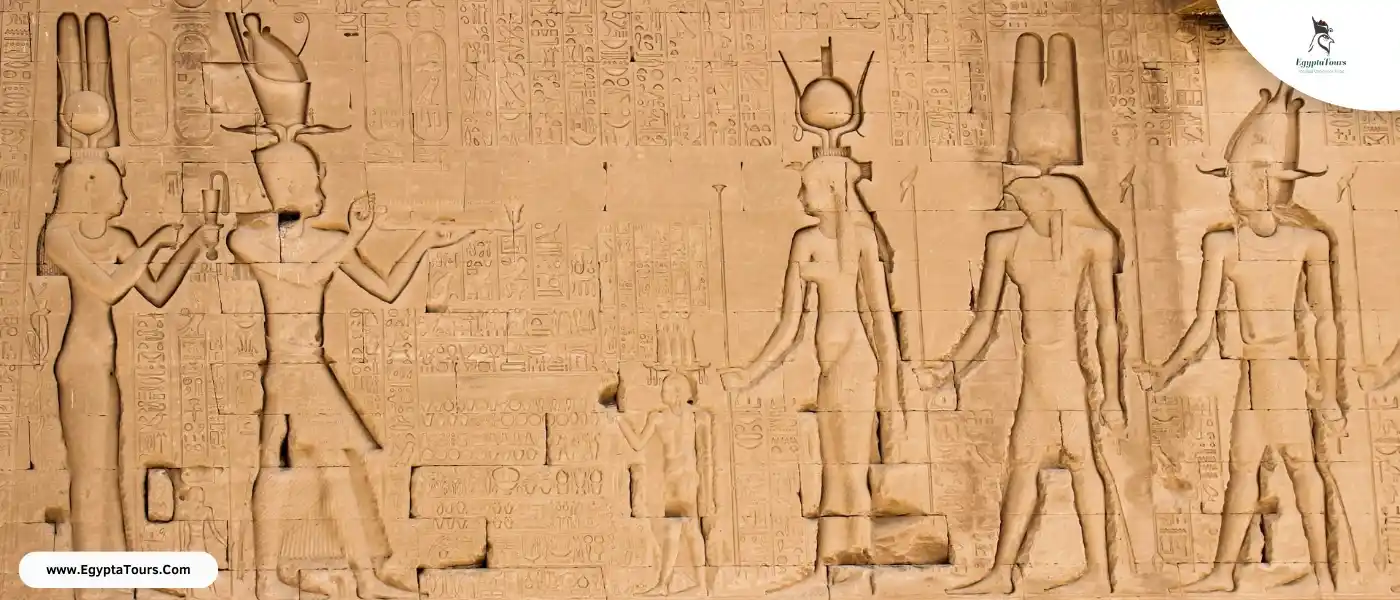
How-was-the-worship-of-Hathor-reflected-in-temples-EgyptaTours
The widespread popular worship of Hathor was manifested in the construction of lavish temples that highlight her multiple images and roles, as she is the goddess of love, beauty, the sky, motherhood and music.
This appears astonishingly in architectural and artistic form in the temple of Dendera which is located there, possessing an attractive and innovative design.
Its famous columns with unique Hathoric capitals appear large and bear a capital that is carved with skill in the shape of the head of the goddess Hathor with her distinctive face.
The wall paintings and inscriptions on the temple walls showed some of Hathor’s religious festivals, such as the music and dance festival that was held for her, or scenes of her assisting the dead in the afterlife.
Small shrines belonging to her were also discovered in some other major temples.
You can also see her artistic and architectural influence in the decoration of columns and walls with drawings that highlight her cow-like face.
Some important drawings appear for her in the temple of Horus at Edfu, her husband in some traditions.
Gods and deities are numerous in the rich ancient Egyptian civilization which prominently included the goddess Hathor who had widespread popularity.
She was symbolized by the celestial cow or depicted as a beautiful and elegant woman who carried horns above her head with the sun disk between them.
This composite image indicates beauty, motherhood and power. She was rightly given the title goddess of the sky, in addition to many other titles.
Hathor had many different roles and qualities in ancient Egyptian religion. Some of them seemed opposite, but they all fit together. She was not a minor goddess; she was the most important goddess for the early Egyptians. She was involved in everyone’s life, from birth to the afterlife.
The ancient Egyptians believed the sky was like a big body of water and where their gods came from. Hathor, as the mythical mother of the world and some gods, was called the lady of the sky or the lady of the stars.
She was shown as a heavenly cow in this form. As a cow, she gave birth to the sun and placed it in her horns each day. Hathor being a sky goddess is also shown in her name.
When it comes to Hathor, Horus, and Ra, it is not always clear who was born from whom. Hathor was the female partner of sun gods like Horus and Ra. In some stories, she is the wife of Ra and the mother of Horus the Elder. In other stories, she is the daughter of Ra and the wife of Horus.
Hathor was one of the goddesses called the Eye of Ra. This role was linked to her being a mother goddess. Every day, Ra was said to enter Hathor, and she gave birth to the sun at dawn. The sun also had a female form, the eye goddess, which was another form of Hathor.
This eye goddess would then give birth to Ra as her son again. It sounds confusing, but it is meant to show the Egyptians’ idea of the endless cycle of life, death, and rebirth.
As the Eye of Ra, Hathor could punish people for Ra. This is why she was called the Distant Goddess, because she sometimes traveled far from Ra. If she became wild and angry, Ra would bring her back to her kind and gentle form. These two sides of Hathor showed the Egyptian idea of a woman, who could be very loving but also very fierce.
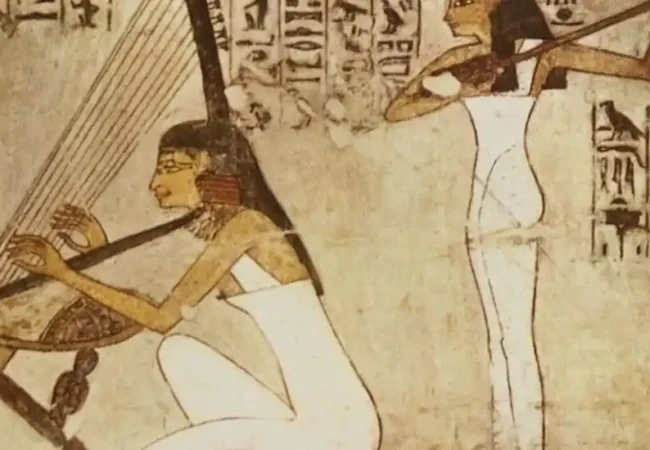
The Egyptians, like many other old religions, respected music and dance a lot. Their festivals included eating, drinking, music, and dancing. People believed these were gifts from the gods. Hathor was linked to music, dance, incense, parties with drinking, and flower decorations. Her names and the way people worshiped her showed this. Temple carvings of Hathor show musicians playing many instruments, like lyres, harps, tambourines, and the special sistra.
Hathor’s connection to drinking and partying comes from the Eye of Ra stories. When she got angry, beer was used to calm her down. Because of this, music, drinks, and other human activities were considered important to her. The red Nile waters, colored by silt, were compared to wine.
Hathor, as a mother and creator, was also the goddess of love, beauty, and sexuality. Egyptian myths say the world began with the god Atum, who created life using his hand. This hand is seen as the female side of creation and can be represented by Hathor. Because of this, one of her titles is the Hand of God. The Egyptians were very imaginative in their ideas.
Hathor, together with Ra, was also seen as the wife of other gods like Horus, Amun, Montu, and Shu. In the story The Tale of the Herdsmen, she appears both as a hairy, animal-like goddess and as a beautiful naked woman. Hathor was said to have lovely hair, which was a sign of her beauty and sexual attraction.
Hathor was the godly mother of Horus and a divine example for Egyptian queens. The myth of Isis and Osiris says Horus was their son. But Hathor was linked to Horus as his mother long before that. Even after Isis became known as his mother, Hathor was still shown feeding the baby Horus. The goddess’s milk symbolized royalty, showing that Horus had the right to be king.
The Egyptians worshiped godly families, usually made of a father, mother, and young son. In Dendera Temple, the family is made of the grown Horus of Edfu, Hathor, and their child Ify. At Kom Ombo Temple, Hathor in a local form was also worshiped as the mother of Horus’ son.
One lasting symbol of Hathor is the sycamore tree because it produces milky sap. This milk came to represent fertility and led to many of Hathor’s titles. Hathor is seen as the mythological mother of all people because she helped create humanity.
The goddess was also linked to Shai, the idea of fate in ancient Egypt. In the New Kingdom, she appears in two stories, The Tale of the Doomed Prince and The Tale of the Two Brothers, where she shows up at the birth of important characters to predict how they would die.
The Egyptians thought that no one could avoid their fate. It was fixed and could not be changed. But in The Tale of the Doomed Prince, the prince avoids the violent death that Hathor predicted for him. The story is not finished, but it suggests that the gods might help someone escape their fate if they want to.
She was the goddess of the sky and was connected to the stars, so she also looked after trade and foreign goods. The ancient Egyptians, like other early civilizations, used the stars and the sun to guide them. Hathor helped guide their way and kept their boats safe on trips to Nubia or other distant places. Because she traveled widely as the Eye of Ra, these lands were familiar to her.
Egypt had strong trade connections with many countries, including the coastal cities of the Middle East. It’s no surprise that the worship of Hathor spread beyond Egypt. Evidence of Hathor worship has been found in places like Syria and Lebanon. The Egyptians also started to connect local gods from these regions with Hathor.
The divine mother was not limited by the line between life and death. She could enter Duat, the land of the dead, just as easily as she could travel to other places. Many tomb writings from the Old Kingdom mention her. The Egyptians believed she could guide a soul into Duat and help it move into the afterlife.
She was sometimes linked to Imentet, the goddess of the west who represented the land of the dead. The Theban Necropolis was often shown as a mountain with a cow emerging from it.
In New Kingdom texts, the Egyptian afterlife is shown as a rich and beautiful garden. Hathor, as a tree goddess, was believed to give the dead fresh air, food, and water. Because of this, she became a symbol of a calm and happy afterlife.
Step inside the majestic Temple of Dendera and experience history in person
In reality, Hathor was an embodiment of duality and complexity, strikingly combining good and evil.
On the good side, she was like a gentle and nurturing mother who cared for Horus, son of Isis and she provided help and comfort to the dead in their tombs.
On the side of evil and anger, she appeared terrifyingly in the myth of the destruction of mankind when she was an instrument of punishment, protecting the god Ra in his battles and destroying his enemies.
No, it is not mentioned in the known myths that they had a child. They were ultimately gods worshipped and revered by the ancient Egyptians, not biological human beings who reproduce.
If Hathor removed her sacred bracelet, this indicated in some mythological traditions her immediate transformation from the form of a beautiful woman characterized by love and giving to the other, more powerful and fierce aspect which is “the lioness goddess Sekhmet.”
She was considered a goddess of immense power.
She fiercely defended her father, the god Ra, when he wrestled with the evil serpent Apophis and she also protected and defended her adopted son, the god Horus, when he wrestled with his powerful uncle, the god Set.

Explore our top-rated Egypt travel packages and embark on an unforgettable journey. From the Pyramids of Cairo to the magical temples of Luxor, Aswan, and Abu Simbel, discover expertly curated tours designed for your perfect Egyptian adventure