The Ancient Egypt Social Pyramid: A Complete Guide
📋 Summary & Quick Facts
The ancient Egypt social pyramid was much more than a simple class system; it was a divinely ordained structure designed to maintain cosmic balance (Ma’at) and manage the vast resources of the Nile River. At the absolute apex was the pharaoh, worshipped as a living god, who was supported by a highly organized administration of viziers, regional governors (nomarchs), priests, and nobles.
The middle tier consisted of skilled scribes, soldiers, craftsmen, and merchants who drove the nation’s economy, trade, and military expansion. The broad base of the pyramid was made up of farmers, laborers, and slaves whose tireless daily work produced the food and built the monumental architecture that sustained the civilization. Together, this rigid but incredibly effective hierarchy ensured Egypt’s prosperity and stability for over three millennia.
Key Takeaways
-
-
Divine Justification (The Power of Ma’at): The hierarchy was not just political; it was deeply religious. The concept of Ma’at (truth, justice, and cosmic order) meant that every individual, from the pharaoh to the humblest peasant, believed their specific role was essential to keep the universe from falling into chaos.
-
The Nile River as an Economic Engine: The predictable flooding of the Nile created massive agricultural surpluses. This abundance is what allowed society to specialize—freeing up parts of the population to become scribes, priests, and the builders of the pyramids.
-
Limited but Possible Social Mobility: While the social egyptian pyramid was largely rigid and class status was typically inherited at birth, it wasn’t completely locked. Exceptionally talented individuals—particularly literate scribes and decorated soldiers—could climb the social ladder and earn royal favor.
-
The Backbone of Bureaucracy: The pharaoh held absolute power, but the civilization survived on its bureaucracy. The system relied heavily on the Vizier (the king’s second-in-command and chief architect) and the Nomarchs (provincial governors) to manage taxes, justice, and local administration across the vast empire.
-
Temples as Economic Hubs: High-ranking priests and nobles did more than conduct rituals; they managed the temples, which functioned as massive economic centers that controlled land, grain distribution, and wealth.
-
The ancient egypt social pyramid consisted of a clearly and consistently arranged set of classes. This strict system relied on the precise organization of each individual according to their function and role within society.
The pharaoh occupied the very top of the hierarchy, with classes gradually descending to the workers and slaves at the broad base. This arrangement maintained order within the state and was directly linked to deep religious beliefs.
The ancient Egyptian social pyramid was based on a strict hierarchy emphasizing roles related to religion governance, and geography to maintain societal harmony. The pharaoh viewed as a living god led the social pyramid while strict class roles supported societal stability and resource management.
Religious principles such as Ma’at guided societal order and promoted justice balance, and unity influencing personal morality and state administration.
The Social Pyramid in Ancient Egypt
The ancient Egyptian social pyramid was a practical and ideological system designed to ensure societal stability and efficient resource management. This hierarchy rooted in divine authority was considered the natural order of life authorized by the Egyptian gods.
At the apex of this structure was the pharaoh believed to be a living god, and under his leadership each class played a specialized role in administration religion, or labor.
Unlike modern societies which offer opportunities for social mobility the social pyramid in Nile Valley Egypt was relatively fixed for most of its history.
Position was often inherited at birth in keeping with the belief that this structure reflected the cosmic order. However certain professions such as scribes or soldiers allowed for upward mobility through skill dedication, and the favor of the king.
This strict but functional system was vital in maintaining Egypt’s dominance over the centuries. Within the ancient Egyptian social pyramid the Nile Valley was uniquely organized to exploit the region’s resources.
The predictable flooding of the Nile also led to surplus crops enabling the growth of specialized professions and massive construction projects. Temples served as both spiritual and economic centers where governance blended with religious practices.
The shape of the ancient Egyptian social pyramid
The ancient Egyptian social pyramid was one of the most complex and enduring systems in human history supporting a civilization that flourished for over three thousand years. Ancient Egyptian society was centered around the fertile Nile Valley.
This stratified society served as a well-organized engine with each level of its hierarchy contributing to the collective prosperity of ancient Egypt.
The Amazing Rise of Ancient Egyptian Society and the Gods
Human habitation in the Egyptian desert dates back to around 8000 BC. Migration toward the Nile Valley led to the establishment of agricultural communities in the Fayum region by around 5200 BC. Pottery from around 5500 BC also reflects early settlement although the first settlement in Fayum dates back to around 7200 BC.
Fayum was a fertile and resource-rich region until around 4000 BC when drought forced its inhabitants to migrate toward the Nile Valley.
This movement marked the beginning of the formation of early Egyptian societies during the Predynastic Period (c. 6000–3150 BC), laying the foundations for future cities along the Nile.
To protect themselves from environmental challenges wild animals, and rival tribes people organized themselves into tribes relying heavily on their personal gods for protection. Their belief systems also evolved to explain natural forces they could not understand such as storms and drought.
These beliefs manifested themselves in three main forms:
- Animism: The idea that objects, plants animals, and the earth possess spirits.
- Fetishism: The belief in the supernatural power of objects such as the djed and the ankh.
- Totemism: The spiritual relationships between clans and specific ancient Egyptian animals, plants, or symbols.
Ma’at and the Social Order for a Balanced Society
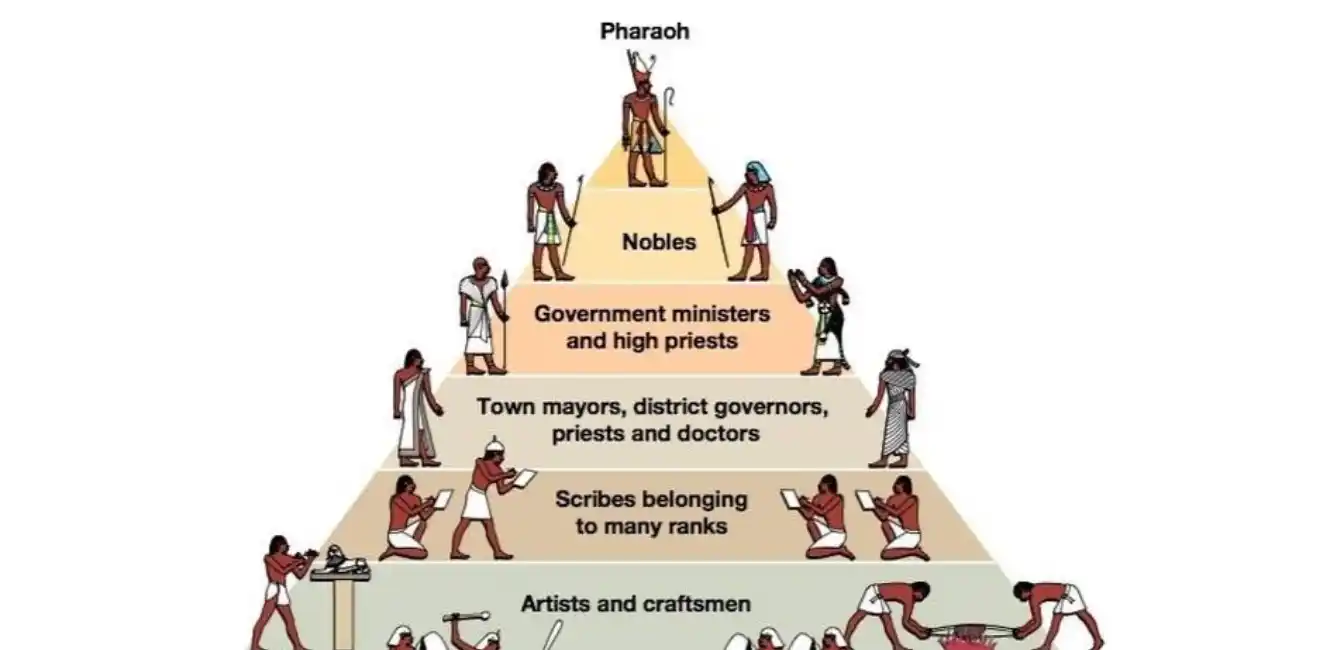
The-Social-Order-for-a-Balanced-Society-Ancient-Egyptian-Social-Pyramid-EgyptaTours
The principles of Ma’at were the foundation of the ancient Egyptian social hierarchy symbolizing truth, balance, and justice as the guiding force of the universe and society. Ma’at was established by the gods at creation. Ma’at governed all aspects of life, from personal morality to state administration ensuring universal harmony and stability.
The pharaoh was viewed as the living embodiment of Ma’at upholding its principles by ensuring justice securing borders overseeing laws, and regulating natural cycles such as the Nile floods.
Egypt’s social hierarchy along the Nile reflected this divine order with each class performing a specific role. Priests maintained rituals nobles managed resources scribes ensured accounting, and farmers and workers sustained the economy.
Ma’at also shaped personal behavior with individuals being judged in the afterlife based on their adherence to its principles.
This collective harmony fostered unity and purpose although deviations from Ma’at such as corruption or injustice led to societal unrest and weakened ruling dynasties. Ma’at’s influence extended beyond Egypt’s borders influencing diplomacy and trade contributing to the stability and success of the civilization over thousands of years as a harmonious and enduring society.
Social Classes in Ancient Egypt
Social-Classes-in-Ancient-Egypt-Ancient-Egyptian-Social-Pyramid-EgyptaTours
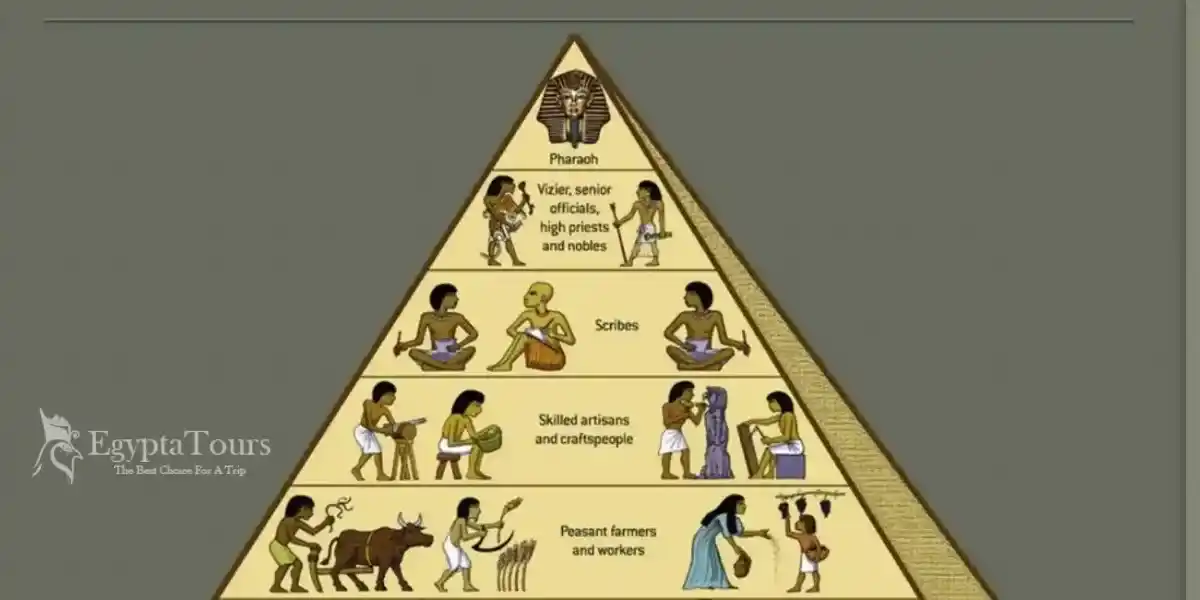
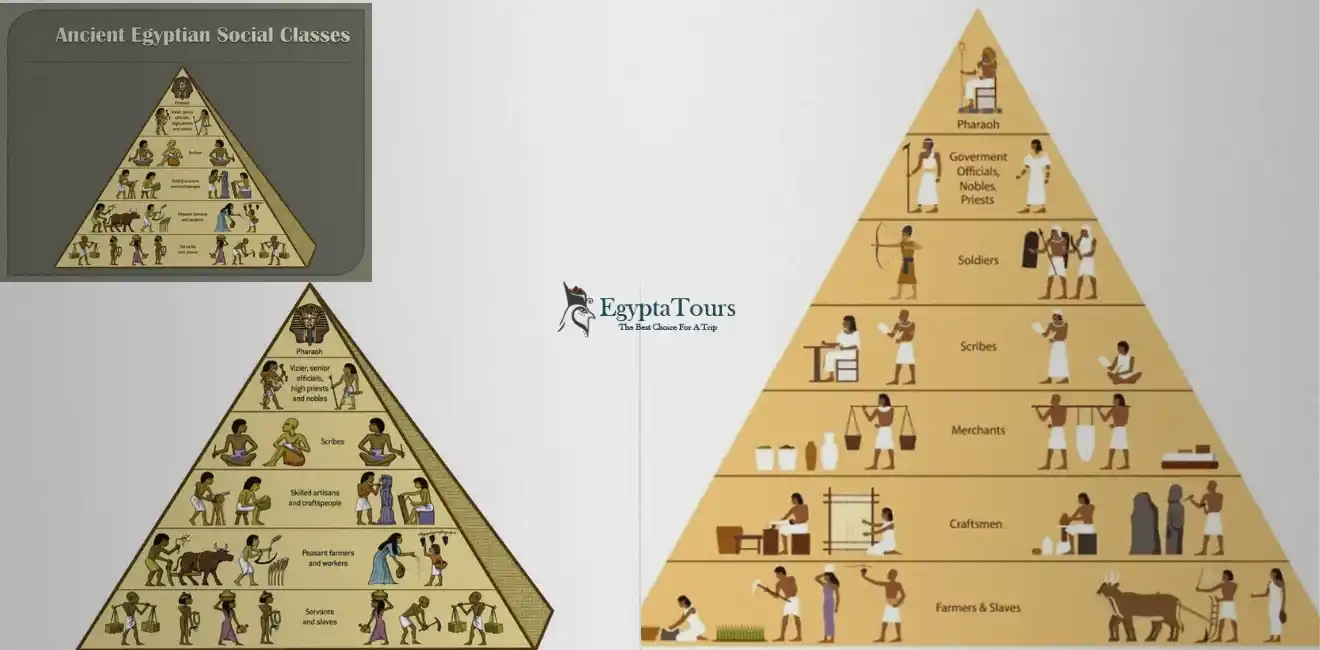
The ancient Egyptian social pyramid was clearly defined similar to a pyramid of power and population distribution. At the top were the pharaoh and his court while the broad base consisted of the workers and farmers whose labor sustained the civilization.
This pyramid consisted of the following levels:
Levels of the Ancient Egypt Social Pyramid
Unlike modern societies, social mobility was rare, and positions were often inherited at birth. However, skilled professions like scribes or soldiers occasionally allowed for upward mobility through dedication and royal favor.
1. The Divine Ruler (Pharaoh)
Occupying absolute power, pharaohs were considered living gods acting as intermediaries between the human and divine worlds.
-
Djoser (c. 2670 BC): Commissioned the Step Pyramid of Saqqara, history’s first monumental stone structure.
-
Ramesses II (c. 1279–1213 BC): Left an indelible mark through military victories like the Battle of Kadesh and architectural marvels like Abu Simbel.
2. The Vizier
Established during the Early Period (c. 3150–2613 BC), the vizier was the second most powerful person in Egypt. They oversaw all government aspects, from public works to judicial affairs.
-
Imhotep: Serving under Djoser, he was a prominent vizier, brilliant architect, and scholar credited with designing the Saqqara pyramid.
3. Nomarchs (Regional Governors)
By the Old Kingdom (c. 2613–2181 BC), officials known as Nomarchs administered Egypt’s provinces (“nomes”). They wielded considerable power over local administration and tax collection. However, excessive independence among Nomarchs sometimes led to the disintegration of the central government during periods of pharaonic weakness.
4. Scribes, Priests, and Nobles
-
Priests: Maintained crucial religious rituals and managed temples, which served as economic centers.
-
Nobles: Managed resources and large estates.
-
Scribes: Ensured meticulous accounting and record-keeping.
5. Farmers, Workers, and Slaves
Forming the massive base of the pyramid, these individuals performed the essential labor that sustained the economy and built the civilization’s enduring monuments.
FAQS
What was the basis of social thought in ancient civilizations?
Social thought focused heavily on strict class systems and religion, precisely defining an individual’s role according to their societal function and status.
How did the ancient Egypt social pyramid function?
It was rooted in the principle of Ma’at, which linked cosmic justice to a fixed societal hierarchy. Every individual had a specific role that served the state and religion to ensure universal harmony.
What was the exact structure of the social Egyptian pyramid?
The system was strictly hierarchical. It began with the pharaoh at the apex, followed by the vizier, nomarchs, priests, nobles, and scribes, and gradually descended to the vast population of workers, peasants, and slaves at the bottom.
Similar Posts
About EgyptaTours

EgyptaTours is a name synonymous with trust, excellence, and unforgettable travel experiences, proudly standing as one of the leading travel agencies in Egypt. Renowned for its deep expertise, personalized service, and carefully crafted itineraries, EgyptaTours serves as the ultimate gateway to discovering Egypt in its most authentic and inspiring form.