





Qaitbay Citadel: Alexandria’s Iconic Coastal Fortress
The Qaitbay Citadel, which was built in response to this attack, is now a popular tourist attraction in Alexandria. It is a reminder of both the city’s rich history and its determination to overcome adversity. If you’re visiting Alexandria, make sure to add the Qaitbay Citadel to your list of things to see.
Imagine if one day you woke up to find that your city had been invaded by an unknown force. This is exactly what happened to the people of Alexandria in 1480, when the city was attacked and taken over by the Mamluks.
Geographical Location of The Citadel of Qaitbay
The Citadel of Qaitbay is located at the western end of Alexandria. This location was very important because it helped protect the city from attacks especially from the Crusaders, starting in the 15th century.
One special thing about the citadel is that it was built using stones from the ruins of the ancient lighthouse. This lighthouse was built in the 3rd century AD and was one of the Seven Wonders of the Ancient World.
The lighthouse was badly damaged by a strong earthquake in Egypt in 1303, during the rule of the Mamluk Sultan Qalaun.
Visiting the Citadel of Qaitbay is highly recommended for tourists who come to Alexandria. Many tours to Egypt include a half day or full day trip to Alexandria with a visit to the citadel.
The citadel can be reached from Corniche Street by going west. It is located at the end of Corniche Street.
History of the Qaitbay Citadel

History-of-the-Qaitbay-Citadel-EgyptaTours
The Qaitbay Citadel is an ancient structure that sits on a small island in the Mediterranean Sea, just off the coast of Alexandria, Egypt. The fortress was originally built in the late 15th century by Sultan Al-Ashraf Qaitbay, who ruled over Egypt and Syria from 1468 to 1496.
The Citadel was constructed as a replacement for the earlier medieval fortifications of Alexandria, which had been destroyed by the Ottomans in 1489. Qaitbay chose the site for the Citadel because of its strategic location – it controlled the entrance to Alexandria’s harbor and was well-protected against naval attacks.
The Citadel was extensively renovated and expanded in the 19th century By <strong>Mohammed Ali</strong> Pasha, Egypt’s first modern ruler. Today, it is a popular tourist attraction and is considered a UNESCO World Heritage Site.
Description and Design of Citadel

Design-of- the-Qaitbay-Citadel-EgyptaTours
Inside the citadel, there are inner and outer walls. The inner walls are lower in height and include rooms for soldiers and places to store weapons.
The outer walls are made of four strong defensive walls that protect the citadel from attacks.
The eastern side of the outer walls faces the Mediterranean Sea. It is about two meters wide and eight meters high.
The western side is the widest part of the walls and has three round towers. This part is the oldest section of the citadel.
The northern side of the citadel faces the Eastern Harbor of Alexandria and is divided into two parts. The lower part is a covered corridor with several rooms that were used for military purposes during attacks.
The upper part is a narrow walkway with small openings, where soldiers stood to defend the citadel.
The inner walls were built from strong stone and almost completely surround the main tower, except on the northern side.
The Main Tower of the Citadel
The main tower is the biggest and strongest building in the complex. It is square in shape. It is 30 meters tall and 17 meters wide on each side.
The tower has three floors. At each corner, there is a round tower. Small windows are placed in different areas so archers could shoot arrows to defend the building during an attack.
The First Floor of The Qaitbay Citadel
On the first floor of the citadel, there is a mosque built in the Mamluk style.The mosque has four small iwans (or galleries) and an open courtyard in the center with a marble floor.
It also has a nicely decorated mihrab. However, the mihrab does not face Mecca because the architect focused more on military needs than religious direction.The mosque once had a minaret, but it was lost over time.
The Second Floor of Qaitbay Citadel
The second floor of the citadel has many corridors, many small rooms, and a few large rooms that were used for different activities.
Because the Citadel of Qaitbay is very important in Egypt, many kings and rulers took care of it throughout history.
One of the first rulers to make changes to the fortress was Sultan El Ghory, the last Mamluk ruler of the Burji dynasty (1501–1516).
He repaired some parts of the citadel, added weapons and soldiers, and fixed areas that were damaged.
Surroundings and Architecture

Surroundings-and-Architecture-of- the-Qaitbay-Citadel-EgyptaTours
The Qaitbay Citadel is located on the eastern side of Alexandria, overlooking the Mediterranean Sea. It’s a very picturesque spot, and it’s no wonder that it’s a popular tourist destination.
Built in the late 15th century, the Qaitbay Citadel is an impressive sight. It’s made up of a series of fortifications that include a wall, a moat and several towers. The walls are made from a mix of limestone and sandstone, and they’re decorated with Islamic designs.
The citadel is also home to some beautiful architecture. The entrance gate is particularly impressive, as is the hall with its marble floor and domed ceiling.
Constructors and Inhabitants
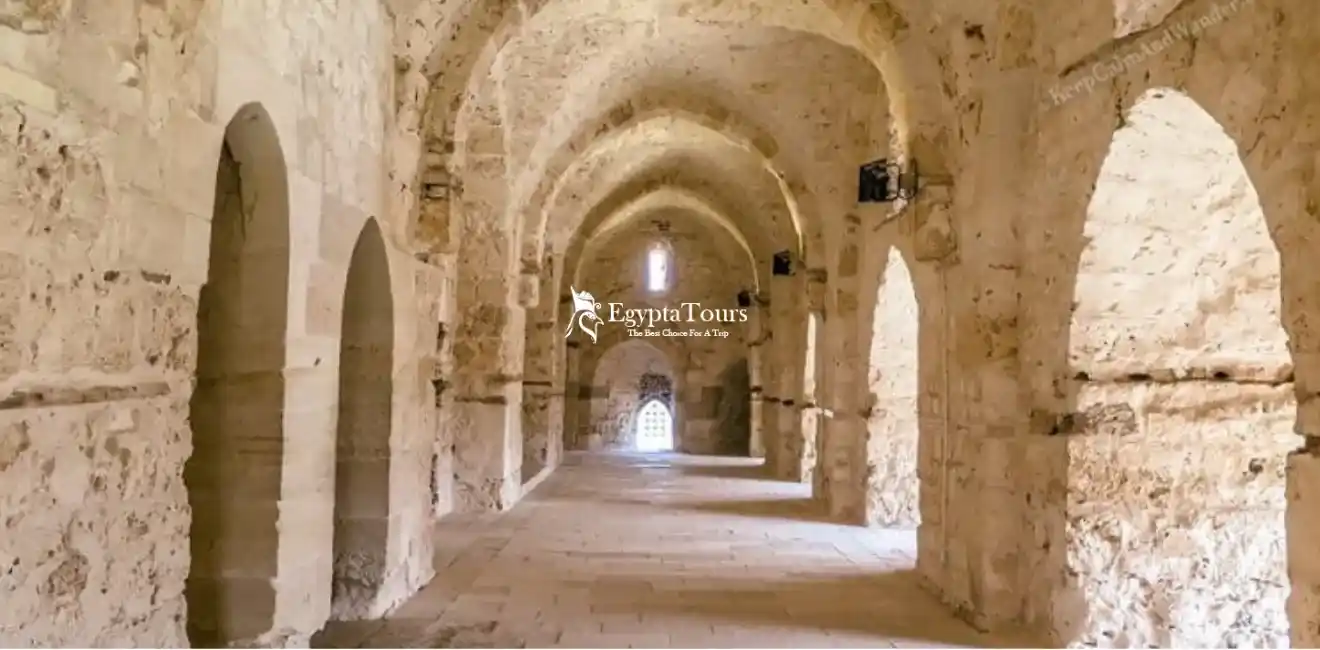
Constructors-and-Inhabitants-of- the-Qaitbay-Citadel-EgyptaTours
The citadel is named after Sultan Qaitbay who oversaw the renovations of the project in the 15th century. It was built on top of an ancient lighthouse (also known as Pharos Lighthouse) believed to have been constructed in the 3rd century BC by Ptolemy II.
The materials used to construct this fortress were mainly limestone and granite, and it was built to be a stronghold against naval invasions. It has a central keep, which is the location of what was once a royal palace, and several corridors and chambers connected to it.
During its heyday, it was home to various Egyptian pharaohs and their families, including Queen Cleopatra VII who used it as her summer palace. As such, many historical artifacts have been found here such as coins bearing Cleopatra’s face, as well as statues of gods such as Isis and Osiris.
Unique Features and Artifacts

Unique-Features-and-Artifacts-of- the-Qaitbay-Citadel-EgyptaTours
The Qaitbay Citadel is full of unique features and artifacts which make the experience even more interesting. At the entrance, you’ll find an old wooden door with carvings on it. This door dates back to the Ottoman period, and was initially used to protect inhabitants from potential attacks. Further inside, you’ll find statues of prominent figures from Ancient Egypt, a well made of marble, and a mosque with intricate archways and a beautifully tiled ceiling.
One of the most intriguing artifacts at the Citadel is the stone carving of a man wearing a headdress of feathers, once believed to be King Amenhotep III. The carving is thought to date back more than 3,000 years! There’s also a cannon made of bronze at the top of the castle walls, which was used centuries ago for defensive purposes.
If you’re looking for an incredible cultural experience full of surprises and plenty to learn about, then be sure to check out the Qaitbay Citadel when visiting Alexandria!
The Military History of Qaitbay Citadel
Sultan Qaitbay tried to protect Alexandria from Ottoman attacks, but his military plans were not strong enough. Sultan Qansoh El-Ghoury expected the Ottoman invasion and greatly increased the number of soldiers in the citadel, adding better and more modern weapons. The fortress was also used as a prison for his political enemies.
In 1517, the Ottomans took control of Egypt and continued to use the citadel for military purposes. They placed soldiers, cannons, and support workers there, such as drummers, trumpeters, builders, and carpenters.
The citadel became weaker as the Ottoman army lost its strength. In 1798, Napoleon’s army captured the fortress easily because the soldiers there were not well prepared and the French had better weapons. Inside the citadel, French soldiers discovered old Crusader weapons from the time of Louis IX.
After that, the citadel slowly lost its military importance. However, in the early 19th century, Muhammad Ali Pasha repaired the walls and added new, modern weapons.
The Restoration and Transformation of Qaitbay Citadel
British naval forces attacked Alexandria on July 11, 1882, causing great damage to the citadel. The attack badly damaged the building. Cannon fire completely destroyed the western side and heavily damaged the northern side. The ruins were left as they were for about 25 years before repair work started.
Qaitbay Citadel was left empty for more than twenty years after it was badly damaged by the British attack in 1882. In 1904, the Ministry of Defense began the first major repair work, focusing on the upper floors. This was the beginning of the citadel’s change from a military fort to a historical monument.
King Farouk ordered fast repairs between 1940 and 1941. He wanted to use the old fortress as a royal rest place. The repairs kept most of the citadel’s original style, while making the inside suitable for modern use.
The Committee for the Preservation of Islamic Monuments was responsible for this work. They depended on studies done by French experts during the period of occupation. These early restoration efforts helped save the building from collapsing after many years of neglect.
After Egypt’s 1952 revolution, the role of the citadel changed completely. In the same year, the Egyptian Navy turned the historic building into a Maritime Museum. This change helped protect the citadel and made it an educational place for visitors who want to learn about Alexandria’s naval history.
The Important Role of Qaitbay Citadel
The Qaitbay Citadel has played an important role in Alexandria’s history. It was strategically built to protect the city from sea invasion and to act as a lookout for pirates or any other potential enemy ships.
Aside from its defensive purposes, the Citadel also served as a harbor during the Mediterranean Crusades as it was able to house and protect numerous ships. It was also used as a trading post during this time, allowing goods from all over the world to enter Alexandria. This made it one of the most important ports in the area that connected Europe and Africa.
Additionally, it has served as a military barracks for members of the military throughout its history, and there have been numerous sightings of artifacts within its walls, making it an invaluable cultural treasure of Egypt.
What is The Best Time to Visit the Citadel of Qaitbay
There is no single best time to visit the Citadel of Qaitbay because it depends on what you want to do and see.
However, some general points can help you choose the right time to visit.
The weather is one of the most important factors. The Citadel is in Egypt near the Mediterranean Sea, so the weather is usually mild during the year, except in summer when it becomes very hot.
The best time to visit the Citadel for sightseeing and archaeology is during spring or autumn when the weather is cooler.
Another thing to think about is your activities at the Citadel. Since it is an outdoor site, visiting in summer can be uncomfortable because of the heat.
If you want to enjoy activities like the Sound and Light Show, the best time to visit is during the high season, from April to September, when these events are usually available.
In general, the best time to visit the Citadel of Qaitbay depends on the weather and the activities you want to enjoy.
How do I get to Alexandria and the Citadel of Qaitbay?
To get to the Citadel of Qaitbay, follow these simple steps: First, travel to Alexandria. If you are coming from Cairo, the easiest way is by car using the coastal road. The trip usually takes about two hours.
When you arrive in Alexandria, follow the road signs to Qaitbay Citadel. It is on the eastern side of the city near the harbor.
There is a parking area close to the entrance, so finding a place to park is easy.
After parking, walk to the citadel entrance. The walk takes about 10 minutes.
Entry Guidelines and Timings:
When planning your visit, make sure to check the entry guidelines and timings. Entry is open to all visitors, but you need to remember that the Citadel is a historical site, so it’s important to be respectful.
Transportation options:
If you are traveling from Cairo, you can also take a train to Alexandria. The trip takes around two hours and is affordable. From the train station, you can take a taxi or a bus to reach the Citadel.
If you are coming from another city in Egypt, taking a bus is a good option. Many bus companies operate across the country with different times and prices, so it is best to check in advance and choose what suits you.
Best Tours To Qaitbay Citadel
The Qaitbay Citadel of Alexandria is open seven days a week from 8 am till 7 pm. Tickets cost 10 Egyptian pounds, and must be purchased in advance. It’s also worth noting that the Citadel can get very crowded during peak season, so make sure to arrive early if you want to avoid long lines.
Lastly, don’t forget to dress appropriately – this means covering your shoulders and knees out of respect for the site. As long as you follow these simple guidelines, you should have no problems enjoying all that this incredible historical landmark has to offer!
| Alexandria Tour Name | View Tour |
|---|---|
| 1 Day Tour to Alexandria | View Tour |
| Alexandria 4 Days Trip from Cairo | View Tour |
| Alexandria Highlights Tour | View Tour |
| Alexandria Historical Sites Tour | View Tour |
| Alexandria Shore Excursion | View Tour |
| Alexandria City Tour & Library of Alexandria | View Tour |
| Alexandria Cultural Day Tour | View Tour |
Other Attractions Near the Citadel

Other-Attractions-Near-the-Qaitbay-Citadel-EgyptaTours
If a visit to the Citadel is not enough for you, there are plenty of other attractions located nearby. You’ll be able to see some of the most beautiful ancient sites in the world, including The Catacombs of Kom el-Shoqafa, the Roman Amphitheater and the Serapium.
The Catacombs are a network of ancient tombs, featuring unique designs and sculptures, making them one of the most interesting places to visit in Alexandria. The Roman Amphitheater dates back to the 3rd century and is still used today for cultural events. Lastly, there is the Serapium which was originally used as a temple dedicated to Osiris, but now serves as an archeological site.
No matter where you go in Alexandria you are sure to be captivated by its breathtaking monuments and rich history. With so many historical landmarks near one another, you can plan an amazing day at this magical city!
Conclusion
The Qaitbay Citadel is a beautiful and ancient landmark located in Alexandria, Egypt. It is well worth a visit if you are in the area!
Discovering the Qaitbay Citadel: FAQ
What is the Qaitbay Citadel?
The Qaitbay Citadel is a 15th-century fortress located on the Mediterranean coast in Alexandria, Egypt. Built by Sultan Al-Ashraf Sayf al-Din Qa’it Bay, it served as a defense against invading forces.
Where is the Qaitbay Citadel situated?
It’s located on the eastern side of the northern tip of Pharos Island in Alexandria. The location is significant as it stands on the exact site of the famous Lighthouse of Alexandria.
What are the visiting hours?
The citadel is open from 8:00 AM to 5:00 PM daily, but hours may vary during holidays. Always check ahead for any changes.
How much is the entrance fee?
The entrance fee for foreigners is approximately 60 EGP, with discounts available for students. Egyptian citizens pay a lower fee, around 10 EGP.
Can you explore the whole citadel?
Yes, visitors can explore most areas, including the towers and the main courtyard. Some sections might be restricted for restoration work.
Is there a guided tour available?
Yes, guided tours are available for an extra fee. They provide detailed historical insights and ensure you don’t miss any key features.
Are there any nearby attractions?
Yes, the citadel is close to the Alexandria Aquarium and several historic mosques. The Corniche promenade is also a popular spot nearby.
What’s the best way to get there?
The citadel is accessible by taxi, bus, or walking from central Alexandria. It’s always a good idea to arrange transportation beforehand during peak tourist seasons.
Is it suitable for children?
The citadel can be a fun educational experience for kids. However, be cautious around steep stairs and narrow passages.
What should I bring?
Comfortable walking shoes, a hat, sunscreen, and water are recommended. A camera is a must to capture the stunning views.
Is photography allowed inside?
Yes, photography is allowed, but tripods and professional gear might require special permission. Always check the current rules before your visit.
About EgyptaTours

EgyptaTours is a name synonymous with trust, excellence, and unforgettable travel experiences, proudly standing as one of the leading travel agencies in Egypt. Renowned for its deep expertise, personalized service, and carefully crafted itineraries, EgyptaTours serves as the ultimate gateway to discovering Egypt in its most authentic and inspiring form.