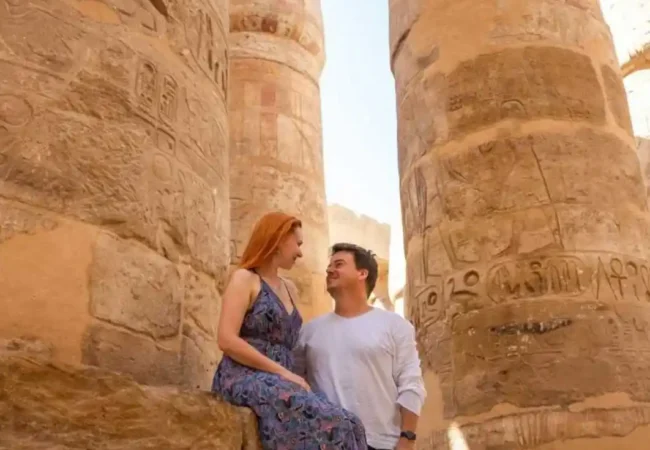







Queen Tiye: Powerful Woman of ancient Egypt
Queen Tiye (c. 1398 BC – 1338 BC, as well spelled Tye, Taia, Tiy and Tiyi) was the Major Royal Wife of the Egyptian pharaoh Amenhotep III and Tiye, mum of pharaoh Akhenaten and grandma of pharaoh Tutankhamun; her parents were Yuya and Thuya. In 2010, DNA analysis assured her as the mummy familier as “The Elder Lady” found in 1898 in the tomb of king Amenhotep II .
Tiye was become a queen of Egypt of the 18th dynasty. She do a massive influence at the courts of both her husband and son and is known to have communicated immediately with governor of foreign nations.
The Amarna letters also offer that she was highly respected by these rulers, particularly during the reign of her son. Although she supposes in the traditional polytheistic religion of Egypt, she confirming Akhenaten’s monotheistic repairs, most likely because she recognized them as important political stratagems to raise the power of the throne at the expense of the priesthood of Amun.
Queen Tiye died in her early sixties and was buried in the Valley of the Kings. Her mummy has positively been specified as that known as the ‘Elder Lady’, and a conformation of her hair, maybe a keepsake of the young king’s, was found in Tutankhamun’s tomb.
Queen Tiye was born in Akhmin in Upper Egypt, her family has significant religious and political influence. Her father Yuya was a highly respected figure in society. He had extensive lands and served as a priest, he was supervisor of sacred bulls and commander of chariots. Her mother Tuya had important and famous religious titles including Singer of Hathor and Chief of Amun’s Entertainers, that show her royal lineage.
Queen Tiye had a brother named “Anen” who was a priest of Amun. She married Amenhotep III and had children including Princess Satamun, Princess Iset, Princess Henutta Neb, Princess Nebetah and Prince Thutmose who died when he was young. She also was the mother of Smenkhkare and “Akhenaten” who was one of Egypt’s most famous pharaohs. Tiye played an important role in his upbringing and education.

Who-Was-Queen-Tiye-EgyptaTours
When taking any touring to Egypt you will discover a lot about the ancient Egyptian history and the position of women in the ancient Egyptian history. Women in ancient Egypt were actually ahead of their time – they could judge the country and they had many of the same basic rights as men. This is various than other ancient cultures, like the society of Ancient Greece where women were counted to be statutory minors without the same rights as men.
There were numerous powerful women who ruled in Ancient Egypt and took on quite important part in the history of the country. Here are a few of the women who made an influence you are sure to hear a lot about these historical numbers on your Egypt guided tour. There are many powerful women in ancient Egypt like Queen Hatshepsut, Tiye, Queen Cleopatra, Queen Nefertari and there also much more influenced Queens.
Queen Hatshepsut
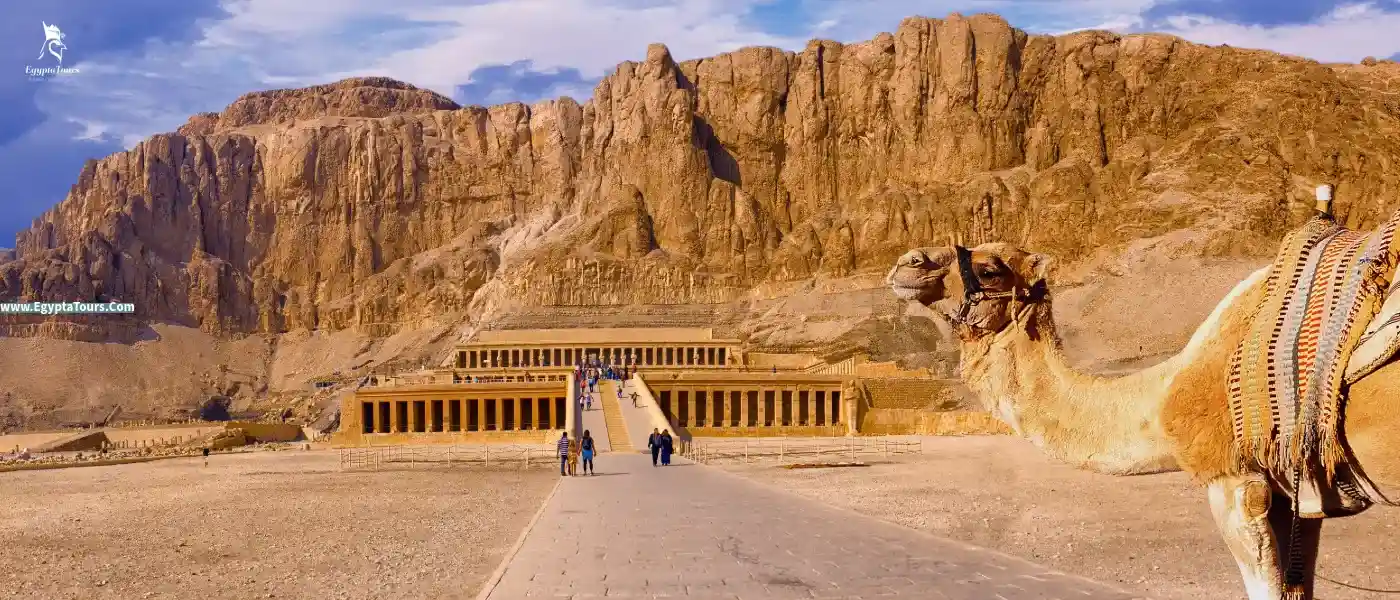
Queen-Hatshepsut-Temple-EgyptaTours
Queen Hatshepsut was the first female pharaoh in old Egypt, incoming to the throne in 1478 BC. She is thought to be one of the most effective pharaohs and Egyptologist James Henry Breasted count her the “first great woman in history.”
Queen Hatshepsut was considered one of the most popular women that changed the history of Egypt
Hatshepsut did a lot for Egypt through her 22-year rule. She determined a lot of important trade road which had been disrupted because of the Hyksos conquest of Egypt – which participate to the increase of wealth in the 18th dynasty. She also supervises the famous tradition mission to the Land of Punt. Queen Hatshepsut built one of the loveliest Egyptian temples in the West bank of Luxor, it is situated couple miles from the Valley of the Kings and Valley of the Queens.
She was also considered one of the most productive builders of the time, commissioning hundreds of constructing throughout Egypt. During your Egypt trip be sure to visit Karnak’s Red Chapel (Chapelle Rouge), which is, a glory filled with carved stones depicting events from Hatshepsut’s life. Also, a great source to learn more about Queen Hatshepsut is to check Kara Cooney’s most recent book “The Women Who Would Be King”
Cleopatra
Cleopatra VII (51 – 0 B.C.) Regional rule had been come to the land of the Nile after more than 500 years of majestic dominance by the Assyrians, the Babylonians, the Persians – even the Macedonians.
Cleopatra was considering the first female master of Egypt in centuries. She almost had it all. She seized Egypt on the cusp of its assimilation into the Roman Empire. She used all her tricks and diplomatic skillfulness to keep Egypt whole and unoccupied for two decades. She also put herself at the center of the wheel of power as the reproducer of future kings. Cleopatra VII, as she is called by historians, was a woman of singular and productive talents.
She raised and controlled her own armies and navies, even travelling with her men and making ruling about strategy and positioning, granting this woman the sudden addition of military experience.
She made the Nile product more grain than anywhere else in the Mediterranean, made Egypt mines produce great of gold. She had economic power that made all of Rome sit up and listen.
The ancient Egyptians brilliantly used female power to avert potential aggressive from men, to avoid war, to get through a crisis, to keep a culture going for more than 3000 years. Egyptians knew that women avoid risk, steer clear of shock and awe. Women were regularly chosen as pharaoh for this very reason.
They don’t typically wage war, rape, or throttle; they rule pragmatically; they don’t hog all the trust. Society won’t let them. They avoid owning their ambition; society would excoriate them for displaying it. In Egypt, such women were the deliverance of a people again and again.
Queen Nefertari
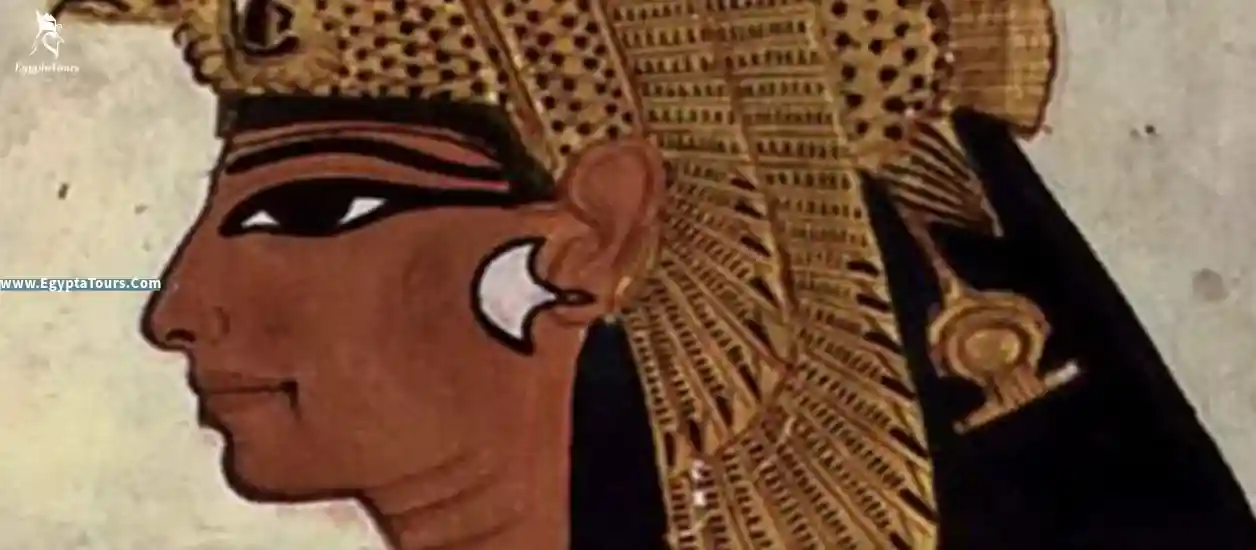
Powerful-woman-in-ancient-Egypt-EgyptaTours
Not much is known about Queen Nefertari, the wife of Ramses II. Their union likely started as a political one, but it blossomed into love and Ramses II celebrated that love with monuments and poetry dedicated to his beautiful queen. She was given various roles in her function as queen and Ramses II even took her on his military campaigns.
The Rise of Queen Tiye: from Commoner to Powerful Royal Consort
Tiye’s father, Yuya, was a non-royal, rich landowner from the Upper Egyptian township of Akhmim, where he served as a vicar and agitate of oxen or warlord of the chariotry. Tiye’s mother, Thuya, was interested in many religious connexion, as her various titles attested (Singer of Hathor, Chief of the Entertainers of both Amun and Min…), which offer that she was a member of the regal family.
Egyptologists have point out that Tiye’s father, Yuya, was of foreign source due to the brow of his mummy and the many unli spellings of his name, which might suggest that it was a non-Egyptian name in origin. Some suggest that the tiy’s strong political and unconventional religious opinions might have been due not merely to a powerful character, but to foreign coming down.
Anen was Tiye brother, who was Second Prophet of Amun. Ay, a successor of Tutankhamun as pharaoh after the latter’s death, is believed to be yet another brother of Tiye, despite no clear date or monument confirming a link between the two. Egyptologists imagine this connection from Ay’s ancestry (also from Akhmin), because he is familiar to have built a oratory dedicated to the regional god Min there, and because he transmitted most of the titles that Tiye’s father, Yuya, held at the court of Amenhotep III during his existence.
Amenhotep III was married Queen Tiye by the second year of his reign. He had been born of a secondary wife of his father and needed a powerful tie to the royal row. Their marriage was celebrated by the issue of commemorative scarabs, announcing Tiye as Great Royal Wife and giving the names of her parents.
He appears to have been crowned while still a child, perhaps between the ages of six and twelve. The couple had at least seven, and possibly more, children.
How Tiye Became Queen
Queen Tiye married Amenhotep III at the age of 11or 12 in the second year of his rule, being approximately two years younger than her holy husband.
The very young couple appear to supplement each other from the first moment and they never parted again. The effectiveness that Tiye had on the pharaoh, never seen before in the “Two Lands”, is not changed.
So much so that, on the opportunity of their marriage, Amenhotep III transmit scarabs to all the neighbor’s property in which he announced the being of his first Great Royal Wife, as well as that of the all- strong Yuya and Tjuyu.
From that moment, and to everyone’s amazed, Tiye did not stop appearing in all the monuments built by her husband Amenhotep, and in provision almost on the same standard as him.
The political weightiness of the young queen was massive, and she had no doubt about treatment to Amenhotep III, who had the massive luck of enjoying a long and flourishing reign.
Some think that Tiye was the actual ruler in the shadows, aided by her mother-in-law Mutemwiya and by the laziness of her husband.
Queen Tiye’s Titles and Royal Status
Queen Tiye was one of the most prestigious figures during her time. She held various important titles such as “Great Royal Wife” which was her official and main title in the country. She also had the name of “Lady of the Two Lands” and “King’s Mother”. Her name appeared in royal inscriptions, monuments and official records alongside King Amenhotep III despite the absence of other queens’ names. These titles were not just ceremonial but they emphasized her political authority and role in state affairs and governance.
Queen Tiye’s Political Influence and Role in Governing Ancient Egypt
Pharaoh Amenhotep IV start his rule with a similar policy feel to that of his father’s reign and he exist with the Royal Court in Thebes at Malkata Palace. Tiye claimed the Title of “King’s Mother” and took on a consulative role for her son.
When the new Pharaoh moved away from the old religion and start to build his new Capital City, Tiye went with him and had her own specific House in the city.
King’s Mom Tiye was pectoral in quite a few scenes throughout Amarna, appear her as the doting grandma and mother to the Royal Family. It is offer that she constant her Foreign and Diplomatic roles for her son, perhaps with the support of his daughter in law, Great Royal Wife, Queen Nefertiti.
After queen Tiye death, Pharaoh Akhenaten did not go ahead her Diplomatic and Foreign roles. He disfavors the previously powerful commitment to Foreign Policy and allowed lands to be possessed away from Egypt. He decreases the Military, the Defences and turn off Foreign Militaria Campaigns. Furthermore, he refused to upholding any of them with Gold or encouragement.
This all leading to the final return of the ancient Deities and moving the capital away from Amarna after Pharaoh’s death about 5 years after that of Queen Tiye death.
Queen Tiye’s Role and Influence in Art
Egyptian art and symbolism clarify the power of Queen Tiye . She was depicted at the same scale as Pharaoh Amenhotep III and this is considered a rare honor reserved for kings and gods. Her statues express strong and realistic facial features, distinguishing her from idealized beauty. Her images and sculptures symbolize her authority, strength and wisdom as well as her association with the goddess Hathor make her a symbol of fertility, protection and divine legitimacy in the royal family.
Her Relationship with the Religious Transformation
Queen Tiye was raised in a traditional polytheistic household despite that, she supported Akhenaten’s religious reforms promoting the worship of Aten. Her support was strategic rather than purely religious, he helped to reduce the power of Amun’s priests. And also despite the turmoil, she helped stabilize the political situation with her intelligence.
Queen Tiye’s Relationship with Queen Nefertiti
Queen Nefertiti was the daughter of Amenhotep III and daughter in law of Queen Tiye. Despite this, they maintained a strong relationship and cooperated to support Akhenaten during his reign. Tiye’s experience and authority complemented Nefertiti’s public and ceremonial role, they created a significant female presence at the Amarna court and reinforcing royal legitimacy during religious and political upheaval.
Queen Tiye’s mummy
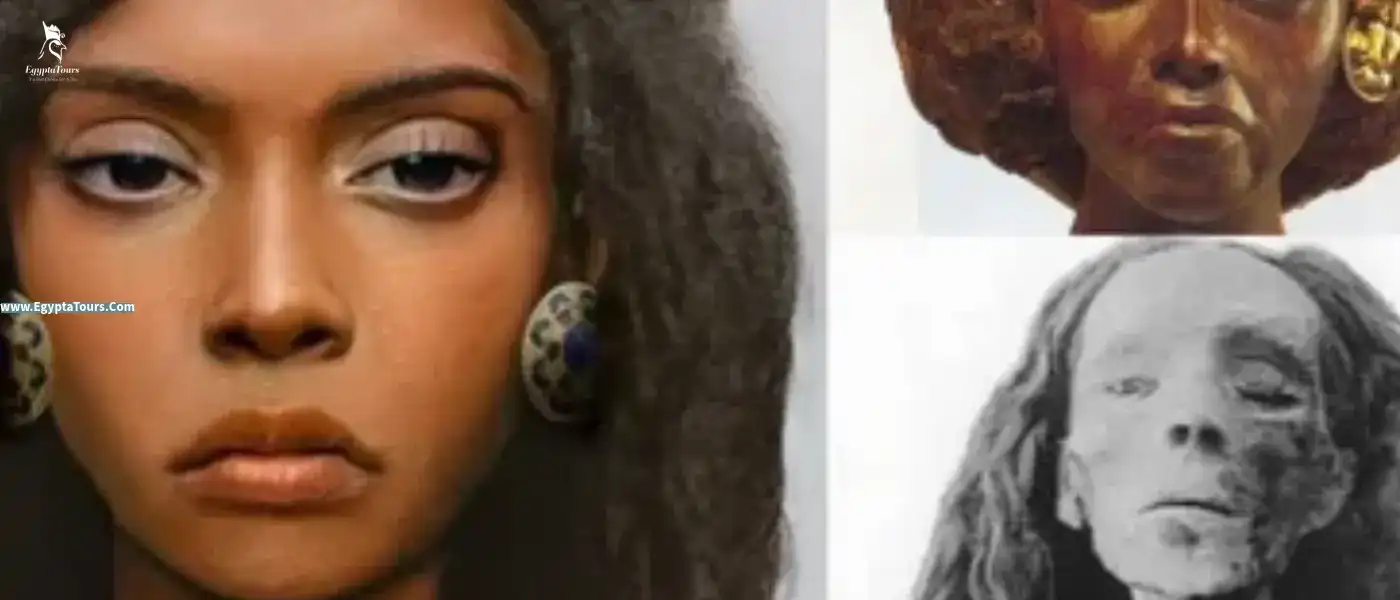
Queen-Tiye-mummy-EgyptaTours
Queen Tiye appears to have first been buried in the tomb of Akhenaten and then re-buried in the tomb of her husband Amenhotep III. There is no clear convention on this, however, because the argument for burial in Amenhotep III’s tomb is based on the find of her Shabti dolls there but nothing else. Further, the archaeologist Victor Loret was discovered her actual mummy in 1898 CE) in the tomb of Amenhotep II.
The appeal that she was first buried in her son’s tomb is conforming by inscriptions but, as these writings are not clear and often imperfect, they are open to translation.
Her mummy was first specific only as “The Elder Lady” and it was only later, when more information came to the light on the rule of Akhenaten, that she was positively identified by name. By the time it became clear that, centuries before the reign of Cleopatra, well known from Greek and Roman consideration, there existed a queen of Egypt who ruled with the same authority as a man and exercised her power in similar measure with the great kings of the old world.
“In 2022, the test suggested a genetic affinity with Sub-Saharan Africans inclde the mummies. However, complexity is clear in biological heritage version. DNA analysis discrepancies among research teams have led to undecided about the ancient Egyptians’ genetic structure and origins.
In April 2021, mummy of queen Tiye was transferred from the Museum of Egyptian Antiquities to the National Museum of Egyptian Civilization in the Pharaohs’ Golden Parade happening.”
Finally, if you make a trip in Egypt don’t miss to visit the National Museum of Egyptian Civilization and see the mummy of queen Tiye.
Conclusion
Tiye, the wife of Pharaoh Amenhotep III, was one of the most influential women in ancient Egypt. Known for her wisdom and strong political influence, she played a vital role alongside her husband in the affairs of state.
Tiye was often associated with the goddess Hathor, symbolizing her connection to power, fertility, and motherhood. As the mother of Amenhotep IV (later known as Akhenaten), she witnessed the profound religious changes that he introduced, including the worship of the Aten.
A famous statue of Queen Tiye, showing her regal presence, is housed in the Neues Museum in Berlin, highlighting her lasting legacy as a key figure in the 18th Dynasty.
Queen Tiye: Essential FAQ
Who was Queen Tiye?
Queen Tiye was the Great Royal Wife of Pharaoh Amenhotep III, mother of Akhenaten, and grandmother of Tutankhamun. She lived in the 14th century BCE and held unusual influence at court.
Was Tiye born into the royal family?
No. She came from a powerful non-royal family in Akhmim. Her parents, Yuya and Thuya, were wealthy and well connected.
How did Tiye gain such influence?
Amenhotep III publicly honored her. Scarab inscriptions praised her, foreign rulers addressed her directly, and she appeared in art at the same scale as the king. She managed estates and took part in diplomacy.
What were her main titles?
Great Royal Wife, King’s Mother, and Lady of the Two Lands. These titles reflect her role as consort and later as queen mother.
Did Tiye act as a co-ruler?
There is no firm evidence that she ruled as pharaoh. She likely served as a powerful advisor during the late reign of Amenhotep III and into Akhenaten’s early years.
What is her connection to Akhenaten’s religious changes?
She lived through the shift toward the Aten. Her exact views are unknown. Records show she visited Akhetaten, which suggests she remained influential during that period.
Did Tiye live at Amarna?
Yes, at least for a time. Wine jar labels mention the “House of the King’s Mother” at Amarna, and art shows her present there.
How is her name spelled?
You will see Tiye, Tiy, or Ty. All refer to the same queen.
Who were her children?
Known children include Akhenaten, Sitamun, Iset, Henuttaneb, and Nebetah. Beketaten may also be her daughter, though evidence is debated.
Was she Tutankhamun’s grandmother?
Yes. DNA studies link Tiye as the grandmother of Tutankhamun and the daughter of Thuya and Yuya.
What does her mummy tell us?
The “Elder Lady” in tomb KV35 is identified as Tiye. DNA and a lock of hair found with Thuya support this. She was an older woman at death, with a distinctive coiffure typical of elite women of her time.
Where was Tiye buried?
Her body was found in the KV35 cache in Thebes. She may have had an initial burial linked to Amarna, then was reinterred for safety.
What do the Amarna Letters say about her?
Foreign rulers wrote about her status and sometimes wrote to her. This shows that she was recognized internationally as a key figure.
Was she foreign?
No. Despite some older theories, Tiye was Egyptian. Her parents held high offices and were buried in the Valley of the Kings‘ area in tomb KV46.
What did she look like in art?
She appears with a vulture headdress, a heavy wig, and sometimes a sun disk with cow horns, linked to Hathor. Artists portrayed her with mature features and dignity.
What are the most important artifacts linked to her?
Commemorative scarabs from Amenhotep III’s reign, statues and reliefs from Thebes and Amarna, and her mummy in KV35. Her jewelry and personal items appear in museum collections worldwide.
Did she outlive Amenhotep III?
Yes. Records place her alive into Akhenaten’s reign, likely until about his Year 12.
What myths persist about Tiye?
Two common myths are that she was foreign and that she ruled as pharaoh. Evidence supports neither claim.
Why does Tiye matter today?
She shaped royal policy, diplomacy, and court culture at a peak of Egypt’s power. Her life links three famous rulers, Amenhotep III, Akhenaten, and Tutankhamun.
Where can I learn more from primary sources?
Look for the Amarna Letters, the KV35 and KV46 tomb finds, and Amenhotep III’s commemorative scarabs. Museum catalogs and excavation reports provide reliable context.
About EgyptaTours

EgyptaTours is a name synonymous with trust, excellence, and unforgettable travel experiences, proudly standing as one of the leading travel agencies in Egypt. Renowned for its deep expertise, personalized service, and carefully crafted itineraries, EgyptaTours serves as the ultimate gateway to discovering Egypt in its most authentic and inspiring form.