





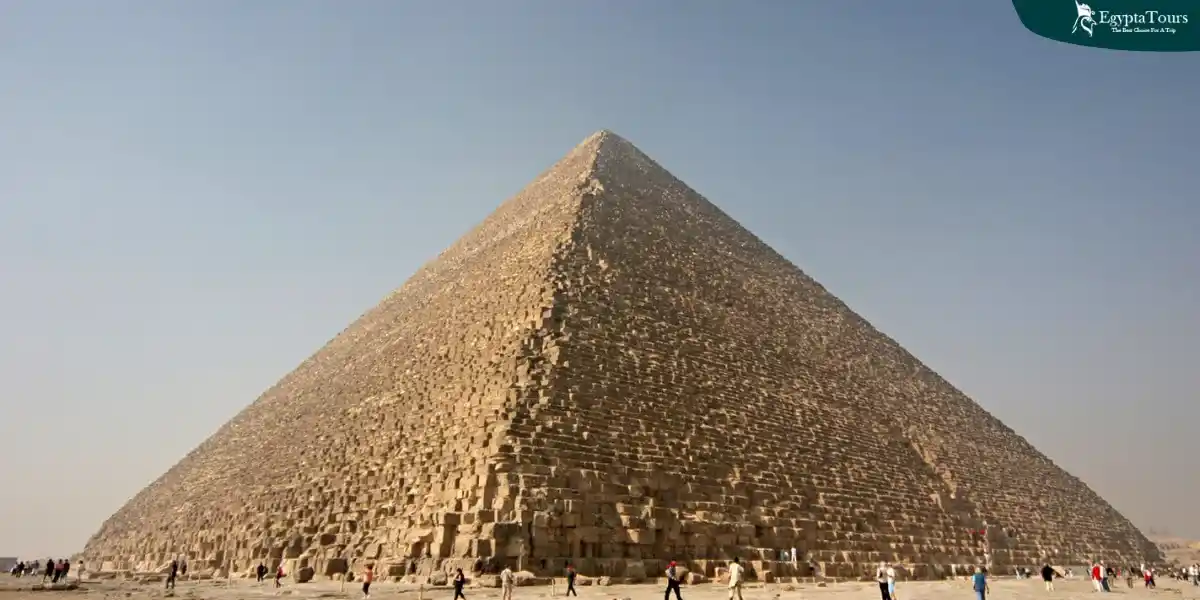
The Great Pyramid of Giza: Ultimate Guide to Egypt’s Most Famous Pyramid
The Great Pyramid of King Khufu is one of the most fascinating and mysterious structures in the world.
For centuries, it has been an enigma, with its many secrets still hidden from us.
Built around 4,500 years ago in Egypt, the Great Pyramid of King Khufu is the only surviving ancient wonder of the world, and its construction and purpose remain a mystery.
In this blog post, we will explore the secrets of the Great Pyramid of King Khufu and attempt to unravel the mysteries that have been puzzling us for centuries.
The Great Pyramid of Giza, also known as the Pyramid of Khufu, is one of the oldest and most iconic monuments in the world. Built for King Khufu around 2560 BC, it is located on the Giza Plateau in Egypt and is believed to be one of the Seven Wonders of the Ancient World.
The Great Pyramid has fascinated people for centuries and remains an important archaeological site.
Its exact location is known to us today thanks to ancient records, which provide us with a wealth of information about its construction and purpose.
In this article, we will explore the location of The Great Pyramid For king Khufu and why it was built in such a specific spot.
Location of the Great Pyramid of Khufu
The Pyramid of Khufu is in Al Haram, Nazlet El-Semman, in the Giza Desert, part of the Giza Governorate. It is located in Giza, inside the famous Giza Pyramids Complex, near the Nile River, at the exact point where the longest lines of latitude and longitude meet. It stands close to the other two great pyramids and the Great Sphinx, which together amaze and impress all visitors.
History of the Great Pyramid of Khufu
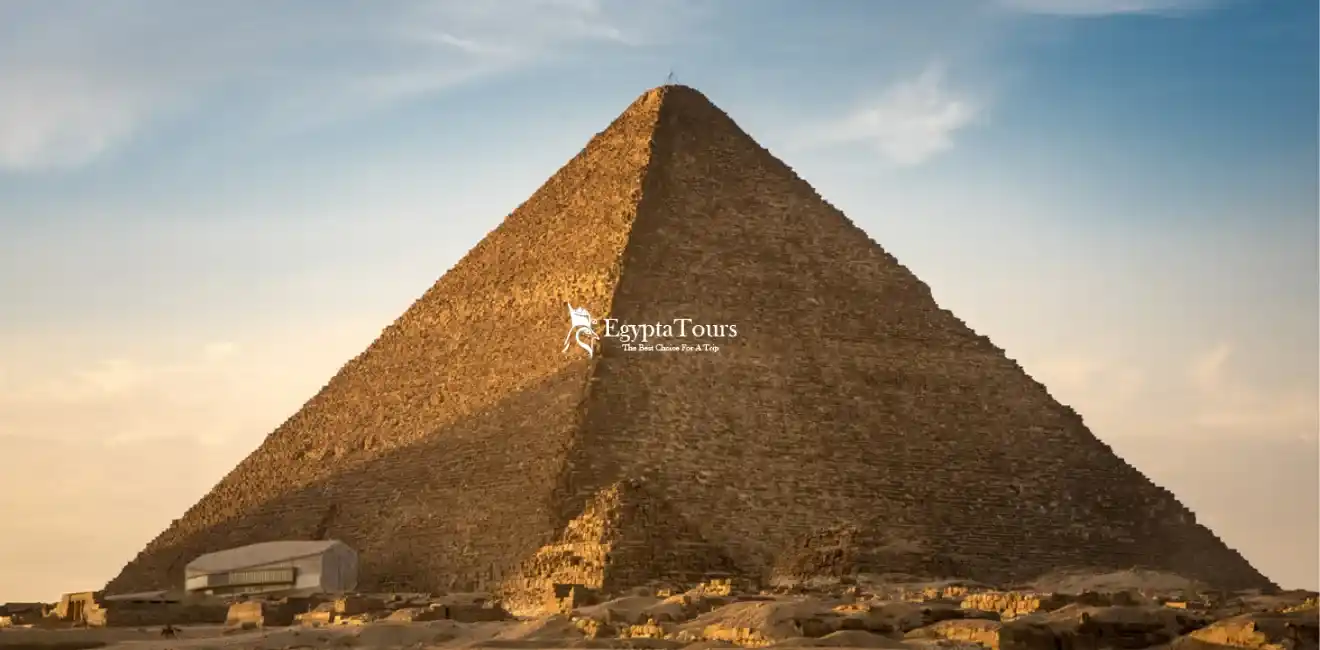
History-Of-The-Great-Pyramid-Of-Khufu-Giza-EgyptaTours
The Pyramid was built by Pharaoh Khufu during the Fourth Dynasty, around 2560 BC, in the Old Kingdom (2686–2181 BC), as his tomb. The Greeks later called it the Pyramid of “Cheops.”
It was the first of the three pyramids built during Egypt’s Old Kingdom. The ancient ruins in the Memphis area, including the Pyramids of Giza, Ṣaqqārah, Dahshūr, Abū Ruwaysh, and Abū Ṣīr, were all declared a UNESCO World Heritage site in 1979.
The Pharaohs of the Fourth Dynasty were known as the pyramid builders. They used their resources, like a stable government, wealth from trade, strong leadership, and a large population, to create amazing and lasting structures.
The first pharaoh to do this was Sneferu, Khufu’s father. Khufu began planning his pyramid after he became king. He chose Giza for his tomb because there were no other major monuments nearby, and because his mother, Hetepheres I (2566 BC), was buried there.
Dating the Great Pyramid of Khufu was done using several methods, including historical records and radiocarbon dating. These methods show that Khufu and the Great Pyramid were from around 2700 to 2500 BC. Many famous historians wrote about the Great Pyramid, including the ancient Greek historian Herodotus, who was one of the first to describe it in detail in the 5th century BC.
The ancient Greek historian Diodorus Siculus visited Egypt between 60 and 56 BC and wrote many details about Egypt’s history, land, customs, and monuments, including the Great Pyramid. The Greek geographer, historian, and philosopher also visited Egypt in 25 BC and said that the pyramids were tombs for kings.
The Roman writer Pliny the Elder wrote about the Great Pyramid in the first century AD and tried to explain how it was built. During the Greek and Coptic periods, many scholars and historians recorded information about the Great Pyramid.
During the Islamic period in 820 AD, the Abbasid Caliph Al-Ma’mun (786–833) is said to have dug a tunnel into the side of the Great Pyramid and discovered the ascending passage and its connected chambers.
Many Islamic historians and scholars, such as Al-Maqrizi (1364–1442) and the Arab scholar Abd al-Latif al-Baghdadi (1163–1231), studied the pyramid carefully to learn its secrets. On July 21, 1798, during the Battle of the Pyramids, Napoleon Bonaparte and his French army captured Cairo, and he entered the Great Pyramid of Khufu.
The Great Pyramid Construction
Great-Pyramid-Construction-Methods-And-Engineering-EgyptaTours
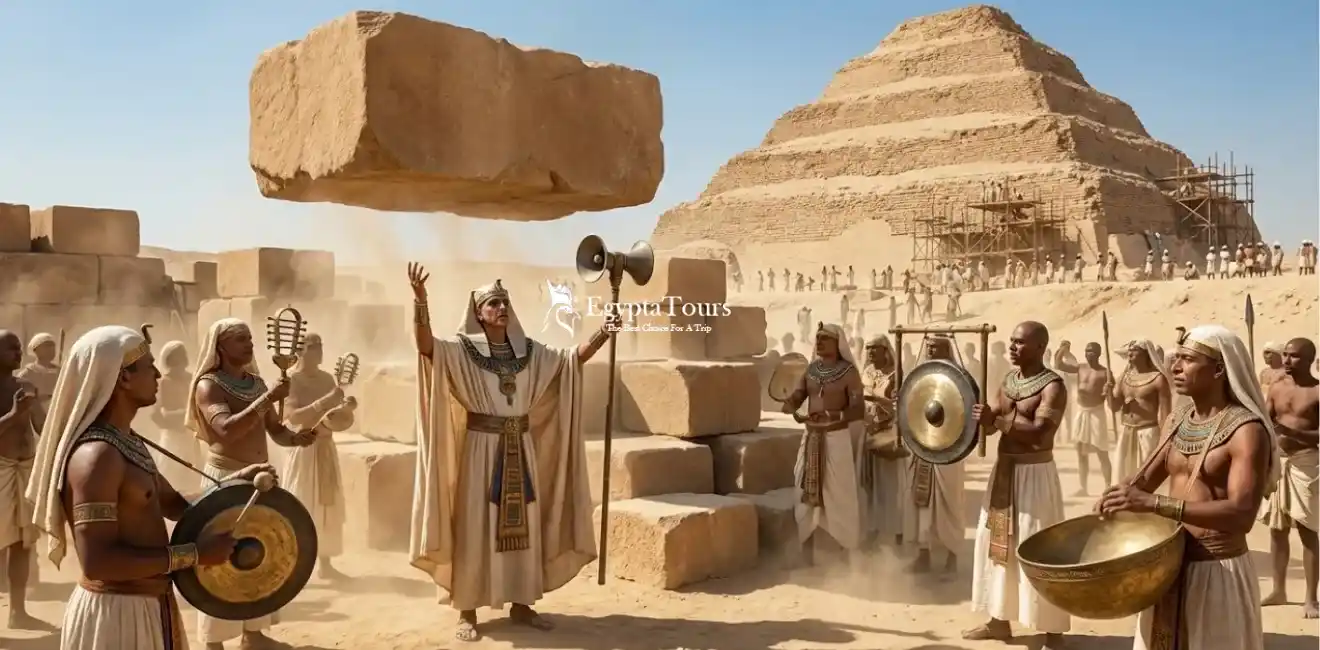
The construction of The Great Pyramid of Giza for Pharaoh Khufu is one of the most impressive feats in human history.
The pyramid, built around 2560 BC, is the oldest and largest of three pyramids in the Giza Necropolis and stands as a testament to ancient Egyptian engineering and architecture.
Though much mystery still surrounds its construction, it is believed that it took over 20 years to build and required an estimated 2.3 million stone blocks weighing up to 2.5 tones each.
This article will discuss the theories surrounding how this incredible structure was built with such precision and accuracy over 4500 years ago.
The Great Pyramid Purpose
The Great Pyramid of Khufu is a pyramid built by the ancient Egyptians.
It is the oldest and largest of the three pyramids in the Giza Necropolis bordering what is now El Giza, Egypt.
The Ancient Egyptians believed that a pyramid shape was a divine form, so they built pyramids for their kings to use as tombs.
The Great Pyramid of Khufu was built as a tomb by Pharaoh Khufu around 2580 BC.
It was the tallest building in the world until the Eiffel Tower was built in 1889 AD.
The pyramid is made up of two million limestone blocks weighing more than 2 tons each! Many people think it would take over one million people working day and night for three months to build such a massive structure.
The purpose of building The Great Pyramid was to create a place where Pharaoh Khufu could spend eternity after he died. The king needed somewhere safe where his body could be preserved forever so that he could continue living after he died.
Building the Great Pyramid of Khufu: Materials, Workers, and Methods
Building-The-Great-Pyramid-Materials-Workers-Methods-EgyptaTours
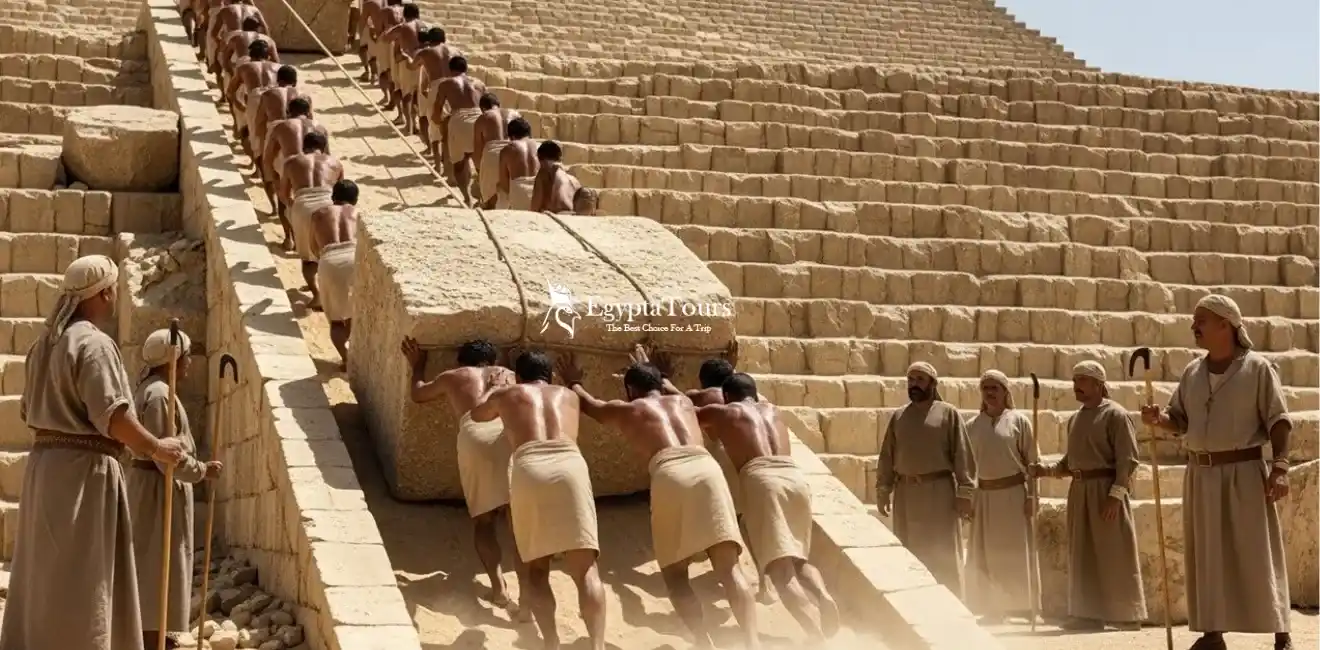
The huge Pyramid of Khufu needed careful planning for materials, workers, and design. Builders mainly used limestone from the Giza Plateau, while fine white limestone from Tura, 13–17 km away, was used for the smooth outer surface. The King’s Chamber, passageways, and sarcophagus were made from granite brought from Aswan, 934 km away.
Modern research shows that Herodotus was wrong about 100,000 slaves. About 4,000 skilled workers built the pyramid, cut stone, and did the masonry. They worked with 16,000–20,000 support workers who made tools and provided food. Workers were paid with daily rations, including ten loaves of bread and beer.
The construction teams were organized in a clear hierarchy. Two main divisions were divided into smaller groups of 200 men each. DNA studies show that the workers came from all over Egypt, making the project a national effort that helped unite the country.
Builders moved stones weighing 2.5 tons using sleds. They poured water on the sand under the sleds, which reduced friction by half. The Nile River and man-made canals were used to transport the stones. The pyramid was built very accurately – its sides are aligned with true north, with only a 2 minutes 28 seconds difference.
Khufu’s vizier and nephew, Hemiunu, was the architect who led this amazing project.
The Interior Deign of The Great Pyramid
Interior-Design-Of-The-Great-Pyramid-Chambers-And-Passages-EgyptaTours
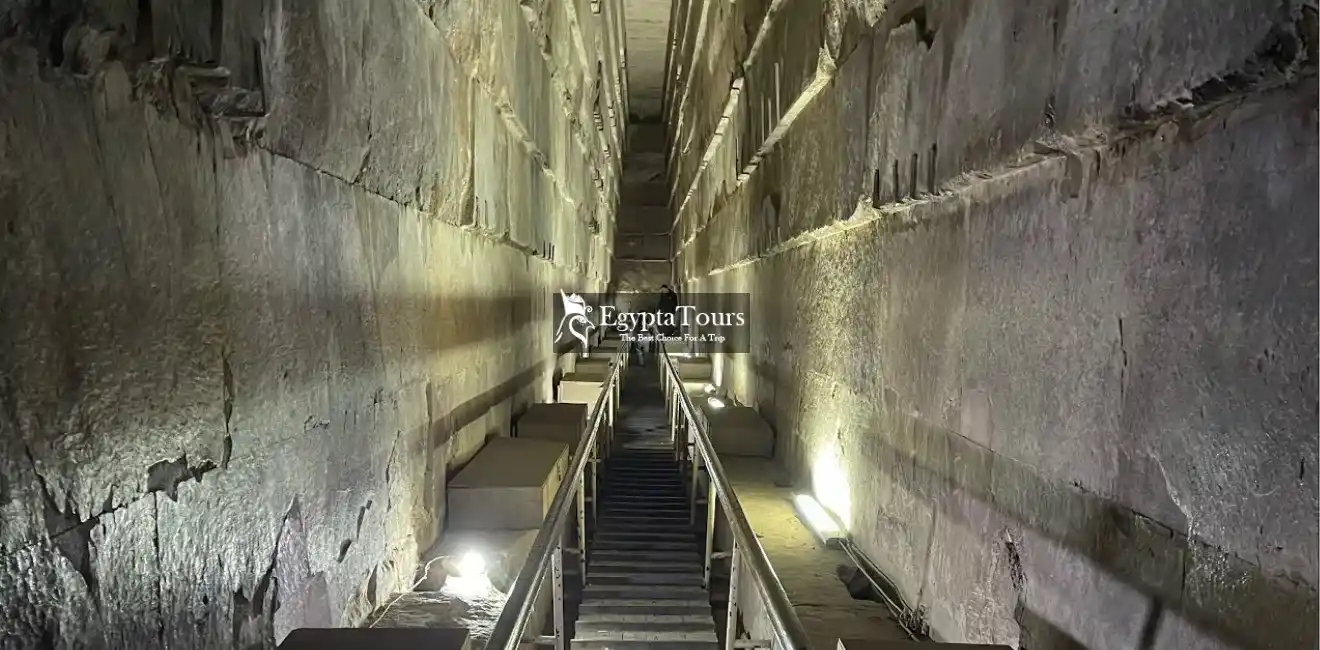
The interior of the Great Pyramid is divided into three chambers: the King’s Chamber, the Queen’s Chamber, and a third chamber that has not been entered.
The King’s Chamber is a rectangular room 20 m long by 5 m wide with an entrance on its north face that leads to a descending corridor which ends at a small lobby.
At this point there are two shafts that lead up to other parts of the pyramid.
One shaft leads to the Queen’s Chamber while another leads to an exit near ground level on the north side of the pyramid.
The Queen’s Chamber is also rectangular in shape but smaller than the King’s Chamber at 15 m long by 7 m wide with an entrance on its south face leading to a descending corridor ending in a small lobby at which point there are two shafts leading up to other parts of the pyramid; one shaft leads to an exit near ground level .
The interior of the Great Pyramid is composed of three main chambers: the King’s Chamber, the Queen’s Chamber, and the Grand Gallery. The King’s Chamber is located in the center of the pyramid and is where Khufu’s sarcophagus was found.
The Queen’s Chamber is located above the King’s Chamber and was probably used for storage or as a place for Khufu’s wife, Queen Meritites, to perform rituals.
The Grand Gallery is a long, narrow chamber that leads up to the King’s Chamber.
It was likely used as a passageway for Khufu’s funeral procession.
The walls of these chambers are made of large stone blocks, some of which were painted or covered in hieroglyphs.
The ceiling is constructed from large limestone slabs, and the walls and floors are covered in various shades of white limestone.
Most of the surfaces have been smoothed and polished to give them a luxurious finish. Additionally, several false doors have been discovered in some chambers that were used as decoration or possibly to fool grave robbers.
The Mysteries About How The Great Pyramid Built
Mysteries-Of-How-The-Great-Pyramid-Was-Built-EgyptaTours
The Great Pyramid of Khufu, also known as the Pyramid of Cheops or the Pyramid of Cheops, is the oldest and largest of all the pyramids in Egypt. It is located on the west bank of the Nile River at Giza, about 10 km from Cairo.
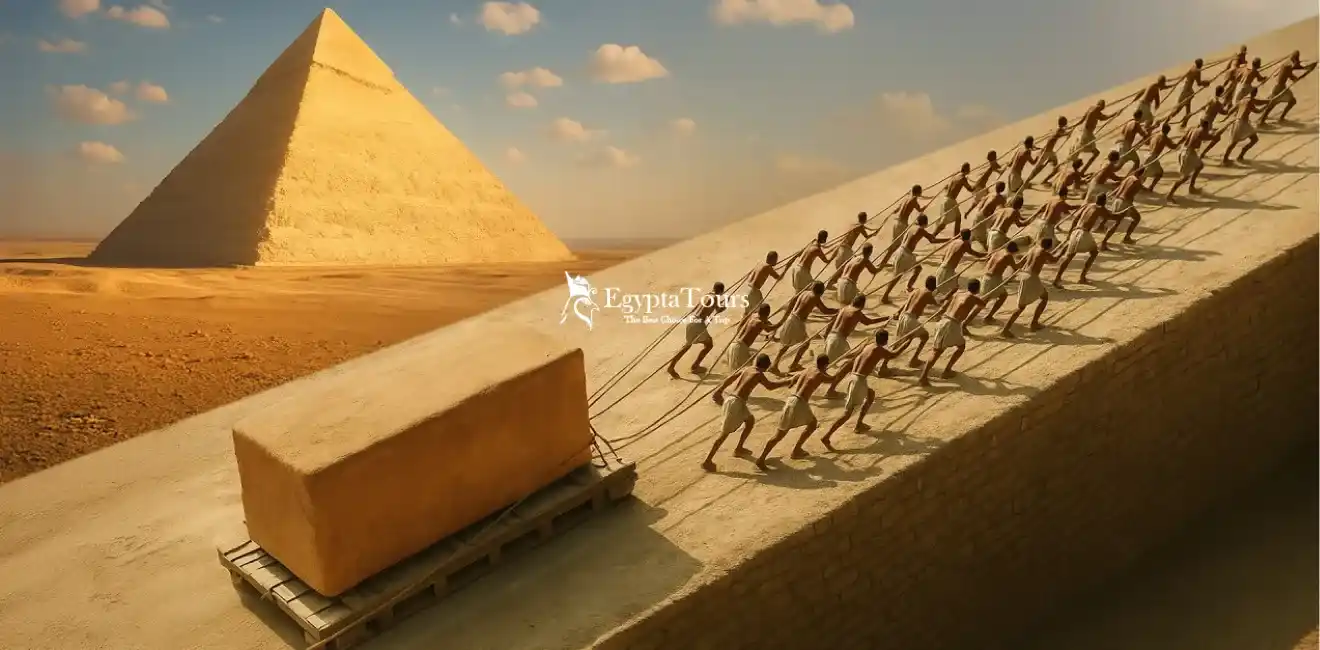
The Great Pyramid of King Khufu is one of the most famous, and perhaps most mysterious, structures in the world. For centuries, people have speculated about how this massive monument was built.
Unfortunately, much of what we know about the pyramid comes from myths and legends rather than facts.
In this section, we’ll dispel some of the most common myths about the Great Pyramid of King Khufu.
One popular myth is that the pyramid was built by slaves.
This is simply not true. The workers who built the pyramid were paid for their labor and were well-treated by their Egyptian overseers.
In fact, many of the workers were recruited from neighboring countries and were eager to work on such a prestigious project.
Another common myth is that the pyramid was built using secret techniques that are now lost to history. This too is false. The methods used to build the pyramid are actually quite simple and have been well-documented by archaeologists.
The ancient Egyptians simply used large blocks of stone and lots of manpower to construct the pyramid.
So, next time you hear someone spouting off about the mysteries of the Great Pyramid of King Khufu, be sure to set them straight!
The Great Pyramid is a place that attracts travelers and sparks a lot of curiosity. Many theories have been suggested about it, which made the pyramid one of the most important landmarks in Egypt and famous all over the world. The following passages share different ideas from some early experts about how the pyramid was built:
The Greek Hypotheses Of The Khufu Pyramid
There are many ideas about the Pyramid of Khufu, but the most well-known is the Greek theory. It claims that the pyramid was built by slaves, but this has been proven wrong. To achieve such amazing accuracy, the builders needed strong management skills and careful planning to organize about 40,000 skilled workers. This large workforce was arranged in a clear hierarchy and divided into teams. The workers were paid and had many rights.
The following are some Greek historians and writers, each with their own ideas about how the Great Pyramid was built, some with accurate evidence and some without.
Herodotus Theory About The Great Pyramid
Herodotus’ theory is one of the most famous Greek ideas about the Great Pyramid. He was the first well-known writer to make a theory about Khufu’s pyramid. Herodotus was an ancient Greek historian who wrote many important works. In the second book of his The Histories, he shared some interesting ideas about the Great Pyramid.
Herodotus described Khufu as a harsh king who treated people like slaves and forced them to build the enormous pyramid. This idea is not true because the workers were paid for their labor. However, his story made travelers admire the king’s great efforts in building a successful part of Egypt, and it helped correct the false ideas people had about the pyramid.
Herodotus said that a group of 100,000 workers worked in three month shifts for about 20 years to build the Great Pyramid. He also claimed that the Pyramid of Khafre has a passage where the Nile flows through an island and leads directly to King Khufu’s tomb.
Herodotus described the outside of the Great Pyramid and, according to his early interpreters, mentioned that the workers ate garlic, radishes, and onions while building it. This shows that the Greek interpreters either did not understand the hieroglyphs well or they just chose an easy way by giving made up explanations.
The Theory Of Diodorus Siculus About The Khufu Pyramid
Diodorus Siculus was another important ancient Greek historian who shared his views about the Great Pyramid based on the evidence he collected. He claimed that neither Khufu nor Khafre was actually buried in their pyramids.
Instead, he suggested that the kings were buried elsewhere because they feared the workers might use their bodies to take revenge. This idea is connected to the false “slavery” story mentioned earlier by Herodotus.
However, it is clear that the slavery story is not true and has nothing to do with the life or death of the two kings, and it does not reflect their true greatness in any way.
He also wrote that the pyramid’s outer stones were in excellent condition at that time, and a 6-cubit-high platform helped form the top shape of the pyramid. He added that the Great Pyramid was built and supported using several ramps because lifting tools had not been invented yet. However, his ideas were not backed by strong or official evidence to prove them.
Strabos Theory About The Great Pyramid
Strabo’s ideas are also part of the interesting but not fully proven Greek theories about the Great Pyramid. Strabo was a Greek philosopher, geographer, and historian who visited Egypt after it was under Roman rule. In his famous work Geographica, he wrote that inside the pyramid, at a certain height, there is a stone that may have been removed and replaced with a passage leading directly to the tomb.
His statements were controversial because they suggested that the Great Pyramid had been opened or disturbed before. Strabo’s theory is another idea that caused many people, whether Egypt experts or not, to question the history of ancient Egypt.
Pliny The Elder About The Great Pyramid
Pliny the Elder, a famous Roman writer, shared his ideas about the Great Pyramid. He suggested that the pyramid was built to make ordinary people work very hard for no real reason. He also said it was built to show the king’s power and protect his position from rivals.
Pliny had two ideas about how the pyramid reached such a great height and impressive shape. One idea was that heaps of salt and niter formed around the pyramid and were washed away by the river. The other idea was that bridges were built, then taken apart into bricks, and each person used them to build their own homes, claiming that the water could not reach the pyramid’s height.
He also described Thales of Miletus’ method for measuring the pyramid’s height more easily by using the shadows it made.
The Big Void Theory Of The Khufu Pyramid
The Great Pyramid has been the subject of many unusual and strange theories over the centuries because it still holds many mysteries. In 2017, a group of Japanese researchers found a large empty space, about 30 meters (98 ft) long, above the Grand Gallery using muon scans. The purpose of this space is still unknown.
There are also many other ideas about why the pyramid was built. Some are very unlikely, like the idea that it was made by people from Atlantis or even by aliens. These theories confuse many people and add to the ongoing “mystery” of the Great Pyramid.
The Orion Correlation Theory Of The Pyramids
One of the well known ideas about the pyramids is the Orion Correlation Theory. This theory says that the pyramids match the positions of Orion’s Belt, the Leo constellation, and the Milky Way. Some people even suggest that the pyramids could be older than we think.
Many mysteries and unanswered questions still surround the pyramids, which is why they attract so many visitors from around the world. It is interesting how people spend a lot of effort to prove their ideas, while travelers and locals enjoy seeing who can find the most unusual facts about the pyramids.
It is important to note that these theories are part of the pyramids’ unique appeal. Some people find them interesting, while others do not believe in them.
The Legacy of King Khufu
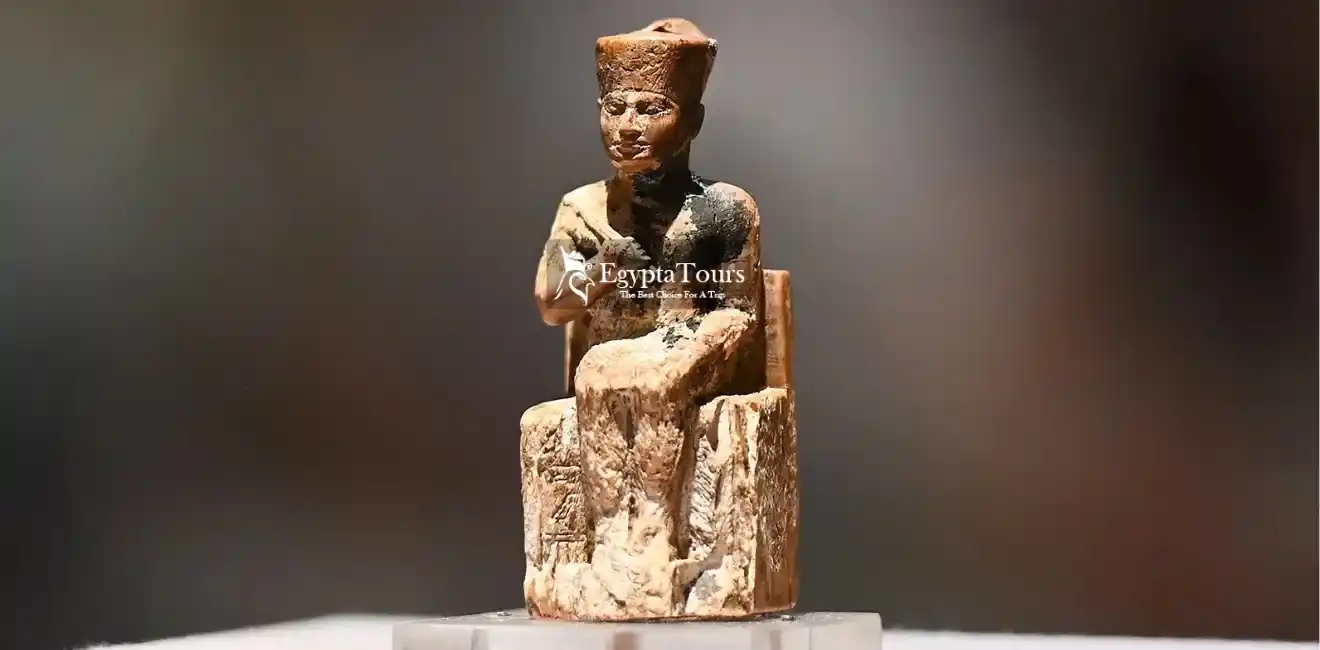
Legacy-Of-King-Khufu-Pharaoh-Of-The-Fourth-Dynasty-EgyptaTours
King Khufu (2589–2566 BC) was the second Pharaoh of the Fourth Dynasty during the Old Kingdom. His original name was Khnum-Khufu. He became king after his father, Sneferu and was crowned in the 26th century BC. The exact length of his reign is not known. Ancient Egyptian and Greek historians say he ruled for 50 or 63 years, but modern scholars think it might have been between 23 and 46 years.
Khufu is remembered in history because of his pyramid at Giza. The only fully preserved statue of him is a small, three-inch ivory figure found in Abydos in 1903, now kept in the Grand Egyptian Museum. Khufu’s mummified body has never been found, as it was taken from the Great Pyramid at some time in the past.
The Grand Pyramid’s Complex of Giza
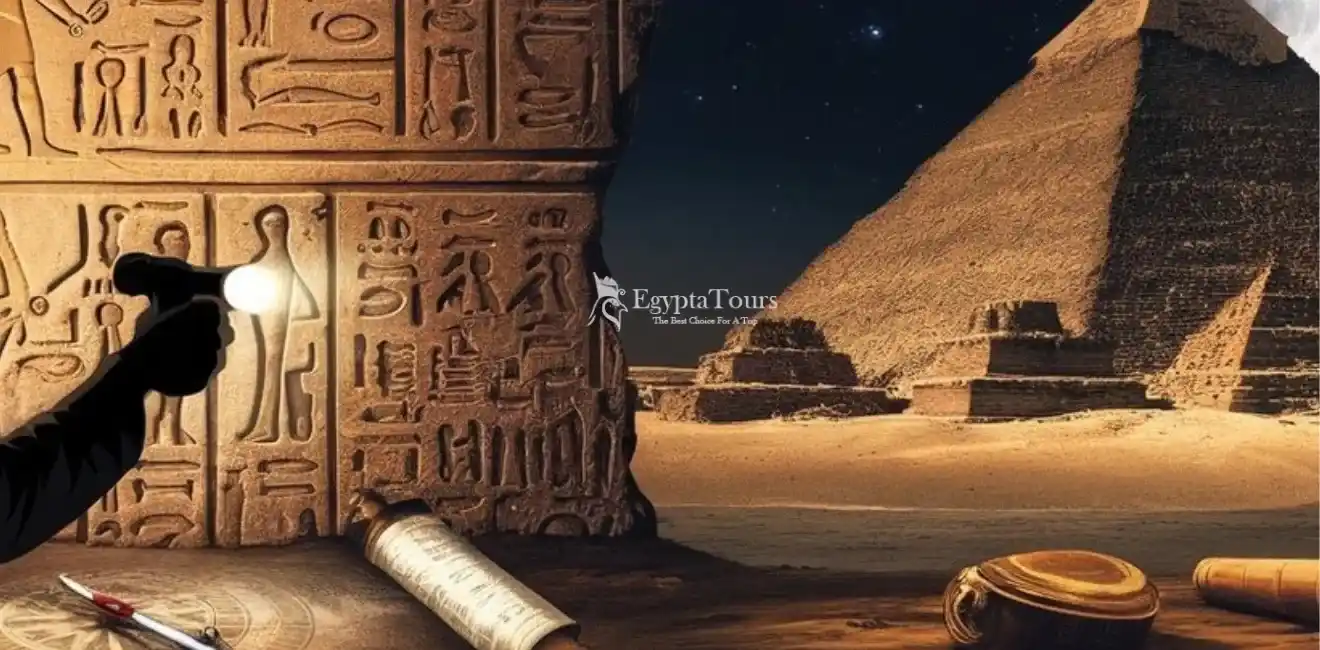
Grand-Pyramid-Complex-Of-Giza-Plateau-EgyptaTours
The pyramid’s temple was built on the eastern side of the Giza pyramid complex. It is 52.2 meters (171 ft) long from north to south and 40 meters (130 ft) wide from east to west. The temple had a large rectangular courtyard, covered with black basalt. Most of the temple has disappeared over time.
The mortuary temple leads to the King’s burial chamber, which is the best-preserved part of the pyramid. There are three smaller pyramids in good condition, built to honor Khufu’s mother, Hetepheres I, and his wives, Meritites I and Henutsen.
On the southern side of the pyramid, there are two large rectangular pits lined with stone, which held fully disassembled boats. One of these boats was removed and rebuilt. This boat is called Khufu’s solar boat and is now in the Grand Egyptian Museum. It is 43.3 meters (142 ft) long and made from 1,224 separate pieces tied together with ropes.
The Missing Tip of The Great Pyramid
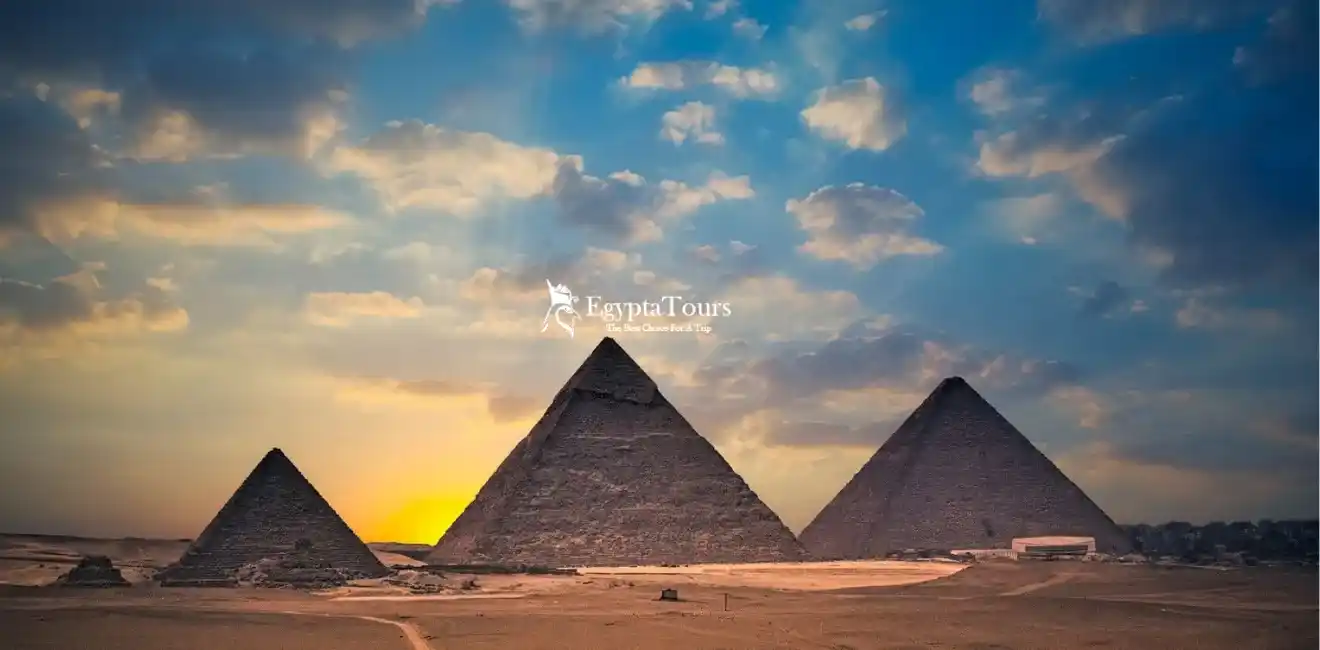
Missing-Tip-Of-The-Great-Pyramid-Capstone-Theory-EgyptaTours
The top of the Great Pyramid is called the pyramidion, which is the capstone. The pyramidion was made from a mix of granite and limestone basalt, and people still have many questions about it. Some theories suggest that the capstone was made of solid gold or covered in gold.
However, other pyramids from the Fourth Dynasty, like Khufu’s Satellite Pyramid and the Red Pyramid, had capstones made of white limestone, and there is no proof that they were covered in gold.
The idea of a gold covered capstone is supported later in the Fifth Dynasty, as seen in Sahure’s causeway, which had a capstone with a white gold finish.
The Best Cheap Tour Packages
| Tour Name | Duration |
|---|---|
| Egypt 12 Days : The Ultimate Itinerary | 12 Days – 11 Nights |
| 6 Days Cairo and Hurghada Tour Package | 6 Days – 5 Nights |
| Full Day Tour to Giza Pyramids Memphis and Sakkara | 1 Day – 0 Night |
| Giza Pyramids Day Tour | 1 Day – 0 Night |
Conclusion
Khufu’s Pyramid, also known as the Great Pyramid of Giza, is the largest and most renowned pyramid in Egypt.
Originally standing at 146.6 meters, the pyramid was once covered with smooth limestone casing that gave it a bright, reflective appearance.
These outer casing stones have mostly eroded or been removed over time, revealing the inner core structure.
Inside the pyramid, there are three main burial chambers, each designed for different purposes.
The King’s Chamber, located deep within the pyramid, was intended to house Khufu’s sarcophagus, while the Queen’s Chamber and a subterranean chamber were either symbolic or possibly used for other funerary functions.
The Great Pyramid’s sheer size and intricate internal design make it an architectural marvel on the Giza Plateau.
The Great Pyramid of Khufu, built during the 4th Dynasty of ancient Egypt, is one of the most iconic monuments in history.
Located at Giza, it served as the pharaoh’s tomb and was constructed with incredible precision and engineering skill.
Surrounding the pyramid are boat pits, which housed full-sized ships believed to carry Khufu’s soul across the afterlife. This monumental structure, also known as the Pyramid of Cheops, remains a testament to the architectural achievements of ancient Egypt.
Exploring the Mysteries of the Great Pyramid of Khufu
What is the Great Pyramid of Khufu?
The Great Pyramid of Khufu, also known as the Pyramid of Giza, is the largest of the three pyramids on the Giza plateau. Constructed during the reign of Pharaoh Khufu around 2560 BC, it originally stood at 481 feet tall and is considered the last of the Seven Wonders of the Ancient World.
Why was the Great Pyramid built?
The pyramid was built as a tomb for Pharaoh Khufu. It was meant to ensure his safe passage to the afterlife and demonstrate his absolute power. It also served as a national project that unified the people of Egypt around a common purpose.
How was the Great Pyramid constructed?
The pyramid was made using millions of limestone and granite blocks, some weighing up to 80 tons. The exact methods of construction remain a mystery, but theories suggest the use of ramps, levers, and a large workforce.
Who built the Great Pyramid?
Skilled workers and laborers, possibly totaling tens of thousands, constructed the pyramid. Contrary to popular belief, they were not slaves but rather paid laborers who worked in shifts.
How long did it take to build the Great Pyramid?
The construction likely took about 20 years. This estimation is based on historical records and the scale of the project, considering the tools available at the time.
What’s inside the Great Pyramid?
The pyramid contains three main chambers: the King’s Chamber, the Queen’s Chamber, and an unfinished subterranean chamber. There are also intricate passageways and shafts, some of which remain unexplored.
Has the Great Pyramid been explored fully?
Not entirely. While many areas have been studied, some parts remain inaccessible. Modern technology, like ground-penetrating radar and microdrones, continues to uncover new insights.
Why is the Great Pyramid significant?
The Great Pyramid is an architectural marvel and a testament to ancient Egyptian engineering. It provides insights into ancient Egyptian culture, religion, and technological capabilities.
Can you visit the Great Pyramid?
Yes, the Great Pyramid is open to tourists. Visitors can explore parts of the interior, though access to some areas is restricted for preservation reasons.
Are there hidden chambers in the Great Pyramid?
Recent scans suggest there may be hidden voids or chambers. However, their purpose and contents, if any, remain unknown until further exploration is possible.
About EgyptaTours

EgyptaTours is a name synonymous with trust, excellence, and unforgettable travel experiences, proudly standing as one of the leading travel agencies in Egypt. Renowned for its deep expertise, personalized service, and carefully crafted itineraries, EgyptaTours serves as the ultimate gateway to discovering Egypt in its most authentic and inspiring form.