





Anubis: Powerful Egyptian God of the Afterlife Explained
Anubis is one of the most famous gods in ancient Egyptian mythology.
He is considered the god of mummification, guardian of tombs, and guide of souls to the afterlife.
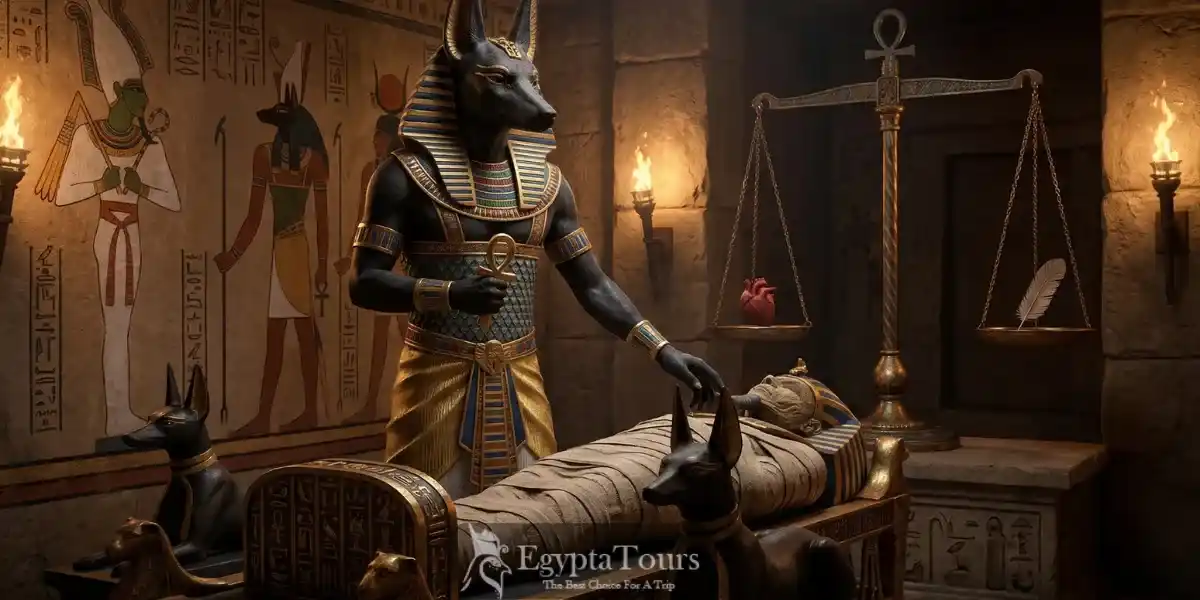
He is often depicted as a man with the head of a jackal, the animal believed to guard graves in the desert.
He held a special place in Egyptian funerary beliefs, associated with death and burial rituals, including mummification, to ensure the preservation of the body and its preparation for the afterlife.
His images appear in many ancient Egyptian tombs and temples.
It was believed that he protected the dead from evil spirits and helped them reach the other world peacefully.
His name was also associated with the concept of divine justice, as he was believed to oversee the weighing of the hearts of the dead to determine their fate in the afterlife.

Who-is-Anubis-And-what-did-he-look-like-EgyptaTours
Anubis is the god of death and mummification in ancient Egyptian mythology.
He was considered the protector of tombs and the guide of souls on their journey to the other world.
He played a pivotal role in the rituals of mummification and the scales of divine justice, overseeing the trial of the dead and the weighing of their hearts to ensure their passage to eternal life.
His association with the jackal is believed to stem from sightings of it roaming around cemeteries at night, leading ancient Egyptians to believe that it protected the dead.
His worship evolved over the ages, initially as a local god associated with the tombs of Abydos, and later becoming a deity of great importance throughout Egypt.
As for his appearance, Anubis was depicted in ancient Egyptian art as a man with the head of a jackal, an animal believed to roam cemeteries and protect them from evil spirits.
His black color symbolizes the color of fertile soil, decomposition, and rebirth, not evil as is common in some cultures.
He was sometimes depicted wearing a white sash, symbolizing purity and cleansing.
Anubis in Ancient Egyptian Mythology

Anubis-in-Ancient-Egyptian-Mythology-EgyptaTours
Anubis is considered one of the most prominent gods in ancient Egyptian mythology.
His name was closely associated with the rituals of mummification, death, and the protection of souls in the other world.
He played a central role in funerary beliefs, as it was believed that he protected the body after death, guided souls on their journey to the other world, and oversaw the trial of the dead to ensure they received divine justice.
Egyptian mythology states that Anubis is the son of Osiris and Nephthys, and that Ra gave him the task of mummifying Osiris after Set killed him.
Anubis’s Role in Ancient Egyptian Mummification Rituals

Anubis’s-Role-in-Ancient-Egyptian-Mummification-Rituals-EgyptaTours
The mummification process in ancient Egypt was complex and required many steps to ensure the proper preservation of the body, and Anubis played a pivotal role in this process. Here are the main steps of mummification and Anubis’s role in them:
- The mummification process begins with cleansing and purifying the body with water and natron. It was believed that Anubis oversaw this process to ensure the complete purification of the body.
- Priests wore Anubis masks during the mummification process, in reverence for him and to seek his blessing.
- Internal organs such as the liver, lungs, and intestines were removed and preserved in canopic jars, then the body was dried using natron for 40 days. Each canopic jar had a lid bearing the head of one of the four sons of Horus, who were under the protection of Anubis.
- After drying the body, it was anointed with oils and perfumes to preserve the skin and prevent decomposition. These oils and perfumes were made from natural materials such as myrrh, frankincense, and cinnamon.
- The body was then wrapped in linen bandages, and amulets and magical symbols were placed between the bandages to protect the body. These bandages were inscribed with religious texts to help the deceased on their journey to the other world.
- After the body was wrapped, it was placed in a coffin.
- The coffin was decorated with drawings and inscriptions representing scenes from the deceased’s journey in the other world.
Absolute ruler of the underworld
In very ancient times, Anubis was known as the main ruler of the underworld, called Duat. Later, people believed that Osiris took over this role. Anubis’ job was to watch over the land of the dead and help the souls of the dead reach their final resting place safely. As the ruler of the underworld, Anubis also made sure everything stayed in order, protected the dead from evil forces and kept the balance between the world of the living and the world of the dead.
The Guardian of the Scales
One of Anubis’ important jobs was being the Guardian of Scales, deciding what would happen to souls. In the Book of the Dead, Anubis weighs a person’s heart against a feather. The feather stands for “Ma’at,” which means truth. If the heart was heavier than the feather, the person would be eaten by Ammit, a female demon called the “devourer of the dead.” If the feather was heavier or balanced the heart, Anubis would guide the person to Osiris so they could go to heaven and have a good afterlife.
Protector of Tombs
As the Egyptian god in charge of protecting the dead, many prayers to Anubis were written in tombs and people gave him offerings to keep the dead safe. Anubis’ role included both protecting the tombs from robbers and protecting the souls from evil forces. He kept this role until Osiris became more popular and took over.
Anubis in Archaeological Discoveries

Anubis-in-Archaeological-Discoveries-EgyptaTours
Anubis is one of the most prominent symbols that appeared in Egyptian archaeological discoveries. Many statues and inscriptions depict him as the god of protection and mummification, which helped scientists understand the beliefs of ancient Egyptians about death and eternal life.
Archaeologists have found many amulets and small statues of Anubis in Egyptian tombs, believed to protect the deceased on their journey to the other world.
Anubis’s Shrine
Anubis was worshiped all over Egypt and his main temple was in Cynopolis, in the 17th province of Upper Egypt. Cynopolis means “city of the dog” in Greek, which makes sense because jackals and dogs are closely related, and some scholars think Anubis may have been an ancient wolf.
In 1922, a shrine for Anubis was found in King Tut’s tomb. It was made of wood, plaster, lacquer and gold. The statue shows Anubis as an animal lying down, just like in his hieroglyph. The shrine was on a sledge, so it was probably used in the Pharaoh’s funeral procession. It faced west to help guide the Pharaoh to the afterlife which the ancient Egyptians believed was in the direction of the setting sun.
Anubis’s shrine was found in the tomb of Tutankhamun in the Valley of the Kings in western Thebes.
Howard Carter discovered Tutankhamun’s tomb on November 4, 1922, and the Anubis shrine was part of the king’s burial equipment.
The presence of Anubis’s shrine in Tutankhamun’s tomb is believed to symbolize the king’s protection on his journey to the other world.
Anubis’s shrine is made of wood and covered with gold leaf, and contains a statue of Anubis in the form of a recumbent jackal.
The statue is made of wood and covered with black paint, with gold details in the ears, eyes, and claws.
Anubis’s shrine is one of the most important artifacts found in Tutankhamun’s tomb, and is currently on display at the Egyptian Museum in Cairo.
Anubis Statue
A statue of Anubis was found in the tomb of King Horemheb (Tomb 57).
The statue is made of cedar wood and painted black, with a gilded plaster collar, gold-inlaid eyes, and copper claws.
The Anubis statue is one of the finest examples of the skill of ancient Egyptian artists in sculpting statues.
Anubis is considered a symbol of reckoning and balance in Egyptian mythology, as he oversaw the weighing of the hearts of the dead to determine their fate in the other world.
The Anubis statue caused controversy when it was chosen as the icon for the 2019 Africa Cup of Nations.
Some considered the choice of a statue of the god of death as an icon for the tournament inappropriate.
Anubis in Art

Anubis-in-Art-EgyptaTours
Besides the Anubis statue found in King Tut’s tomb, images of Anubis appear often in ancient Egyptian art. In the Valley of the Kings, Anubis was shown as the “Jackal Ruler of the Bows” to protect tombs. The nine bows stood for all the enemies of Egypt and people believed Anubis had defeated them all. Masks and small statues of Anubis from the Ptolemaic period (332–30 BC) can still be seen in museums today.
In tomb paintings and murals, Anubis is often shown with the dead or taking part in the “Weighing of the Heart” ceremony, showing how important he was for guiding souls in the underworld. Funeral texts and inscriptions also call on Anubis for protection and guidance, showing how important he was in Egyptian religion.
Statues of Anubis, either as a jackal or a human with a jackal’s head, were placed in and around tombs and temples to protect them. People believed Anubis would stop robbers and protect the tombs from evil or harmful forces.
The Tale of Two Brothers
This story is a bit different because it is outside the usual Osiris myths. Instead of the regular Egyptian gods, it focuses on the god Bata and Anubis.
Bata, Anubis’s younger brother, worked on Anubis’s farm. One day while doing chores, he met Anubis’s wife. She liked him and asked him to sleep with her. Bata was shocked and said, “You have treated me like a son and what you ask is wrong!” He promised not to tell anyone if she never asked again.
But Anubis’s wife had other plans. When Anubis came home, she lied saying Bata had attacked her and tried to get her to sleep with him.
Angry, Anubis tried to kill his brother. But no matter how hard he tried, he could not hurt Bata because the gods protected him. The next day, Bata explained his side of the story. To prove his honesty, he cut off his penis and threw it into the river, where fish ate it. Then he told Anubis he was leaving for the Valley of Cedars and said:
“There I will take out my heart and put it high in a cedar tree on a flower. If the tree is cut down, I will seem to die. But if you spend seven years looking for the tree, find it and put my heart in water like a seed, I will live again. You will know it is time when you see your pot of beer frothing.”
Bata reached the valley and lived there alone for a while. Feeling sorry for him, Ra-Herakhty asked the god Khnum to make Bata a wife using his potter’s wheel. Bata and his wife were happy for some time, but this would not last. The Seven Hathors came to Bata and warned him that his wife’s life would end unhappily.
Bata loved his wife very much and told her to be careful because he knew she had a sad fate. He also told her about his heart hidden at the top of the cedar tree and that he would die if the tree was cut down.
One day, while walking on the beach, the sea tried to grab Bata’s wife. She escaped, but the sea took a lock of her hair. This hair eventually reached the king of Egypt who loved its sweet smell. His advisors realized the hair came from Ra-Herakhty’s daughter and sent people to find her.
When the king found her, Bata’s wife told him about her husband’s heart and that Bata would die if the tree was cut down. The king wanted her for himself, so he had the tree cut down, making Bata appear to die.
At the same time, Anubis saw his pot of beer frothing and knew it was time to look for Bata. He found Bata’s body but was very sad because he could not find his heart. Before going home, Anubis took a cedar berry as a keepsake, not knowing it was actually Bata’s heart.
When Anubis got home, he put the cedar berry in a cup of water. The berry did not grow like a normal seed, but it brought Bata back to life. Bata drank the water and fully recovered.
Meanwhile, Bata’s former wife had married the king. Bata made a plan: he turned into a bull, which Anubis gave to the king as a gift. Bata then changed into a splinter which the queen (his former wife) gave birth to as a baby boy.
Later, the king died and the prince (Bata) became king. Bata accused his mother/wife of wrongdoing and she was punished. He made Anubis his crown prince. When Bata died many years later, Anubis became king.
Anubis Family
Anubis is one of the oldest gods in Egyptian mythology. At first, he was said to be a son of Ra and was the main god of the dead. Later when Osiris became more important, stories about Anubis were added to Osiris’s myths.
By 2000 BCE, people believed Anubis was the child of Nephthys and Osiris. Nephthys left Anubis because she was afraid her husband Set would find out she was unfaithful. Isis later found Anubis and took care of him.
In some other stories, Anubis was said to be the son of Bastet or Set.
In “The Tale of Two Brothers,” Anubis had a younger brother named Bata. Bata was an old local god, but he eventually disappeared from myths.
In myths where Osiris was his father, Anubis had brothers named Horus, Babi, Sopdet and Wepwawet.
Anubis Worship
Although Anubis does not appear in many stories, he was very popular with the Egyptians and people from other cultures. The Greeks connected him with their god Hermes who guided the dead to the afterlife. Later, this combination was called Hermanubis. People worshipped Anubis a lot because he gave them hope. They trusted that their bodies would be treated with respect after death, their souls would be protected and they would be judged fairly.
Anubis had male priests who wore wooden masks shaped like his face when doing rituals. His main temple was in Cynopolis in Upper Egypt, but monuments to him were built everywhere and he was honored all across the country.
Conclusion
Anubis, the ancient Egyptian god of mummification and the afterlife, was one of the most important deities in ancient Egyptian mythology.
Often depicted as a jackal or a man with a jackal’s head, Anubis played a key role in guiding souls to the afterlife and overseeing the embalming process.
His origins can be traced back to the Early Dynastic Period, where he was revered as the protector of graves and the guardian of the dead, ensuring their safe passage into the underworld.
Anubis, also known as Anpu or Inpu, is a significant figure in Egyptian history and one of the most important Egyptian deities.
As the son of Ra, he played a crucial role in guiding souls through the afterlife, particularly in connection with the Book of the Dead.
Anubis was the Lord of the Sacred Land and a protector of royal tombs, overseeing the embalming process and ensuring the deceased’s safe passage into the afterlife.
His association with mummification and funerary rites solidified his role as a key guardian of the dead in ancient Egypt.
FAQs
What was Anubis god of?
Anubis was a god in ancient Egyptian mythology because he embodied the concepts of death, protection, and justice in the afterlife.
His name was primarily associated with the rituals of mummification and the protection of the dead during their journey to the other world, which are among the most important beliefs that formed the basis of Egyptian religion.
Ancient Egyptians believed that the body must be preserved after death to ensure the survival of the soul, and Anubis was considered responsible for protecting the body from decomposition and guiding souls on their journey to eternal life.
His worship was widespread throughout ancient Egypt, and temples and shrines were built for him.
Was Anubis good or bad?
Anubis in ancient Egyptian mythology was not considered good or evil in the traditional sense, but rather a god with a specific and important role in the lives of ancient Egyptians. Anubis was the god of the dead and mummification, and it was believed that he protected the dead and guided them on their journey to the other world.
He was not seen as a frightening or tormenting god, but as a protector and guide for souls on their journey to the other world.
Who killed Anubis?
There is no story or legend indicating his death. As a god, the concept of death for him is different from the concept of death for humans.
Is Anubis a guy or a girl?
Anubis was depicted as a male with the head of a jackal, and was considered the god of the dead and mummification. Anubis was never depicted as a female, but always as a male with the head of a jackal, reflecting his strength and protective role.
His depiction with the head of a jackal may be due to the association of this animal with cemeteries and the sight of it roaming around them at night.
Anubis is an important symbol in ancient Egyptian mythology, embodying the values of protection, justice, and the preservation of souls on their journey to the other world.
Thanks to his role in mummification and guiding souls to eternal life, Anubis remained one of the most famous gods in ancient Egyptian civilization, and still represents a symbol of justice and protection today in modern culture.
His influence appears in many contemporary works of art and literature, where he is used as a symbol of death, mystery, and the afterlife.
About EgyptaTours

EgyptaTours is a name synonymous with trust, excellence, and unforgettable travel experiences, proudly standing as one of the leading travel agencies in Egypt. Renowned for its deep expertise, personalized service, and carefully crafted itineraries, EgyptaTours serves as the ultimate gateway to discovering Egypt in its most authentic and inspiring form.