




Dendera Temple Egypt: Complete Visitor Guide
Dendera Temple Egypt is one of the most spectacular and best-preserved temple complexes in the country. Located near Luxor, this extraordinary site combines breathtaking architecture with deep spiritual significance. Known in ancient times as Tentyra, Dendera represents one of the finest surviving examples of authentic ancient Egyptian design and artistry.
Often described as the hidden gem of Egypt’s archaeological treasures, the Dendera Temple Complex has remarkably withstood the passage of time. Unlike many other temples, its ceilings still display vivid original colors, and its walls are covered with detailed carvings and hieroglyphics that tell powerful stories of gods, rituals, and cosmic beliefs. Visiting Dendera offers an unforgettable opportunity to experience the grandeur, beauty, and spiritual depth of ancient Egyptian civilization in one stunning location.
Where-is-the-Dendera-temple complex-situated-EgyptaTours
Dendera, one of the best sights in Luxor and one of the preserved temples in egypt, On the west bank of the Nile opposite the city of Qena, 2.5 km (1.6 miles) south-east of the city of Dendera (known to the ancient Egyptians as Iunet or Tantere) lies this majestic Dendera temple.
It is most famous for the striking temple of Hathor. It is located about 60 kms from Luxor and covers more than 40.000 square meters
The History of the Dendera Temple Complex:
The-History-of-the-Dendera-Temple-Complex-EgyptaTours
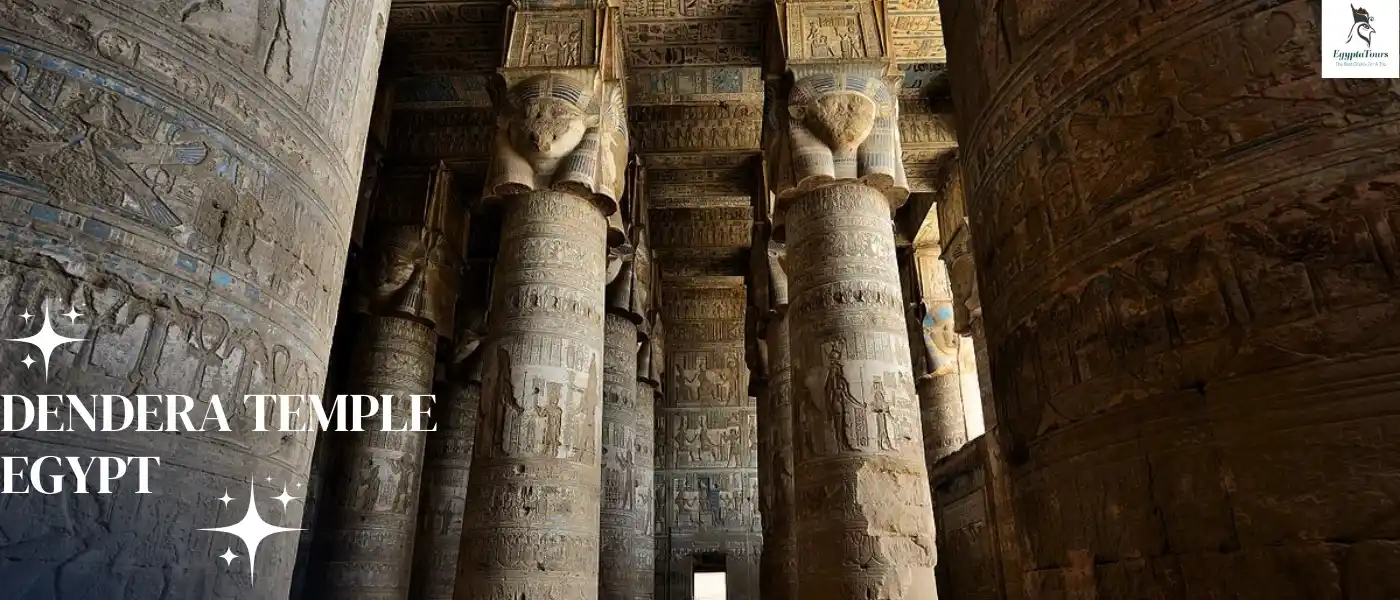
Originally called Tentyris, Dendera temple Egypt was one of the most important religious centers in ancient Egypt.
Three sanctuaries made the city sacred: the Sanctuary of Horus, the deity of the sky and pharaoh’s protector; the Sanctuary of Ihy, Horus’s youthful sistrum-playing son; and the Sanctuary of Hathor, the Goddess of Love, Joy, and Fertility.
Just a few remnants of the other two can be found, while only the latter has practically survived intact.
The complex is surrounded by a mud-brick wall that contains the remains of many shrines and temples dating all the way back to the old kingdom (2575-2150 BC).
Although built by a dynasty of rulers who were not native Egyptians themselves, the design of Dendera temple has been found to be in accordance with that of other classical Egyptian temples, except for the front of the hypostyle hall, which the Emperor Tiberius is credited with building (according to an inscription above the door).
In the most ancient times, Dendera Temple must have had a sanctuary, which was destroyed and rebuilt several times.
There is evidence that the Old Kingdom pharaoh Pepi I built religious structures and a fountain at the site, and there are still remnants of Dendera temple constructed during the eighteenth dynasty (during the New Kingdom).
There is evidence that the first building on the site went up around 2250 BCE, but the standing structures mostly date from the Ptolemaic era forward. The Mentuhotep II monument was the oldest standing building when the site was rediscovered, and it is believed that construction on it started in 1995 BCE.
The Mentuhotep monument has since been moved to Cairo. The oldest structure currently there is from Nectanebo II, built around 345 BCE.
All that said, it may be more accurate to say the structure as we know it began in 54 BCE, when construction began on the Temple of Hathor, the most prominent structure at the Dendera complex.
What You Can See Inside the Dendera Temple Complex
What-You-Can-See-Inside-the-Dendera-Temple-Complex-EgyptaTours
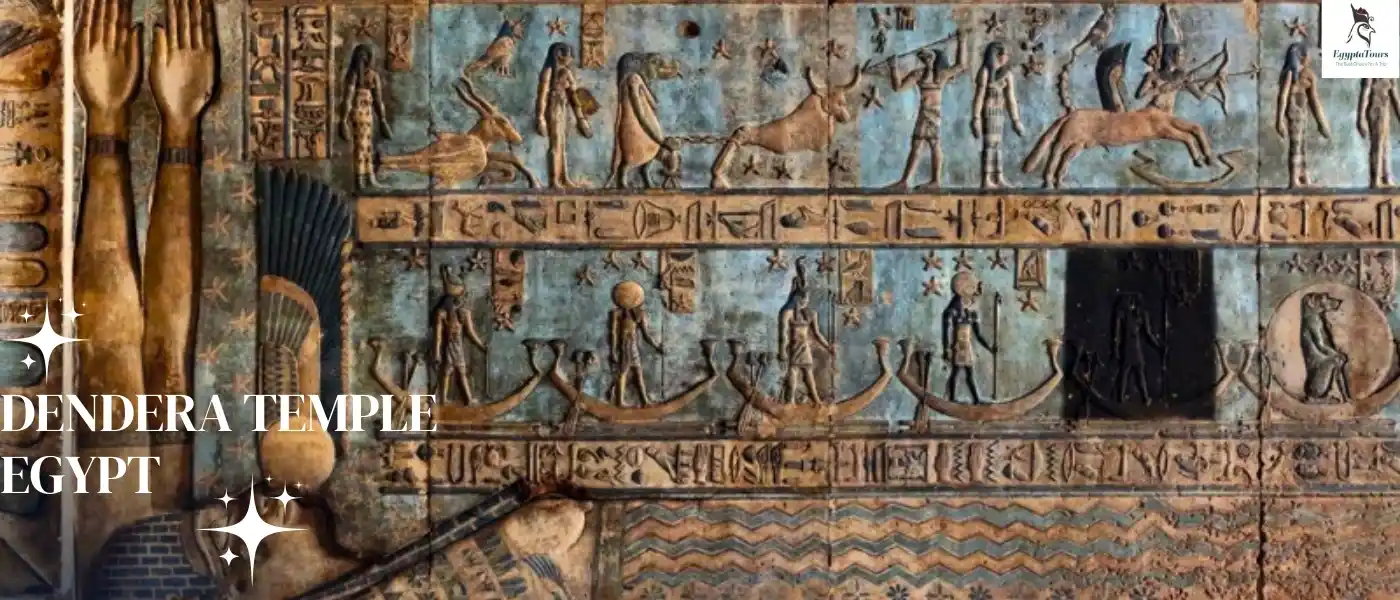
The present complex dates from the late Ptolemaic and Roman periods, specifically during the reigns of Ptolemy XII and Cleopatra VII.
This explains the predominance of a wonderfully scenic style, less severe than that of the oldest Egyptian temples, as shown in the lithograph of the interior of the first hypostyle room, a stunning chamber over 80 feet deep with 18 massive columns covered in bas-reliefs.
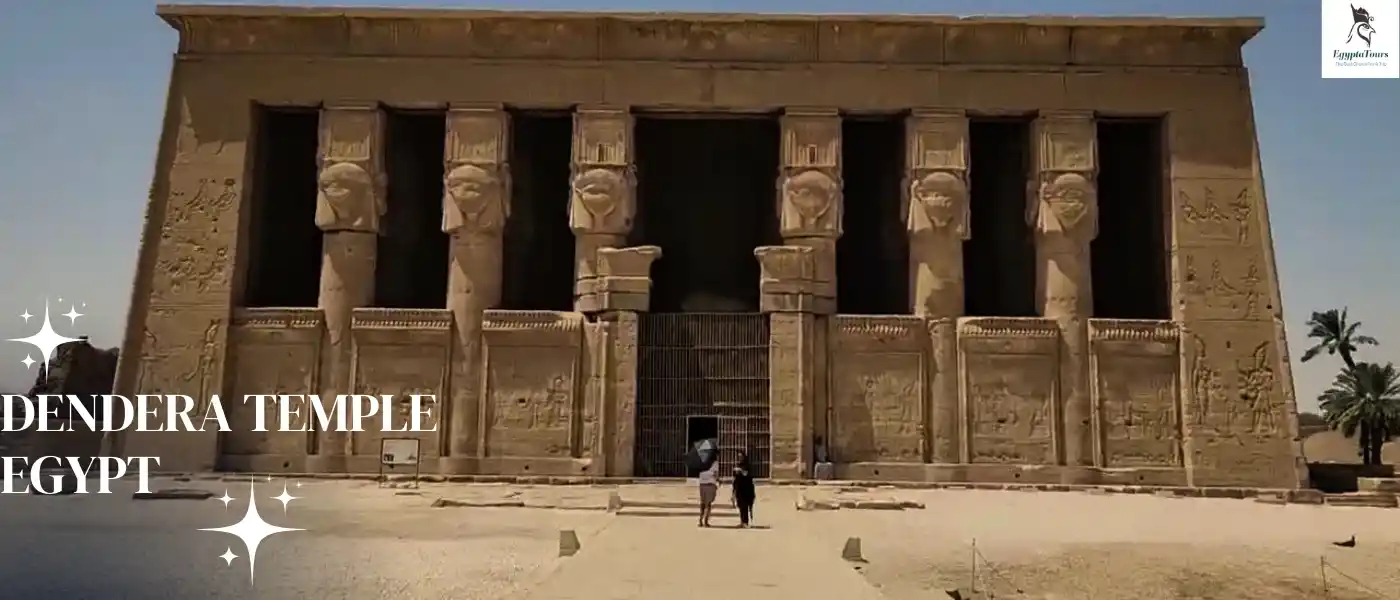
The temple of Dendera does not feature the pylon usually present in sacred Egyptian architecture; The building’s front is formed by a large structure spanning 139 feet wide by 60 feet high, with 6 columns on the façade supporting an outstanding cornice.
The intercolumniations are occupied as far as halfway up by panels covered with hieroglyphic texts and bas-reliefs, while the entrance opens in the center, forming a high, empty space wider than the adjacent ones.
Inside, 18 more columns stand in three rows; all the capitals reproduce the features of the patron goddess of the place.
To some extent, as it is higher than the rest of the temple, this hypostyle room, added under Tiberius, acts as the missing Pylon.
The Layout of the Dendera Temple complex
The temple complex at Dendera is quite large, boasting a basilica, two birthhouses, a sacred lake, and numerous other temples and shrines within its walls.
The site includes monuments from the Middle Kingdom, the Ptolemaic Era, and the time of Roman provincial rule, as well as buildings from other periods of ancient Egypt.
The Temple of Hathor
The-Temple-of-Hathor-EgyptaTours
Outside the Temple of Hathor, we first see six columns with Hathor style capitals. When we enter the first hypostyle hall, we find 18 very large columns, about 15 meters high and they look amazing.
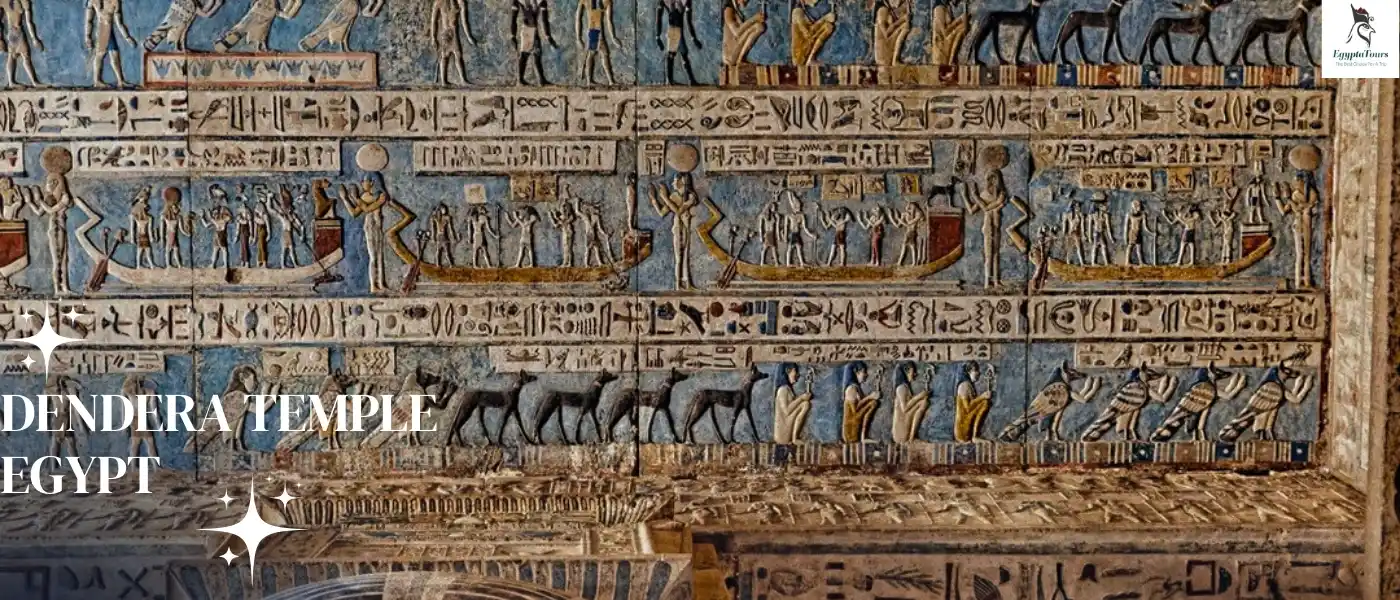
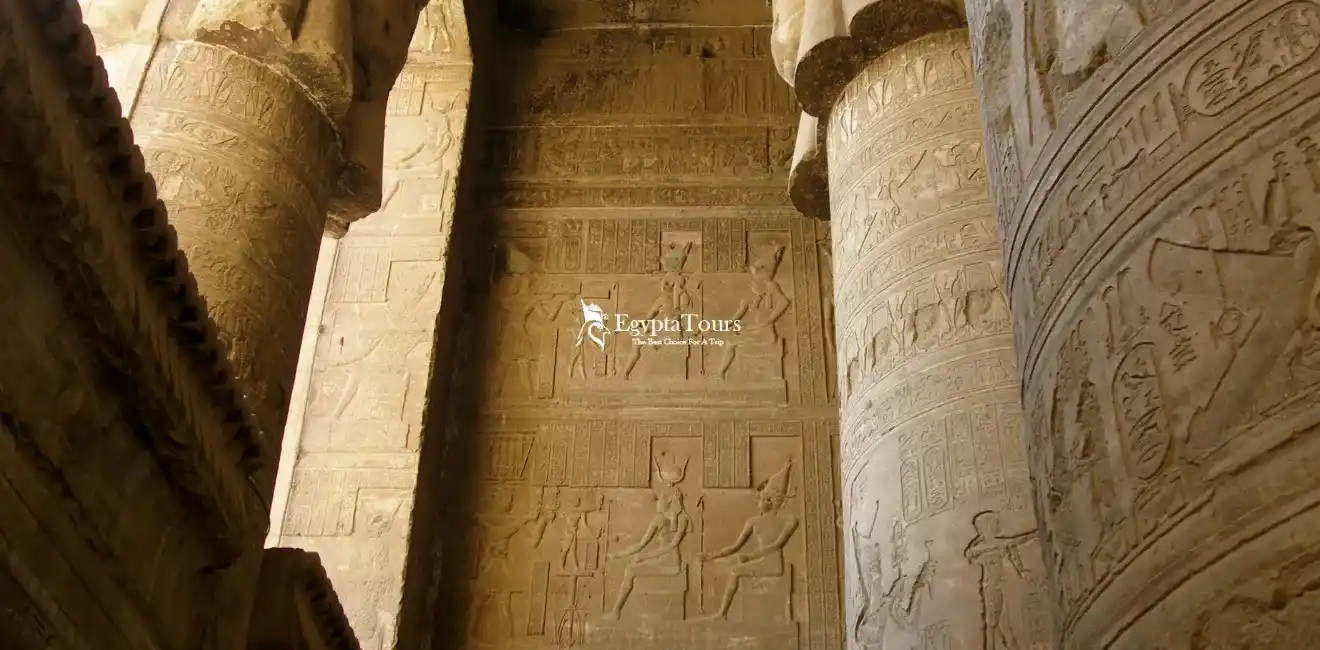
Every part of the temple is decorated. The walls, ceilings, and columns are all covered with hieroglyphs that tell stories. The tops of the columns look like a sistrum, which was Hathor’s musical instrument, and each column ends with the head of the goddess.
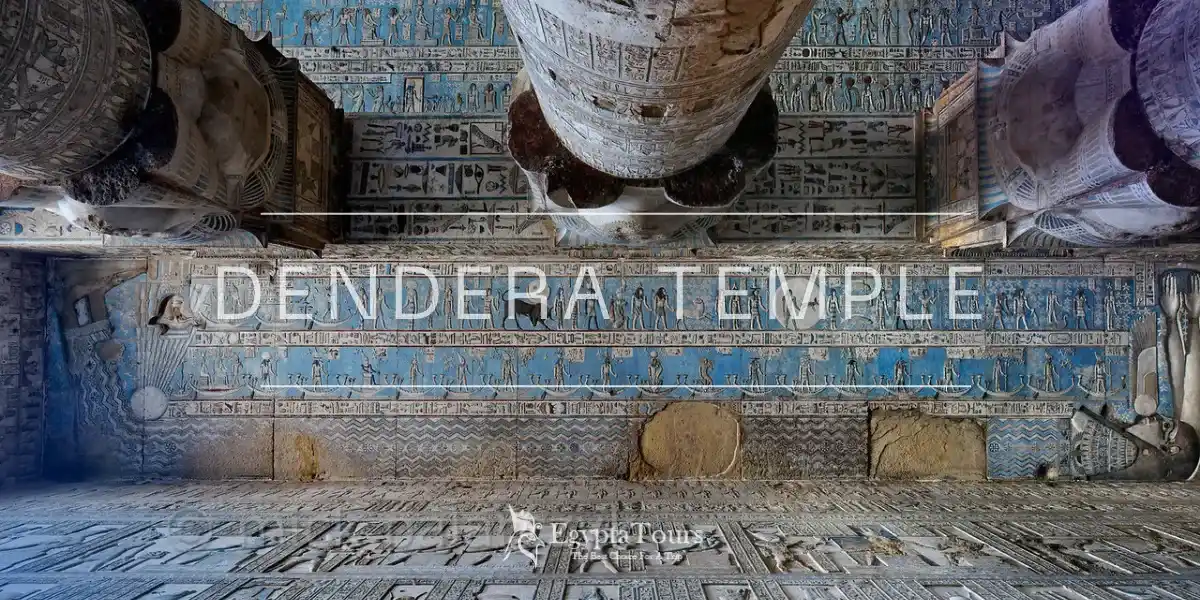
The ceiling is richly decorated with hieroglyphs on a blue background. We can see the sky goddess Nut bringing the sun into the world. The hieroglyphs on the walls talk about the dedication of the temple and include many records about astronomy.
The second hypostyle hall was the place where the statue of the goddess Hathor appeared when she left her sanctuary during festivals and religious processions in the temple.
It has six columns that mark the right and left sides of the corridor after the first hall. On both sides, there are small rooms, such as the Treasure Room, offering rooms, and storage rooms for keeping offerings.
This area was lit by four windows in the roof. In the Temple of Hathor, there are several windows that allowed light to enter the temple. In one of the other rooms, there was a sacred boat used to carry Hathor in processions along the Nile to the Temple of Horus in Edfu.
Deep inside the temple, you reach the holiest place where the statue of Hathor was kept. Only the Pharaoh and the high priests were allowed to enter this area. Around this sacred space, there were chapels where the people of the town could come to pray to the goddess.
To reach the lower part of the Temple of Hathor, you go down a staircase that leads to the crypt. This is where the temple’s secret papyri were stored.
There are two staircases that lead to the upper floor. One is spiral and represents the staircase of light. The other staircase is straight and was used to carry the statue of Hathor up to the roof during the summer solstice. On the walls, you can see carvings of priests bringing offerings to the goddess.
On the roof of the temple, there are two chapels: one dedicated to Osiris and another where the Dendera Zodiac was discovered. Outside the temple, on the southern outer wall, you can see the final and only image of the famous queen Cleopatra VII and her son Caesarion offering gifts to Hathor.
Why Dendera Temple Is One of Egypt’s Greatest Treasures
Many ancient Egyptian temples are now old and ruined, but Dendera has stayed almost unchanged. Its walls, ceilings, and carvings are still in very good condition, showing thousands of years of history like ancient people saw it.
The main building, the Temple of Hathor, was started in the late Ptolemaic period and finished under Cleopatra VII. Inside, visitors are often amazed by the bright colors on the ceiling, especially the deep blue, which still looks fresh even after more than 2,000 years. These colors lasted because the temple was buried under sand and silt for many centuries, which protected them from the sun and weather.
Because of this preservation, Dendera feels less like a ruined site and more like a sacred place frozen in time.
A Sacred Center of Healing and Worship
Dendera was more than just a temple; it was one of ancient Egypt’s most famous healing places. People traveled long distances to get cures through holy rituals, sacred water, and dream healing.
Hathor, the temple’s goddess, was connected to happiness, fertility, music, and protection. She is often shown with cow horns holding a sun disk, or as a cow, representing care and divine energy. Priests and priestesses served her with music, dancing, and rituals, believing that harmony itself could heal.
The temple had Special birth rooms for holy ceremonies ,Healing sleeping rooms where visitors waited for visions and Purification pools and holy wells.
Some researchers think that Cleopatra VII may have given birth to her son, Caesarion, in this temple, showing its importance to both royalty and religion.
Highlights Inside the Temple Complex
Highlights-Inside-the-Temple-Complex-EgyptaTours
The Great Hypostyle Hall
The main part of the temple is its large hypostyle hall, held up by 24 huge columns with Hathor’s calm face on top. The columns are almost 15 meters tall, making a stone forest under a ceiling painted with stars, planets and the sky goddess Nut. Standing here, you can’t help but feel amazed by the skill and effort of the ancient builders.
The Hidden Crypts
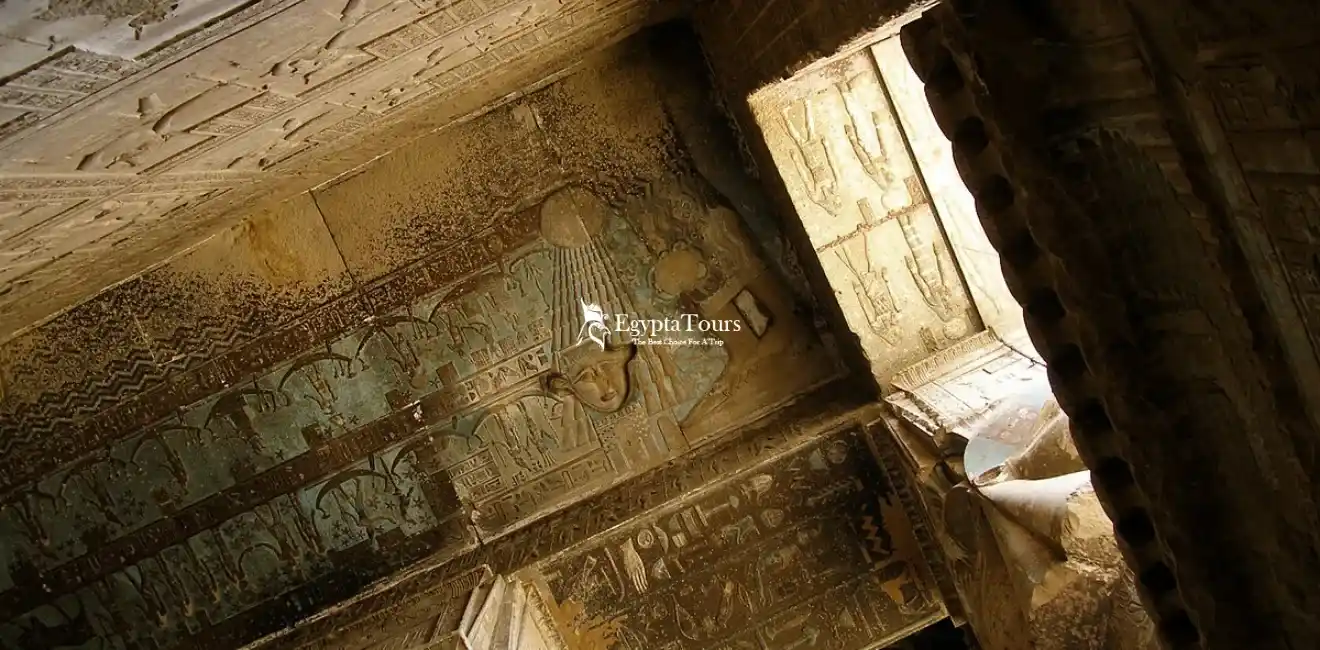
Under the temple is a group of small, narrow rooms that were once used to keep sacred objects. These rooms have some of Dendera’s most interesting carvings, including the famous Dendera Lights. While modern stories tell different myths about these images, experts say they actually represent creation and rebirth in Egyptian mythology.
Rooftop Chapels and Astronomy
Going up to the roof shows small temples dedicated to Osiris and the cycle of life, death and rebirth. This area used to have the famous Dendera Zodiac, a detailed star chart used to follow festivals and events in the sky. The original is now in the Louvre, but a careful copy lets visitors see its accuracy and beauty.
The Ancient Healing Complex
One of the most interesting parts of Dendera is its healing area. Visitors slept in special rooms hoping Hathor would give them healing dreams. The temple doctors used both spiritual rituals and herbal medicine, making it one of the first holistic health centers in the ancient world.
The Historical Significance of the Dendera Complex
The Dendera Temple Complex is one of Egypt’s most important religious places. Over time, it was rebuilt, expanded and renovated, showing the styles, gods and beliefs of different periods.
The site goes back to the old Kingdom and evidence shows that Pharaoh Pepi I of the sixth dynasty started the first buildings. This early stage made Dendera a place of worship that grew and changed over thousands of years.
Most of the buildings we see today were mainly finished during the Greco Roman period, with important work by Egyptian rulers of Greek and Roman origin. Roman Emperor Tiberius who ruled from 14–37 AD, added to the Temple of Hathor, the main part of the complex.
His work, along with that of earlier Ptolemaic pharaohs, shows a mix of cultures, as emperors and pharaohs used Egyptian symbols and rituals to honor Hathor and gain respect from the Egyptian people.
Besides the Temple of Hathor, the Dendera complex has other religious buildings that show how Ancient Egyptians practiced their religion. One is a small Coptic church, showing Egypt’s Christian period and how the complex changed with new religions. Another important building is the mammisi or birth house.
This temple is for the divine birth of Egyptian gods and focuses on the birth of Isis, the goddess of magic, motherhood and fertility. The birth house has carvings showing Isis, her son Horus and the sky events connected to their divine births.
Hieroglyphs in Dendera Temple
Hieroglyphs-in-Dendera-Temple-EgyptaTours
The hieroglyphs at Dendera are some of the most detailed and carefully made in Egypt. They show stories about Egyptian gods, the universe and religious life. These hieroglyphs record prayers, rituals and myths, often with carvings that bring Egypt’s gods and goddesses to life.
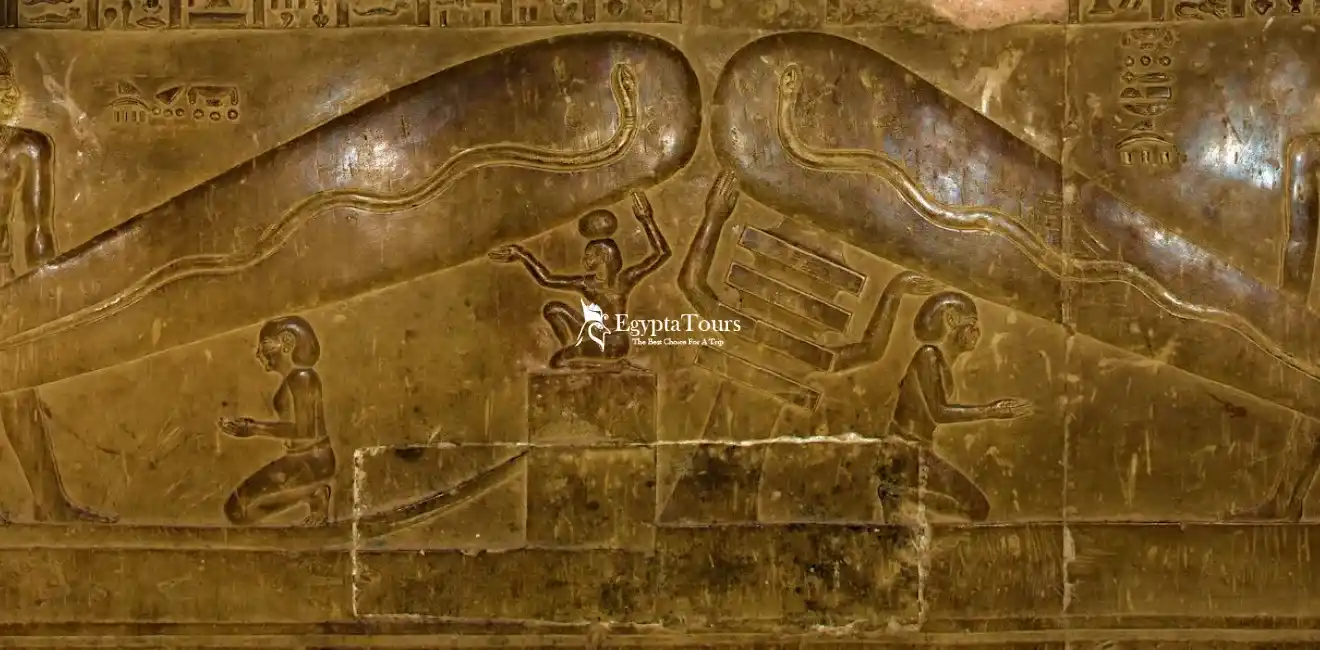
A well known and debated hieroglyph, the Dendera Light, shows a snake coming out of an oval container. Some people think it looks like an electric light but most Egypt experts say it represents the god Harsomtus and the story of creation.
The carvings in the crypt are special and have deeper meanings about divine energy and hidden knowledge. They are often thought to give blessings or protect sacred objects stored in these rooms.
Restoration and Preservation of Dendera Temple
Restoration work at Dendera started in 2005 to protect its bright colors and detailed decorations that make it famous worldwide. The work stopped in 2011 because of political and social problems but began again in 2017.
Experts have worked hard to clean and strengthen the temple and bring back its original colors. Working with the french Archaeological team, Egyptian authorities are also turning parts of the site into an open air museum to make it easier for visitors and help people learn about its history and culture.
Facts of Dendera Temple
- The Dendera Temple Complex is one of the best preserved temple sites in ancient Egypt, famous for its colorful and detailed Ptolemaic and Roman artwork.
- The site is large, covering about 40,000 square meters and is surrounded by a mudbrick wall that has protected it from weather and kept it strong for thousands of years.
- The main building is the Temple of Hathor, but the complex also includes other temples, small chapels, a sacred lake for purification, a healing area, and a Coptic church. Each building shows different periods of Egyptian history and religion over many centuries.
- Most of the current buildings are from the Greco-Roman period, but some parts go back to the Old Kingdom (around 2575–2150 BCE).
- A famous feature of Dendera is the Dendera Zodiac, a special star map. It was taken from the temple in the early 1800s and is now in the Louvre in Paris, where it continues to interest historians, astronomers, and art lovers.
Dendera Temple Mysteries
Dendera-Temple-Mysteries-Lamps-EgyptaTours
Dendera Temple is surrounded by many secrets that are still unknown. The meaning of the hieroglyphs in the temple has led to many different explanations, especially among people who enjoy mysteries.
Dendera’s Iamps
One of the biggest mysteries of ancient Egypt is how the Egyptians lit the inside of tombs, temples, and pyramids. It is not clear how they could see while working inside these dark places. If they had used torches or oil lamps, smoke would have covered the walls and ceilings with soot. However, no soot marks have been found in these buildings.
Some people believe the Egyptians used special oils that did not produce smoke. Others think they used mirrors to reflect light. However, this idea is hard to understand, especially in deep tombs like those in the Valley of the Kings or in the Temple of Dendera.
Under the floor of the Temple of Hathor, there is a crypt that can be reached by going down a complex staircase. At the bottom, several passages lead to one of the most mysterious bas-reliefs. These carvings have caused a lot of speculation, especially about what are known as the Dendera lamps.
In one of the crypt corridors, two figures are shown holding an object that looks like a light bulb. It also appears to show something similar to a large electric coil. Because of this, some people believed the ancient Egyptians knew about electricity. However, Egyptologists have rejected this idea. They explain that the images are actually mythological symbols, showing a djed pillar and a lotus flower, which represents Upper Egypt.
Dendera’s Zodiac
The Dendera Zodiac is on the ceiling of a chapel that shows the resurrection of Osiris. It was removed by a soldier from Napoleon’s army and taken to France. The original is now in the Louvre Museum, and the one seen here is a copy.
This was the first time a zodiac was shown in a circular shape. Before this, zodiacs were usually square or pyramid-shaped. The sky is shown as being supported by four women and spirits with cow heads.
The Dendera Zodiac shows all the zodiac signs. For the ancient Egyptians, each sign was linked to a season of the year and to their 360-day calendar. The star Sirius is also shown.
Interestingly, the Dendera Zodiac includes the oldest known date of the year and shows two eclipses. However, when experts studied the positions of the stars, they found they did not match the date written in the hieroglyphs. Instead, the zodiac seems to show the sky as it was about 650 years before it was made.
Because of this, scholars still debate whether the calculations were scientific or only symbolic. Either way, the Dendera Zodiac proves that the Egyptians had advanced knowledge of astronomy.
The Sculptures of Hathor and Bes
Here is one last interesting fact about the temple. In Egyptian art, gods and pharaohs were usually shown in profile in carvings and paintings. However, in this temple, the goddess Hathor and the dwarf god Bes are shown facing forward.
In the Temple of Dendera, there is a sculpture of Bes. He was a dwarf god with a satyr-like appearance who protected women and children. He was also linked to love and sexual pleasure. For this reason, his statue was placed in the house of birth.
The gateways of Domitian
The-birth-house-of-Ihy-EgyptaTours
The gateways of Domitian and Trajan are built into this mudbrick wall and lead to a large open courtyard. Exceptionally, the entrance to the temple of Hathor has neither a colonnade nor a pylon.
The Mammisi
To the right of the gateway there is a Mammisi ( a Roman birth house), which is often ascribed to Trajan but may also have been constructed by Nero.
The birth house’s dedication inscriptions and decorations refer to Trajan, but Nero is shown inside the hypostyle hall of the temple of Hathor presenting a model of the birth house as an offering, suggesting that he was involved in its construction.
Although it was built during the Roman era, this birth house is the latest one still standing and largely adheres to the traditional Ptolemaic model in many ways.
The Birth house of Ihy
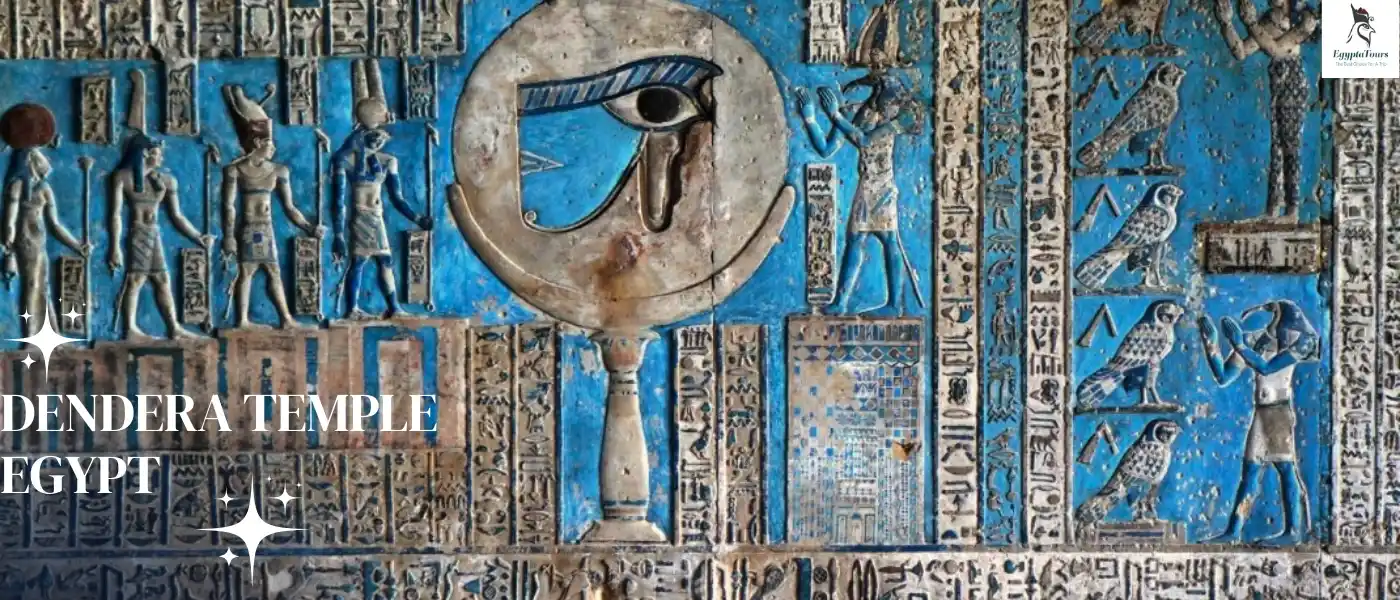
This birth house was the place where Ihy (Ahy) or Harsomptus (Horus the uniter of the two lands), two young deities who were said to be the sons of Hathor and Horus, were born ritualistically.
The divine birth and childhood of these two deities are depicted in stunning detail on the exterior walls. On the capitals of the columns surrounding the birth house, Bes—a patron of childbirth—is also depicted in numerous ways.
The Coptic Christian basilica and Mammisi of Nectanebo II
The ruins of a Coptic Christian basilica dating to the 5th century AD can be found next to this birth house.
There is a smaller birth house that was built by Nectanebo I and then further decorated in the Ptolemaic era between the Coptic church and the temple of Hathor.
Only the false door and a few of the decorations still remain in this building, which was partially demolished to make room for an expansion of the courtyard in front of the temple to Hathor.
The Ptolemaic pharaohs making offerings to Hathor and Khnum creating Ihy on his potter’s wheel while being observed by Heqet in the form of a frog were depicted on the walls of the birth house.
The sanatorium
A building known as the “sanatorium” can be found further south, next to the temple of Hathor.
This structure appears to be one-of-a-kind in Egyptian religion and architecture.
In essence, the sanatorium served as a spa where sick people could go to be healed by Hathor, who was revered as a goddess of healing.
There were sacred bathing waters, sleeping quarters (where the sick hoped to receive the goddess’s help in their dreams), and the priests of Hathor ran an early pharmacy, dispensing unguents and providing guidance on effective treatments.
An inscription on the base of a statue indicates that sacred texts were wetted with water, which then had the power to heal a wide range of illnesses, before being poured over the statues.
How To Get To Dendera Temple
The temple is about 82 kilometers north of Luxor, near the city of Qena. The easiest way to reach Dendera is by taxi, or you can join an organized tour from Luxor.
The trip takes about one and a half hours, and it leads to one of the best-preserved and most mysterious temples in Egypt.
Another way to go from Luxor is by train to Qena. The train ride takes about 45 minutes, and from Qena you can take a taxi to the temple.
Best Time To Visit Dendera Temple
Summer in Egypt is very hot, especially in the desert. The hottest months are June, July, August, and September, so it is best to avoid traveling then. It is also a good idea to avoid busy holiday times like Christmas, New Year, and Easter, when many European tourists visit the country.
The best time to travel to Egypt is in March, October, and November. During these months, the weather is comfortable and there are fewer tourists.
Why Dendera Temple Is One of Egypt’s Greatest Treasures
Many ancient Egyptian temples are now old and ruined, but Dendera has stayed almost unchanged. Its walls, ceilings, and carvings are still in very good condition, showing thousands of years of history like ancient people saw it.
The main building, the Temple of Hathor, was started in the late Ptolemaic period and finished under Cleopatra VII. Inside, visitors are often amazed by the bright colors on the ceiling, especially the deep blue, which still looks fresh even after more than 2,000 years. These colors lasted because the temple was buried under sand and silt for many centuries, which protected them from the sun and weather.
Because of this preservation, Dendera feels less like a ruined site and more like a sacred place frozen in time.
Highly Recommended Tour To Visit Dendera Temple
Conclusion
The Dendera temple complex is one of the best preserved in Egypt.
It is a very popular tourist attraction that is featured in several Nile River cruises from Luxor to Aswan or Luxor tours.
The grounds around the complex have been extensively landscaped, which makes the Dendera temple truly unmissable.
The Dendera Temple complex in Egypt is home to the Temple of Hathor, which is considered one of the best preserved temples in Egypt.
Built during the Greco-Roman period, the temple showcases stunning reliefs and astronomical ceilings that include detailed signs of the zodiac, reflecting the fusion of Egyptian and classical influences.
Dedicated to Hathor, the goddess of love and beauty, the temple also features vibrant colors and intricate carvings that have survived the centuries, offering a vivid glimpse into ancient religious and cosmological beliefs.
Live Your Dream Tour With Egyptatours Throughout Our Egypt Classic Tours Packages, Nile Cruises, Day Tours Or At Least You Can send us a request To Build Your Tour.
Discovering the Dendera Temple: FAQs
What is the Dendera Temple known for?
The Dendera Temple is famous for its well-preserved reliefs and carvings that showcase Ancient Egyptian art and architecture. It’s also known for the Dendera Zodiac, a celestial map carved into the temple’s ceiling.
Where is the Dendera Temple located?
The Dendera Temple is situated in the city of Dendera, near Qena, in Egypt. It’s on the west bank of the Nile River, about 60 kilometers north of Luxor.
Who built the Dendera Temple?
The construction of the current temple began under the Ptolemaic dynasty around 54 BCE and was completed by the Roman Emperor Tiberius. However, the site has been a place of worship since prehistory.
To which deity is the temple dedicated?
The Dendera Temple complex is primarily dedicated to Hathor, the Ancient Egyptian goddess of love, music, and fertility.
What is the Dendera Zodiac?
The Dendera Zodiac is a bas-relief carved into the ceiling of one of the temple’s chapels. It depicts the night sky and includes a unique representation of the zodiac signs.
Can visitors explore the temple’s rooftop?
Yes, visitors can access the rooftop of the Dendera Temple, which offers panoramic views of the surrounding landscape and the opportunity to see additional carvings and engravings.
What is unique about the temple’s hypostyle hall?
The hypostyle hall stands out for its 18 massive columns topped with detailed Hathor-headed capitals. These columns support a stunningly decorated ceiling rich with astronomical scenes.
Is the Dendera Temple open to the public all year?
The Dendera Temple is open year-round, but visiting hours may vary. It’s best to check with local authorities or tour operators for the most current information.
Are there any notable features inside the temple?
Besides the Dendera Zodiac, the temple is adorned with colorful reliefs, crypts with hidden chambers, and an extensive set of hieroglyphic inscriptions that provide insights into the religious life of Ancient Egypt.
How can I get to the Dendera Temple?
Visitors can reach the Dendera Temple via road from Luxor or Cairo. Many tour operators offer excursions that include guided tours of the temple complex.
What should I wear when visiting the temple?
Dress modestly and comfortably, as you’ll be walking and exploring. Lightweight clothing, a hat, and sunscreen are recommended, especially during the hot months.
About EgyptaTours

EgyptaTours is a name synonymous with trust, excellence, and unforgettable travel experiences, proudly standing as one of the leading travel agencies in Egypt. Renowned for its deep expertise, personalized service, and carefully crafted itineraries, EgyptaTours serves as the ultimate gateway to discovering Egypt in its most authentic and inspiring form.