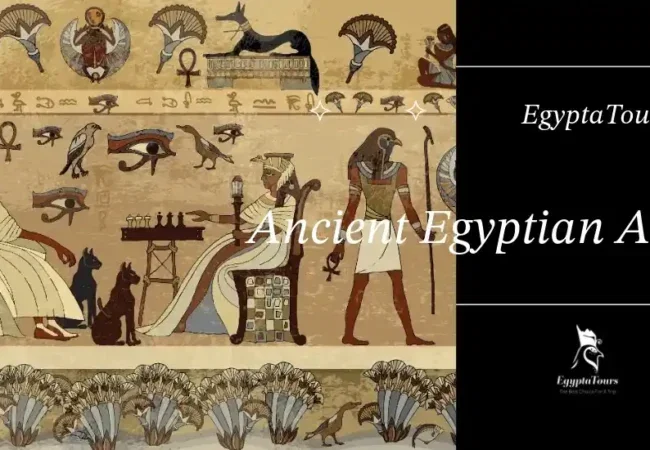
Ancient Egypt is full of wonders that are discovered by prospectors and explorers day after day, and this is what made it one of the most influential ancient cultures, as the Egyptians were known for their sharp minds and deep passion for life, and they were able to preserve their beliefs and concepts to this day, and this is what we know through archaeological sites.
Eye of Horus Meaning
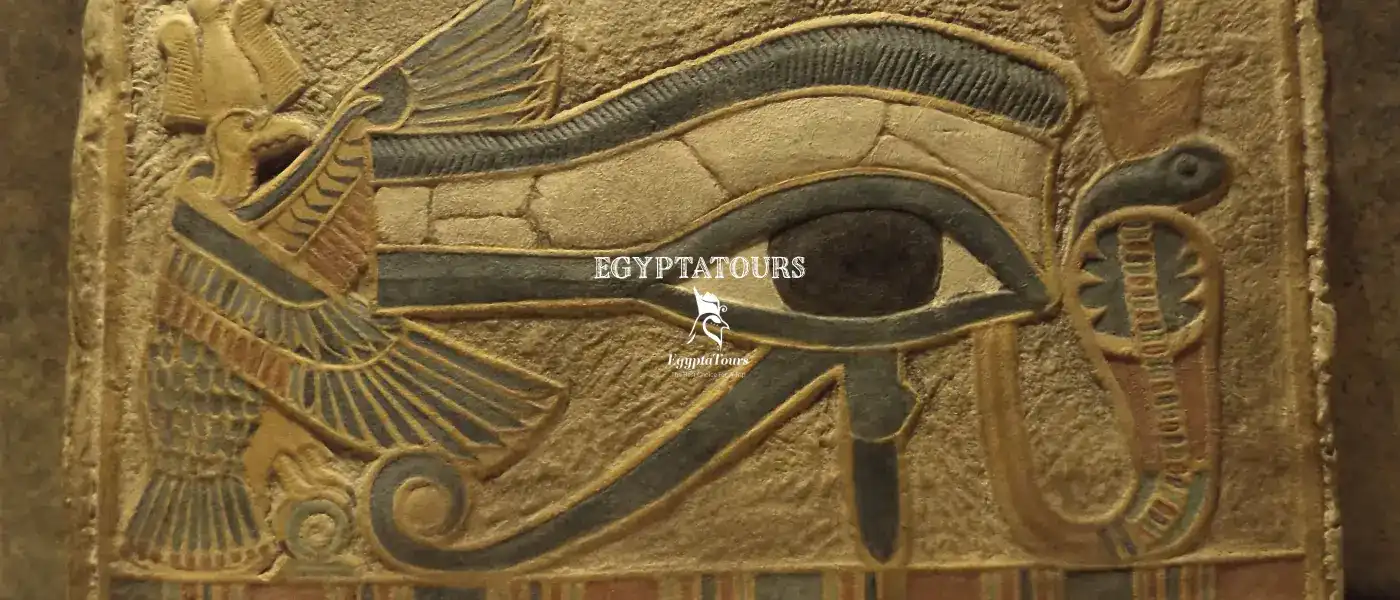
How-to-Harness-the-Protective-and-Restorative-Powers-of-the-Eye-of-Horus
The Eye of Horus is an ancient Egyptian symbol of protection, royal power and good health. The eye represents the goddess Wadjet, Edjo, or Utu.
It is also known as the “Eye of Ra”.
The name Wadjet Is derived from “wadjet”, which means “green”, and therefore “green”. She was known to the Greeks and Romans as “Auraeus”, from the ancient Egyptian “earet”, meaning “erect”, from the image of a cobra erected for protection.
Wadjet was one of the oldest idols. Egyptian and later became associated with other goddesses such as Bast, Sekhmet, Mut, and goddess Hathor. Wedjet was the guardian goddess of Lower Egypt and the main shrine of the Delta was under her protection.
Hathor was also depicted with this eye.
Funeral amulets were often made in the shape of the Eye of Horus.
The eye of Horus is the “main element” of the seven bracelets made of “gold, porcelain, carnelian and lapis lazuli” that were found on the mummy of Shoshenq II.
It was found to be “the protector of the pharaoh in this life and the afterlife” and to ward off evil.
The sailors of ancient Egypt and the Near East used to draw The symbol is on the bow of their ships to ensure the safety of their sea voyage.”
Eye of Horus Symbol
Horus is considered the first god who was worshiped in ancient Egypt.
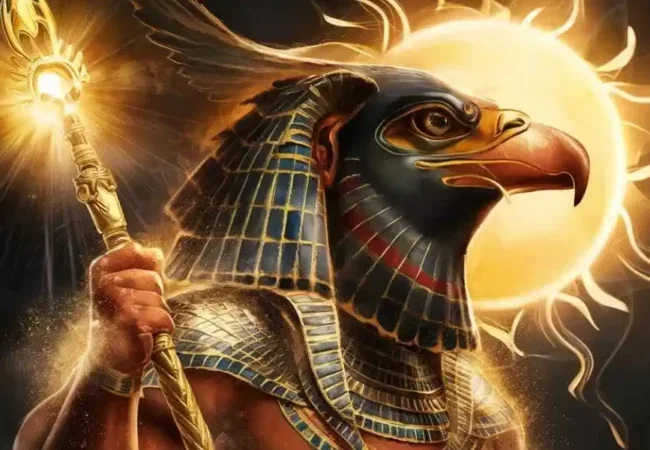
The Egyptians considered him the god of the sky, and they embodied him in the form of a man with the head of a falcon.
The Eye of Horus was used in funerals, amulets, and on coffins, because it embodies the god’s vision of mortal life, and an eye that guides the Pharaoh during his journey from life to death.
Therefore, the Egyptians believed that the Pharaoh represented the god of heaven, and that the spirit of Horus was transmitted from the Pharaoh after he died to the next Pharaoh.
“The significance extended beyond religious beliefs and into daily life, where it was used as a symbol of health and prosperity and it was thought to protect and guide the deceased on his journey to the afterlife.
Today, The Eye of Horus still serves as a protective emblem against wickedness.
Throughout history, the Eye of Horus was also known by other names, such as: Wadjet, The Real Eye of Horus, Udjat eye, and The Eye of Heru”
Eye of Ra Ancient Egyptian symbols
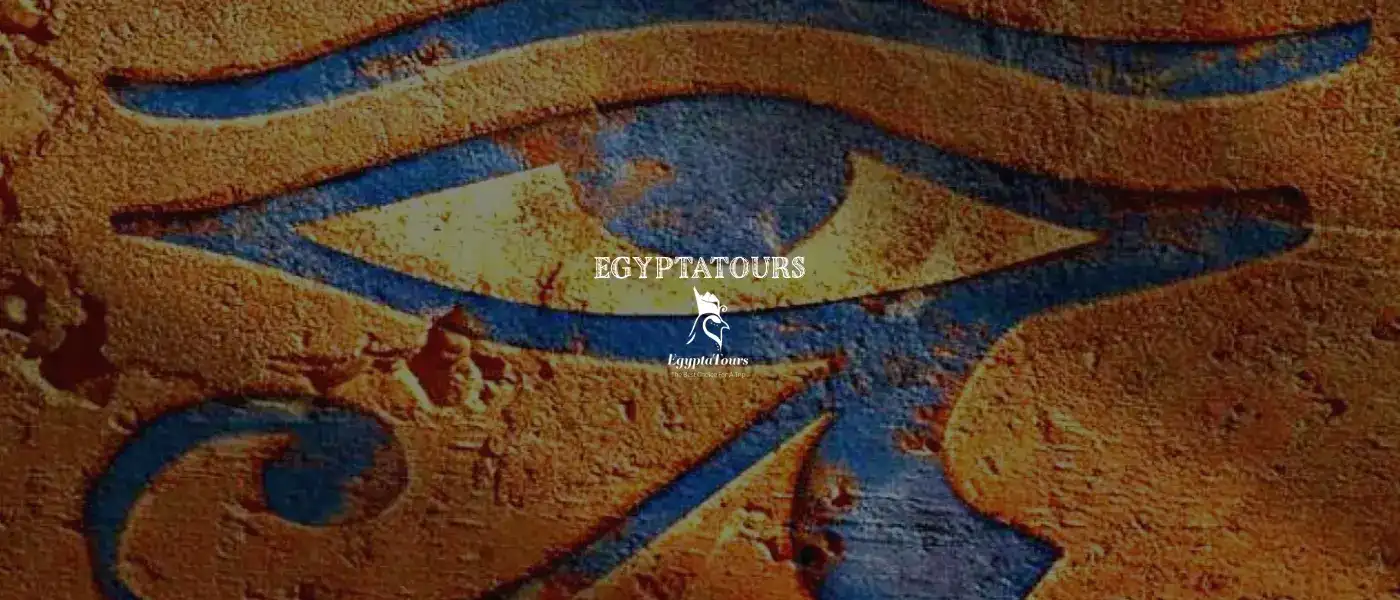
Eye-of-Ra-Ancient-Egyptian-symbols
The Eye of Ra (in English: Eye of Ra) is one of the symbols used by the ancient Egyptians to symbolize strength and anger.
What is meant by the Eye of Ra is the right eye of Ra, the sun god of the Pharaohs, so it was linked and embodied in the form of the body of a man and the head of a falcon with a sun disk above it, surrounded by a cobra.
The significance of the Eye of Ra inscription in the Pharaonic civilization
It is worth noting that the Eye of Ra represents the female face of the sun god, and was engraved on walls and amulets for protection, considering that it is the destructive and violent force of the sun.
The Eye of Ra can be seen in many texts that refer to the Pharaonic civilization, where it was directly linked to the gods.
Ra was appointed religiously in the Pharaonic civilization
The Eye of Ra is considered a religious symbol for the ancient Egyptians.
They used it during worship and during the performance of their religious rituals.
They considered it the mother of the gods, his sister, his daughter, or his friend, because they linked what the queens of Egypt wore on their heads to what the gods wore in their embodiment of them, and they also held celebrations.
With his protection for them, and with the things that the god Ra gives them, as they linked his presence to aspects of life, and the flooding of the Nile River after it dried up, as they considered this the return of the god to Egypt.”
The Eye of Horus is a powerful ancient Egyptian symbol that has captivated the minds of historians, archaeologists, and spiritual seekers alike. Often confused with the Eye of Ra, these two symbols hold distinct meanings and significance within the rich tapestry of Egyptian mythology.
In contrast, the Eye of Horus is a symbol of protection and healing, the Eye of Ra is often associated with the destructive power of the sun and the god’s role as a cosmic enforcer.
While the Eye of Ra is a symbol of the sun god Ra, representing his power, authority, and divine right to rule.
Those two powerful symbols have been found on ancient Egyptian jewelry, coins, and other artifacts, showcasing their continual significance in the cultural and spiritual landscape of the ancient world.
Understanding the nuanced differences between the Eye of Horus and the Eye of Ra is important for anyone looking for delve deeper into the opulent tapestry of Egyptian mythology and its permanent effect on human civilization.
Egyptian Mythology
Egyptian myths are those sacred stories that the ancient Egyptians believed in.
The myth is distinguished by its philosophical depth. Mythology at that time, like science now, was taken for granted in its contents.
In most cases, the characters in the myth were gods or demigods, but the presence of humans in them was complementary and nothing more.
Myth tells sacred stories that justify the phenomena of nature, for example, the origin of the universe, the creation of man, and other topics addressed by philosophy in particular and the humanities in general.
Among the most famous Pharaonic myths are: the Myth of Isis, the Myth of Osiris, the Myth of Uncle Set, and the Myth of Horus.
Eye of Horus Decoration
“The Eye of Horus is a great mention of the constant power of the gods to ancient Egyptians who used this special symbol as it has spiritual meaning in this sacred land. The symbol of Horus depends on six parts that represent a specific concept for each part such as:
1- The Pupil: The Pupil of the Eye of Horus “Udjat” or “Wedjat” eye, is a powerful symbol in ancient Egyptian mythology that portrays the eye of the falcon-headed god Horus and it is linked with protection and healing.
This eye is represented as a stylized human eye with types like a teardrop or a lotus petal.
The symbol was thought to protect against evil and spread blessings to Egyptians who showed or wore it in their houses.
2- The Eyebrow: The Eyebrow of Horus had major importance in ancient Egyptian culture, as this element symbolizes the domain of mind and mental condensation, and it also symbolizes the strength of fastened thinking and intellect skill.
The eyebrow is a visual reminder of the relationship between the Eye and the seeking for knowledge and as a symbol of protection as well as a doorway to higher consciousness of the gods of Egypt.
The Eyebrow also adds to the Eye of symbolism of the Eye of Horus as it appear the interwoven parts of physical and intellectual growth in Egyptian theology.”
3- The Sclera: The Sclera of the wonderful eye of Horus represents the ability to differentiate between good and incorrect which is symbolized in the white component of the eye.
This sacred image offers the importance of moral visibility in ancient Egyptian beliefs, and it was shown as a corset around the eye and a protector against harmful powers and bad influences.
This fantastic symbolism has a deeper cultural meaning as it centers on the great importance of maintaining equity.
The Sclera became a strong symbol as it represented not just physical sight but a spiritual understanding required to make the right decisions.
4- The Right and Left Eye: The power of the sun is symbolized by the Right Eye of Horus which represents reason and male vitality, and it stands as a symbol of order, and the Left Eye is linked with the moon and it represents feminine energy and creativity.
The Right and Left Eyes of Horus represent the equation of conflicting energies and the peaceful union of duplicity.
This ancient iconography had a deep understanding of universal balance and oneness.
5- Teardrop: The Teardrop of Horus has fantastic meaning in ancient Egyptian mythology as its characteristic teardrop shape is drowned below the eye, and it carries the meaning of sacrifice and revival.
This amazing symbol is a heartbreaking image of the sadness of God “Horus” for his father God “Osiris” in ancient Egyptian mythology.
The Teardrop of Horus exemplifies the continuing religious practices of ancient Egyptian civilization and its premeditation into the secrets of existence.
6- The Wedjat Markings: The Wedjat Markings on the Eye of Horus are symbols that have passionate meaning, as these lines outspread from the outer eye corners describe the feathers of a falcon, and express the notion of protection.
You will be surprised once you look at the Wedjat Markings as they are reminded of the outstanding spiritual connection between the symbology and the protecting powers in ancient Egyptian beliefs.
These six parts of the Eye of Horus are also attached to the six senses: sight, smell, taste, hearing, touch, and mind.
Eye of Horus Vs Eye of Ra
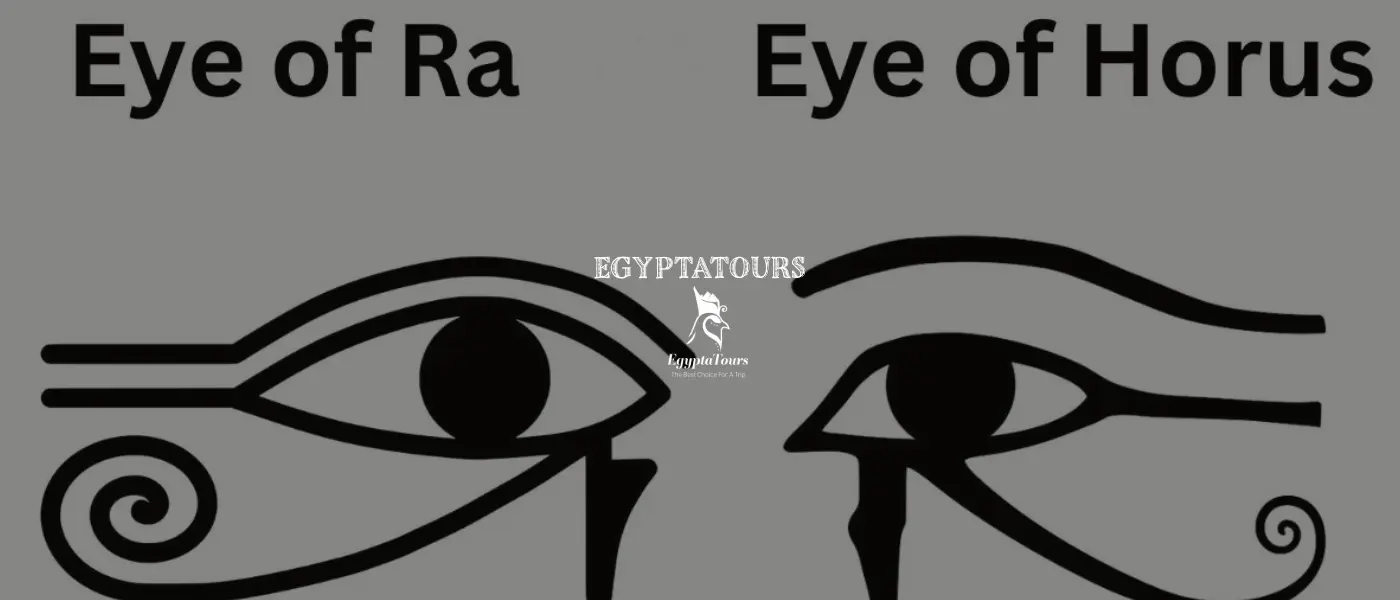
Eye-of-Horus-Vs-Eye-of-Ra-EgyptaTours
Horus was an Egyptian god who was linked with the sky, justice, royalty, and protection.
The Eye of Horus is exemplified as a scared eye with patterns that symbolize a falcon’s feathered plumage. The Symbol is also connected to monarchy, healing, and protection, and it was thought to have magical and protective power.
Ancient Egyptian mythology depicts Horus losing his left eye in a fight with his uncle “Seth”, and the God “Thoth” then restored the eye.
This fight symbolized recuperation and rebirth, and the lost repaired eye became a strong protective symbol and was used later as a talisman.
“Ra” was an important idol in ancient Egyptian religion, and he was connected with the sun, creation, rebirth, and life, and it was symbolized by the Eye of Ra which is a fierce and combustion eye.
The Eye of Ra also portraits the sun’s wakefulness as well as its potential to kill enemies and bring evildoers to equity.
The Eye of Ra is also linked with light and godly wisdom.
There are several ancient mythologies about the Eye of Horus is said to be a portrayal of the Eye of Ra, as it represents a unified idea of divine vision and protection.
This ancient symbol has importance in Egyptian mythology where it is linked with great deities like Horus and Ra.
The eye is a mark of good health, royal authority, and protection from bad powers, and its usage in mythology offers the interdependence of many sections of the divine in ancient Egyptian belief systems.”
The Eye of Ra is an important part of Egyptian history and mythology, symbolizing the sun god Ra’s power and protection.
Often depicted as a fierce, female deity, the Eye was believed to defend against the forces of chaos threatening the world.
In some stories, the Eye was dyed red to represent her fiery and destructive nature, showing her role as both a protector and a punisher.
The Eye of Horus and its Importance in Ancient Egyptian Belief
It is one of the most common ancient Egyptian symbols found inside tombs and on coffins. It is a single eye looking directly forward and became a symbol of health and protection in the belief of the ancient Egyptians. In their belief, it protected them from evil spirits, envy, diseases, and harmful animals. Therefore, it was widespread in the form of a necklace that they wore and adorned themselves with, and it was made of gold to protect the pharaohs.
It was first drawn on ancient Egyptian coffins in the year 2200 BC, and they believed that it looked into the world of the living. The ancient Egyptians used it for many purposes.
The Complete Legend of the Loss and Restoration of the Eye of Horus
This legend was widespread in Egypt in the pre-dynastic era. Horus was the son of the god Osiris and represented the god of good for the ancient Egyptians. He was killed by his brother Set, who represented the god of war, the desert, and chaos in ancient Egypt. Thus, Set occupied the kingship of Egypt, and it became one of the worst eras in Egyptian rule due to Set’s injustice.
Isis, the wife of the god Osiris, managed through magic to bring her husband back to life once more, until Set killed him again and cut his body into 40 pieces. Isis, accompanied by some of her companions, collected these pieces and tried to bring him back to life again, but she could not, and he remained stuck between the world of the living and the dead and became the ruler of the underworld.
Isis gave birth to Horus, the son of King Osiris, and she taught him the arts of fighting well so that he would later return to avenge his father from Set. Horus fought a great series of battles against his uncle Set and was victorious in many of them. But during one of the battles, Horus lost his eye, as Set tore it out and threw it away.
His wife, Hathor, later restored it, and this eye then became a symbol of warding off evil, protection, healing, and bringing good. They believed that the right part of the eye symbolized the sun, masculine energy, and logic, while the left part symbolized feminine energy, creativity, and the moon, and this embodied cosmic balance.
Numerical and Mathematical Symbols within the Design of the Eye of Horus
The ancient Egyptians used the symbol of the eye in calculation, where it was used for fractions. The left part of the eye represented a half, while the pupil represented a quarter, the eyebrow represented 1/8, the right part of the eye represented 1/16, the eyelash represented 1/32, and the teardrop represented 1/64. This greatly helped the ancient Egyptians in volumes and measuring agricultural areas.
The Eye of Horus as a Protective Amulet in Daily Life
Many Egyptians used necklaces and amulets containing the eye and believed that it was a source of positive energy and helped them achieve their goals. It was also a symbol of wealth for men, and they also believed that it helped them acquire wisdom and plan the family budget correctly.
Many ancient Egyptians thought that the eye protected them from negative electromagnetic influences, helped improve blood circulation, improve the immune system, fight cancer cells, help in the speedy healing of wounds, deep sleep, reduce inflammation, protect from magic and envy, increase concentration and attention, delay aging, regulate body temperature, and relieve nervousness.
The Role of the Eye of Horus in Religious Rituals inside the Temples
There are some ancient Egyptian legends that say that Horus himself plucked out his eye and offered it as a sacrifice to the gods. Therefore, it was used extensively in funerary rituals, and they said that it was a stylized eye that indicated special signs. There are some ancient Egyptian texts that indicated that the eye represents the sun god, and therefore it was personified with Ra, the sun god, and then there became the solar disc eye and the lunar Eye of Horus.
The Doctrinal Difference Between the Eye of Horus and the Eye of Ra
The eye was very similar to the Eye of Ra, but one represented the right eye and the other represented the left eye. It was believed that the Eye of Horus was a stylized falcon eye that symbolized healing and protection and was used for many purposes, including medical and mathematical ones.
While the Eye of Ra is a human eye that resembles the sun, and it represents the power of anger, divine intervention, and an extension of the will of the god Ra. They believed that it was a bridge between the divine and humanity, a symbol of royal authority, a guardian of the divine order, and a protector of the dead.
The Use of the Eye of Horus in Ancient Egyptian Medicine
The eye was used in ancient times in medicine, especially in the science of anatomy, and it expressed many things, such as the eye of truth, insight, the eye of the mind, and the eye of God in the human mind, according to their belief. They believed that the triangular-shaped body on the right side of the pupil of the eye represented the beginning of the sense of hearing.
The pupil of the eye represented the center of vision for the ancient Egyptians, and the eyebrow represented wisdom and thought. Therefore, the Eye of Horus was called the eye of the mind, and it represents the gathering of the white matter fibers inside the brain. As for hearing, it was represented by the triangular shape on the left side of the pupil of the eye.
As for the tail below the eye, it represents the sense of taste for the ancient Egyptians and resembled a tongue. As for the straight line coming from the eye from below, it represents the sense of touch, and it is very similar to the correct anatomy of the brain that we have reached now, and this indicates the skill of the ancient Egyptians in medicine and anatomy.
There are some ancient Egyptian medical papyri that used the eye as a treatment, as they believed that it invoked divine medical powers. Therefore, they used it in many spells to heal the sick and also used it for protection from eye diseases.
The Eye of Horus as a Symbol of Protection in Sea Voyages
Fishermen and sailors used the eye as a symbol of protection from evil and they used to draw it on their boats, whether for fishing or for trade, to protect them from the evil spirits that exist in the sea.
The Presence of the Eye of Horus in Pharaonic Jewelry and Amulets
The ancient Egyptians used the eye in many jewels and amulets. The common people used them from wood, while the high state officials, kings, and princes made them from gold and considered them a symbol of royal authority. They also believed that it protected them from disease, envy, and evil spirits.
The Eye of Horus and its Role in Funerary Practices and Mummification
The eye was one of the artifacts used in funerals, and they believed that it protected the dead and was their eye on the world until they were resurrected again. It helped in their protection and safeguarding from evil spirits until the resurrection. They used it in mummification because they believed that it guaranteed the safety of the body and a proper life in the afterlife.
The Eye of Horus and its Relationship with Astronomy and the Egyptian Calendar
It helped the ancient Egyptians in astronomy, as they used it to divide and calculate time accurately, and the division into small parts helped them in the ease of calculation. They also considered it a symbol of the moon and used it to follow the movement of the planets and stars in the sky and to create the calendar.
They believed that it was able to see different locations at the speed of light and that it was evidence of communication with the spiritual world and a gateway to understanding the depths of the universe in ancient Egyptian culture.
The Presence of the Eye of Horus in Markets and Souvenirs in Egypt
The ancient Egyptians used it in necklaces and at that time they colored it blue because of its great religious significance for the ancient Egyptians. Some Egyptians also used it as one of the souvenirs for tourists and they made jewelry, rings, and bracelets from it, and they made them from gold and silver.
Many tourists who have visited Egypt buy it because it expresses an authentic Pharaonic symbol from thousands of years ago, and it is considered one of the most important current souvenirs found in many Egyptian markets.
Prominent Tourist Places to See the Symbols of the Eye of Horus
There are many ancient Egyptian places and monuments where the eye can be seen, because the ancient Egyptians used it extensively in their religious and funerary rituals and considered it a symbol of protection and a help to them in the other world.
1. The Temple of Edfu
The Temple of Edfu is located in the city of Edfu on the west bank of the Nile River. Its construction took about 180 years, and it is the second largest ancient Egyptian temple. It was built specifically for the worship of the god Horus and was constructed during the Ptolemaic period. On its walls are many ancient Pharaonic inscriptions that contain the myth of Horus and Set.
The Temple of Edfu was the center of many celebrations and festivals related to the god Horus, and the temple to this day still has stunning decoration and attractive architectural inscriptions.
2. The Temple of Kom Ombo
The temple is located on the east bank of the Nile River and has many inscriptions dating back to the Roman era, although it was established in the Ptolemaic era. It is distinguished by its unique design.
This temple was built specifically for the worship of Horus, who was symbolized by the falcon, and Sobek. It has many ancient Pharaonic inscriptions, the most important of which are the surgical tools used by the ancient Egyptian.
The temple is distinguished by its unique design, as the visitor passes through a hall that contains many columns and ends with two chapels: the northern chapel on the left for the worship of the god Horus, and the southern chapel on the right for the worship of Sobek, who was associated with fertility, floods, and plants for the ancient Egyptians.
3. The Temple of Philae
The Temple of Philae is one of the most famous ancient Egyptian temples. It was built by King Ptolemy II and established by Isis, the mother of the god Horus. Isis appeared on the walls of the temple celebrating the birth of her son Horus and breastfeeding him in the thickets.
The Roman emperor was depicted offering sacrifices to Isis, her husband Osiris, and their son Horus. This museum was flooded after the construction of the Aswan High Dam, and UNESCO helped save it.
4. The Temple of Karnak
The Temple of Karnak is the largest temple in the history of ancient Egypt and includes a group of temples, as it was one of the largest religious landmarks for the ancient Egyptians.
It was built on the east bank of the Nile River in the city of Luxor (formerly Thebes).
It was built specifically for the worship of the god Amun, who was a symbol of wealth and power for the ancient Egyptians.
It has a group of temples, such as the great chapel of Amun, the chapel of Montu in the north, the temple of Akhenaten, which was built for the worship of Aten, and the chapel of Mut, the wife of Amun. It is connected to the Luxor Temple through the Avenue of Sphinxes, which is decorated with a large number of statues on the right and left.
The walls of the Karnak Temple are decorated with many wonderful inscriptions, and it has great columns and huge statues, as the great hall alone contains 135 columns.
There are two huge obelisks in it, each about 30 meters high. The priests used to perform many religious rituals in it, and therefore it is one of the most important ancient Egyptian temples that reflects the arts and architecture of the ancient Egyptian.
5. The Temple of Luxor
The Luxor Temple is one of the ancient Egyptian temples located south of the Luxor Temple. Its history dates back to the Eighteenth Dynasty, and many religious celebrations of the ancient Egyptians were held in it.
The celebration known as the Opet Festival was held in it, in which the god Amun visited the Luxor Temple in a majestic procession.
It contains a hall with many columns and was decorated with many ancient Pharaonic pictures of the Opet Festival. It has a large courtyard consisting of two wings, and it has a group of huge statues and some inscriptions in the Roman and Greek style.
The Eye of Ra vs. The Eye of Horus: Power and Protection in Ancient Egyptian Mythology
The Eye of Ra and the Eye of Horus are two powerful and significant symbols in ancient Egyptian mythology, but they represent different concepts. The Eye of Ra is associated with the sun god Ra and symbolizes his immense power, wrath, and protection.
It was considered a destructive force used by Ra to defend against his enemies and maintain cosmic order. Often linked to the goddess Sekhmet, it represented the scorching and aggressive aspects of the sun.
In contrast, the Eye of Horus, also known as the Wadjet, is a symbol of healing, protection, and restoration.
It originates from the myth of Horus, the falcon-headed god, who lost his eye during a battle with Set, the god of chaos.
The eye was later restored by the god Thoth, and from then on, it became a symbol of wholeness, recovery, and protection. While the Eye of Ra is more closely tied to divine authority and power, the Eye of Horus is associated with healing, well-being, and safeguarding.
Both symbols, however, played vital roles in Egyptian culture and were used in various religious and protective contexts.
How to Harness the Protective and Restorative Powers of the Eye of Horus
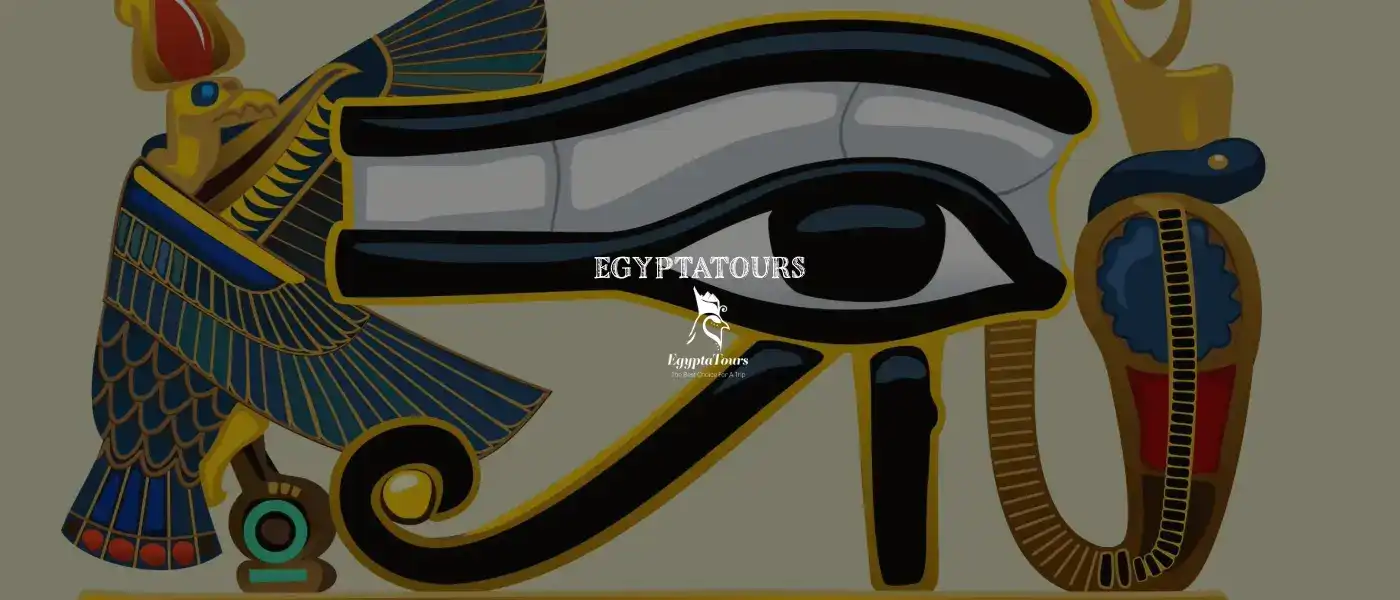
Eye-of-Horus-Decoration-EgyptaTours
Eye of Horus amulet The Eye of Horus is thought to have the strong power to ward off evil and protect people from harm, and to transcend beyond physical apology to spiritual and physical health. Ancient Egyptians could use the Eye of Horus to incoming a divine defense that protected them from negativity and kept their inner light to choose between right and wrong, good and bad.
The Eye of Horus serves also as a strong reminder of the Constant vigilance of the god and a sense of protection to ancient Egyptian people who used this unique sign.
The Eye of heru is a strong symbol of health, and growth that transcends religious contexts. This wonderful symbol is still important to many people around the world for its defense and also in many cultures.”
Eye of Horus Tattoo
“Tattoos, or what are called Pharaonic tattoos, are the latest things that prove that the world is in a state of love and fascination with the Pharaonic civilization, as they draw tattoos inspired by the Pharaonic civilization, and these tattoos have become a common tradition in the West, especially for celebrities and stars.
The Pharaohs are considered the first to invent tattoos thousands of years ago, as they used them for cosmetic purposes and were pricked with needles in the form of a huge necklace. The priests of temples also used them.
There are also those who used them with the aim of warding off magic, envy and evil spirits, as Queen Nefertari, wife of Ramesses II, did when she tattooed the Eye of Horus. .
Among the most famous forms of Pharaonic tattoos and tattoos followed by celebrities are hieroglyphics, the faces of Queen Nefertiti, Queen Isis, Tutankhamun, Cleopatra, and drawings of birds and ancient gods.
History of the Eye of Horus
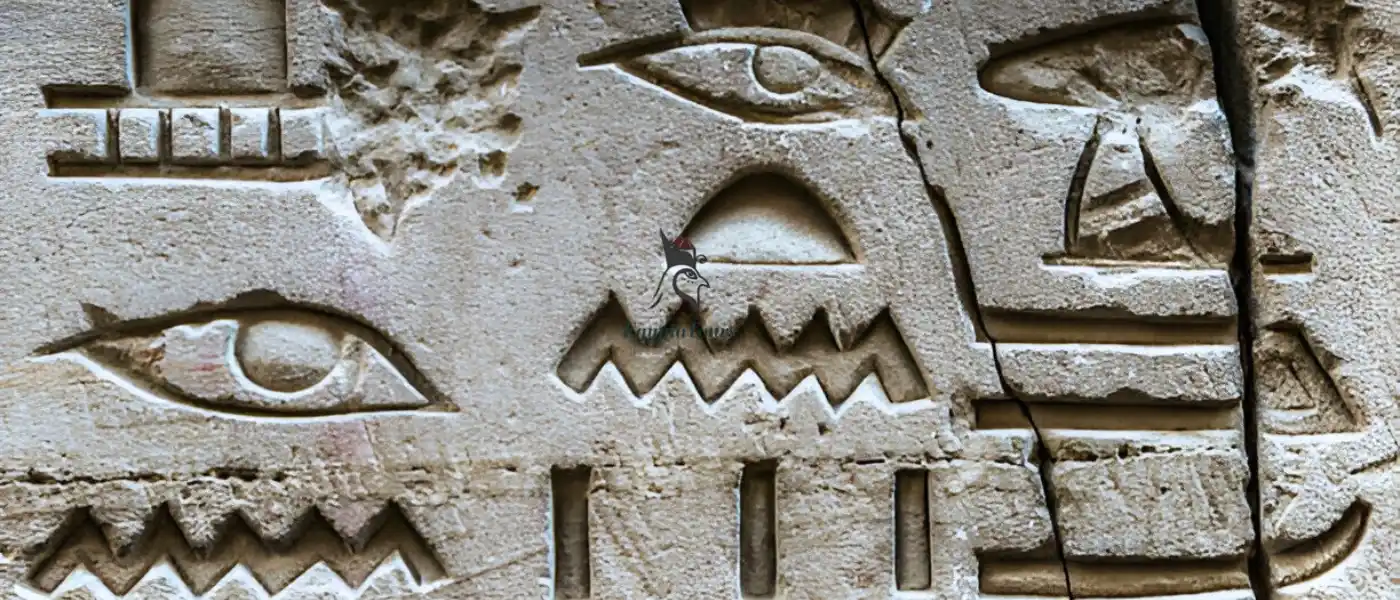
History-of-the-Eye-of-Horus-EgyptaTours
Horus was the son who bore the legacy of revenge and retaliation for the murder of his father Osiris who fell victim to the conspiracies of his brother Set.
Horus’s battle against his uncle was not just an ordinary conflict, but rather an extended epic that witnessed fierce battles and heavy losses, the most important of which was the loss of his left eye during the battle. H
owever fate did not leave him helpless as with the intervention of the wise Thoth or the goddess Hathor he regained his sight through a magical eye known as the Udjat which became a symbol of protection and supernatural power.
The Eye of Horus was not just a legend, but rather turned into the most powerful magic spell known to the ancient Egyptians as Horus himself used it to bring his father Osiris back to life giving it a sacred form that made it spread among the nobles and rulers.
This eye also had the unique ability to strengthen vision heal eye diseases, and protect the living from envy and evil.
It was also used to protect the dead and grant them eternal peace.
It was not just a symbol, but rather the secret of strength health, and immortality in the belief of the ancient Egyptians.
The reason for the use of the Eye of Horus by the Pharaohs
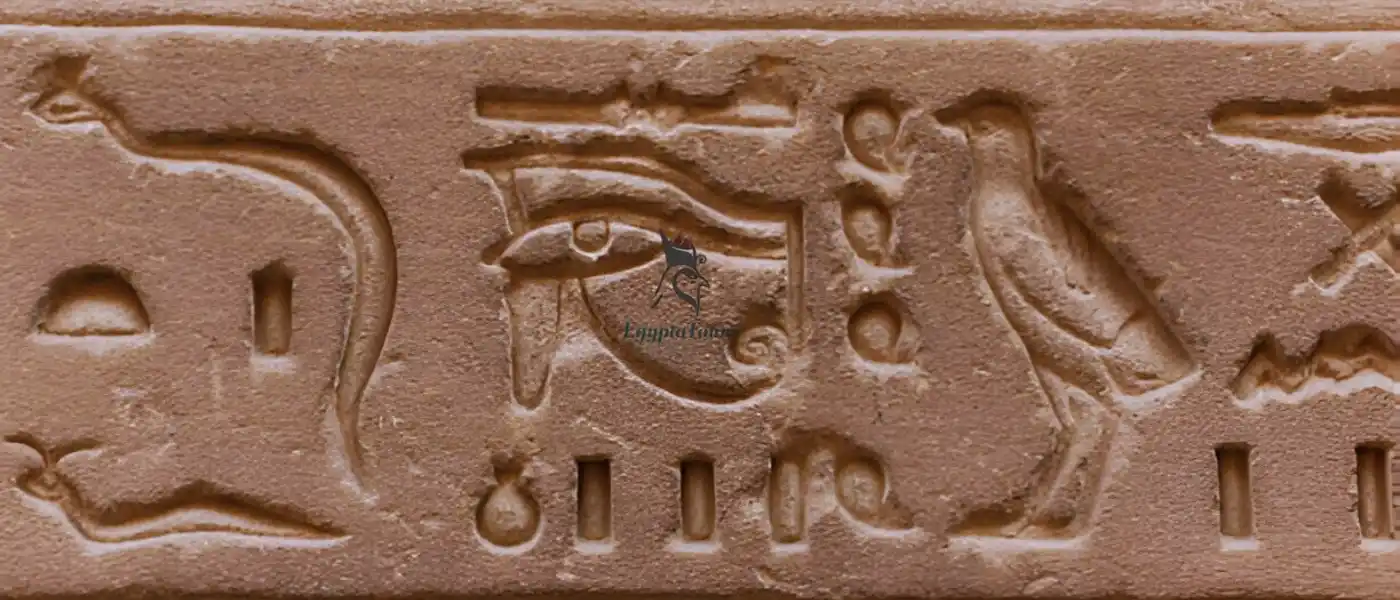
The-reason-for-the-use-of-the-Eye-of-Horus-by-the-Pharaohs-EgyptaTours
The Eye of Horus carries more than just a symbol of protection as it represents the essence of the eternal struggle between light and darkness, insight and delusion.
According to historian Khaled Youssef Al-Hanafi Set, the god of chaos did not just kill Osiris, but also took out Horus’ left eye which was not just an organ of vision, but a window to total perception and deep spiritual awareness.
While he lost this eye Horus did not see the universe with his usual clarity, but rather saw the world through the eyes of his enemy with a distorted awareness dominated by selfish conflict and deception which caused him to lose his spiritual insight and his ability to distinguish between essence and appearance.
But the legend does not end here as with the return of Thoth the Lord of Wisdom the eye was returned to Horus thus restoring his divine light and inner sense which made him worthy of the throne of heaven justice and goodness.
Since then, it has become a symbol of divine power and protection, and the pharaohs adopted it as a sacred amulet that protects them from evil and maintains the balance of rule and the stability of states.
It was not just an eye, but a weapon against darkness and a shield that protects its owner from all visible and invisible evil.
The reason for designing the Eye of Horus in blue through the ancient Egyptian
The color blue has always been more than just a color in ancient Egyptian civilization as it carried spiritual connotations that made it associated with kings holiness and protection from evil.
Its choice in decorating tombs was not a coincidence, but rather an embodiment of the idea of divine protection from envy and evil spirits as it was considered a color that gives tranquility and shows the limitless expanse of the sky.
Horus is the lord and protector of the sky so the color blue was closely associated with him just as it symbolized the deceased’s journey in the afterlife.
After leaving life it is believed that the soul ascends to the heavens where it meets Osiris, the lord of death and the underworld and the father of the god Horus in a spiritual scene that shows the concept of resurrection and immortality in ancient Egyptian belief.
The Eye of Horus and Calculation
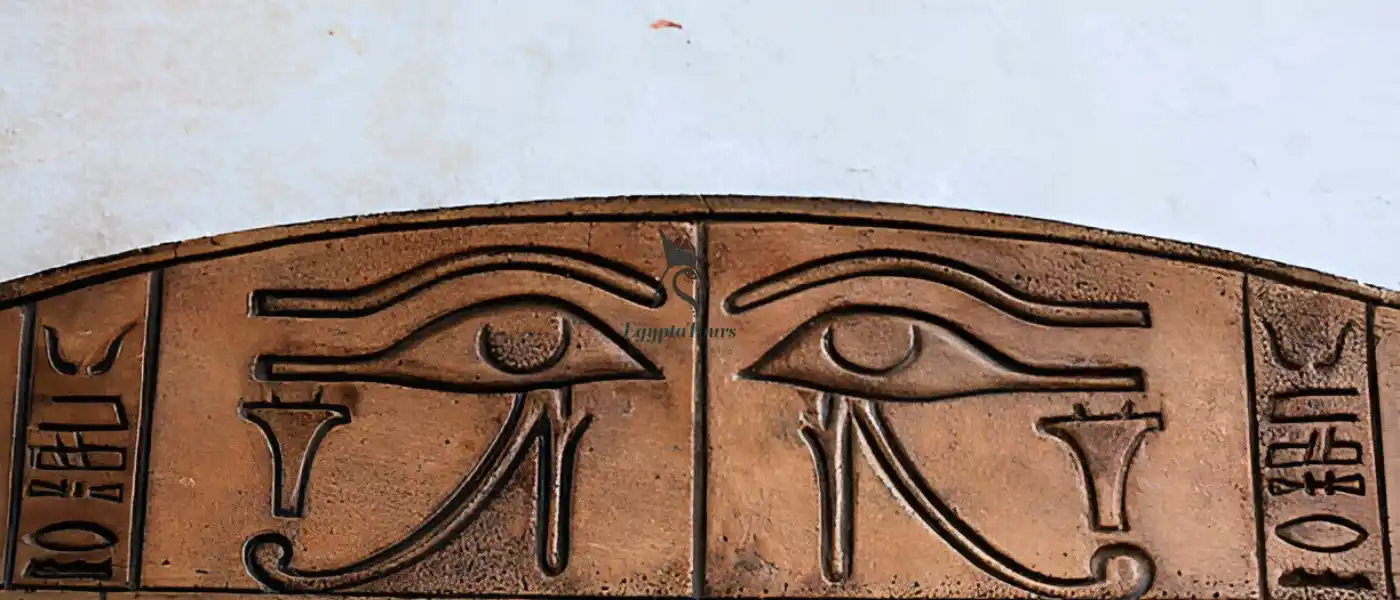
The-Eye-of-Horus-and-Calculation-EgyptaTours
The ancient Egyptians invented a mathematical system based on single fractions especially in measuring agricultural areas and volumes.
It is strange that the symbols of these fractions were inspired by the Eye of Horus as each part of it represented a specific fraction such as 1/2, 1/4, 18 up to 1/64, which helped them record accounts with amazing accuracy.
This system was used to divide crops and measures as the total values reached 63/64 which shows the accuracy of the Pharaohs in measuring resources.
The Egyptian sack “Khar” was equivalent to four “Haqeeqat” measures which proves their skill in integrating mathematics into daily life.
Freemasonry and the Eye of Horus
The Eye of Horus has always been surrounded by mystery and symbolism as Freemasonry adopted it as one of its most important symbols, and it first appeared in its official celebrations in 1797.
They also gave it many names such as “the eye of the soul” the eye of insight, and the eye that sees everything considering it a symbol of power and control over peoples, as it is often surrounded by a ray of light to indicate enlightenment and hidden knowledge.
Is it permissible to wear the Eye of Horus
The Prophet may God bless him and grant him peace did not use or recommend amulets whether they were made of paper fabric or other things, but rather he guided his nation to fortify themselves with the verses of the Holy Qur’an and to treat themselves with it through blowing and legal exorcism as the true treatment and true prevention lies in remembering God and trusting in Him, and not in hanging symbols that have no basis in Sharia, so a person must resort to the Qur’an and supplication as the Prophet may God bless him and grant him peace did to protect himself from harm and envy through legitimate means that achieve blessing and reassurance.
The Eye of Horus and Spiritual Science
The science of metaphysics has always been a focus of interest in ancient Egyptian civilization as the Egyptians sought to understand the hidden secrets of the universe, believing that there are invisible forces that rule the world although they remain beyond sensory perception and direct scientific experience while natural sciences depend on testing and experimentation.
The science of the occult in ancient Egypt was based on symbols and talismans that they believed allowed communication with those forces and among the most powerful sacred symbols that embodied this philosophy was the Eye of Horus which was not just a symbol of protection, but was considered a window to understanding the secrets of existence and a key to communicating with the invisible world.
The relationship of the Eye of Horus to the five senses
The eye carries a much greater significance than just a symbol of protection as it represents a cognitive center that is directly related to the five senses of hearing sight smell taste, and touch.
Although these senses are known to everyone there is a hidden dimension that only a few realize which is the sixth sense which shows the ability to insight and deep thinking which is the key to understanding deeper dimensions of existence.
In ancient Egyptian civilization this superior perception was associated with the god Thoth who was later known as Hermes and was a symbol of the mysterious knowledge that was later called the Hermetic sciences a set of secrets that were believed to give their owners an understanding that goes beyond the limits of traditional human perception.
Eye of Horus: Left eye Artifacts
“1- The Papyrus of Ani: The Papyrus of Ani is an ancient Egyptian funeral text from the 19th dynasty that includes beautiful rituals, spells, and pictures designed to help descend to the afterlife and it offers the Eye of Horus.
2- The Coffin of Tutankhamun: The mask of the Egyptian Pharaoh “Tutankhamun” shows the Eye of Horus on the brow of the ancient coffin for defense and divine power.
3- The Temple of Horus at Edfu: The Temple of Edfu is one of the most amazing temples in Egypt and was dedicated to the god Horus.
The amazing walls of Edfu temple and pillars have reliefs and inscriptions and also they have some of which describe the Eye of Horus as a protective symbol.
4- The Rosetta stone: The top part of the stone has a carved relief of the Eye of Horus and it symbolizes the power of the pharaohs.
5- The Narmer Palette: This unique palette has many symbols containing the Eye of Horus which is shown on the top of the palette.
6- The Palette of King Amenemhat III: The palette has many symbols containing the Eye of Horus which is shown on the left side of the palette.
7- The Book of the Dead: This magical Book of the dead includes many portraits containing one that shows the Eye of Horus .
Incorporating the Eye of Horus into Your Daily Life for Transportation
There are modern artists like Salvador Dali, Pablo Picasso, and Andy Warhol who have used the Eye of Horus in their popular works.
Dali used the Eye of Horus in his popular artwork The Persistence of Memory” which depicts the melting clocks while Picasso shows the shelling of the Basque town of Guernica during the Spanish Civil War in his painting “Guernica” and Warhol also applied the Eye of Horus in his silkscreen prints which had pictures of celebrities.
The Eye of Horus has also been applied in fashion as it has been on garments and other things as Alexander McQueen applied the Eye of Horus in his Spring/Summer 2000 combination.
There are also fantastic celebrities like Rihanna and Katy Perry who have worn the Eye of Horus.
The great Eye of Horus has appeared in many kinds of media including films and television shows like “The Mummy” and “Stargate SG-1” and it could be seen in games like “Assassin’s Creed” and “Call of Duty-Black Ops II”.
The Eye of Horus was exited in ancient Egyptian mythology and religious beliefs as the symbol has been tested by new interpretations that have been discovered over time, likes:
- Symbol of Protection: There are many people who from all over the world use jewelry decided with the Eye of Horus as a protective symbol against evil energies and to supply them with spiritual protection as it is thought to have tremendous protecting abilities.
- The presence of the pretty Eye of Horus on jewelry is seen as a nice way to carry a special symbol of strength.
- The Eye of Horus continues to be used in many countries as a spiritual significance by those who value its symbolic importance.”
Spiritual Practices
The Eye of Horus is a powerful symbol that is linked with the knowledge of ancient Egyptian gods.
The historical importance of the Eye could be found in ancient Egyptian mythology where it announced the protecting eye of the falcon-headed god Horus.
Today, there are many people who use this symbol in meditation to strengthen their spiritual correlation and get deep insights.
The Eye of Horus is a prevalent theme in many various types of art and design that appear in clothes, accessories, jewelry, and home décor.
This amazing ancient Egyptian symbols not only has a visual aspect but also has a deep symbolic and cultural importance, and its use by various nations demonstrates its fame and attractiveness across a vast range of artistic expressions.
The Eye of Horus can be seen at tourist attractions like temples, and museums.
There are visitors from all over the world who meet this beautiful symbol in many forms containing wall carvings, and souvenirs.
The pervasiveness of the Eye of Horus participates to the ancient Egyptian cultural experience repine by travelers.
The Eye of Horus is a symbol linked with divination, magic, protection, and psychic skills, and it is used in many terms and expressions to signify spiritual insight and protection.
This ancient symbol has fantastic metaphysical significance as its connect with the idol Horus lends to the true meaning of mythology.
Frequently Asked Questions
What is the Eye of Horus meaning?
It is one of the ancient Pharaonic symbols for the ancient Egyptians, and they believed that it protected them from the forces of evil. Therefore, they used it for many purposes, including medical, religious, funerary, astronomical, mathematical, and others, and it is a reference to the eye of Horus during his struggle with his uncle Set.
Is the Eye of Horus good or bad?
The eye was a symbol of good and protection for the ancient Egyptians, while Set was a symbol of evil. Therefore, there were many struggles between them until good finally triumphed at the hands of Horus.
What powers does the Eye of Horus give?
The ancient Egyptians believed that the symbol of Horus granted them wisdom, balance, and healing, and it was a symbol of divine power. Therefore, there are many amulets and religious and funerary rituals on which the symbol of the Eye of Horus was placed.
Is the Eye of Horus masculine or feminine?
The ancient Egyptians believed that the Eye of Horus combined masculine and feminine energies, although the god Horus was male, they believed that there were some feminine qualities such as the healing and nurturing eye.
What is the symbol?
It is an ancient symbol for the ancient Egyptians associated with safety and protection. It is an eye that resembles a human eye, which is the left eye, with a line that resembles a teardrop line and another line that resembles the cheek line found in falcons.
Is the Eye of Horus good luck?
Yes, the ancient Egyptians believed that the Eye of Horus was one of the things that attracted good, good luck, prosperity, protection, healing, and health. It also protected them from evil spirits, magic, and envy, which increased the feeling of security and prosperity, as they believed that it was closely related to the gods.
What is the third Eye in Egypt?
The ancient Egyptians believed that the Eye of Horus was their third eye. Therefore, it was used extensively in medical and religious inscriptions, and it was just a spiritual symbol for them that was capable of communicating with the other world, and therefore it was placed on the walls of the tombs.
Can I wear an Eye of Horus?
The eye can be worn as one of the ancient Egyptian souvenirs, and many bracelets, rings, and necklaces containing it are made.
The Eye of Horus is one of the most important ancient Pharaonic symbols that the ancient Egyptian believed was a symbol of good, growth, and prosperity on the face of the earth. They also believed that it was the eye of the god, and therefore it was used for many purposes, whether medical or religious. They also used it to protect them, and it is now used in souvenirs as one of the ancient Pharaonic symbols.
What does the Eye of Horus symbolize?
The Eye of Horus is an ancient Egyptian symbol with unique amulet properties used as a shield to protect against envy and evil spirits, in addition to protection from harmful animals and diseases.
What is the meaning of the eye symbol in Freemasonry?
The Eye of God is the symbol of absolute divine knowledge observing everything with infinite precision, and it is a constant reminder to humans that every thought and action is being watched by the Creator, and that nothing escapes the all-seeing eye of God.
Ultimately, the Eye of Horus remains an eternal symbol that carries within it power protection, and the ability to heal.
It is not just a symbol in an ancient civilization, but a profound concept that shows man’s quest to achieve a balance between spiritual strength and protection from dark forces.
This eye remains a guide for generations reminding us that light is able to fight darkness.