


Karnak Temple: Discover the Best of A Colossal Religious Complex
Luxor is home to some of the most amazing ancient temples, and among them is the huge Karnak Temple, the biggest religious complex ever built by humans. This open-air site is not just one temple, but a large spiritual city that developed over more than two thousand years.
Located on the east bank of the Nile in modern Luxor, the Karnak Temple Complex was the center of religious life in ancient Egypt. It was mainly dedicated to the Theban Triad: Amun, Mut and Khonsu, and was the main religious center of the powerful Amun Ra temple during the New Kingdom.
What makes Karnak special is not just its enormous size, but also how it shows the changes in politics, religion, and art in ancient Egypt over many dynasties. Every pillar, wall, and shrine tells a story of power, faith and connection to the gods.
The-Karnak-Temple-Complex-EgyptaTours
The Karnak Temple complex is very big, with different areas for different gods. There are four main parts: the Precinct of Amun-Re, the Precinct of Mut, the Precinct of Montu, and the Temple of Amenhotep IV.
The Precinct of Amun-Re is the largest part. It is for the main god, Amun-Re, and has many of the most impressive statues and buildings.
The Precinct of Mut is for the mother goddess. Most of it was built by Thutmose II and Thutmose III. Later, Amenhotep III added some parts. Mut was the Egyptian goddess of the sky. Her three main symbols are the lioness, the Uraeus crown, and the vulture, which appear on many buildings here.
The Precinct of Montu is for the god Montu. You can see the Temple of Montu, the Temple of Harpre, the Temple of Ma’at, a sacred lake, and the Gateway of Ptolemy III and IV.
The Temple of Amenhotep IV is the fourth part of Karnak. It is very old and comes from the New Kingdom period. It was first built at the start of Akhenaten’s reign, when he was called Amenhotep IV. Some evidence shows that parts may have started during his father Amenhotep III’s reign and were finished by Akhenaten.
Karnak Temple History
The oldest parts of Karnak go back to around 2000 BCE. Over the years, about 30 different pharaohs added new buildings and decorations. The first part was built by Senusret I during the Middle Kingdom (around 2000–1700 BCE), and improvements continued until the Ptolemaic Kingdom (305–30 BCE).
The area around Karnak was called ‘Ipet-isut’, which means “the most chosen of places.” It was an important religious center in ancient Egypt, especially for the Theban Triad: Amun, his wife Mut, and their son Khonsu. Many other gods were also worshipped there, some from the earliest times and others later in Egypt’s history.
In many ways, the story of Karnak is closely tied to the city of Thebes. Thebes wasn’t important at first, but as Karnak became the main place for worship and united many religious practices, more people settled nearby. This helped Thebes grow into one of ancient Egypt’s most important cities.
When was Karnak Temple Built?
Construction at Karnak started around 2055 BC, during the early Middle Kingdom, and continued until about 100 AD, in the Roman period.
For over 2,000 years, different rulers added new gateways, courtyards, halls, chapels, and statues. The biggest expansions happened during the New Kingdom, when Thebes became Egypt’s capital and main religious center.
The temple was first built as a worship place for Amun-Ra, but it grew into the spiritual heart of Egypt. The ancient Egyptians called it The Most Select of Places, because they believed it was where the gods connected with the earth.
Where is the Temple of Karnak?
The Karnak Temple is in Karnak, in Luxor Governorate, on the east side of the Nile River in southern Egypt.
It is about 3 kilometers north of Luxor Temple and is linked to it by the Avenue of Sphinxes, a ceremonial road that was recently restored and reopened.
Karnak’s location makes it a key stop for visitors exploring Luxor’s ancient temples, especially those interested in old religious practices, architecture, and the history of the pharaohs.
Who Were the Gods Amun, Mut and Khonsu?

Who-Were-the-Gods-Amun-Mut-and-Khonsu-EgyptaTours
Amun
Amun (also called Amon, Ammon, or Amen) was the ancient Egyptian god of the air and sky. During the New Kingdom, he joined with the sun god Ra to become Amun-Ra, the main sun god. His main worship place was Karnak, which became the center of his followers across Egypt.
Mut
Mut was the wife of Amun and the mother goddess of ancient Egypt. Her name means mother. She stood for fertility, protection, and the motherhood of kings. A special area inside Karnak was built just for her worship.
Khonsu
Khonsu was the moon god and the son of Amun and Mut. He was linked to healing, time, and the moon. His temple is inside the Karnak complex and is one of its most beautiful later additions.
The Great Temple of Amun
It is very lucky that the main temple at Karnak is still in good condition. The Great Temple of Amun was built in 1630 BCE by Pharaoh Tuthmosis I. Later, other pharaohs added to it, changed it, and decorated it, including famous rulers like Ahmose I, Thutmose I, Akhenaten, Hatshepsut and Tutankhamun.
The temple is not perfect, but for being 3,651 years old, it still looks very well preserved. Most visitors notice the very large statues in the main hall. They are impressive now, but imagine how amazing they looked when they were first built. Visiting ancient Egyptian sites is partly about using our imagination thinking about how everything looked in its original form.
The Sacred Lake of Karnak

The-Sacred-Lake-of-Karnak-EgyptaTours
While the temples, kiosks, and obelisks are all very impressive, for many people it is the sacred lake that leaves the biggest impression. You can find this lake just south of the Temple of Ramses II. The clear water of the lake stands out against the dry limestone of the temple buildings.
The buildings around Karnak’s Sacred Lake are all reflected in its calm, mirror-like water, making it perfect for taking beautiful photos. At the edge of the lake, you can also see a large stone scarab beetle dedicated to the sun god Atum-Khepri. Many visitors especially like the Obelisk of Queen Hatshepsut, which is reflected in the clear water.
That is all for today. Of course, we have only shown a small part of the amazing things you can see at Karnak. Maybe later we can add more to this guide. For now, we hope we have inspired some readers to visit Karnak themselves. As we said at the beginning, you can contact us if you have any questions. We can help plan a fully customized Egypt trip, including anything you want for your adventure!
Karnak Temple Interior Design
Karnak-Temple-Interior-Design-EgyptaTours
The temples are arranged along two directions east to west and north to south. The first shrines from the Middle Kingdom were built on a small hill in the middle of what is now called the Temple of Amun.
On The West Side
The entrance that visitors use today was once a quay built by Rameses II. It allowed boats to reach the temple from the Nile River. During festivals like Opet, boats carrying statues of the gods would arrive and leave from here. The statue of Amun also traveled from this quay on its weekly trip to temples on the west bank, such as Deir El-Bahri and Medinet Habu. Many kings’ names are carved on the quay, showing the water levels of the Nile during their reigns.
On The Right
In front of the first pylon, there is a small barque shrine built by Hakor in Dynasty XXIX. It was used as a resting place for the gods during their journey to and from the river.
An avenue of ram-headed sphinxes leads visitors to the large front of the first pylon. Each sphinx holds a statue of the king, Rameses II, in its paws (later taken over by Pinudjem of Dynasty XXI). The sphinxes have the body of a lion and the head of a ram, which is a symbol of the god Amun.
The First Pylon
The pylon is unfinished, but its height, originally 43 meters, is still very impressive. We are not sure who built it. It might have been King Taharqo from Dynasty XXV, because his buildings are in the front area. Or it could have been Nectanebo I from Dynasty XXX, who built the walls that connect to the pylon and surround the temple.
You can still see the remains of a mudbrick ramp on the inside of the pylon. This is the only example we have and shows how the pylon was built.
The Forecourt
It is now inside the entrance pylon, but it would have originally been outside the main temple. In the middle are the remains of the large Kiosk of the Nubian king Taharqo, with one complete papyrus column still standing. Remember that Karnak Temple was built to grow outward from a central core, with the oldest part in the middle of the main axis, behind the sanctuary of Amun.
To the north of the forecourt, next to the first pylon, is the triple barque shrine of Seti II. It has three rooms for the barques of Mut, Amun, and Khonsu, the gods of the Theban triad.
On the south side of the forecourt is the entrance to a temple of Rameses III. He wanted more than the simple shrines of earlier kings, so he built a large barque shrine like a small version of his mortuary temple at Medinet Habu.
Its first courtyard has Osiris statues of Rameses, and its walls show festival scenes and writings. Next to this is the “Bubastite Gate,” built by Sheshonq of Dynasty XXII, who is the biblical king “Shishak.”
The Second Pylon
The pylon was started by Horemheb but was not finished until Seti I’s reign. Seti’s son, Rameses II, built two huge statues of himself that stood in front of the gate. A third statue of Rameses II still stands in its original place, with a small statue of his daughter Bent’anta between its feet.
Later, this statue was taken over by Rameses VI and then by the High Priest Pinudjem I. Inside the pylon walls, many sandstone talatat blocks from Akhenaten’s temple were found. They had been reused as filling in the walls.
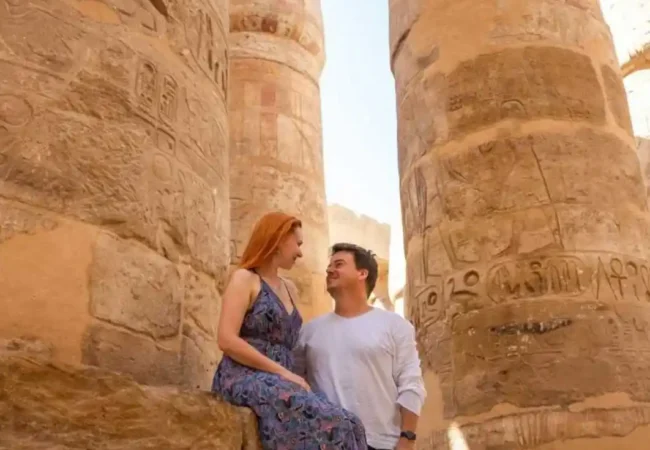
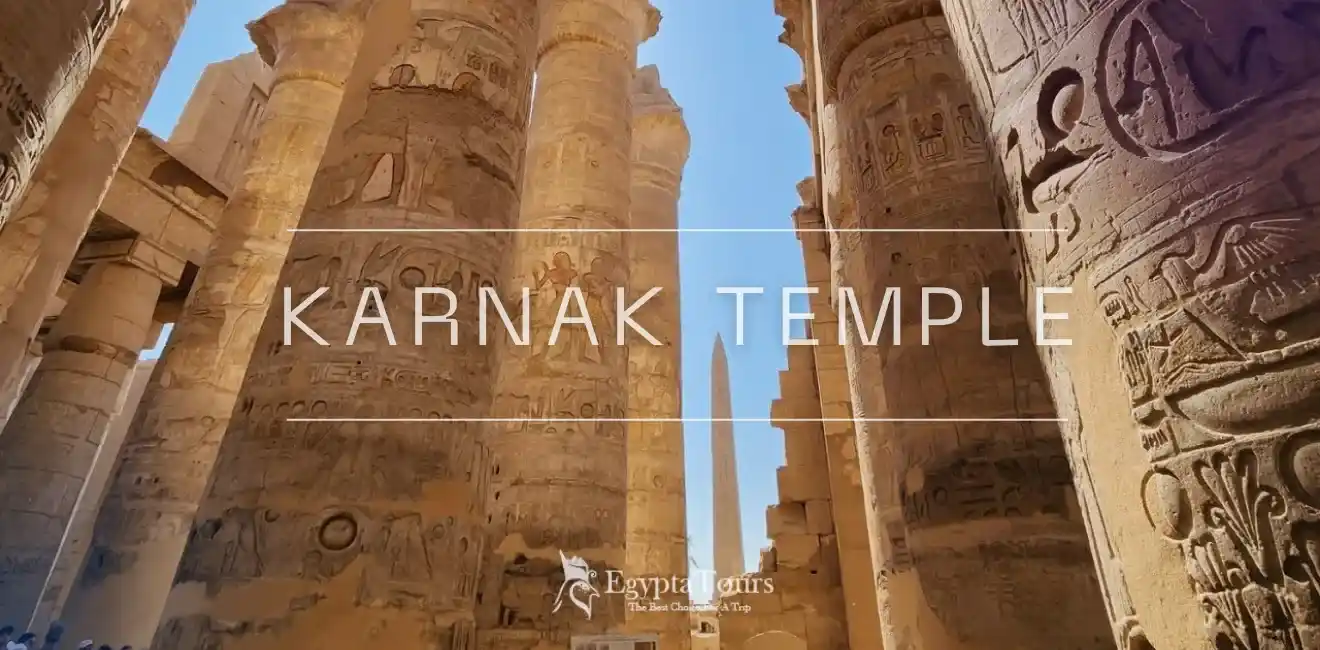
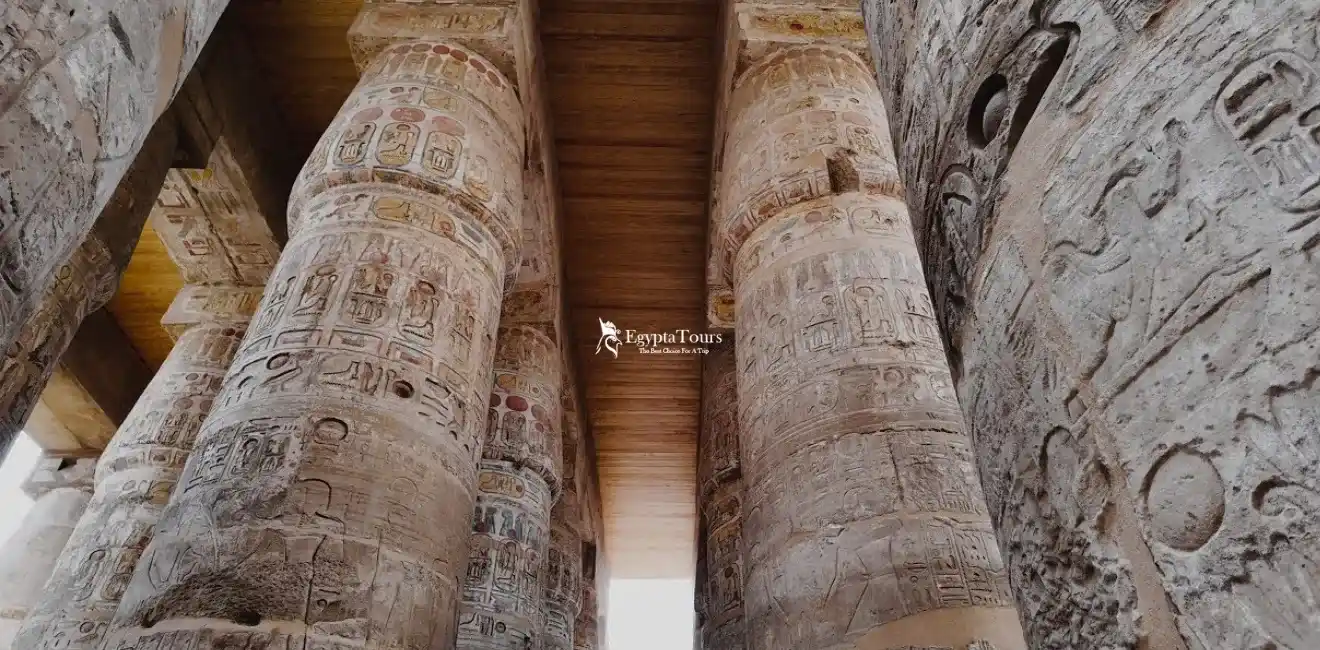
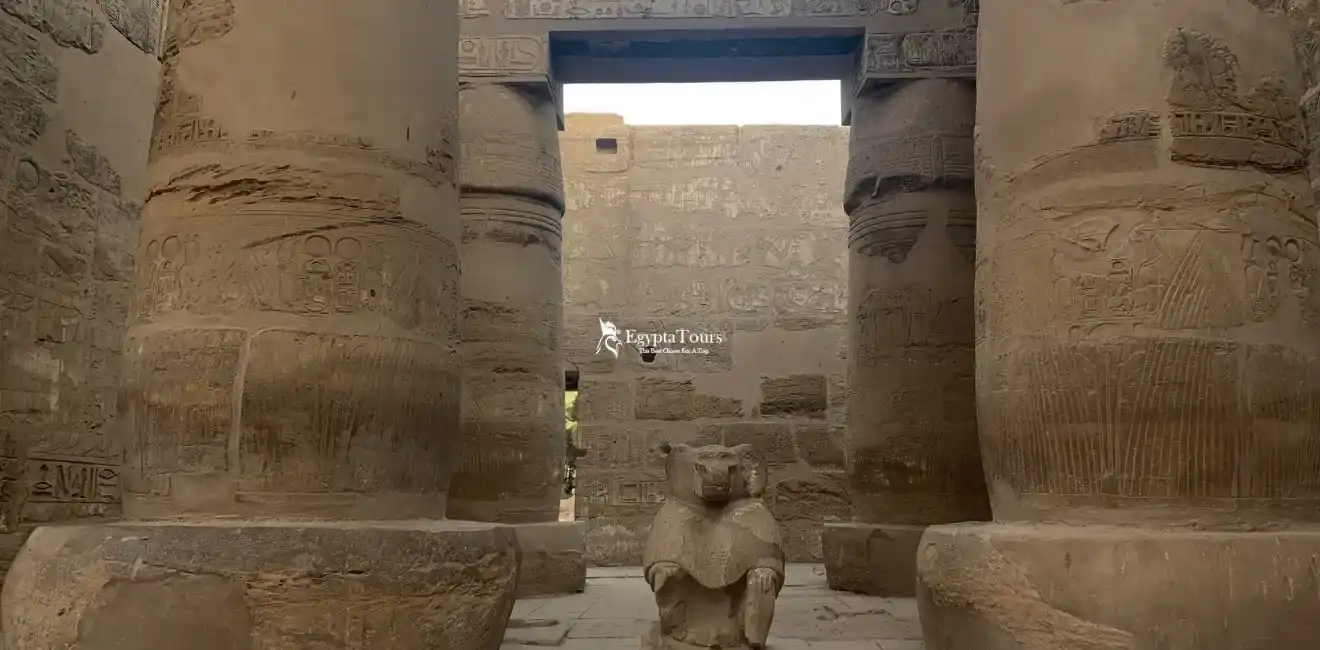
Through the second pylon is the famous hypostyle hall. With 134 giant columns, visitors are amazed by its size and beauty. The 12 center columns are taller (21 meters) with open papyrus capitals, which may represent the original “mound of creation.” The other 122 columns are smaller (15 meters) with closed capitals, perhaps showing the swamp that surrounded the mound.
The hypostyle hall
The hall was started by Amenhotep III, who built the side walls between the second and third pylons. It was not finished until Seti I’s reign.
Seti carved beautiful raised reliefs on the northern half of the walls. His son, Rameses II, finished the southern half, sometimes carving over his father’s work with his own reliefs, including temple foundation rituals. Rameses wanted everyone to remember him.
Both Seti and Rameses left us clear examples of temple rituals and how pharaohs connected with their gods. Their battles are shown on the outer walls. Rameses added a stone roof to the hall, which would have made the space dim and mysterious, lit only by the high windows.
The columns are very close together, so it is hard to see the whole hall at once. When the hall was in use, the spaces between columns were filled with statues of gods and kings. Looking back from beyond the third pylon, we can see how tall the hypostyle hall must have been.
The third pylon
This part was built by Amenhotep III. To the east, we reach the older part of the temple from early Dynasty XVIII. Many reused blocks have been found inside the third pylon, from buildings that are now being rebuilt in the open air museum.
One of the two obelisks of Thutmose I is still standing between the third and fourth pylons, and the bases of two obelisks from Thutmose III can also be seen. The north-south axis of the temple starts from this courtyard.
Fourth, fifth and sixth pylon
It seems that each pharaoh wanted to build bigger and better than the previous one. As we get closer to the sanctuary, the original Temple of Amun, the pylons become smaller and closer together.
The fourth and fifth pylons, built by Thutmose I, are much smaller than the third. The space between them is the oldest surviving part of the temple. This area once had a hall with wide papyrus columns, maybe the first example of the hypostyle hall, and had large Osiris statues of Thutmose I along the walls.
Later pharaohs added to and restored this area, including his daughter Hatshepsut, who built two red granite obelisks here. One still stands, and the top of the other lies on its side near the sacred lake. The writings on Hatshepsut’s obelisk explain how it was made from one piece of granite and covered with gold. It is dedicated to her father Amun and shows her right to be pharaoh.
Not much remains of the sixth pylon, built by Hatshepsut’s successor Thutmose III, except for inscriptions about prisoners on its lower walls. Before the sanctuary are two beautiful pillars, called the north and south pillars, built by Thutmose III. The north pillar shows the papyrus, the symbol of Lower Egypt, and the south pillar shows the lotus flower, the symbol of Upper Egypt.
The Sanctuary
The granite barque shrine we see today was built by the Greek Philip Arrhidaeus. It replaced an earlier shrine made by Thutmose III. The rooms around the shrine were built by Hatshepsut, who had made an even older shrine here. Walking around the passage, we can see a pair of statues of Amun and Amunet, dedicated by Tutankhamun, which are thought to show the face of the young king.
The open area (journey inside the temple)
Behind the granite sanctuary is the oldest part of Karnak Temple, where the very first sanctuary stood at the center of the temple. In the Middle Kingdom, a shrine of Senwosret I was here, but most of it was taken for stone. All that remains is a large alabaster slab where the shrine once stood. The central court is surrounded by partly ruined rooms that have interesting broken reliefs if you have time to explore them.
Following a paved path along the south side of the central court, visitors reach the Festival Temple of Thutmose III, also called “Most Splendid of Monuments.” It was built as a memorial to Thutmose and his family’s cult.
The pillars inside the hall are said to copy the poles of an ancient tent and still have good traces of their colored decoration. One room to the southwest of the hall once had a “table of kings,” listing 62 kings, which is now in the Louvre in Paris.
To the north of the hall are some ruined statues in an area that was later used as a church during the Coptic era. Behind the columned hall are rooms dedicated to Amun.
A larger room to the north is sometimes called the Zoological or Botanical Garden because it has fine carvings of plants and animals that Thutmose saw during his campaigns in Syria.
Paths lead along the wall behind the Festival Temple. Near Karnak’s east gate is a small “Temple of the Hearing Ear,” built by Rameses II.
Here, people of Thebes brought their requests to the gods of Karnak, or more often to the priests, who would speak to the gods for them. This followed an earlier tradition of small shrines built at the back of the Thutmose complex.
Just inside the old eastern walls are remains of later buildings, like a colonnade built by Taharqo. The eastern gate would have been very impressive, but now it is mostly ruined.
Outside this gate, the remains of Amenhotep IV’s (Akhenaten) Karnak temple were found. These were dug up in the 1970s, and many of Akhenaten’s large statues in the Luxor and Cairo museums came from here.
Following the walls north, we reach the Temple of Ptah. The first three sanctuaries were built by Thutmose III for the Memphite god Ptah. The temple was restored by the Nubian king Shabaqo and later added to by the Ptolemies and Romans.
There are Ptolemaic screen walls and columns with flower decorations in front of the original sanctuaries. The north and center sanctuaries were for Ptah, and the south one was for Hathor. Today, the southern shrine, usually locked, has a beautifully restored statue of the lioness goddess Sekhmet.
Beyond the outer wall to the north is the ruined Precinct of Montu. Montu, a falcon-headed god, was important before Amun became the main god of Thebes. The temple was first built by Amenhotep III, and his name can still be seen on some blocks. Later kings added to it, and Ptolemy III built a large gate in the quay area to the north. There were many small chapels and shrines here, as well as a row of human-headed sphinxes.
Moving west, past the shrines of the “God’s Wives of Amun,” we reach the Open Air Museum. It contains various blocks and reconstructed shrines from other parts of Karnak. Most of the pieces were found inside the second and third pylons or on the floor of the court of the seventh pylon.
jubilee. Its square pillars have beautiful carvings showing the king offering to Amun in his ithyphallic form. Next to this is a simple white alabaster shrine built by Amenhotep II, and a similar one built By <strong>Thutmose IV</strong>. Archaeologists are also reconstructing parts of a temple of Thutmose IV at the back of the museum, which have some very fine reliefs.
One of the newest reconstructions in the Open Air Museum is the “Red Chapel” of Hatshepsut, which was the original Sanctuary of Amun at the heart of Karnak. Thutmose III took it apart to build his own sanctuary, reusing Hatshepsut’s door frames.
Later, Amenhotep III used some of the Red Chapel’s blocks to fill in his third pylon, which helped them survive in good condition. French archaeologists have spent years rebuilding the chapel from these blocks, which was very difficult because of the original construction style.
On the south side of the Temple of Amun is the Sacred Lake. The area in front of it was once a fowl yard, where Amun’s birds were driven through a stone tunnel into the lake each day. Today, there are seats here for the Sound and Light show, and beneath them the remains of priests’ houses have been found.
Seventh, eighth, ninth pylons
Pylons seven, eight, nine and ten run on a north-south line to the main temple, called the transverse axis. When the area in front of the seventh pylon was dug up, 751 stone statues and stelae were found, along with over 17,000 bronze objects.
Many of these are now in the Cairo Museum, and some statues are in the Luxor Museum. They were probably buried in the Ptolemaic Period, but no one knows exactly why.
The way through the eighth to tenth pylons is blocked because of ongoing work. The ninth pylon is being carefully taken apart and rebuilt.
Some blocks from local Aten temples were used inside it, and these Akhenaten talatat blocks can now be seen in the Luxor Museum. East of the ninth pylon is a chapel for Amenhotep II’s jubilee, restored by Seti I after the Amarna Period.
In the southwest corner of the Amun precinct is the Temple of Khonsu, “son” of Amun and Mut. It is a small, well preserved temple from the late New Kingdom, built at the end of the Ramesside Period.
The temple feels like a miniature, with short pillars and low ceilings, which suits Khonsu, the child god. Reliefs in the back rooms still have some good colors, including a rare image of a lion-headed ithyphallic god.
A doorway from the Khonsu Temple leads to a nearby later building. This is a temple for the hippopotamus goddess Apet (or Opet), who helped women in childbirth and may be a later form of the goddess Tauret. Inside, the reliefs show the funeral rites of Osiris in the Graeco-Roman style.
Karnak can be confusing because its buildings were made over a very long period in Egyptian history. Most visitors on guided tours to Egypt have little time to see much, and many visits are needed to get even a small idea of the temple as a whole.
How Did The Ancient Egyptians Make The Karnak Temple?

How- Did -The -Ancient -Egyptians- Make -The- Karnak -Temple
The builders of the Temple of Amen-Ra at Karnak used local limestone to carve and transport the massive stone blocks. Once they were at the site, it was up to hundreds of workers to put them together.
This required great precision—if a block was even slightly out of place, it could ruin the entire temple.
To ensure that everything went smoothly, each stone had to be measured carefully before being placed in its final location.
Once all the blocks were set in place, they still had some work left: polishing and decorating them with hieroglyphs.
The Egyptians were masters at this type of craftsmanship; today’s archaeologists are still having trouble figuring out how exactly they did it!
What Is The Significance of The Karnak Temple?

What- Is -The -Significance -of -The -Karnak -Temple
Karnak Temple is a religious complex located in Luxor, Egypt. It is one of the largest temple complexes in the world and was built by the ancient Egyptians.
Karnak Temple was used as a place to worship Amen-Ra, who was believed to be “the hidden one” by people who lived during this time period.
This was done through rituals that included animal sacrifices and other ceremonies that would allow him to hear their pleas for help in times of need.
The Karnak Temple is composed of three main structures: The Hypostyle Hall (a hall with columns), The Great Court (an open space surrounded by smaller buildings), and The Sacred Lake (where boats were used for transportation).
Transportation to The Karnak Temple
It’s important to note that Karnak Temple is located in Luxor, Egypt.
If you want to visit the temple, then you can use several modes of transportation. You can take a taxi or hire a car, or even use public transportation such as buses and trains.
Tour Guide and Visitor Information at The Karnak Temple
Tour- Guide- and -Visitor -Information -at- The -Karnak -Temple
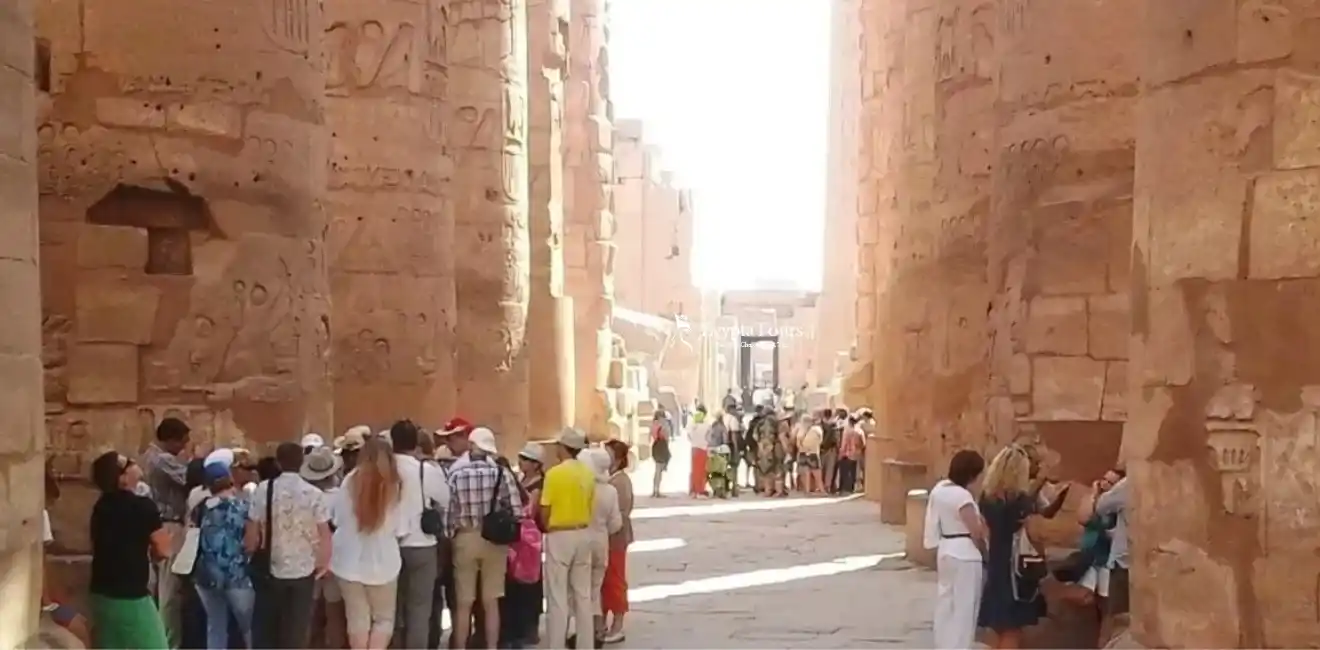
While you’re at Karnak Temple, you’ll want to stop by one of the visitor information centers to pick up brochures and maps.
These centers are located in the parking lot and near the main entrance.
You’ll also find restrooms here if you need them.
While you’re in this area, make sure to grab some snacks or drinks from one of the nearby shops (they sell food and drinks like water bottles, fruit juices, yogurt smoothies, sandwiches and chips).
You might even find a souvenir or two that’s worth adding to your collection!
If you have time before or after your trip to Karnak Temple, there are plenty of other sights close by that are worth checking out:
- The Luxor Temple is just five minutes away by car or taxi; if walking isn’t for you then hop on a bus instead!
- This temple complex contains several monuments honoring ancient Egypt’s most important gods including Amon-Ra (sun god) along with his wife Mut (goddess) plus their son Khonsu (moon god).
- It also contains several smaller temples as well as large statue depicting Ramses II who ruled from 1279-1213 B.C..
Tours Include A Visit To Karnak Temple Complex

Tours -Include -A -Visit -To- Karnak -Temple -Complex
| Tour Name | Duration |
|---|---|
| 10 Days Cairo & Nile Cruise and Hurghada Trip | 10 Days – 9 Nights |
| Two Days Luxor Tour from Hurghada | 2 Days – 1 Night |
| 4 Days Cairo and Luxor Holiday Package | 4 Days – 3 Nights |
| 5 Days Cairo and Luxor Trip | 5 Days – 4 Nights |
| Luxor Short Breaks | Tour Category |
Inside the Complex of the Karnak Temple
The temple complex of Karnak is huge, and the first place you’ll want to go is the Great Hypostyle Hall.
This hall is one of the largest in Egypt and has 134 columns, each one decorated with carved hieroglyphics. Each column also has royal figures carved into them, along with scenes depicting religious rituals that took place at this temple during ancient times.
Next up on your tour of Karnak Temple: The Temple of Amun-Re (also known as Ipet-resyt), which was dedicated to Amun-Re before being taken over by several other deities such as Ptah and Mut.
Located behind this temple is a smaller room called Festival Hall, which used to hold celebrations for various gods throughout the year.
A visit to the ancient temple complex of Karnak is a journey through time, from the ancient past through the present.
Here’s what you should know about it:
Karnak Temple Complex is a UNESCO World Heritage Site and one of the most visited tourist attractions in Egypt.
It’s located on the East bank of the Nile River, and it was built over several centuries starting around 1400 BCE.
The temple complex still holds many secrets that are yet to be discovered.
If you want to learn more about this ancient wonder, here’s what you should know:
Karnak Temple is a complex of ancient temples located in Luxor, Egypt.
It is an awe-inspiring site that has stood the test of time, having been built over a period of 2000 years and still standing today.
A visit to Karnak Temple is like taking a journey through time, from the ancient past through the present. Here’s what you should know about this fascinating temple complex before planning your visit.
History and Architecture the Karnak Temple was built by ancient Egyptians in the New Kingdom, during the 18th dynasty.
The complex itself consists of many temples, chapels, pylons and a large court surrounded by walls.
There are several stone sphinxes that have been found throughout the site as well.
During its time period, it became home to an even more impressive structure known as King Tut’s Great Temple of Luxor.
Best Tours to Karnak Temple
-
Luxor West Bank Tour (Valley of the Kings & Hatshepsut Temple)
Conclusion
The ancient Temple of Karnak is a UNESCO World Heritage site that offers visitors a chance to explore the history of Egypt.
The complex contains some of the most important monuments from its time and remains one of the best places to visit in Luxor today.
The Karnak Temple, one of the largest religious complexes in the world, spans over 54,000 square feet and was primarily dedicated to Amun-Ra, the supreme god of ancient Egypt.
The temple complex saw contributions from many pharaohs, including Thutmose III and Ramesses II, who expanded and embellished the site.
The Karnak Temple Complex, located in Luxor, is one of the most awe-inspiring ancient sites in Egypt.
At its heart lies the grand Precinct of Amun, a vast area dedicated to the chief deity of the New Kingdom, featuring colossal columns and sacred lakes.
Nearby, the Precinct of Mut honors the lion-headed goddess and includes a series of temples and shrines that reveal the spiritual depth of ancient Thebes.
Together, these precincts form a monumental testament to Egypt’s religious devotion and architectural brilliance.
The sacred space honored the god Amun and his divine consort, the goddess Mut, as well as their son, Khonsu. Karnak was a major center of worship, reflecting the immense power and devotion to the god Amun in ancient Egypt.
Everything You Need to Know About the Karnak Temple Complex
What is the Karnak Temple Complex?
Karnak is one of the largest ancient religious sites located in Luxor, Egypt. It’s a sprawling collection of temples, chapels, and other structures dedicated to Theban gods.
When was Karnak built?
Construction began over 4,000 years ago during the Middle Kingdom and continued through the Ptolemaic Kingdom, evolving over time.
Who built the Karnak Temple Complex?
A succession of pharaohs contributed, including famous names like Ramses II and Hatshepsut. Each ruler added their own touches and expansions.
Why is Karnak significant?
Karnak served as a vital religious center in ancient Egypt and is known for its impressive architecture and historical inscriptions, offering insights into Egyptian culture and beliefs.
How can visitors explore Karnak today?
You can visit Karnak as part of a guided tour or independently. The site is open to the public, with highlights including the Great Hypostyle Hall and various obelisks.
Are there any notable features at Karnak?
Yes, the Great Hypostyle Hall is renowned for its massive columns. The Sacred Lake and towering obelisks are also must-see features.
Is there an entry fee for visiting the Karnak Temple Complex?
Yes, there is an entry fee for tourists. Prices may vary, so check current rates before planning your visit.
What are the visiting hours?
Typically, the site is open from early morning until late afternoon. Check for any seasonal changes in operating hours.
What should I wear when visiting Karnak?
Dress comfortably and conservatively. Lightweight clothes, a hat, and sunscreen are recommended due to the warm climate.
Are there any accommodations near Karnak?
Luxor offers a variety of accommodations ranging from luxury hotels to budget-friendly options, all within a short distance of Karnak.
Do I need a guide to explore Karnak?
While not required, hiring a guide can enhance your experience by providing detailed historical context and pointing out lesser-known details.
Can I take photos at Karnak Temple?
Yes, photography is generally allowed, though some restrictions may apply in certain areas. Always check with the staff or guide.
Is Karnak accessible to people with disabilities?
Accessibility can be challenging due to uneven ground and steps. Some areas are easier to navigate than others, so planning is advised.
About EgyptaTours

EgyptaTours is a name synonymous with trust, excellence, and unforgettable travel experiences, proudly standing as one of the leading travel agencies in Egypt. Renowned for its deep expertise, personalized service, and carefully crafted itineraries, EgyptaTours serves as the ultimate gateway to discovering Egypt in its most authentic and inspiring form.