





Ancient Egyptian Symbols and Their Meanings
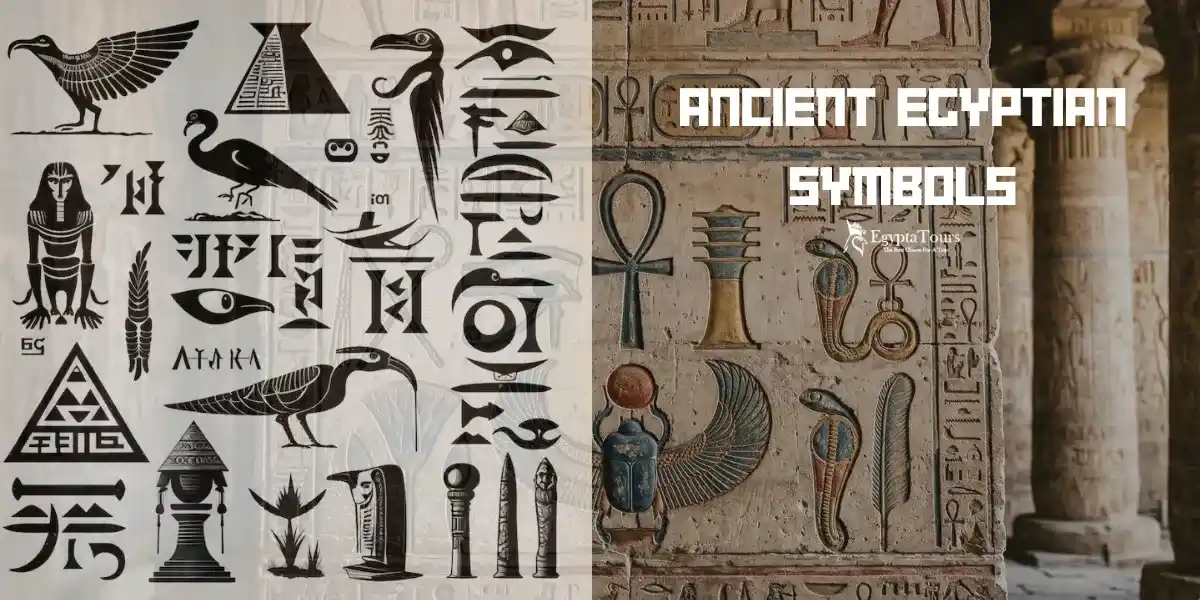
Ancient Egyptian symbols has affected life in ancient Egypt which was a coalition between the physical and the spiritual aspects that became the foundation of their culture that appeared in the form of artistic architecture, amulets, symbols, and many objects that were used to bring good fortune and protection.
These ancient Egyptian Symbols played a pivotal role in passing the culture from one generation to another, as they were written on temple walls and obelisks and used religious rituals and magical for both the living and the dead.
The Egyptian symbols were depicted in the form of treated and hieroglyphs as “The Words of Gods” which was used to document the most serious events in ancient Egyptian History, culture, and their spiritual beliefs.
Ancient Egyptian Symbols and their Meanings

Ancient-Egyptian-Symbols
Hieroglyphs a language of the ancient Egyptians that many things in Ancient Egypt wrote by it.
These ancient Symbols can be found all over Egypt, like tombs and temples.
The ancient Egyptian symbols was used to show ideas, concepts, and emotions.
Ancient Egyptians thought that death was a piece of life.
They thought that it was important for people to die to be born again.
The Egyptians created symbols to show this operation of death and rebirth.
A lot of old Egyptian things and construction have these ancient symbols on them.
These symbols are used on coffins, tombs, and other things to show eternal life and resurrection, for example,
The hieroglyph for “to live” is a form of a heart with an air symbol.
The hieroglyph for “to die” is a form of a skull with two crossed bones.
The Ankh is one of the most well-known symbols in ancient Egypt and has many concepts. It represents fertility, eternal life, and protection from evil spirits.
So, for those wondering what ancient Egyptian symbols and their names are?
Discover the Significance of the Most Iconic Ancient Egyptian Symbols

Discover-the-Significance-of-the-Most-Iconic Ancient-Egyptian-Symbols-EgyptaTours
The Ankh: is one of the most popular ancient Egyptian hieroglyphs, used in writing, art, writing and decorations.
It represents the word “life” and life itself, as well as the morning sun, heaven, male and female, and the earth.
It was often used to express the desire for someone to live – e.g., “may you live and be well”, and was held as a key to external life.
Its beautiful shape was emulated by neighboring cultures, who adapted it in many various ways, such as by using it as a variation of the Christian cross. Nowadays it is often connected with the Goth subculture.
Note: The Ankh is considered to be an ancient Egyptian symbol for Life, Protection, Light, Faith, Energy, transformation, and fertility.
The Ankh can also refer to the meaning and symbols of sexual union between the two opposite sexes and fertility due to its connection to the goddess Isis.
The Ankh is the obvious and simple example of the ancient Egyptian understanding of continuance, reproduction, future life, and overall, the concept of the cycle of life.
Eye of Hours Meaning

Eye-of-Hours-Meaning-Ancient-Egyptian-Symbols-and-their-Meanings-EgyptaTours
The Ankh is one of the most famous and used as ancient Egyptian Symbols and the world the Ankh showcases the concept of internal like and divine protection.
It’s a cross with a looped top in a key-like shape, which has no start or end like the spirit of Ra, plus represents eternal life, the morning sun, clairvoyance, purifying the life-giving power of water, and the union of opposites like earth and heaven and male and female (Isis and Osiris).
The Ankh Egyptian symbol appeared in the Early Dynastic Era (3150 -2613 BCE) and by the Old Kingdom (2613-2181 BC) the Ankh symbol became a powerful icon of eternal life and was popular as Neb-Ankh.
The symbol is connected with “The Knot of the Goddess Isis” and her powerful cult (c. 3150 – c. 2613 BCE) as it represents the band that holds all of life together.
The Ankh symbol can be seen in the hands of mostly all the Pharaohs and the ancient Egyptian gods and goddesses.
It’s also known as crux ansata by Coptic Christians which represents immortality and life That symbol appears on temple walls, in paintings, and in tombs as it was the key to existence and used as a talisman to provide divine protection to the point where it was believed to be the key that can open the door to the afterlife.
The Ankh can be viewed as a icon of Joy and Balance between masculinity and femininity.
The ancient Egyptian Symbol was referred to as the key of the Nile River which represents the external union of heaven and land.
The symbol of Ankh was often seen with the Was Symbols and the Died.
Note: The Ankh symbol is a symbol of life, protection, energy, transformation, faith, light, and fertility.
The Ankh can also refer to the meaning and symbols of sexual union between the two opposite sexes and prodigality due to its connection to the goddess Isis.
The Ankh is the clearest and simple example of the ancient Egyptian understanding, future life, reproduction, immortality, and many other ancient Egyptian Symbols.
The Ankh: Symbol of Eternal Life
The ankh, one of the most recognizable symbols from ancient Egypt, has captivated people for millennia. Known as “the key of life” or “cross of life,” this iconic symbol dates back to the Early Dynastic Period (c. 3150 – 2613 BCE).
The ankh represents “life” or “breath of life” in Egyptian hieroglyphics, symbolizing both mortal existence and the afterlife.
Origin and Meaning
The exact origin of the ankh remains uncertain. Some theories suggest it evolved from a sandal strap, with the top loop extending around the ankle and the vertical post connecting to the sole.
Others propose it represents the union of male and female genitalia, symbolizing fertility and creation.
The ankh’s shape has also been interpreted as the sun rising over the horizon, signifying the daily renewal of life.
The ankh’s profound meaning extends beyond its physical representation. For ancient Egyptians, it embodied the concept of eternal life, reflecting their belief that earthly existence was just one part of an everlasting journey.
This powerful symbol came to represent the promise of life after death, a central tenet of ancient Egyptian religion.
Depictions in Art
In ancient Egyptian art, the ankh frequently appears in the hands of gods and pharaohs, symbolizing their power to sustain life and revive souls in the afterlife.
Deities such as Anubis or Isis are often depicted pressing the ankh against the lips of the deceased, rejuvenating their spirit for the journey beyond.
The ankh was a popular motif in various forms of Egyptian art and daily life. It adorned temple walls, shrines, and funerary objects. Mirrors, mirror cases, and even floral bouquets were crafted in its shape.
The symbol often appeared alongside other hieroglyphs, such as the was and djed signs, collectively representing “life, dominion, and stability”.
Religious Significance
The ankh held immense religious importance in ancient Egyptian culture. It was closely associated with the cult of Isis, the goddess of fertility and motherhood.
The ankh’s connection to Isis imbued it with greater significance, linking it to the promise of personal resurrection and eternal life.
In funerary contexts, the ankh played a crucial role. Caskets and sarcophagi, often adorned with the symbol, were referred to as neb-ankh, meaning “possessing life.” The deceased were called ankhu, or “those having life,” reflecting the belief in their continued existence beyond death.
The ankh’s religious significance extended to temple ceremonies and royal rituals. It was used in purification rites, where chains of ankh signs sometimes replaced the usual zigzag lines representing water.
This symbolism reinforced the ankh’s association with life-giving substances and divine power.
The ankh’s influence persisted even during times of religious upheaval. During the Amarna Period (1353-1336 BCE), when Akhenaten established the cult of Aten as Egypt’s sole deity, the ankh remained a prominent symbol.
Its enduring presence throughout Egyptian history attests to its fundamental importance in the culture’s spiritual beliefs.
Scarab beetle Symbols

Scarab-beetle-Symbols-Ancient-Egyptian-Symbols
The Scarab symbol was one of the most well-known iconic of ancient Egypt during the first intermediate era (2181-2040 BCE) until the rise of Christianity.
This ancient Egyptian symbol is seen in Egyptian art and iconography which is a part of the dung beetle. The shape of the scarab talisman came from the act of rolling the dung into a ball and laying its eggs in it and the manure served as food for the young when they hatched. Ancient Egyptians saw life coming from nothing which represented the recreation of life, transformation, and resurrection.
The scarab was specified with the God Khepri who was more like Ra’s assistant who coils the ball of the sun across the sky.
The scarab hieroglyph letter refers to the ideas of existence, growth, effectiveness, transformation, and divine manifestation which explain why the symbol was used in governmental places, describing the titles of officials, and creating official royal seals.
The most popular scarab talisman was the hardstone made from green jasper, amethyst, and carnelian.
Note: The Scarab is an ancient Egyptian symbol for life, good luck, transformation, death, growth, and creation.
The Scarab was one of the most important talismans ever created in Egypt due to its influence, power, and importance in representing, metamorphosis, the ideal of immortality, and the cycle of life.”
The Djed Pillar: Stability and Strength
The djed pillar stands as one of the most recognizable ancient Egyptian symbols, representing stability, strength, and endurance. This powerful emblem has deep roots in ancient Egyptian mythology and religion, playing a significant role in both daily life and funerary practices.
Connection to Osiris
The djed pillar has a strong association with Osiris, the god of the afterlife and resurrection. Many believe it symbolizes Osiris’s spine, reflecting the Egyptians’ understanding of the spine’s importance in maintaining bodily function and stability.
This connection to Osiris imbues the djed with profound meaning related to rebirth and regeneration, key concepts in ancient Egyptian beliefs about the afterlife.
In the myth of Osiris, the god is murdered by his brother Seth, the god of chaos.
Osiris is later revived by his wife Isis and son Horus, allowing him to become the ruler of the underworld. The djed pillar, as a representation of Osiris’s backbone, symbolizes his triumph over death and his ability to function after resurrection.
Appearance in Egyptian Art
The djed pillar is typically depicted as a vertical shaft with four horizontal bars near the top, often accompanied by a series of vertical lines between each bar. Sometimes, it is portrayed with eyes between the crossbars and holding the crook and flail, symbols associated with Osiris.
This symbol appears in various forms of ancient Egyptian art, including temple decorations, amulets, and funerary objects. One notable example can be found in the temple complex of the Step Pyramid of Djoser at Saqqara, dating back to the Old Kingdom period (2613-2181 BCE).
Symbolic Meaning
The djed pillar carries multiple layers of symbolism in ancient Egyptian culture. As a hieroglyph, it represents the concept of stability, which aligns with its physical appearance as a sturdy pillar.
This symbolism extends to ideas of permanence, endurance, and the enduring presence of the gods in one’s life.
In funerary contexts, the djed pillar played a crucial role. It was often used as an amulet, placed near the spines of mummified bodies or worn around the neck.
These amulets were believed to ensure the deceased’s resurrection and eternal life in the afterlife. The Book of the Dead refers to the djed pillar amulet as “the magical protection of Osiris,” highlighting its importance in funerary rituals.
The djed pillar was also central to a ceremony called “raising the djed,” which was part of the Sed festival, an ancient Egyptian jubilee celebration. This ritual symbolized Osiris’s triumph over Seth and represented the renewal and perpetuation of life beyond death.
The ceremony was particularly elaborate at Abydos, the cult center of Osiris, where reenactments of the Osiris myth were performed.
Through its rich symbolism and deep connections to ancient Egyptian mythology, the djed pillar remains a powerful emblem of stability, strength, and eternal life in ancient Egyptian culture.
Egyptian God Symbols

Egyptian-God-Symbols-EgyptaTours
The Eye of the Ra is a famous ancient Egyptian symbol talisman capable of repelling all negative energy and creating total harmony.
The origin of the symbol can be traced to a number of connected stories like the time when he sends his eye as a loving father to look for his lost children.
During the obscurity of Ra’s original eye, another one grew.
When the first eye successfully returned with the children, the eye was used as an arm by other gods. The sun god Ra does his routine of sailing his boat across the sky during the day and then goes to the underworld at night when he was vulnerable and weak.
The legend says the daughter of Ra used the power of the eye to punish the humans who neglected his instructions and laws but many gods be afraid of the eye would destroy people so they capture and calmed the eyes and then come back to Ra.
The ancient Egyptian symbols represents royal power and regeneration, authority, and peace. The eye of Ra is associated with the destructive power of the sun, but the Egyptians also used it to protect their building and themselves.
The talisman was painted with a dark red color and worked to protect against evil entities or spells and create good health. Another representation of the eye of Ra is the icon of a cobra wrapped around a solar disk.
Note: The Eye of Ra is an ancient Egyptian symbol of love, good health, royal authority, protection, and power. The Eye of Ra represents the power of the sun to supply protection and destructive force. The Eye of Ra is believed to repel all negative energy and establish balance and harmony and the power to see everything.
Lotus Symbols Meaning

Lotus-Symbols-Meaning-Ancient-Egyptian-Symbols-and-their-Meanings-EgyptaTours
The lotus symbol is considered to be a true symbol in Egyptian Mythology and ancient Egyptian art. The flower a.k.a “Water lily” locked at night, sinks underwater then wakes up in the morning, that’s why it became a symbol of creation, the sun, and regeneration.
The Ancient Egyptian Symbol Lotus has been contacted with Atum-Ra the sun god as a huge lotus emerging from the primitive waters of Nun when the world was born and from which the sun god back.
The worship of Osiris also used the symbol related to funeral imagery and with the dead entering the underworld which symbolizes reincarnation.
The ancient Egyptian were usually used symbols in art to represent Upper Egypt.
It was found in honored and horrible places all over Egypt, on the architecture of the capital tops of Egyptian pillars representing the Tree of Life, in Hieroglyphics, written in papyrus, plus in the tombs, written in papyrus, found on thrones, and the headdresses of the divine pharaohs.
Note: The Lotus Flower is an ancient Egyptian symbols of Purity, Rebirth, cleanliness, Enlightenment, and Regeneration.
This ancient Egyptian symbol of the sun reflects the meaning of rebirth and creation such as the flowers locking and sinking underwater in the night and then raising again the sunshine.”
How Ancient Egyptian Symbols Influenced Art, Architecture, and Culture

How-Ancient-Egyptian-Symbols-Influenced-Art-Architecture-and-Culture
“Egyptian mythology contains an infinite number of great stories to discover plus you can scout about these memorable ancient Egyptian Symbols by booking unforgettable EgyptaTours packages or enjoying one of the incredible Nile River cruises to observe the majestic temples of Egyptian pharaohs and witness the legends of gods and goddesses.”
Ancient Egyptian Tattoos
Even thousands of years later, the world of ancient Egypt sound enigmatic and mysterious, so much so that even theses days we are still Inspired and in awe with this ancient civilization and culture.
From mythology to mesmerizing art and symbolism, ancient Egyptian culture will probably never be stopping to surprise and inspire us.
That would demonstrate why Egyptian tattoos are so common, worldwide. The ancient symbolism, Egyptian hieroglyphs, motifs, and deities serve as never-ending inspiration for various concepts of Egyptian tattoos. Even ancient Egyptian tattoos appear to make a comeback in modern times.
The Winged Sun Disk: Divine Protection
The winged sun disk stands as one of the most recognizable ancient Egyptian symbols, representing divine protection, royalty, and power. This iconic emblem, featuring a solar disk flanked by two outstretched wings, has captivated scholars and enthusiasts of ancient Egyptian culture for centuries.
Origins of the Symbol
The winged sun disk has its roots in the Old Kingdom of Egypt, dating back to the 3rd millennium BCE. Initially, it was associated with the god Horus of Behdet, a particular form of the falcon god Horus.
Over time, the symbol evolved to become a representation of various solar deities and gained prominence in Egyptian religious iconography.
The emblem’s composition reflects the dualistic nature of Egyptian thought. The central sun disk, often accompanied by two uraeus cobras, symbolizes the unification of Upper and Lower Egypt.
This design embodies the concept of “The Two Lands,” a common reference to the divided yet united nature of ancient Egypt.
Association with Ra and Horus
As ancient Egyptian religion developed, the winged sun disk became closely associated with Ra, the sun god, and Horus, the sky god. This connection reinforced the symbol’s significance as a representation of divine power and protection.
In the myth of Horus and Set, Horus transforms into a great winged disk to defeat his enemies, cementing the symbol’s association with victory and divine intervention.
The Temple of Horus at Edfu, built during the Ptolemaic period, provides valuable insights into the symbol’s meaning.
According to temple texts, Horus of Behdet, in the form of a winged sun disk, attacked his enemies with such might that “they could no longer see with their eyes, nor hear with their ears”. This narrative highlights the symbol’s role as a powerful protector of Egypt and its pharaoh.
Use in Royal Iconography
The winged sun disk played a crucial role in ancient Egyptian royal iconography. It was prominently featured in temple architecture, often adorning the tops of entry passages and doors.
This placement was believed to offer protection and blessings from the gods to those entering sacred spaces.
In royal contexts, the winged sun disk symbolized the divine nature of the pharaoh and his connection to the gods. It appeared on royal seals, monuments, and various artifacts associated with Egyptian rulers.
The symbol’s presence in royal iconography reinforced the pharaoh’s role as a mediator between the divine and earthly realms.
The winged sun disk’s influence extended beyond Egypt’s borders, appearing in the iconography of other ancient Near Eastern cultures, including Assyria, Persia, and the Kingdom of the Hittites. This widespread adoption speaks to the symbol’s potent representation of divine protection and royal power.
Isis Knot (Tyet) Symbol and Its Meaning
One of the ancient Egyptian symbols is the Isis knot symbol, which greatly resembles the ankh symbol with some differences, especially at the bottom where it has a curved shape. It is a symbol related to Isis and was used in various rituals.
Examples of its uses include being used as a magical amulet placed with the mummy for protection in the afterlife, as they believed, in addition to special protection in funerary rituals. It was also linked to the idea of life after death, so it was placed with other symbols on burial amulets.
What is the Pharaonic Shen Ring?
This ring is a circle or an oval shape, open at the bottom, and appears with one of the gods holding it. This ring was used in inscriptions, amulets, and art and is one of the ancient Egyptian symbols representing eternity and divine life.
Here, the word “shen” means protection, which is why it was used to signify that the person or object surrounded by the ring was protected by divine power, as they believed. The ring also symbolizes authority and royalty, and sometimes it was used around the king’s name to indicate that he was also under divine protection.
What is the Royal Cartouche?
The royal cartouche is an oval frame surrounding the name of a king. When used, it identifies the name and makes it more distinct from other texts. As for its shape, it is a long oval ring with a horizontal line at the bottom, resembling a rope tied at one end.
When the king’s name was written inside this shape, it was believed that he was thereby protected from evil forces and surrounded by divine power. It was also a symbol of authority, legitimacy, and eternity, as they believed.
The Symbol of Amentet and the Underworld
From the name of the symbol, we find that it relates to the goddess Amentet, who is one of the ancient Egyptian symbols representing the personification of the West and the other world.
This goddess is known as the “Lady of the West,” and her symbol for the west indicates her association with tombs and death. It was generally believed that she would welcome the souls as they entered the underworld.
Thus, it signifies the end of earthly life and the beginning of another journey to the underworld, which is a world after death. Although she is not one of the major deities, she has a strong role in welcoming the dead, as they believed.
The Legend of the Sacred Benben Stone
It is a pyramid-shaped stone and the first thing that appeared in the world, according to what the ancient Egyptians believed. They believed that the world began with vast waters called Nun, and amidst these waters, the Benben mound emerged, and from its top, the god Atum appeared.
Atum, according to their beliefs, is the god of the creation myth; he created air, moisture, and more. The stone was also a symbol of light and life, as the Egyptians found that the sun shone on it for the first time. The Bennu bird also stood on it and sang the song of life.
Types of Pharaohs’ Crowns and Their Meanings
The crowns of the pharaohs are numerous and are considered ancient Egyptian symbols. They are as follows:
The White Crown (Hedjet)
The people of the South knew the first crown was the White Crown, which was depicted on wall inscriptions. In the northern region, it was equivalent to the Red Crown. There is no clear reason for its name. Its origin dates back to the city of Nekhen, where in the temple of Hierakonpolis, wall inscriptions of the goddess Nekhbet crowning one of the kings with the White Crown were found.
The Red Crown (Deshret)
It is considered the official crown of the ruler of Lower Egypt and was made of felt. It was pointed at the top and had a forward curve, but later the pointed part became longer and extended upwards because the curve weakened the square shape of the crown. The color red is associated with blood, fire, and also life and resurrection, as they believed, and a symbol of uncontrollable power.
The Double Crown (Pschent)
This crown is a combination of the Red Crown of Lower Egypt and the White Crown of Upper Egypt, thus it is a composite crown. Egyptologists have not been able to determine its real name, but some wall inscriptions indicating it were found in the temple of Philae. It consists of two parts, one part taken from the White Crown and the other part from the Red Crown.
The Atef Crown
This crown was associated with the god Osiris and its origin dates back to approximately the pre-dynastic period. It began to appear on the head of a falcon above the Horus name of King Sneferu, which is on the palanquin of Hetepheres found in the Egyptian Museum. It was treated as the Double Crown, as it is similar to it, because both have a connotation of authority, control, and sovereignty.
The Blue Crown (Khepresh)
It is an irregular headdress, and this crown became known in the New Kingdom era. However, some Egyptologists have pointed out evidence suggesting that this crown dates back to the Second Intermediate Period, where a wall inscription on one of the columns of Karnak described King Neferhotep as being honored by being crowned with the Blue Crown.
Significance and Meanings of Colors for the Pharaohs
Each color had a significance and meaning for the pharaohs. Some of them, but not all, can be clarified through the following:
- White: Symbolized purity and was used in ancient times for the clothes of priests and many ritual statues.
- Green: Represented youth and growth and was used for amulets and statues.
- Blue: Meant eternity, protection, and magic and was used in amulets as a symbol of celestial deities.
- Yellow: Meant divinity, the sun, and immortality and was used in gold, pharaohs’ coffins, and jewelry.
What are the Canopic Jars and their function?
Canopic jars are one of the ancient Egyptian symbols, consisting of four pottery jars in which the deceased’s internal organs were placed after being mummified. They believed these were important for the deceased’s needs after resurrection.
They used to extract many body organs such as the lungs, intestines, and liver, and then preserve each of them in a jar protected by the magic of the gods. However, the heart was returned to the body to be used in the judgment of Osiris to weigh the person’s deeds, as they believed.
A Simple Explanation of Hieroglyphic Writing
Hieroglyphic writing is one of the most important ancient Egyptian symbols, as it was used for writing and expressing everything that happened in ancient times, from events, natural phenomena, and more. Therefore, signs were used in it.
The first of these signs are the pictorial signs, which indicate the meaning of the word. Some languages still rely on this method, such as Chinese writing, with some modern methods retaining its writing style.
The second sign is the phonetic signs, which indicate a specific sound in a word, similar to the letters used in languages today. They are divided into unisound signs, bisound signs, and trisound signs.
Examples of hieroglyphic writing:
- 𓂀 Udjat Eye of Horus.
- 𓄿 A Vulture.
- 𓇋 I Reed / Cane.
- 𓉔 H House / Home.
The Sistrum and its Religious Role
It is one of the sacred musical instruments in ancient Egypt. It was closely associated with ritual ceremonies in honor of the goddess Hathor and was used for religious celebrations and dances. It is also considered a tool for protecting the pharaoh, as it was used in royal ceremonies by having beings shake the sistrum to request the pharaoh’s protection and bring blessings.
The Was Scepter, Symbol of Power in Ancient Egypt
The Was Scepter was a central ancient Egyptian symbol representing power, authority and dominion, closely linked to both the gods and the pharaohs in ancient Egyptian culture and mythology. The ancient Egyptians believed that the sky was held up by four pillars shaped like the Was Scepter, giving it a cosmic significance and connecting it to the divine order. It was also known as the “Sculptor of the Earth,” symbolizing completeness and totality.
The scepter is topped with a canine head, a design that appeared during the reign of King Djet (c. 3000 – 2990 BCE) of the First Dynasty. Each deity had their own version of the scepter, including Hathor, Isis, Ra and many others. The god Ptah uniquely combined the Ankh, Djed and Was Scepter into a single staff, reflecting his supreme holiness.
Because the Was Scepter is frequently associated with Set, the god of chaos, it also became linked to the desert and war. Its meaning varied depending on who held it: in the hands of Isis, it represented duality and fertility; in Hathor’s hands, it symbolized happiness; in Horus’s hands, it represented the sky and in Ra’s hands, it symbolized rebirth.
Overall, the Was Scepter remains one of the most significant ancient Egyptian symbols of divine power, representing not only royal authority and dominion, but also wealth, happiness and spiritual balance. In the hands of Ptah, its combination with the Ankh and Djed elevated it to the ultimate emblem of the “Sculptor of the Earth.”
The Tyet, Symbol of Feminism in Ancient Egypt
The Tyet, also known as Tjet, Tiet or Tyet, is an ancient Egyptian symbol closely linked to feminine power and the goddess Isis. Often called the “knot of Isis” or the “blood of Isis,” the Tyet resembles the Ankh symbol with the key difference being that its arms curve downward. This symbol dates back to the Old Kingdom (2613 – 2181 BCE) and represents the female genitalia, emphasizing its connection to female reproductive power.
The Tyet was commonly used as a funerary amulet, often made from red stone or glass and was closely associated with several ancient Egyptian goddesses, most notably Isis. It stands as a powerful emblem of the female reproductive organs and of Isis in her role as the universal mother.
In some depictions, the Tyet was combined with the Djed pillar, symbolizing the union of feminine and masculine power, representing balance and completeness. The symbol was also linked to Nephthys and connected with burial and resurrection, emphasizing the concepts of eternal life and rebirth. Frequently, the Tyet was paired with the Ankh, providing the protection and security of both Isis and Osiris.
During the New Kingdom (1570 – 1050 BCE), when Egypt reached its peak glory and the cult of Isis flourished, the Tyet became widely recognized and revered.
In essence, the Tyet is an ancient Egyptian symbol representing life, feminine power, security, protection, regeneration, love, blood and health. It also embodies the deeper concepts of life and death, as it symbolized the female menstrual cycle and the natural cycle of renewal.
The Udjat Eye (The Eye of Ra), Symbol of Protection & Power
The Udjat Eye, also known as the Eye of Ra, is one of the most revered ancient Egyptian symbols. This powerful amulet was believed to repel all negative energy and establish total harmony. The origin of the symbol is linked to several connected myths, including the story when Ra sent his eye as a loving father to search for his lost children. During the absence of Ra’s original eye, another eye grew and when the first eye returned successfully with the children, it was later used by other gods as a weapon.
The sun god Ra made his daily routine which was sailing across the sky during the day and traveling through the underworld at night, a time when he was weak and vulnerable. According to myth, Ra’s daughter used the power of the eye to punish humans who ignored his instructions and laws. However, many gods feared the eye’s destructive power and captured it to calm it before returning it to Ra.
The Eye of Ra symbolizes royal power, authority, regeneration and peace. Although it represents the destructive energy of the sun, it was also widely used for protection, safeguarding buildings and securing the wellbeing of people. The amulets were often painted dark red and were believed to protect against evil forces, enhance good health and create spiritual balance. Another depiction of the Eye of Ra is a cobra wrapped around a solar disk, symbolizing the sun’s protective and destructive powers.
In essence, the Eye of Ra is an ancient Egyptian symbol of protection, love, good health, royal authority and divine power, believed to repel all negative energy, establish harmony and provide the ability to see everything.
Hekha and Nekhakha, The Symbol of Kingship
The crook and the flail have always been symbols of the state’s power and the king’s authority, showing his complete control over his people. The word Hekha is an epithet of the god Osiris, meaning “to rule,” reflecting royal power and dominion. These symbols first appeared during the Early Dynastic Period, under the reign of King Narmer around 3150 BCE.
Originally, the ancient Egyptians used the crook and flail as symbols of Osiris, which later became representations of pharaonic authority. The crook symbolizes kingship and wisdom, as the Pharaoh is the shepherd of his people, while the flail represents fertility of the land, showing the Pharaoh as the provider of food for his subjects. Most crooks and flails were made of wood due to scarcity but the Pharaohs often used elaborately decorated gold versions.
The symbols Heka and Nekhakha stand for kingship, power, divine authority, fertility and wisdom. The crook represents the care and wisdom of the Pharaoh, while the flail represents the discipline and order needed to maintain society. That’s why these symbols and artifacts are found alongside statues and depictions of Pharaohs’ gods throughout history, reflecting their divine rule and control over their land and people.
Ouroboros, The Symbol of Infinity and Time
The Ouroboros is one of the ancient Egyptian symbols associated with the sun, representing the journey of Aton and an aspect of the sun god. It stands for rebirth, continuity and renewal, showing the endless cycle of beginnings and endings over time. According to mythology, the symbol originated when Atum emerged from the dark, primordial waters of Nun as a serpent, renewing itself every morning.
The Ouroboros first appeared in the tomb of King Tutankhamun in the 14th century BCE, highlighting the union of Ra and Osiris. Often seen as a symbol of infinity, it has appeared in many cultures, including Greek and Norse mythology.
This symbol represents more than just the sun—it embodies time, life, death, fertility, rebirth, health, luck and the cycle of life. It has appeared in Gnosticism and Hermeticism and is especially famous in alchemy, where it takes the form of a serpent or dragon. In this context, it expresses the unity of all things, both material and spiritual, undergoing an eternal cycle of destruction and re-creation.
Uranus, The Symbol of Royalty
The Uraeus is an ancient Egyptian symbol representing the cobra, the animal form of the goddess Wadjet, who is closely associated with royalty. This symbol embodies sovereignty, divine authority and kingship. According to Egyptian mythology, the Uraeus was believed to grant magical powers and protection as the cobra was given to the Pharaohs by Geb, the god of the earth as a mark of their legitimate rule.
The Uraeus appeared in many forms: as an ornament on statues, at the top of the Pharaoh’s crown as jewelry, on amulets and even in hieroglyphs representing shrines or sacred buildings.
This symbol stands for royalty, the sun, protection, divinity and supreme authority, and it affirms the Pharaoh as the “Great of Magic.” Over the ages, the Uraeus has been associated with many gods and is sometimes called the Eye of the Moon, the Eye of Hathor, the Eye of Horus or the Eye of Ra. It was prominently featured with Pharaohs like King Tutankhamun, symbolizing their divine power and legitimacy.
The Ka, The Symbol of the Soul
The ancient Egyptian Ka symbol represents the spirit and soul, believed to embody the souls of the newly born and the resurrected in the afterlife. The Ka is the life force and the spiritual essence of the soul, one of the most complex concepts in Egyptian mythology and symbolism. It was seen as a gateway to the heavens, influencing every aspect of life.
The Ka was considered the source of a person’s life energy, received from the holy gods and also the spiritual double that resides within each individual. It symbolizes the sustaining and creative power of life. During life, the Ka lived alongside a person’s body and after death, it needed the body to remain intact. This belief explains why the ancient Egyptians practiced mummification, to preserve the Ka and secure the chance for eternal life.
For royalty, the Kas represented individuality, while for common people, they were more collective. Divine Kas were thought to serve as guardians; for example, the Ka of Osiris was believed to watch over the pyramids. The Ka was often depicted alongside the king’s Horus name on poles. Egyptians also viewed the Ka as a person’s conscience and guide, embodying qualities like kindness, honor, compassion and calmness.
The hieroglyph for the Ka shows arms raised at the elbows, and Ka statues and images were always shown in an idealized form of youth, vigor and beauty. According to Egyptian belief, all humans were created from clay by the ram-headed god Khnum.
In short, the Ka is an ancient Egyptian symbol of soul, spirit, life, death, rebirth, afterlife, youth, vitality and eternity. It is the divine life force given by the gods, yet remains independent from the person, guiding them toward righteousness.
Leb, Symbol of the Heart
The Leb is an ancient Egyptian symbol representing the heart, considered the seat of consciousness and the source of life. It was the only organ that remained inside the body.
Seba, Symbol of Stars, Time, Traveling and New Beginnings
The star amulet, called Seba, symbolized the stars and had an important influence on Egyptian architecture. Stars were used to decorate temples and tombs, demonstrating the Egyptians’ advanced understanding of astronomy and astrology, which shaped their calendar and ideas about the afterlife.
The term Seba means “learning” or “discipline” and the symbol is often linked to doorways and gates, emphasizing knowledge and guidance. Egyptians believed that stars represented the souls of the deceased as well as devoted followers of Osiris. The sky goddess Nut is frequently depicted adorned with five-pointed stars, showing how central they were to Egyptian cosmology.
Stars played a key role in organizing the Egyptian calendar and were tied to beliefs about life after death, revealing the deep connection the Egyptians saw between the cosmos, spirituality and human life.
Primordial Hill, Symbol of Creation
The Primordial Hill is an ancient Egyptian symbol. The Egyptians believed that at the moment of creation, a hill emerged from the waters of darkness, forming the first dry land, which inspired them to build their remarkable immortal constructions.
IB, Symbol of Judgment and the Soul
The Heart (IB) is a religious Egyptian symbol regarded as the key to the afterlife. It played a central role in the judgment before Osiris in the Hall of Truth, during the weighing of the heart ceremony, where Anubis examined the heart and placed it on a scale against the feather of Ma’at to determine if the person had maintained balance and righteousness throughout life.
The heart represented the metaphysical essence of memory, intellect and wisdom as well as emotions like love, courage and sorrow. It was kept within the mummified body and secured with a scarab heart amulet to prevent it from revealing any secrets.
Nebu, Symbol of Gold
The Nebu is an ancient Egyptian symbol of gold, a metal considered divine and believed to be the flesh of the gods. It is closely associated with Ra, the sun god who was called the Mountain of Gold. Its shining surface reflects the brilliance of the sun and in the afterlife, gold symbolized immortality.
During the Old Kingdom, Pharaohs were referred to as the Golden Horus and in the New Kingdom, the royal tombs were known as the “House of Gold.”
Feather of Ma’at, Symbol of Justice and Truth
The ancient Egyptians believed that entering the afterlife depended on the weight of a feather. One of the most famous Egyptian symbols is the feather of Ma’at, which represents one of the forms of the goddess Ma’at, embodying the principles of order, harmony, law, balance, morality, truth and justice.
The judgment process in the afterlife relied on the feather of Ma’at. When a deceased person was brought by Anubis to the Hall of Truth to stand before Osiris, the ruler of the underworld, the heart of the deceased was weighed against the feather. If the heart was lighter than the feather, the person was allowed to enter the eternal Fields of Reeds. But if the heart was heavier than the feather, it was devoured by Ammit, the soul-eating creature that erased the person from existence.
This ceremony highlighted the importance of truth, balance and moral conduct in Egyptian belief, showing how the heart and soul were tested against the divine order before achieving eternal life.
The Tree of Life, Symbol of Destiny and Eternal Life
Every ancient civilization had its own version of the Tree of Life, often linked to the presence of water. In ancient Egypt, the Tree of Life was a powerful symbol that played a central role in their mythology. Many Egyptians believed it granted eternal life and complete understanding of the cycles of time.
The Tree of Life was connected to the sun and thought to take the form of a palm or sycamore tree, believed to grow at the gates of heaven. It was closely tied to the creation myth and the nine gods of the Ennead of Heliopolis. The symbol first appeared in Heliopolis, at the temple of Ra, the sun god.
Also called the Sacred Ished Tree, it was considered the home of the Bennu bird (the Phoenix) and was linked with the Djed symbol, highlighting its role in life, regeneration and divine order.
Djew, Symbol of Afterlife and the Heavens
The Djew is an ancient Egyptian symbol representing the afterlife, tombs, death and royalty. The Egyptians believed that the heavens rested on a cosmic mountain with two peaks and the Nile River flowing between them, which is why tombs were often built along the mountainous regions bordering the Nile valley. Anubis, the god of the dead, was known as “He Who is Upon His Mountain.”
Khet, Symbol of the Physical Body
The Khet is the physical form in which the soul existed, necessary for the soul to retain intelligence and stand before the guardians of the underworld. All bodies were mummified and placed in their own burial chambers with the life of the deceased depicted on the walls so that their memory would be preserved.
During the judgment ceremony, the body was awakened through funerary rituals and rites to reunite with the soul. The condition of the body directly affected the quality of the afterlife which is why the ancient Egyptians sought to perfect the mummification process and provide the deceased with the finest tombs, ensuring the preservation and viability of the Khet.
Akh, Symbol of Thought and Intellect
The ancient Egyptians believed that the Akh belongs to the sky while the Ba and Ka are connected to the body on earth. The Akh is a magical concept linked to thought and intellect, viewed as a living entity that evolved throughout Egypt’s long history and often described as a type of ghost.
The Akh can be understood as a spirit with unfinished business, able to return to the world in any form it chooses. It comes into existence when Ka and Ba reunite. The Akh had the power to influence a person’s life, capable of bringing illness, nightmares and guilt but it could also be invoked to help and protect living family members.
Papyrus, Symbol of Writing and Knowledge
The papyrus, a sacred water plant, symbolizes the primeval marshes of creation and represents the power of writing and knowledge. It also served as a political emblem for the delta of Lower Egypt and the unification of Upper and Lower Egypt. The papyrus is closely associated with Thoth, the god of writing, wisdom and knowledge and its divine energy was believed to flow constantly from the banks of the Nile.
Vulture, Symbol of Kingly Protection
The vulture, an exotic symbol of Upper Egypt, represented royal protection granted by the goddess Nekhbet. It is often depicted alongside the Uraeus on the kings’ headdresses and shown clutching a Shen ring in its claws, symbolizing eternal protection.
Egyptian Pool, Symbol of Water and Prosperity
The rare Egyptian pool symbolizes water, particularly the primordial waters of Nun which were considered the source of all creation. Many sun gods in ancient Egypt are depicted as emerging from this pool, representing the rising sun.
The pool is shown as a horizontal rectangle with seven evenly spaced vertical wavy lines. This symbol appears in numerous tombs and temples, often accompanied by a fruit-bearing palm tree, while the Four Sons of Horus rise from a lotus flower growing at the edge of the pool.
Imiut Fetish, Symbol of Mummification and Preservation
The Imiut fetish is one of the oldest religious symbols in ancient Egypt. It consists of a stuffed animal skin tied to a pole set in a lotus bud stand. This object is linked to some of the earliest Egyptian funerary rites, dating back to the First Dynasty (3100–2890 BC). It was also known as the Anubis fetish and closely connected to the mummification process.
Hennu and Solar Boats, Symbol of Ra’s Journey Across the Sky
The Hennu symbol represents the falcon god Seker of Memphis. During the day, Ra traveled in a vessel called the Mandjet and at night he sailed in the Mesektet. The Hennu boat and Sokar bark carried Ra across the skies, bringing light to the world, guided by Seker who was closely associated as the triple god Ptah-Seker-Osiris.
Sema, Symbol of Union
The Sema symbol is a magical concept in ancient Egypt representing union. It appears throughout depictions of Upper and Lower Egypt, symbolizing connection and balance. The Egyptians saw the Sema in nature and the human body such as lungs attached to the windpipe for breathing and the union of male and female genitalia to create life.
In funerary practices, the Sema symbol was placed on the chest of mummies to ensure life and vitality during the soul’s journey through the underworld.
Sa, Symbol of Protection
The Sa is an ancient Egyptian symbol of protection, particularly for young lives. It is closely associated with Bes, the god of fun and Taweret, the hippopotamus goddess who protects women during childbirth. The symbol is linked to pregnant women and mothers seeking to shield their children from harm.
Shaped like a loop, the Sa was worn as an amulet, creating a magical connection between the mortal world and the supernatural, offering safety and divine protection.
Ahket, Symbol of Horizon and Inundation
The Ahket symbol represents the horizon and completes the Djew symbol of the mountain, viewed as a magical place in the sky where the divine sun rises to bring life and love to the world. Ahket is also the name of the inundation season, when the Nile River’s floodwaters nourish all life and vegetation across Egypt.
Feather of Shu, Symbol of Air and Wind
The feather of Shu is one of the most ancient and enigmatic symbols in Egyptian mythology. It embodies the principles of air, breath, life and the power of creation and order. Shu, the god of air, was the firstborn of Atum, the creator god and the father of Nut, the sky goddess and Geb, the earth god.
Shu is commonly depicted as a man wearing a single ostrich feather on his head or sometimes as a lion-headed figure adorned with four feathers. Although his feather is occasionally mistaken for the feather of Maat, it was Maat who later became the central figure in the judgment of souls with her feather representing truth and justice.
The feather of Shu was thought to possess magical abilities, enabling him to separate the sky from the earth, generate winds and storms, and sustain life. In creation myths, Shu lifted his daughter Nut to form the sky’s arch while placing his son Geb beneath her as the earth, using his feather to maintain the separation and prevent disorder. Another story describes how Shu used his feather to create the first humans from clay, breathing life and soul into them, which also highlights his important role in the judgment of souls.
Duat, Symbol of the Underworld
The Duat is a mythical symbol representing the realm of the dead, ruled by Osiris, the god of the underworld. It is also the home of many gods, including Thoth, Anubis, Hathor and Maat who play key roles during the judgment of souls.
Horus Falcon, Symbol of Kingship
The Horus Falcon is a powerful and enduring symbol in ancient Egyptian culture and religion, reflecting the Egyptians’ deep respect for the falcon, which was considered Egypt’s official bird and closely associated with Horus, the sky god of protection and kingship.
This falcon was also used as a hieroglyph representing “God” or “Divine,” often combined with other symbols to form the names of deities such as Ra-Horakhty (Horus of the Two Horizons), Khonsu (The Traveler) and Montu (The Warrior). Additionally, the Horus Falcon hieroglyph was employed in writing “pharaoh,” which literally means “Great House” or “Palace.”
Carved depictions of the Horus Falcon can be found on temples, tombs, statues and on amulets worn by the elite. It symbolizes the spirit of this mighty god, often shown wearing the double crown to indicate his rule over Upper and Lower Egypt or with outstretched wings and a sun disk atop its head, signifying royal authority and divine protection.
What does the Feather of Ma’at symbolize?
It is one of the ancient Egyptian symbols that has a close and direct connection to the cosmic order, justice, and truth. It is an ostrich feather that carries the meaning of truth and balance and is placed on the scales as a sign of the divine measure of truth in the other world, as they believed. It is also used in funerary scenes for judging souls.
Symbols of Pharaonic Power: The Crook and Flail
The crook and flail are important ancient Egyptian symbols. The first is a short staff with a curve at the top, symbolizing the pharaoh’s wisdom, authority, care, and sovereignty. It is also associated with the god Osiris, as he carried it.
As for the flail, it is a long handle with three strands of beads and symbolizes coercive power to maintain food and order. It is also a sign of the land’s fertility and is also associated with the god Osiris.
The Two Goddesses: Nekhbet and Wadjet
In Ancient Egyptians’ beliefs, these two goddesses were associated with a royal title, “Nebty,” which means “The Two Ladies,” indicating that the pharaoh belongs to them, meaning he rules under the protection of Wadjet (the North) and Nekhbet (the South).
Thus, both are an embodiment of Egypt’s unity, both spiritual and political. Both of them appear on the royal crown or hover with their wings above the king’s head to protect and guard him.
The Uraeus Symbol (The Sacred Cobra)
The Uraeus is represented as a large serpent standing on the king’s forehead. Of course, it was not real but one of the sacred symbols that work to protect the king.
The Uraeus also symbolizes the goddess Wadjet, who is the goddess of protection, which is why it was shaped like a cobra, which they believed was a serpent for killing and burning and could always protect the king.
What does the Sphinx represent?
It is a huge statue with the body of a lion and the head of a human. It represents many meanings, which are strength, wisdom, protection, and divine authority.
It symbolizes strength through the lion’s body, wisdom from the human head, and authority is shown through the combination of human and animal attributes.
Conclusion: Unlocking the Timeless Allure of Ancient Egyptian Symbols
Delve into the captivating world of ancient Egyptian symbols and uncover their enduring significance. From the iconic ankh to the enigmatic scarab beetle, these powerful symbols have captivated the human imagination for millennia.
Explore their rich meanings, their influence on art and culture, and discover how you can incorporate these timeless designs into your own creative endeavors.
Unlock the secrets of the ancient Egyptians and let their symbols inspire you to connect with the enduring wisdom of the past.
Ancient Egyptian symbols are not just mere decorations; they are profound representations of beliefs, values, and the intricate relationship between the divine and the mortal. Take, for instance, the depiction of a human head in various hieroglyphs.
This symbol often represents individuality and intellect, highlighting the Egyptians’ deep understanding of human consciousness.
One cannot discuss these symbols without mentioning the Book of the Dead a collection of spells that guided souls through the afterlife. It features numerous symbols that served as protective charms or instructions for navigating challenges in the afterlife.
Another significant symbol is the Eye of Ra, which embodies protection, royal power, and good health. This emblem was believed to ward off evil and ensure safety in both life and death.
Similarly, the Knot of Isis symbolizes fertility and motherhood; it reflects not only personal strength but also community ties.
Understanding these ancient Egyptian symbols allows us to appreciate their rich cultural heritage while recognizing their enduring impact on modern symbolism.
Ancient Egyptian symbols held deep cultural and political meaning, often representing power, divinity, and regional identity.
One important symbol was the white crown, which represented the White Crown of Upper Egypt and was worn by pharaohs to signify their rule over the southern region of the kingdom.
This crown, known as the Hedjet, also served as the White Crown of Upper Egypt in ceremonial and artistic depictions.
Another notable royal headdress was the Blue Crown, or Khepresh, often associated with warfare and ceremonial occasions, symbolizing the pharaoh’s divine power and military strength.
Embracing this knowledge can deepen our connection to history and inspire us to explore how these timeless motifs continue to resonate today.
Symbols in Religion and Spirituality
Faith ran through every part of ancient Egypt, and symbols were at its heart.
People trusted symbols to bring them closer to gods and protect their souls after death. Some symbols acted as signs from higher powers, and others carried prayers with them.
Priests used sacred symbols during rituals to honor gods and ask for help. The ankh, for example, meant life and was seen as a bridge between the human and the divine. The scarab beetle stood for rebirth. Egyptians wore amulets with these marks for protection, luck, and strength.
Temples, too, displayed these signs to make sacred spaces feel even more holy.
In funeral customs, symbols held a special place. Mourners decorated tombs with images referencing safe travel to the afterlife. Writing the right symbol was considered as important as speaking the right prayer.
This helped ease the journey for the dead and protected them from harm in the next world.
The use of these images turned beliefs into something people could see and touch.
FAQs: Ancient Egyptian Symbols
What are Ancient Egyptian symbols?
Ancient Egyptian symbols are visual representations used in hieroglyphs and art to convey meanings, ideas, and concepts in the context of ancient Egyptian culture and religion.
What is hieroglyphics?
Hieroglyphics is the writing system used by ancient Egyptians that combines logographic and alphabetic elements. It consists of pictures and symbols that represent sounds, words, or ideas.
What is the significance of the Ankh symbol?
The Ankh is a symbol of life and immortality. It resembles a cross with a loop at the top and is often seen being held by deities in ancient Egyptian art.
What does the Eye of Horus represent?
The Eye of Horus symbolizes protection, royal power, and good health. It is often used as an amulet to ward off evil and bring safety.
What is the meaning of the Scarab beetle in Ancient Egypt?
The Scarab beetle represents rebirth and transformation, often associated with the sun god Ra. It symbolizes the cycle of life, death, and regeneration.
What does the symbol of the Djed pillar signify?
The Djed pillar symbolizes stability and strength. It is often associated with Osiris, the god of the afterlife, and represents resurrection and eternal life.
What is the significance of the Was scepter?
The Was scepter is a symbol of power and dominion, often held by gods and pharaohs to signify their authority and control.
What does the Feather of Ma’at symbolize?
The Feather of Ma’at represents truth, balance, and justice. It is associated with the goddess Ma’at, and during the judgment of the dead, a person’s heart was weighed against this feather.
What is the meaning of the Crook and Flail?
The Crook and Flail are symbols of kingship and authority in ancient Egypt. The crook represents leadership and the flail symbolizes fertility and agriculture.
What does the lotus flower symbolize?
The lotus flower symbolizes purity, creation, and rebirth. It is often associated with the sun and is depicted in many ancient Egyptian artworks.
What is the significance of the Nekhbet and Wadjet?
Nekhbet (the vulture goddess) and Wadjet (the cobra goddess) are symbols of protection. They are often depicted on the crowns of Pharaohs, signifying their protection over Egypt.
What does the Uraeus represent?
The Uraeus is a symbol of sovereignty and divine authority, often depicted as a rearing cobra. It signifies protection and the power of the pharaoh.
What is the role of symbols in ancient Egyptian religion?
Symbols played a crucial role in ancient Egyptian religion, often representing gods, concepts of the afterlife, and the principles governing the universe.
How were symbols used in tombs?
Symbols were used extensively in tombs to provide protection for the deceased and to ensure a safe passage to the afterlife. They often depicted scenes of daily life, deities, and spells.
What is the significance of the Sun Disk?
The Sun Disk represents the sun god Ra and symbolizes light, creation, and life. It is often depicted above the heads of gods and pharaohs.
What does the symbol of the Sphinx represent?
The Sphinx is a mythical creature with the body of a lion and the head of a human, symbolizing strength and wisdom. It often serves as a guardian figure.
What is the meaning of the symbol of the Snake?
The snake symbolizes protection and royalty. It is often associated with the goddess Wadjet and is seen as a protective force for the pharaoh.
How were ancient Egyptian symbols used in everyday life in Ancient Egypt?
ancient Egyptian symbols were used in everyday life for various purposes, including amulets for protection, decorative motifs in homes, and in religious practices.
What resources can I explore to learn more about Ancient Egyptian symbols?
You can explore books on ancient Egyptian history, visit museums with Egyptian artifacts, or look for online resources and databases that focus on hieroglyphics and ancient Egyptian symbols.
About EgyptaTours

EgyptaTours is a name synonymous with trust, excellence, and unforgettable travel experiences, proudly standing as one of the leading travel agencies in Egypt. Renowned for its deep expertise, personalized service, and carefully crafted itineraries, EgyptaTours serves as the ultimate gateway to discovering Egypt in its most authentic and inspiring form.